NWS Nieuws & Achtergronden
Discussieer hier diepgaander over de actualiteiten.



Ik denk wel dat ik een robot thuis hebt dan die doet wat ik zeg.quote:Op vrijdag 21 september 2012 11:06 schreef Tijn het volgende:
[..]
Zeker, er is al +/- 150 jaar een gigantische automatiseringsslag aan de gang, die begon met de industriële revolutie en nu met computers en robots z'n hoogtepunt aan het bereiken is. De vraag is niet of robots een hoop van ons bestaande werk zullen gaan doen, maar of we genoeg andere banen weten te creëren om iedereen aan het werk te houden.
Het is de combinatie van ons vermogen om automatisering steeds verder door te voeren en de almaar groeiende wereldbevolking die toch ooit tot een keerpunt in de maatschappij zullen moeten komen, want hoe lang kunnen we nog op deze manier doorgaan?
Maar hoe zorgen we ervoor dat al die oudjes steeds een uptodate robot kunnen kopen ??
Of een nieuwe processor voor de robot of nieuwe software
door robots te maken voor de robotfabrieken, denk ik.
Een robot met sensitieve handen die mij kan wassen en schone kleding pakt en de vieze was in de wasbak doet en die zak dicht doet en weggooit
Er gaat niets boven lekker in de zon zitten in de achtertuin met een heel koud glas bier , als je al 72 jaar bent en nog gezond, laat ze maar lachen de sukkels
Het is niet alleen automatisering die werk uit handen neemt. Ook het anders organiseren van processen levert een besparing van arbeidsplaatsen op.quote:
[..]
Het is de combinatie van ons vermogen om automatisering steeds verder door te voeren en de almaar groeiende wereldbevolking die toch ooit tot een keerpunt in de maatschappij zullen moeten komen, want hoe lang kunnen we nog op deze manier doorgaan?
Zo was ik deze zomer bij CenterParks, ingecheckt via internet. We kwamen aanrijden, hebben 1 persoon gesproken door het auto raampje. En toen we weer weggingen de sleutels in de inlever bak gegooid. Het gehele proces geoptimaliseerd en teruggebracht tot een contact momentje van een minuut.

Walgelijk. Als ik een huisje huur wil ik juist persoonlijk contact en advies.quote:Op vrijdag 21 september 2012 21:22 schreef HarryP het volgende:
[..]
Het is niet alleen automatisering die werk uit handen neemt. Ook het anders organiseren van processen levert een besparing van arbeidsplaatsen op.
Zo was ik deze zomer bij CenterParks, ingecheckt via internet. We kwamen aanrijden, hebben 1 persoon gesproken door het auto raampje. En toen we weer weggingen de sleutels in de inlever bak gegooid. Het gehele proces geoptimaliseerd en teruggebracht tot een contact momentje van een minuut.
The only limit is your own imagination
Ik ben niet gelovig aangelegd en maak daarin geen onderscheid tussen dominees, imams, scharenslieps, autohandelaren, politici en massamedia
Waarom er geen vliegtuig in het WTC vloog
Ik ben niet gelovig aangelegd en maak daarin geen onderscheid tussen dominees, imams, scharenslieps, autohandelaren, politici en massamedia
Waarom er geen vliegtuig in het WTC vloog


Dat geldt voor bijna niemand (meer). Het boeken van vakanties gebeurt al jaren op zeer grote schaal volledig geautomatiseerd via internet, met advies van recentiesites als Zoover of TripAdvisor. De laatste keer dat ik niet via internet een weekendje weg boekte is zeker 10 jaar geleden, als het niet meer is.quote:Op zaterdag 22 september 2012 01:22 schreef El_Matador het volgende:
[..]
Walgelijk. Als ik een huisje huur wil ik juist persoonlijk contact en advies.
Je kunt dat "walgelijk" vinden, maar het is gewoon de realiteit. Zeker grote organisaties willen het boekingsproces zo automatisch mogelijk inrichten, en dat lukt ze goed.

Als je woont in een omgeving waar persoonlijke zorg, aandacht, oprecht advies, vriendelijkheid en behulpzaamheid de norm zijn, dan ga je vanzelf van dat kille, geautomatiseerde, onpersoonlijke, hypereffectieve, maar daardoor ook wrang gevoeliger voor fouten systeem verafschuwen....quote:
[..]
Dat geldt voor bijna niemand (meer). Het boeken van vakanties gebeurt al jaren op zeer grote schaal volledig geautomatiseerd via internet, met advies van recentiesites als Zoover of TripAdvisor. De laatste keer dat ik niet via internet een weekendje weg boekte is zeker 10 jaar geleden, als het niet meer is.
Je kunt dat "walgelijk" vinden, maar het is gewoon de realiteit. Zeker grote organisaties willen het boekingsproces zo automatisch mogelijk inrichten, en dat lukt ze goed.

The only limit is your own imagination
Ik ben niet gelovig aangelegd en maak daarin geen onderscheid tussen dominees, imams, scharenslieps, autohandelaren, politici en massamedia
Waarom er geen vliegtuig in het WTC vloog
Ik ben niet gelovig aangelegd en maak daarin geen onderscheid tussen dominees, imams, scharenslieps, autohandelaren, politici en massamedia
Waarom er geen vliegtuig in het WTC vloog


Hoe meer er geautomatiseerd wordt, hoe minder wij hoeven te doen. Ik zie alleen maar voordelen. En waarom zou je een baan willen? Dat doen de machines voor ons. Ondertussen gaan wij recreëren waardoor er weer nieuwe banen ontstaan. Want laten we eerlijk zijn, wie wil zijn biertje door een robot getapt worden? Of vermaakt worden door een robot die optreedt? Dat zal altijd mensenwerk blijven.

De mens gebruikt al heel lang 'robots' om zwaar werk uithanden te nemen, de lastezel en paard als vervoermiddel of voor landbouw (trekpaard), in India gebruikt men olifanten om zwaar werk te verrichten (boomstammen)
Als werken is ontstaan uit verveling (na de jacht/eten), en robots gaan ons werk uithanden nemen, gaan wij daardoor op een dag toch weer werken uit verveling. Altijd leuke dingen doen gaat ook vervelen uiteindelijk.
Het zal samenwerking blijven tussen mens en machine (robot), net zoals samenwerking mens tot mens.
Als werken is ontstaan uit verveling (na de jacht/eten), en robots gaan ons werk uithanden nemen, gaan wij daardoor op een dag toch weer werken uit verveling. Altijd leuke dingen doen gaat ook vervelen uiteindelijk.
Het zal samenwerking blijven tussen mens en machine (robot), net zoals samenwerking mens tot mens.
1 Million Robots To Replace 1 Million Human Jobs? First Robots Have Arrived At Foxconn.
Foxconn, the Chinese electronics manufacturer that builds numerous mobile devices and gaming consoles, has been in the media lately because of labor issues, complaints over working conditions, rumored riots, and even suicides, all occurring in the past few years as demand for smartphones and tablets is skyrocketing.
While consumers began to complain in response to media coverage over working conditions, prompting Apple to hire an audit of the factories, Foxconn’s President Terry Gou had another idea for dealing with labor concerns: replace people with robots. In fact, last year Gou said that the company would be aiming to replace 1 million Foxconn workers with robots within 3 years.
It appears as if Gou has started the ball in motion. Since the announcement, a first batch of 10,000 robots — aptly named Foxbots — appear to have made its way into at least one factory, and by the end of 2012, another 20,000 more will be installed.
Though little is really known about these new bots, the rate of robot installation thus far is much lower than Gou’s original claim; however, the evidence suggests that it is difficult to know exactly what is going on in the factories and what is coming down the pipe. On top of that, these robots are manufactured in house, meaning that little information about them needs to be shared with the outside world in marketing reports, for example.
The FoxBots that have been installed apparently are designed for simple, yet precise repetitive actions common for simple manufacturing robots (lifting, selecting, placement). When it comes to automated factories, robots that can perform these tasks aren’t really anything new. But one look at the photo of the robot and it’s clear this isn’t just a simple machine, but a similar type of robotic arm to those used in assembly lines of automotive manufacturers.
That means more sophistication might be possible with these bots alone or in tandem.
According to a translated page from the Chinese site Techweb, each robot costs between $20,000 to $25,000, which is over three times the average salary of one worker. However, amid international pressure, Foxconn continues to increase worker salaries with a 25 percent bump occurring earlier this year.
It’s worth noting that you can see automation is already part of the manufacturing process at Foxconn, but the new Foxbots are aimed to not merely complement factor workers, but replace them. As the world’s largest manufacturer of electronics, this move wouldn’t be happening unless the robots were ultimately cheaper than human beings.
If Foxconn ramps up the robot rollout, it’ll be interesting to see what the worldwide response is. While there are those who worry that the rise of robots will bring about the end of work as we know it, others see the Foxconn working conditions as violating human rights, and therefore, might welcome robotic replacements, if it means that conditions for the remaining human workforce could improve.
Because Foxconn employs 1.2 million workers, robot replacements both solve worker problems and create them. It should come as no surprise then that many manufacturers are watching the situation at the company closely.
It would be too easy to criticize Foxconn for a move like this, but the company is not alone – Canon reportedly aims to do the same thing.
An important statistic from the International Federation of Robotics is that the number of operational robots in China increased by 42 percent from 2010 to 2011 (close to 75,000 robots), an unprecedented growth in the 50-year history of robots. At that rate of adoption, it would be 2019 before there were 1 million robots in all of China, but odds are that the use of robots is only going to increase as the pendulum that led to the economic boom in China swings back in the other direction.
In the end, we all know that the future of manufacturing is all about robots. It’s a question now of how fast the transition will occur and whether governments, businesses, and organizations will be able to adjust with the shifting workforce and economies.
During this time of flux, many are looking for leaders to take the lead. Whether Foxconn proves it can correct its current problems with robots or digs an even deeper hole by its displacement of a large workforce will play out in the immediate future.
Regardless, it means bots are here to stay.
http://singularityhub.com(...)robots-have-arrived/
Foxconn, the Chinese electronics manufacturer that builds numerous mobile devices and gaming consoles, has been in the media lately because of labor issues, complaints over working conditions, rumored riots, and even suicides, all occurring in the past few years as demand for smartphones and tablets is skyrocketing.
While consumers began to complain in response to media coverage over working conditions, prompting Apple to hire an audit of the factories, Foxconn’s President Terry Gou had another idea for dealing with labor concerns: replace people with robots. In fact, last year Gou said that the company would be aiming to replace 1 million Foxconn workers with robots within 3 years.
It appears as if Gou has started the ball in motion. Since the announcement, a first batch of 10,000 robots — aptly named Foxbots — appear to have made its way into at least one factory, and by the end of 2012, another 20,000 more will be installed.
Though little is really known about these new bots, the rate of robot installation thus far is much lower than Gou’s original claim; however, the evidence suggests that it is difficult to know exactly what is going on in the factories and what is coming down the pipe. On top of that, these robots are manufactured in house, meaning that little information about them needs to be shared with the outside world in marketing reports, for example.
The FoxBots that have been installed apparently are designed for simple, yet precise repetitive actions common for simple manufacturing robots (lifting, selecting, placement). When it comes to automated factories, robots that can perform these tasks aren’t really anything new. But one look at the photo of the robot and it’s clear this isn’t just a simple machine, but a similar type of robotic arm to those used in assembly lines of automotive manufacturers.
That means more sophistication might be possible with these bots alone or in tandem.
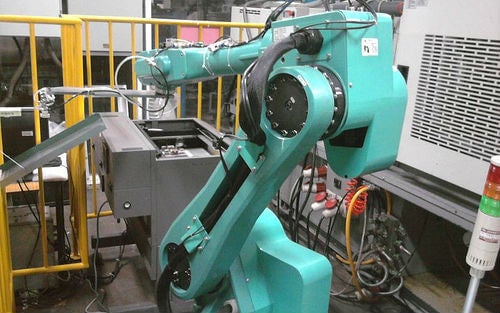
According to a translated page from the Chinese site Techweb, each robot costs between $20,000 to $25,000, which is over three times the average salary of one worker. However, amid international pressure, Foxconn continues to increase worker salaries with a 25 percent bump occurring earlier this year.
It’s worth noting that you can see automation is already part of the manufacturing process at Foxconn, but the new Foxbots are aimed to not merely complement factor workers, but replace them. As the world’s largest manufacturer of electronics, this move wouldn’t be happening unless the robots were ultimately cheaper than human beings.
If Foxconn ramps up the robot rollout, it’ll be interesting to see what the worldwide response is. While there are those who worry that the rise of robots will bring about the end of work as we know it, others see the Foxconn working conditions as violating human rights, and therefore, might welcome robotic replacements, if it means that conditions for the remaining human workforce could improve.
Because Foxconn employs 1.2 million workers, robot replacements both solve worker problems and create them. It should come as no surprise then that many manufacturers are watching the situation at the company closely.
It would be too easy to criticize Foxconn for a move like this, but the company is not alone – Canon reportedly aims to do the same thing.
An important statistic from the International Federation of Robotics is that the number of operational robots in China increased by 42 percent from 2010 to 2011 (close to 75,000 robots), an unprecedented growth in the 50-year history of robots. At that rate of adoption, it would be 2019 before there were 1 million robots in all of China, but odds are that the use of robots is only going to increase as the pendulum that led to the economic boom in China swings back in the other direction.
In the end, we all know that the future of manufacturing is all about robots. It’s a question now of how fast the transition will occur and whether governments, businesses, and organizations will be able to adjust with the shifting workforce and economies.
During this time of flux, many are looking for leaders to take the lead. Whether Foxconn proves it can correct its current problems with robots or digs an even deeper hole by its displacement of a large workforce will play out in the immediate future.
Regardless, it means bots are here to stay.
http://singularityhub.com(...)robots-have-arrived/
"An educated citizenry is a vital requisite for our survival as a free people."
How a Robot Will Steal Your Job
On a visit to Standard Motor Products' fuel-injector assembly line in South Carolina, Atlantic writer Adam Davidson asked why a worker there, Maddie, was welding caps onto the injectors herself. Why not use a machine? That's how a lot of the factory's other tasks were performed. Maddie's supervisor, Tony, had a bracing, direct answer: "Maddie is cheaper than a machine."
Davidson's complex, poignant story, Making It in America, revealed some chilling data about where American manufacturing is headed. It's a matter of simple math. Maddie makes less in two years than a $100,000 machine would cost, so her job is safe—for now.
Elsewhere in America, robots are getting cheaper and more sophisticated, and they're landing better, more advanced jobs. They are driving cars, writing newspaper articles, and filling prescriptions, displacing people with years of schooling and training under their belts. It sounds like a classic sci-fi story, but that disconcerting future isn't in the future. It's here today.
What are the odds your job—your career—will be the next one that can be done better by a machine? Alarmingly high.
***
If you're an average sports fan, you may have heard about Narrative Science. But if you're someone who writes about sports for a living, you've definitely heard of it—you probably already know it's coming after your career.
Part of a joint research project between Northwestern University's schools of engineering and journalism, Narrative Science was officially founded in 2010. It's now led by a small hodgepodge of computer scientists, journalists, and businesspeople whose goal is to use data to create stories via the company's artificial intelligence platform, Quill. Quill takes data fed into it—a football game's stats, for instance—and in seconds pumps out stories. They won't win any Pulitzers, but they're occasionally better than what humans produce.
The sports site Deadspin, last year, challenged Narrative Science to write a better baseball article than one they'd found in a local paper. In the story, the reporter buried the lead—that the pitcher had thrown a perfect game—near the bottom of the story. Narrative Science entered the box scores into Quill and, lo and behold, it came up with an article that announced the perfect game right up top.
Pablo S. Torre is a former staff writer for Sports Illustrated and a current senior writer at ESPN magazine and ESPN.com. He says that while longform feature and profile writers are probably years away from having to worry about a computer taking their jobs, thanks to the nuance required of them, wire service sports writers are not as lucky.
"My sense is that an increasing number of casual readers are skipping right to the box score," Torre told me over Gchat. "If they are reading a game recap, they're trying to identify the biggest or most interesting moments in a game as part of the general trend towards quick summary and bullet-point highlights. So if a robot can approximate that with any semblance of human intelligence, then that's something to be feared."
Torre believes that as society moves more toward a "just the facts, ma'am" terseness, it's going to be deadline-driven Associated Press reporters and the like who struggle to compete with programs that can put together a quick game recap based on just a batch of stats.
"It's not because the AP doesn't do a tremendous job—they do, and are continually underrated," says Torre. "But because what's often desired, post-game and in a pinch, isn't a well-constructed narrative."
***
Like journalists, pharmacists are another group of well-educated professionals whose jobs are now in jeopardy because of robotics. Last year, Slate journalist Farhad Manjoo, whose father is a pharmacist, looked at PillPick, a robot that's been installed to fill prescriptions at the University of California-San Francisco Medical Center. PillPick is huge and expensive, but the machine, made by a company called Swisslog, is also extraordinarily efficient and more precise than a human being. You might want that quality on a job doling out potentially toxic medications: Experts estimate that more than a million people are injured and 7,000 killed due to so-called "medication errors" each year.
Here's PillPick in action:
The robot may look colder and uglier than your friendly neighborhood pharmacist, but does that matter if it's great at what it does?
Before installing the robot, UCSF needed about half of its more than 100 on-staff pharmacists to administer and check the drugs going out to patients on the floor. Now, nearly all have been reassigned to different parts of the hospital, where they make IVs, help adjust patients' drug regimens, and perform other tasks that had been neglected when they were simply filling prescriptions. The robotic pharmacy cost $7 million to install—less than one year's salary for all those pharmacists—and when it's running at full capacity, it can dispense more than 10,000 doses a day. After it became operational last year, the robot filled 350,000 prescriptions without making a single error. (The first error it did encounter was a printer problem, and that was quickly caught by its human operators.)
With society becoming more reliant on an ever-broadening range of drugs, the Bureau of Labor Statistics expects the need for pharmacists to grow by 25 percent between now and 2020. And with their median annual wage sitting at more than $111,000, human pharmacists are relatively expensive to employ. With this in mind, it's not surprising that more and more hospitals are choosing PillPick to replace their pharmaceutical staffs. Earlier this year, Benxi Central Hospital, one of the largest facilities in China, ordered a PillPick robot. Then, in July, Singapore's largest hospital group ordered five PillPicks.
The Singapore sales were a "tipping point," said Stephan Sonderegger, Swisslog's head of healthcare solutions in Asia, in a press release. In other words, in case the smart students studying pharmacology are thinking of transferring, perhaps it's time to consider the fantastic robotics program at MIT.
***
With robots now taking both high-skill and low-skill jobs, you'd have to be a fool to think that a robot could never come for your career. What's more, robots are becoming far more cost effective than they once were. It still costs millions to equip a pharmacy with PillPick, but a new robot from Boston-based company Rethink Robotics Inc., Baxter, was just put on the market for $22,000. That's about how much a human assembly line worker might earn annually. Except that Baxter will never ask for a bathroom break, health insurance, or vacation time.
"This robot is never going to build an iPhone," Rethink Robotics founder and CTO Rodney Brooks told an audience at a robotics tradeshow in Pittsburgh this week. But Baxter can do things that require less dexterity, like picking parts up from a conveyor belt and putting them elsewhere, or sorting and packaging products for shipment. And with more than $60 million in venture capital funding keeping Rethink Robotics afloat, it probably won't be long before Baxter's successors can, in fact, build iPhones.
It was just this week that Foxconn, the Chinese company that manufactures so many of America's favorite gadgets, initiated a plan to buy 1 million robots to replace human workers. When that day comes, thousands of men and women working at Apple's Chinese manufacturing plants will be unemployed. You'll have to wonder—in spite of notorious labor abuses at Foxconn—were those jobs better than none?
***
In Terminator, the robots rose up and slaughtered the world's humans. This Skynet scenario was scary, but a more plausible future is pretty frightening as well. The robots don't exterminate us directly—they just slowly push us out of work, impoverishing the world's laborers until we're slaughtering each other to stay alive.
Writing for io9 earlier this year, computer scientist and futurist Federico Pistono imagined the horror:
Without a backup plan to adjust to a new paradigm, we can expect the worst. Civil unrest, riots, police brutality, and general distress of the population will continue to rise until critical levels are reached, at which point the whole socioeconomic system will crumble upon itself. This has negative repercussions across the whole spectrum of the population, and it is against the interest of everyone on this planet, even of the richest and wealthiest people.
Illah Nourbakhsh, a professor of robotics at Carnegie Mellon University, agrees with Pistano. Nourbakhsh, author of the forthcoming book Robot Futures, says that the "chronic underemployment" robots could create has to the potential to be "very, very bad." But he also told me it's not too late to turn around.
When people want to build a new factory, the government makes them do an environmental impact study to assess what impact the factory is going to have on the world around it. They look at what's going to happen to biodiversity and, if they give off toxic material, they figure out how they're going to remediate that. What's odd to me is that we have nothing like that for employment.
Nourbakhsh says that he'd like to see the introduction of "employment impact assessments." These would require companies transitioning to automated workers to calculate—and then try to mitigate—the damage they'd be doing to the human job market. "We need to have these kinds of controls," he says, "because the captains of industry will do whatever they need to make more money, and replacing humans with robots will always make them more money."
The responsibility to prevent a world overrun with mechanized labor isn't just on CEOs and industry titans. Nourbakhsh says consumers have to begin asking ourselves what we want out of society. Perfect service from robots? Or the gentler qualities only humans can offer?
"Google is creating robot drivers for cars, but the robotic limo driver won't have a really great recommendation about the best bagel spot in New York City," he says. "We lose those kinds of nuanced, fun things with robots. We have to start putting a real value on them, the way we put a real value on labor costs—because they matter."
http://gizmodo.com/5960261/how-a-robot-will-steal-your-job
On a visit to Standard Motor Products' fuel-injector assembly line in South Carolina, Atlantic writer Adam Davidson asked why a worker there, Maddie, was welding caps onto the injectors herself. Why not use a machine? That's how a lot of the factory's other tasks were performed. Maddie's supervisor, Tony, had a bracing, direct answer: "Maddie is cheaper than a machine."
Davidson's complex, poignant story, Making It in America, revealed some chilling data about where American manufacturing is headed. It's a matter of simple math. Maddie makes less in two years than a $100,000 machine would cost, so her job is safe—for now.
Elsewhere in America, robots are getting cheaper and more sophisticated, and they're landing better, more advanced jobs. They are driving cars, writing newspaper articles, and filling prescriptions, displacing people with years of schooling and training under their belts. It sounds like a classic sci-fi story, but that disconcerting future isn't in the future. It's here today.
What are the odds your job—your career—will be the next one that can be done better by a machine? Alarmingly high.
***
If you're an average sports fan, you may have heard about Narrative Science. But if you're someone who writes about sports for a living, you've definitely heard of it—you probably already know it's coming after your career.
Part of a joint research project between Northwestern University's schools of engineering and journalism, Narrative Science was officially founded in 2010. It's now led by a small hodgepodge of computer scientists, journalists, and businesspeople whose goal is to use data to create stories via the company's artificial intelligence platform, Quill. Quill takes data fed into it—a football game's stats, for instance—and in seconds pumps out stories. They won't win any Pulitzers, but they're occasionally better than what humans produce.
The sports site Deadspin, last year, challenged Narrative Science to write a better baseball article than one they'd found in a local paper. In the story, the reporter buried the lead—that the pitcher had thrown a perfect game—near the bottom of the story. Narrative Science entered the box scores into Quill and, lo and behold, it came up with an article that announced the perfect game right up top.
Pablo S. Torre is a former staff writer for Sports Illustrated and a current senior writer at ESPN magazine and ESPN.com. He says that while longform feature and profile writers are probably years away from having to worry about a computer taking their jobs, thanks to the nuance required of them, wire service sports writers are not as lucky.
"My sense is that an increasing number of casual readers are skipping right to the box score," Torre told me over Gchat. "If they are reading a game recap, they're trying to identify the biggest or most interesting moments in a game as part of the general trend towards quick summary and bullet-point highlights. So if a robot can approximate that with any semblance of human intelligence, then that's something to be feared."
Torre believes that as society moves more toward a "just the facts, ma'am" terseness, it's going to be deadline-driven Associated Press reporters and the like who struggle to compete with programs that can put together a quick game recap based on just a batch of stats.
"It's not because the AP doesn't do a tremendous job—they do, and are continually underrated," says Torre. "But because what's often desired, post-game and in a pinch, isn't a well-constructed narrative."
***
Like journalists, pharmacists are another group of well-educated professionals whose jobs are now in jeopardy because of robotics. Last year, Slate journalist Farhad Manjoo, whose father is a pharmacist, looked at PillPick, a robot that's been installed to fill prescriptions at the University of California-San Francisco Medical Center. PillPick is huge and expensive, but the machine, made by a company called Swisslog, is also extraordinarily efficient and more precise than a human being. You might want that quality on a job doling out potentially toxic medications: Experts estimate that more than a million people are injured and 7,000 killed due to so-called "medication errors" each year.
Here's PillPick in action:

The robot may look colder and uglier than your friendly neighborhood pharmacist, but does that matter if it's great at what it does?
Before installing the robot, UCSF needed about half of its more than 100 on-staff pharmacists to administer and check the drugs going out to patients on the floor. Now, nearly all have been reassigned to different parts of the hospital, where they make IVs, help adjust patients' drug regimens, and perform other tasks that had been neglected when they were simply filling prescriptions. The robotic pharmacy cost $7 million to install—less than one year's salary for all those pharmacists—and when it's running at full capacity, it can dispense more than 10,000 doses a day. After it became operational last year, the robot filled 350,000 prescriptions without making a single error. (The first error it did encounter was a printer problem, and that was quickly caught by its human operators.)
With society becoming more reliant on an ever-broadening range of drugs, the Bureau of Labor Statistics expects the need for pharmacists to grow by 25 percent between now and 2020. And with their median annual wage sitting at more than $111,000, human pharmacists are relatively expensive to employ. With this in mind, it's not surprising that more and more hospitals are choosing PillPick to replace their pharmaceutical staffs. Earlier this year, Benxi Central Hospital, one of the largest facilities in China, ordered a PillPick robot. Then, in July, Singapore's largest hospital group ordered five PillPicks.
The Singapore sales were a "tipping point," said Stephan Sonderegger, Swisslog's head of healthcare solutions in Asia, in a press release. In other words, in case the smart students studying pharmacology are thinking of transferring, perhaps it's time to consider the fantastic robotics program at MIT.
***
With robots now taking both high-skill and low-skill jobs, you'd have to be a fool to think that a robot could never come for your career. What's more, robots are becoming far more cost effective than they once were. It still costs millions to equip a pharmacy with PillPick, but a new robot from Boston-based company Rethink Robotics Inc., Baxter, was just put on the market for $22,000. That's about how much a human assembly line worker might earn annually. Except that Baxter will never ask for a bathroom break, health insurance, or vacation time.
"This robot is never going to build an iPhone," Rethink Robotics founder and CTO Rodney Brooks told an audience at a robotics tradeshow in Pittsburgh this week. But Baxter can do things that require less dexterity, like picking parts up from a conveyor belt and putting them elsewhere, or sorting and packaging products for shipment. And with more than $60 million in venture capital funding keeping Rethink Robotics afloat, it probably won't be long before Baxter's successors can, in fact, build iPhones.
It was just this week that Foxconn, the Chinese company that manufactures so many of America's favorite gadgets, initiated a plan to buy 1 million robots to replace human workers. When that day comes, thousands of men and women working at Apple's Chinese manufacturing plants will be unemployed. You'll have to wonder—in spite of notorious labor abuses at Foxconn—were those jobs better than none?
***
In Terminator, the robots rose up and slaughtered the world's humans. This Skynet scenario was scary, but a more plausible future is pretty frightening as well. The robots don't exterminate us directly—they just slowly push us out of work, impoverishing the world's laborers until we're slaughtering each other to stay alive.
Writing for io9 earlier this year, computer scientist and futurist Federico Pistono imagined the horror:
Without a backup plan to adjust to a new paradigm, we can expect the worst. Civil unrest, riots, police brutality, and general distress of the population will continue to rise until critical levels are reached, at which point the whole socioeconomic system will crumble upon itself. This has negative repercussions across the whole spectrum of the population, and it is against the interest of everyone on this planet, even of the richest and wealthiest people.
Illah Nourbakhsh, a professor of robotics at Carnegie Mellon University, agrees with Pistano. Nourbakhsh, author of the forthcoming book Robot Futures, says that the "chronic underemployment" robots could create has to the potential to be "very, very bad." But he also told me it's not too late to turn around.
When people want to build a new factory, the government makes them do an environmental impact study to assess what impact the factory is going to have on the world around it. They look at what's going to happen to biodiversity and, if they give off toxic material, they figure out how they're going to remediate that. What's odd to me is that we have nothing like that for employment.
Nourbakhsh says that he'd like to see the introduction of "employment impact assessments." These would require companies transitioning to automated workers to calculate—and then try to mitigate—the damage they'd be doing to the human job market. "We need to have these kinds of controls," he says, "because the captains of industry will do whatever they need to make more money, and replacing humans with robots will always make them more money."
The responsibility to prevent a world overrun with mechanized labor isn't just on CEOs and industry titans. Nourbakhsh says consumers have to begin asking ourselves what we want out of society. Perfect service from robots? Or the gentler qualities only humans can offer?
"Google is creating robot drivers for cars, but the robotic limo driver won't have a really great recommendation about the best bagel spot in New York City," he says. "We lose those kinds of nuanced, fun things with robots. We have to start putting a real value on them, the way we put a real value on labor costs—because they matter."
http://gizmodo.com/5960261/how-a-robot-will-steal-your-job
"An educated citizenry is a vital requisite for our survival as a free people."
En nog een artikel. Beginnen we dan eindelijk wakker te worden en te zien wat er aan de hand is in de wereld?
Robots, automation to blame for ‘jobless’ economic recovery: economists
The economy may go through boom and bust cycles on a regular basis, but don’t expect job growth to be part of the upswings any more. Future recoveries from recession will likely be “jobless” because technological advances now enable troubled firms to shed middle-income jobs in favor of machines and automation. If these jobs are not recouped during subsequent economic recovery, future recoveries may well remain jobless.
That’s the dour view of economists Henry Siu (University of British Columbia) and Nir Jaimovich (Duke University), who point out in a recent article that “a jobless recovery is not simply an ‘economy-wide‘ delay in firms hiring again. Instead, it can be traced to a lack of recovery in a subset of occupations; those that focus on routine or repetitive tasks that are increasingly being performed by machines.”
This has been the case in the last three recessions, from 1990-91 to 2000-01 to 2008-09, they add. Previously, hiring would surge as businesses began to gear up again from a slowdown. Following each of the 1991, 2001, and 2009 recessions, per capita employment in routine occupations fell and never recovered, they point out.
The reason for this structural change in labor markets is the rise of automation, Siu and Jaimovich explain:
“Automation and the adoption of computing technology is leading to the decline of middle-wage jobs of many stripes, both blue-collar jobs in production and maintenance occupations and white-collar jobs in office and administrative support. It is affecting both male- and female-dominated professions and it is happening broadly across industries –manufacturing, wholesale and retail trade, financial services, and even public administration.”
While Siu and Jaimovich may be right on target with their analysis of what is happening to existing traditional jobs, they fail to account for the wide range of entrepreneurial and new work opportunities that the same technology is creating. In today’s DIY (”do it yourself”) economy, there is an abundance of online resources for developing, testing and marketing new business ideas. Cloud computing makes enterprise-class compute power and applications available for pennies at the touch of a button. Mobile frees up users from the constraints of physical offices and workplaces. Social media opens up markets at virtually no cost. 3D printing enables customized mass production of everything from food to houses at any location.
This levels the playing field for new players. Plus, larger companies are in critical need of people with the skills to put these technologies into practice. Automation is causing a painful retrenchment of many traditional jobs. At the same time, it is creating new ways of working that have yet to appear on economists’ radar screens.
http://www.smartplanet.co(...)very-economists/5537
Robots, automation to blame for ‘jobless’ economic recovery: economists
The economy may go through boom and bust cycles on a regular basis, but don’t expect job growth to be part of the upswings any more. Future recoveries from recession will likely be “jobless” because technological advances now enable troubled firms to shed middle-income jobs in favor of machines and automation. If these jobs are not recouped during subsequent economic recovery, future recoveries may well remain jobless.
That’s the dour view of economists Henry Siu (University of British Columbia) and Nir Jaimovich (Duke University), who point out in a recent article that “a jobless recovery is not simply an ‘economy-wide‘ delay in firms hiring again. Instead, it can be traced to a lack of recovery in a subset of occupations; those that focus on routine or repetitive tasks that are increasingly being performed by machines.”
This has been the case in the last three recessions, from 1990-91 to 2000-01 to 2008-09, they add. Previously, hiring would surge as businesses began to gear up again from a slowdown. Following each of the 1991, 2001, and 2009 recessions, per capita employment in routine occupations fell and never recovered, they point out.
The reason for this structural change in labor markets is the rise of automation, Siu and Jaimovich explain:
“Automation and the adoption of computing technology is leading to the decline of middle-wage jobs of many stripes, both blue-collar jobs in production and maintenance occupations and white-collar jobs in office and administrative support. It is affecting both male- and female-dominated professions and it is happening broadly across industries –manufacturing, wholesale and retail trade, financial services, and even public administration.”
While Siu and Jaimovich may be right on target with their analysis of what is happening to existing traditional jobs, they fail to account for the wide range of entrepreneurial and new work opportunities that the same technology is creating. In today’s DIY (”do it yourself”) economy, there is an abundance of online resources for developing, testing and marketing new business ideas. Cloud computing makes enterprise-class compute power and applications available for pennies at the touch of a button. Mobile frees up users from the constraints of physical offices and workplaces. Social media opens up markets at virtually no cost. 3D printing enables customized mass production of everything from food to houses at any location.
This levels the playing field for new players. Plus, larger companies are in critical need of people with the skills to put these technologies into practice. Automation is causing a painful retrenchment of many traditional jobs. At the same time, it is creating new ways of working that have yet to appear on economists’ radar screens.
http://www.smartplanet.co(...)very-economists/5537
"An educated citizenry is a vital requisite for our survival as a free people."
En nog eentje:
Techonomy: Can a Robot Steal Your Job?
In a Techonomy panel titled "Where's My Robot?" moderator John Markoff of The New York Times started by suggesting that a better question might be "Where isn't my robot?" In this session, Rodney Brooks of Rethink Robotics talked about the next generation of robotics, while MIT's Andrew McAfee discussed worries that robotics would take jobs from people.
Markoff noted that Google's self-driving car has already gone 300,000 miles, Volvo has said it will have a driverless car in the market by 2014, robots in the form of drones are in the skies of Iraq and Afghanistan, and robots are used routinely in surgery. He's seen a variety of "lights-out" factories even using the previous generation of robotics.
Brooks, who founded both iRobot and Rethink Robotics described the difference between the two companies. With iRobot, the focus was on a single-purpose robot, the Roomba. In contrast, Rethink Robotics' Baxter is a more general robot designed to work in manufacturing, programmable quickly by a line worker. Baxter has a face so you can know what it is up to without special icons; it glances at something before it reaches for it, and it looks confused when it doesn't know what to do.
Markoff noted that robotics today work better for things like razors that don't change much than for things like iPhones that change every year, and Brooks said that's because of the complexity of programming the robots, which he is trying to change. Brooks said Baxter will be available this year and cost about $25,000.
Also on the panel was MIT's McAfee, who co-wrote Race Against the Machine with Erik Brynjolfsson.
He thinks we are at a tipping point where robots are becoming able to do more and that may have a very positive impact on the economy, but could also have a large negative impact on unskilled workers. Economists have been warning about displaced labor by new technology for years, and it has never happened, but McAfee said he thinks it might this time because robots can do things that we think of as the province of what humans do.
There will be new companies, new industries, and new economic activity coming, he said, but that people aren't developing new skills.
Evidence suggests that automation has hurt employment in the current recession, but there is disagreement as to whether this is a temporary trend (as it has been in the past) or something more permanent. History is on the side of the job optimists, he said, but he is worried that this time is different.
Brooks said Baxter was designed to complement workers, not replace them, but McAfee is skeptical, noting that manufacturing output grows every good year, but employment is going down —not only in the United States but also in China. (He did say, though, that Baxter is very impressive.)
Markoff asked how this might affect where products are manufactured, and both McAfee and Brooks suggested robotics might make it more effective to build products closer to where they are needed, so it might bring manufacturing back to the country. Brooks said Baxter costs about $4 an hour to run, less than low-cost labor in emerging markets.
McAfee said that might be true, but that it wouldn't bring back many jobs because the robots would be doing just the job. "Outsourcing is a weigh station on the way to automation," he said. Brooks said that computers replaced some of the tasks office workers used to do (such as adding up long columns of numbers) but the total number of office workers grew. McAfee argued that the boundary between augmenting and replacing workers was a narrow one now because of the productivity gains.
Robots don't yet have the dexterity of humans because there hasn't yet been the platform for developing this, as there was for mobility (which led to the Google car), Brooks said. He was hopeful that Baxter might be this, and suggested applications letting older people live more autonomous lives for longer.
Asked about the kinds of new jobs this technology might enable, Brooks explained that this technology might enable jobs for much more customized manufacturing, facilitated by 3D printers and the like, calling out MFG for manufacturing.
Both were very optimistic about self-driving cars, saying it goes from being very exciting to very boring very quickly. An audience member asked if the problem in manufacturing was that most people don't want such jobs and that becomes a problem as current manufacturing people retired. Brooks agreed, noting that even in Spain, where unemployment is over 20 percent, about a quarter of the vacuums sold are robotic because people don't want to clean houses.
Within 10 years, we will have humanoid-looking robots, Brooks predicted. He is skeptical of Ray Kurzweil's belief that by 2029 computers will be as intelligent as people, but McAfee said that if Kurzweil is right, there will be no jobs for humans.
For more, read about DARPA's robotics challenge.
http://forwardthinking.pc(...)robot-steal-your-job
Techonomy: Can a Robot Steal Your Job?
In a Techonomy panel titled "Where's My Robot?" moderator John Markoff of The New York Times started by suggesting that a better question might be "Where isn't my robot?" In this session, Rodney Brooks of Rethink Robotics talked about the next generation of robotics, while MIT's Andrew McAfee discussed worries that robotics would take jobs from people.
Markoff noted that Google's self-driving car has already gone 300,000 miles, Volvo has said it will have a driverless car in the market by 2014, robots in the form of drones are in the skies of Iraq and Afghanistan, and robots are used routinely in surgery. He's seen a variety of "lights-out" factories even using the previous generation of robotics.
Brooks, who founded both iRobot and Rethink Robotics described the difference between the two companies. With iRobot, the focus was on a single-purpose robot, the Roomba. In contrast, Rethink Robotics' Baxter is a more general robot designed to work in manufacturing, programmable quickly by a line worker. Baxter has a face so you can know what it is up to without special icons; it glances at something before it reaches for it, and it looks confused when it doesn't know what to do.
Markoff noted that robotics today work better for things like razors that don't change much than for things like iPhones that change every year, and Brooks said that's because of the complexity of programming the robots, which he is trying to change. Brooks said Baxter will be available this year and cost about $25,000.
Also on the panel was MIT's McAfee, who co-wrote Race Against the Machine with Erik Brynjolfsson.
He thinks we are at a tipping point where robots are becoming able to do more and that may have a very positive impact on the economy, but could also have a large negative impact on unskilled workers. Economists have been warning about displaced labor by new technology for years, and it has never happened, but McAfee said he thinks it might this time because robots can do things that we think of as the province of what humans do.

There will be new companies, new industries, and new economic activity coming, he said, but that people aren't developing new skills.
Evidence suggests that automation has hurt employment in the current recession, but there is disagreement as to whether this is a temporary trend (as it has been in the past) or something more permanent. History is on the side of the job optimists, he said, but he is worried that this time is different.
Brooks said Baxter was designed to complement workers, not replace them, but McAfee is skeptical, noting that manufacturing output grows every good year, but employment is going down —not only in the United States but also in China. (He did say, though, that Baxter is very impressive.)
Markoff asked how this might affect where products are manufactured, and both McAfee and Brooks suggested robotics might make it more effective to build products closer to where they are needed, so it might bring manufacturing back to the country. Brooks said Baxter costs about $4 an hour to run, less than low-cost labor in emerging markets.
McAfee said that might be true, but that it wouldn't bring back many jobs because the robots would be doing just the job. "Outsourcing is a weigh station on the way to automation," he said. Brooks said that computers replaced some of the tasks office workers used to do (such as adding up long columns of numbers) but the total number of office workers grew. McAfee argued that the boundary between augmenting and replacing workers was a narrow one now because of the productivity gains.
Robots don't yet have the dexterity of humans because there hasn't yet been the platform for developing this, as there was for mobility (which led to the Google car), Brooks said. He was hopeful that Baxter might be this, and suggested applications letting older people live more autonomous lives for longer.
Asked about the kinds of new jobs this technology might enable, Brooks explained that this technology might enable jobs for much more customized manufacturing, facilitated by 3D printers and the like, calling out MFG for manufacturing.
Both were very optimistic about self-driving cars, saying it goes from being very exciting to very boring very quickly. An audience member asked if the problem in manufacturing was that most people don't want such jobs and that becomes a problem as current manufacturing people retired. Brooks agreed, noting that even in Spain, where unemployment is over 20 percent, about a quarter of the vacuums sold are robotic because people don't want to clean houses.
Within 10 years, we will have humanoid-looking robots, Brooks predicted. He is skeptical of Ray Kurzweil's belief that by 2029 computers will be as intelligent as people, but McAfee said that if Kurzweil is right, there will be no jobs for humans.
For more, read about DARPA's robotics challenge.
http://forwardthinking.pc(...)robot-steal-your-job
"An educated citizenry is a vital requisite for our survival as a free people."
De manier waarop je een robot kunt programmeren wordt hier ontzettend simpel gemaakt 
Enabling End-Users to Program New Robot Skills
Mobile manipulators like the PR2 have the physical capability to do a range of useful tasks for humans, however their actual capabilities are limited by the software applications written by highly specialized programmers. Instead, Maya Cakmak from Georgia Tech, envisions robots that can be programmed by their end-users for their own specific needs. This past summer, Maya worked on developing a spoken dialog interface that allows a user to program new skills by physically moving PR2’s two arms and using simple speech commands.
Imagine purchasing a brand new “programmable” robot. How would you know what to do, to make the robot do something? This is not a problem for many of our daily appliances as they considerably limit possible user actions. For functionality like robot programming with a verbal dialog interface, however, it is important to guide the user with appropriate feedback from the robot and provide supplementary materials such as user manuals, tutorials, or instructional videos. Maya conducted a user study that replicates the described scenario. Participants in this study (15 men and 15 women, ages 19-70) with no prior knowledge of how to program the robot were left alone with the robot and a combination of supplementary materials. They had to figure out on their own how to program different skills such as picking up medicine from a cabinet or folding a towel.
The study revealed that information presented in the user manual easily gets overlooked and instructional videos are most useful in jump starting the interaction. In addition, trial-and-error plays a crucial role especially for achieving a certain proficiency level.
User studies like Maya’s, provide important insights into how the interface and the supplementary material should be designed to improve the learnability of end-user programmable robots. Check out the video for sample interactions and look for Maya and Leila Takayama’s upcoming publication for more details.
http://www.zeitnews.org/a(...)ram-new-robot-skills
Enabling End-Users to Program New Robot Skills

Mobile manipulators like the PR2 have the physical capability to do a range of useful tasks for humans, however their actual capabilities are limited by the software applications written by highly specialized programmers. Instead, Maya Cakmak from Georgia Tech, envisions robots that can be programmed by their end-users for their own specific needs. This past summer, Maya worked on developing a spoken dialog interface that allows a user to program new skills by physically moving PR2’s two arms and using simple speech commands.
Imagine purchasing a brand new “programmable” robot. How would you know what to do, to make the robot do something? This is not a problem for many of our daily appliances as they considerably limit possible user actions. For functionality like robot programming with a verbal dialog interface, however, it is important to guide the user with appropriate feedback from the robot and provide supplementary materials such as user manuals, tutorials, or instructional videos. Maya conducted a user study that replicates the described scenario. Participants in this study (15 men and 15 women, ages 19-70) with no prior knowledge of how to program the robot were left alone with the robot and a combination of supplementary materials. They had to figure out on their own how to program different skills such as picking up medicine from a cabinet or folding a towel.
The study revealed that information presented in the user manual easily gets overlooked and instructional videos are most useful in jump starting the interaction. In addition, trial-and-error plays a crucial role especially for achieving a certain proficiency level.
User studies like Maya’s, provide important insights into how the interface and the supplementary material should be designed to improve the learnability of end-user programmable robots. Check out the video for sample interactions and look for Maya and Leila Takayama’s upcoming publication for more details.
http://www.zeitnews.org/a(...)ram-new-robot-skills
"An educated citizenry is a vital requisite for our survival as a free people."
Interessante verhalen, vooral dat eerste filmpje was wel tof.
Ze stippen zeker een interessant punt aan, wat te doen met de fabrieksarbeider als die wordt vervangen door een robot?
Ze stippen zeker een interessant punt aan, wat te doen met de fabrieksarbeider als die wordt vervangen door een robot?
robots zullen zelflerende robots gaan ontwerpenquote:
[..]
Nee, waar het om gaat is dat er niet voor alle mensen op de wereld een baan is op die manier. Zeker niet omdat de wereldbevolking nog enorm gaat toenemen.
er is straks voor hooguit 10% van de mensen een baan, kunnen de anderen wel blijven consumeren is de vraag
Er gaat niets boven lekker in de zon zitten in de achtertuin met een heel koud glas bier , als je al 72 jaar bent en nog gezond, laat ze maar lachen de sukkels
Interessant! Mensen moeten dus omgeschoold gaan worden willen we niet massale werkloosheid krijgen. Het probleem is dat de ontwikkelingen zo snel gaan nu dat niet iedereen op tijd omgeschoold kan worden. Overheden moeten hier echt goed op gaan letten.quote:
De manier waarop je een robot kunt programmeren wordt hier ontzettend simpel gemaakt
Enabling End-Users to Program New Robot Skills
http://www.zeitnews.org/a(...)ram-new-robot-skills
De samenleving wordt steeds dynamischer, steeds sneller. Het idee van je gaat in je jonge jaren naar school, je leert een vak en gaat dat doen voor de rest van je leven moet eigenlijk het raam uit.
Studeren moet (voor volwassenen) bijvoorbeeld aantrekkelijker gemaakt worden (gaan we nu de goede kant mee op met Rutte...NOT
 )
)
Opgeblazen gevoel of winderigheid? Zo opgelost met Rennie!
This Burger Was Made Entirely by a Robot
Earlier this year, news permeated the Internet of a machine that had the capabilities of creating a hamburger entirely on its own. The machine, in essence, would take raw ingredients like tomatoes, pickles, onions, lettuce, buns and your choice of meat, and out the other end would emerge a fully-cooked, ready-to-eat "gourmet" hamburger.
The implications of this machine, at the time, were heavy. Why do we need a machine like this? Are our chain restaurants not serving you a burger fast enough? Are we interfacing with too many humans as it is (note: sarcasm)? The new machine, which still remains unnamed, is capable of producing approximately 360 burgers an hour in a 24-square foot area. When the news of this machine surfaced earlier this year, no one knew where the robot's creators (Momentum Machines) would take their product. Would they sell to a burger restaurant chain and let them utilize their machine to streamline their kitchen? Almost 11 months later, the creators have expressed plans to create their own "smart restaurant" chain to strut the capabilities of their burger-making robot.
No word on how it tastes just yet, but here's what a burger made by machine looks like:
The question arises, what constitutes a "gourmet" burger? Yeah, in theory, with this machine, you can plug in quality ingredients like locally sourced tomatoes, quality-grade beef and freshly baked bread, but it's made by a robot, in mass amounts. Isn't this a step backwards in an age where folks are seemingly expressing a quiet revolt against the mundane and a shift towards chef-driven, quality menus?
A step forward for cool technology advancements and potential restaurateurs, but does this advance the consumer experience in any notable way? Unless the price of a gourmet burger suddenly drops to $0.99 and the robot is coined a "Burger ATM", it will be a curious sell to the consumer beyond the novelty of being served by a machine.
What do you think? Where do we go from here with a machine that will make a burger from raw materials? Even scarier thought, what if this machine produced burgers that tasted good? You know that awkward moment when you realize a robot might be making your burgers in the future?
That moment is here.
http://www.huffingtonpost(...)robot_b_2160251.html
Earlier this year, news permeated the Internet of a machine that had the capabilities of creating a hamburger entirely on its own. The machine, in essence, would take raw ingredients like tomatoes, pickles, onions, lettuce, buns and your choice of meat, and out the other end would emerge a fully-cooked, ready-to-eat "gourmet" hamburger.
The implications of this machine, at the time, were heavy. Why do we need a machine like this? Are our chain restaurants not serving you a burger fast enough? Are we interfacing with too many humans as it is (note: sarcasm)? The new machine, which still remains unnamed, is capable of producing approximately 360 burgers an hour in a 24-square foot area. When the news of this machine surfaced earlier this year, no one knew where the robot's creators (Momentum Machines) would take their product. Would they sell to a burger restaurant chain and let them utilize their machine to streamline their kitchen? Almost 11 months later, the creators have expressed plans to create their own "smart restaurant" chain to strut the capabilities of their burger-making robot.
No word on how it tastes just yet, but here's what a burger made by machine looks like:


The question arises, what constitutes a "gourmet" burger? Yeah, in theory, with this machine, you can plug in quality ingredients like locally sourced tomatoes, quality-grade beef and freshly baked bread, but it's made by a robot, in mass amounts. Isn't this a step backwards in an age where folks are seemingly expressing a quiet revolt against the mundane and a shift towards chef-driven, quality menus?
A step forward for cool technology advancements and potential restaurateurs, but does this advance the consumer experience in any notable way? Unless the price of a gourmet burger suddenly drops to $0.99 and the robot is coined a "Burger ATM", it will be a curious sell to the consumer beyond the novelty of being served by a machine.
What do you think? Where do we go from here with a machine that will make a burger from raw materials? Even scarier thought, what if this machine produced burgers that tasted good? You know that awkward moment when you realize a robot might be making your burgers in the future?
That moment is here.
http://www.huffingtonpost(...)robot_b_2160251.html
"An educated citizenry is a vital requisite for our survival as a free people."
Goed artikel na het lezen van dit topic: NWS / Schokende openbaring over vliegtuigmaaltijdenquote:
This Burger Was Made Entirely by a Robot
http://www.huffingtonpost(...)robot_b_2160251.html

Opgeblazen gevoel of winderigheid? Zo opgelost met Rennie!
Geniaal, dat zal een hoop geld schelen.quote:
What do you think? Where do we go from here with a machine that will make a burger from raw materials? Even scarier thought, what if this machine produced burgers that tasted good? You know that awkward moment when you realize a robot might be making your burgers in the futur
As the officer took her away, she recalled that she asked,
"Why do you push us around?"
And she remembered him saying,
"I don't know, but the law's the law, and you're under arrest."
"Why do you push us around?"
And she remembered him saying,
"I don't know, but the law's the law, and you're under arrest."


Hmmm... investeringen en andere zaken groeien weer door na de crisis maar de werkgelegenheid is gedaald. Het gevolg van automatisering om kosten te besparen in economisch moeilijke tijden?
"An educated citizenry is a vital requisite for our survival as a free people."
Nee dat het overgrote deel van het werk voor ons wordt gedaan door machines, zodat de mens bevrijd kan worden van het werk waar hij niet bepaald gelukkig van wordt.quote:
Maarruh, pcp wat wil je dan? Dat de spijkers weer met de hand gesmeed worden?
"An educated citizenry is a vital requisite for our survival as a free people."
Onderzoek naar potentieel gevaar kunstmatige intelligentie
AMSTERDAM - De vooraanstaande Cambridge University gaat onderzoek doen naar de potentiële gevaren van kunstmatige intelligentie.
Dat meldt AP.
De universiteit richt een Center for the Study of Existential Risk op en gaat onder meer het mogelijke gevaar van kunstmatige intelligentie onderzoeken.
"Het is een aannemelijke voorspelling dat ergens in deze of de komende eeuw intelligentie zal ontsnappen aan de huidige biologische beperkingen", aldus Huw Price, filosofieprofessor aan Cambridge. "Dan is de mens niet langer het slimste ding op aarde."
Kwaadaardig
Price benadrukt dat het niet gaat om kwaadaardige machines, maar om machines die zich niet interesseren voor onze belangen.
Als voorbeeld noemt de professor het bestaan van intelligente machines die niet geven om duurzaamheid. Hij vergelijkt het risico met de manier waarop mensen het bestaan van diverse dieren bedreigen of hebben bedreigd.
"Mensen zien het gevaar van kunstmatige intelligentie als een verwaarloosbare zorg, maar we weten niet hoe serieus het risico is. We weten niet in welk tijdsbestek het zich gaat ontwikkelen en zorgen wegwuiven is gevaarlijk", aldus Price.
Nu
AMSTERDAM - De vooraanstaande Cambridge University gaat onderzoek doen naar de potentiële gevaren van kunstmatige intelligentie.
Dat meldt AP.
De universiteit richt een Center for the Study of Existential Risk op en gaat onder meer het mogelijke gevaar van kunstmatige intelligentie onderzoeken.
"Het is een aannemelijke voorspelling dat ergens in deze of de komende eeuw intelligentie zal ontsnappen aan de huidige biologische beperkingen", aldus Huw Price, filosofieprofessor aan Cambridge. "Dan is de mens niet langer het slimste ding op aarde."
Kwaadaardig
Price benadrukt dat het niet gaat om kwaadaardige machines, maar om machines die zich niet interesseren voor onze belangen.
Als voorbeeld noemt de professor het bestaan van intelligente machines die niet geven om duurzaamheid. Hij vergelijkt het risico met de manier waarop mensen het bestaan van diverse dieren bedreigen of hebben bedreigd.
"Mensen zien het gevaar van kunstmatige intelligentie als een verwaarloosbare zorg, maar we weten niet hoe serieus het risico is. We weten niet in welk tijdsbestek het zich gaat ontwikkelen en zorgen wegwuiven is gevaarlijk", aldus Price.
Nu
Geld maakt meer kapot dan je lief is.
Het zijn sterke ruggen die vrijheid en weelde kunnen dragen
Het zijn sterke ruggen die vrijheid en weelde kunnen dragen
Was al gepost
Geld maakt meer kapot dan je lief is.
Het zijn sterke ruggen die vrijheid en weelde kunnen dragen
Het zijn sterke ruggen die vrijheid en weelde kunnen dragen
Dit is toch relaxed jonguh, machines maar werken en wij relaxen. Of wordt in de toekomst iedereen monteur?
Wie dit leest is een lezer van dit.
Ach, als AI zich verder ontwikkelt dan zullen verschillende AI's ook verschillende persoonlijkheden krijgen met verschillende opvattingen. Sommigen zullen dan de mens verdedigen en anderen niet. Beetje als de Transformers zeg maarquote:
Onderzoek naar potentieel gevaar kunstmatige intelligentie
AMSTERDAM - De vooraanstaande Cambridge University gaat onderzoek doen naar de potentiële gevaren van kunstmatige intelligentie.
Dat meldt AP.
De universiteit richt een Center for the Study of Existential Risk op en gaat onder meer het mogelijke gevaar van kunstmatige intelligentie onderzoeken.
"Het is een aannemelijke voorspelling dat ergens in deze of de komende eeuw intelligentie zal ontsnappen aan de huidige biologische beperkingen", aldus Huw Price, filosofieprofessor aan Cambridge. "Dan is de mens niet langer het slimste ding op aarde."
Kwaadaardig
Price benadrukt dat het niet gaat om kwaadaardige machines, maar om machines die zich niet interesseren voor onze belangen.
Als voorbeeld noemt de professor het bestaan van intelligente machines die niet geven om duurzaamheid. Hij vergelijkt het risico met de manier waarop mensen het bestaan van diverse dieren bedreigen of hebben bedreigd.
"Mensen zien het gevaar van kunstmatige intelligentie als een verwaarloosbare zorg, maar we weten niet hoe serieus het risico is. We weten niet in welk tijdsbestek het zich gaat ontwikkelen en zorgen wegwuiven is gevaarlijk", aldus Price.
Nu

Ook zal de mens zich steeds meer mengen met technologie en zullen we misschien wel een soort van cyborgs worden of met genetic engineering passen we ons biologische lichaam aan om slimmer te worden en mee te groeien met AI.
"An educated citizenry is a vital requisite for our survival as a free people."

Mooi toch. Bevolkingsaantallen zullen hierdoor afnemen, productie zal stijgen en de levende mens zal geen (hersendood) werk meer hoeven te verichten. Tussenfase waarin wij komen te zitten of al zitten is ff kut, ja. Maar het lijkt me niet reeel om hier egoistisch om te zijn en deze ontwikkeling te stagneren of zelfs helemaal te stoppen.
[ Bericht 10% gewijzigd door #ANONIEM op 26-11-2012 17:54:07 ]
[ Bericht 10% gewijzigd door #ANONIEM op 26-11-2012 17:54:07 ]
Vraag me af of dat gecorrigeerd is voor leeftijd. Ook de VS vergrijsd als ik het goed heb. De babyboom van de jaren 40 gaat de laatste jaren met pensioenquote:
[ afbeelding ]
Hmmm... investeringen en andere zaken groeien weer door na de crisis maar de werkgelegenheid is gedaald. Het gevolg van automatisering om kosten te besparen in economisch moeilijke tijden?
In Baden-Badener Badeseen kann man Baden-Badener baden sehen.
De haven van Rotterdam wel eens gezien ? Of autofabrieken ? Geen mens meer te vinden wanneer het magazijnen ed betreft. Sensors en redelijk AI's blijken al jaren te voldoen.quote:Op maandag 10 september 2012 22:31 schreef El_Matador het volgende:
Spelletjes en schaak zijn zaken met een vast aantal variabelen. In de echte wereld heb je te maken met veeeel meer variabelen. Zo kan het gevaarlijk zijn een robot in te zetten in een magazijn, die bijvoorbeeld pallets laadt, maar niet kan begrijpen waarom en zo ook niet kan inspelen op noodsituaties.
Voor voorgeprogrammeerde zaken zijn computers voldoende. En zelfs dan niet. De menselijke interpretatie is immer nodig, misschien niet direct (een robot kan het simpele werk wel aan), maar dan toch zeker indirect (wie stuurt die robots aan en wie controleert ze).
Voor gestandaardiseerd werk? Uiteraard. Maar dat is iets anders dan intelligent werk...quote:
[..]
De haven van Rotterdam wel eens gezien ? Of autofabrieken ? Geen mens meer te vinden wanneer het magazijnen ed betreft. Sensors en redelijk AI's blijken al jaren te voldoen.
The only limit is your own imagination
Ik ben niet gelovig aangelegd en maak daarin geen onderscheid tussen dominees, imams, scharenslieps, autohandelaren, politici en massamedia
Waarom er geen vliegtuig in het WTC vloog
Ik ben niet gelovig aangelegd en maak daarin geen onderscheid tussen dominees, imams, scharenslieps, autohandelaren, politici en massamedia
Waarom er geen vliegtuig in het WTC vloog
IPhones, iPads, Computer-Driven Trucks ... How to Invest in This Increasingly Automated Economy
When will the jobs return? That's been the question in this glacially slow recovery.
The answer? Many of jobs won't be coming back, and that's painful news for all of us.
Job creation ebbed for years before the 2007-2008 recession and is likely to fall far short of what it was in previous decades.
Low consumer demand is one reason. Companies have no reason to hire if people aren't buying their products, and recession-wracked Europe, our biggest consumer, isn't consuming as much.
Yet there's another reason for weak job creation that isn't talked about as much. Automation, aided by new technologies, is increasingly replacing labor, changing workplaces and altering the economy in fundamental ways. For evidence of this trend, just look around your house, your office (if you're fortunate enough to have one) and the nearest shopping center.
• IPhones, iPads, and other devices are changing the way we shop, communicate and get news and information, disrupting old labor-intensive industries, such as newspapers and the U.S. Postal Service, while creating new ones that generally employ far fewer people.
• Online banking, brokerage and mortgages are increasingly making it easier for consumers to never set foot in a brick-and-mortar bank.
• Movie-downloading services such as Netflix and Redbox have hastened the demise of video stores.
• Self-checkout aisles at stores and gas stations have eliminated thousands of retail jobs.
Truck drivers' jobs might soon be on the line too. Experiments with computer-driven vehicles have had vastly improved results in the past several years. In 2005, computer-driven cars could go only a few miles. Recently, Google-operated cars went thousands of miles without a mishap, and California Gov. Jerry Brown just signed a bill to allow them on the state's highways.
As technology evolves at an ever-increasing rate, new jobs are created but not fast enough to replace the jobs that are disappearing. This is creating hardship for millions of Americans.
"At some point in the future -- it might be many years or decades from now -- machines will be able to do the jobs of a large percentage of the 'average' people in our population, and these people will not be able to find new jobs," writes Martin Ford in his eye-opening book Lights in the Tunnel, which can be downloaded for free. This book details the challenges that we face and offers some possible solutions, including shorter work weeks, job sharing, and eliminating payroll taxes so employers have less incentive to replace workers.
David Autor, an economist at MIT, points out that the job market has been "hollowed out," with the jobs in the middle -- clerks, administrative positions, factory workers -- disappearing. At the same time, high-wage jobs have been created in computer programming and biotech. Low-wage, automation-resistant jobs in such industries as food service and health care are doing just fine.
While government officials can and should worry about how to create more good-paying jobs, investors who have long suffered from a sideways stock market can profit by seeking out companies on the leading edge of the automation phenomenon.
Examples include Rockwell Automation, which makes industrial systems; Irobot, a maker of automated tools such as vacuum cleaners and floor washers; Aerovironoment, which manufactures unmanned aircraft and other vehicles, and NCR, a great example of an old-line firm that morphed from mechanical cash registers to ATMs and automated check-in systems.
Another approach to finding investment opportunities stemming from the automation trend is to look for stocks with high sales to employees. A recent survey by Bloomberg calls attention to some companies with high sales-to-employee ratios. Among them: Apple, eBay, Microsoft, Amgen and Google.
Every industrial revolution has been accompanied by new technology that underpins the innovations, and that is also fertile ground for investors seeking growth. Microchips, computer storage, optical drives, LCDs, fiber optics and nanotechnology are just a few of the innovations that are driving the new economy.
Green energy is another trend that's here to stay. The list of these companies is long but worth investigating for investing ideas.
The good news is that the United States has enormous capacity to supply needed goods and services (with less labor than ever before, which means higher productivity). Jobs are being replaced, to be sure. However, every scenario that Ford envisions won't necessarily come to pass. Innovators in the global and U.S. economies will doubtless find new ways to make money.
This could mean that today's manufacturing jobs will be increasingly supplanted by more service jobs. For example, all of the new automation equipment will need servicing. One thing that seers of the high-tech future typically fail to envision is technology needs a lot of work to keep it running.
Whatever the future holds along these lines, investing in old-line firms that are labor intensive seems to be an increasingly bad bet. Such companies tend to be mature, which typically means low-growth potential and low investment returns. By focusing on high-revenue companies that harness automation, however, you'll be looking to the future. And after all, investing is all about the future.
Yet it's important to keep in mind that the future never unfolds as neatly as even the best seers predict -- even when they're basically right. The key is to keep abreast of economic developments to see new niches of investing opportunity developing as a result of the automation trend.
On a brighter economic note, this investment will spur general economic growth that, for all we now know, could ultimately produce new jobs in areas that now we can't even conceive.
This work is the opinion of the columnist and in no way reflects the opinion of ABC News.
Ted Schwartz, a certified financial planner, is president and chief investment officer of Capstone Investment Financial Group. He advises individual investors and endowments, and serves as the adviser to CIFG UMA accounts. Because Schwartz has a background in psychology and counseling, he brings insights into personal motivation when advising clients on how to achieve their wealth management goals. Schwartz holds a B.A. from Duke University and an M.A. from Oregon State University. He can be reached at ted@capstoneinvest.com.
http://abcnews.go.com/Bus(...)my/story?id=17760124
When will the jobs return? That's been the question in this glacially slow recovery.
The answer? Many of jobs won't be coming back, and that's painful news for all of us.
Job creation ebbed for years before the 2007-2008 recession and is likely to fall far short of what it was in previous decades.
Low consumer demand is one reason. Companies have no reason to hire if people aren't buying their products, and recession-wracked Europe, our biggest consumer, isn't consuming as much.
Yet there's another reason for weak job creation that isn't talked about as much. Automation, aided by new technologies, is increasingly replacing labor, changing workplaces and altering the economy in fundamental ways. For evidence of this trend, just look around your house, your office (if you're fortunate enough to have one) and the nearest shopping center.
• IPhones, iPads, and other devices are changing the way we shop, communicate and get news and information, disrupting old labor-intensive industries, such as newspapers and the U.S. Postal Service, while creating new ones that generally employ far fewer people.
• Online banking, brokerage and mortgages are increasingly making it easier for consumers to never set foot in a brick-and-mortar bank.
• Movie-downloading services such as Netflix and Redbox have hastened the demise of video stores.
• Self-checkout aisles at stores and gas stations have eliminated thousands of retail jobs.
Truck drivers' jobs might soon be on the line too. Experiments with computer-driven vehicles have had vastly improved results in the past several years. In 2005, computer-driven cars could go only a few miles. Recently, Google-operated cars went thousands of miles without a mishap, and California Gov. Jerry Brown just signed a bill to allow them on the state's highways.
As technology evolves at an ever-increasing rate, new jobs are created but not fast enough to replace the jobs that are disappearing. This is creating hardship for millions of Americans.
"At some point in the future -- it might be many years or decades from now -- machines will be able to do the jobs of a large percentage of the 'average' people in our population, and these people will not be able to find new jobs," writes Martin Ford in his eye-opening book Lights in the Tunnel, which can be downloaded for free. This book details the challenges that we face and offers some possible solutions, including shorter work weeks, job sharing, and eliminating payroll taxes so employers have less incentive to replace workers.
David Autor, an economist at MIT, points out that the job market has been "hollowed out," with the jobs in the middle -- clerks, administrative positions, factory workers -- disappearing. At the same time, high-wage jobs have been created in computer programming and biotech. Low-wage, automation-resistant jobs in such industries as food service and health care are doing just fine.
While government officials can and should worry about how to create more good-paying jobs, investors who have long suffered from a sideways stock market can profit by seeking out companies on the leading edge of the automation phenomenon.
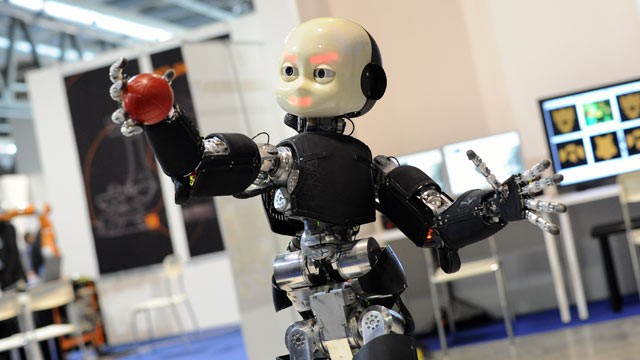
Examples include Rockwell Automation, which makes industrial systems; Irobot, a maker of automated tools such as vacuum cleaners and floor washers; Aerovironoment, which manufactures unmanned aircraft and other vehicles, and NCR, a great example of an old-line firm that morphed from mechanical cash registers to ATMs and automated check-in systems.
Another approach to finding investment opportunities stemming from the automation trend is to look for stocks with high sales to employees. A recent survey by Bloomberg calls attention to some companies with high sales-to-employee ratios. Among them: Apple, eBay, Microsoft, Amgen and Google.
Every industrial revolution has been accompanied by new technology that underpins the innovations, and that is also fertile ground for investors seeking growth. Microchips, computer storage, optical drives, LCDs, fiber optics and nanotechnology are just a few of the innovations that are driving the new economy.
Green energy is another trend that's here to stay. The list of these companies is long but worth investigating for investing ideas.
The good news is that the United States has enormous capacity to supply needed goods and services (with less labor than ever before, which means higher productivity). Jobs are being replaced, to be sure. However, every scenario that Ford envisions won't necessarily come to pass. Innovators in the global and U.S. economies will doubtless find new ways to make money.
This could mean that today's manufacturing jobs will be increasingly supplanted by more service jobs. For example, all of the new automation equipment will need servicing. One thing that seers of the high-tech future typically fail to envision is technology needs a lot of work to keep it running.
Whatever the future holds along these lines, investing in old-line firms that are labor intensive seems to be an increasingly bad bet. Such companies tend to be mature, which typically means low-growth potential and low investment returns. By focusing on high-revenue companies that harness automation, however, you'll be looking to the future. And after all, investing is all about the future.
Yet it's important to keep in mind that the future never unfolds as neatly as even the best seers predict -- even when they're basically right. The key is to keep abreast of economic developments to see new niches of investing opportunity developing as a result of the automation trend.
On a brighter economic note, this investment will spur general economic growth that, for all we now know, could ultimately produce new jobs in areas that now we can't even conceive.
This work is the opinion of the columnist and in no way reflects the opinion of ABC News.
Ted Schwartz, a certified financial planner, is president and chief investment officer of Capstone Investment Financial Group. He advises individual investors and endowments, and serves as the adviser to CIFG UMA accounts. Because Schwartz has a background in psychology and counseling, he brings insights into personal motivation when advising clients on how to achieve their wealth management goals. Schwartz holds a B.A. from Duke University and an M.A. from Oregon State University. He can be reached at ted@capstoneinvest.com.
http://abcnews.go.com/Bus(...)my/story?id=17760124
"An educated citizenry is a vital requisite for our survival as a free people."
3D-printen van elektronica stap dichterbij
AMSTERDAM - Door de ontwikkeling van een goedkope en geleidende kunststof, komt de mogelijkheid om thuis elektronica te printen snel dichterbij.
Onderzoekers van de Universiteit van Warwick in Groot Brittannië beschrijven de ontwikkeling en gebruiksmogelijkheden van het door hen ontwikkelde materiaal vandaag in PLOS ONE.
Op dit moment is het mogelijk om met een relatief goedkope 3D-thuisprinter allerlei verschillende objecten te printen. Soms kunnen verschillende kleuren of materialen in een keer geprint worden, maar één object met werkende elektronica printen was tot op heden niet mogelijk.
Daar lijkt nu verandering in te komen: het onderzoeksteam ontwikkelde een materiaal met de naam ‘carbomorph’. Met dit materiaal is het mogelijk elektronische circuits en sensoren als onderdeel van een 3D-structuur te printen.
Circuits
Zo kunnen bijvoorbeeld aanraakgevoelige oppervlakten geprint worden om die vervolgens aan andere elektronische circuits te koppelen.
Tot nu toe is het team erin geslaagd om objecten te printen met geïntegreerde flex- en aanraaksensoren, zoals een gamepad voor spelletjescomputers en een mok die kan vertellen hoe vol die nog is.
Kabels
De volgende stap is het printen van veel complexere structuren en elektronische componenten, tot aan de kabels die de apparaten met de computer verbinden.
Een groot voordeel van 3D-printen van elektronica is dat verbindingen tussen verschillende onderdelen uitgeprint kunnen worden en er geen lijm of soldeer voor nodig is.
http://www.nu.nl/gadgets/(...)stap-dichterbij.html
AMSTERDAM - Door de ontwikkeling van een goedkope en geleidende kunststof, komt de mogelijkheid om thuis elektronica te printen snel dichterbij.
Onderzoekers van de Universiteit van Warwick in Groot Brittannië beschrijven de ontwikkeling en gebruiksmogelijkheden van het door hen ontwikkelde materiaal vandaag in PLOS ONE.
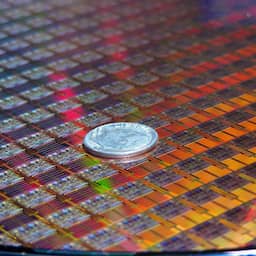
Op dit moment is het mogelijk om met een relatief goedkope 3D-thuisprinter allerlei verschillende objecten te printen. Soms kunnen verschillende kleuren of materialen in een keer geprint worden, maar één object met werkende elektronica printen was tot op heden niet mogelijk.
Daar lijkt nu verandering in te komen: het onderzoeksteam ontwikkelde een materiaal met de naam ‘carbomorph’. Met dit materiaal is het mogelijk elektronische circuits en sensoren als onderdeel van een 3D-structuur te printen.
Circuits
Zo kunnen bijvoorbeeld aanraakgevoelige oppervlakten geprint worden om die vervolgens aan andere elektronische circuits te koppelen.
Tot nu toe is het team erin geslaagd om objecten te printen met geïntegreerde flex- en aanraaksensoren, zoals een gamepad voor spelletjescomputers en een mok die kan vertellen hoe vol die nog is.
Kabels
De volgende stap is het printen van veel complexere structuren en elektronische componenten, tot aan de kabels die de apparaten met de computer verbinden.
Een groot voordeel van 3D-printen van elektronica is dat verbindingen tussen verschillende onderdelen uitgeprint kunnen worden en er geen lijm of soldeer voor nodig is.
http://www.nu.nl/gadgets/(...)stap-dichterbij.html
"An educated citizenry is a vital requisite for our survival as a free people."
De vraag is: is er intelligent werk voor iedereen en is iedereen daar intelligent genoeg voor?quote:
[..]
Voor gestandaardiseerd werk? Uiteraard. Maar dat is iets anders dan intelligent werk...
200 jaar geleden werkten de meeste mensen in de landbouw en konden niet lezen of schrijven.quote:
[..]
De vraag is: is er intelligent werk voor iedereen en is iedereen daar intelligent genoeg voor?
In Baden-Badener Badeseen kann man Baden-Badener baden sehen.
Mensen zijn nu niet intelligenter dan vroeger. Ze weten misschien meer, maar kennis maakt je niet slim.quote:
[..]
200 jaar geleden werkten de meeste mensen in de landbouw en konden niet lezen of schrijven.
Ok de toon van je nieuwsberichten deed even anders vermoedenquote:
[..]
Nee dat het overgrote deel van het werk voor ons wordt gedaan door machines, zodat de mens bevrijd kan worden van het werk waar hij niet bepaald gelukkig van wordt.
Daar kan ik me in vinden, alleen die overstap moet goed worden aangepakt. Het zou me niks verbazen als over 20 jaar een standaard werkweek de helft korter is.
Ik denk niet dat het zo snel gaat. Misschien elke generatie een dag eraf ofzo. De hoop is alleen dat die trend überhaupt wordt ingezet, want voorlopig is er nog weinig sprake van enig denken in die richting.quote:
[..]
Het zou me niks verbazen als over 20 jaar een standaard werkweek de helft korter is.
Kan je zien wat voor een verspilling van resources het was al die mensen een beetje in de modder te laten wroeten.quote:
[..]
Mensen zijn nu niet intelligenter dan vroeger. Ze weten misschien meer, maar kennis maakt je niet slim.
In Baden-Badener Badeseen kann man Baden-Badener baden sehen.
Ik denk het niet, ik denk dat we over 20 jaar eerder meer werken met nog hogere productiviteit om de kosten van de vergrijzing te betalen. Reken er maar om 40 uur te werken waarvan 60-70% voor de overheid (Belastingen, premies).quote:
Daar kan ik me in vinden, alleen die overstap moet goed worden aangepakt. Het zou me niks verbazen als over 20 jaar een standaard werkweek de helft korter is.
In Baden-Badener Badeseen kann man Baden-Badener baden sehen.
Over 20 jaar telt Nederland 18 miljoen inwoners en gaat de wereldbevolking richting de 9 miljard. Wat gaan al die mensen doen als we niet minder maar juist meer uren gaan werken en ondertussen door blijven automatiseren? Of komt er een grote berg werkloosheid aan?quote:
[..]
Ik denk het niet, ik denk dat we over 20 jaar eerder meer werken met nog hogere productiviteit om de kosten van de vergrijzing te betalen. Reken er maar om 40 uur te werken waarvan 60-70% voor de overheid (Belastingen, premies).
Over 20 jaar mag ik hopen dat de vergrijzing over zijn top is en dat de babyboom-generatie aan het afsterven is.quote:
[..]
Ik denk het niet, ik denk dat we over 20 jaar eerder meer werken met nog hogere productiviteit om de kosten van de vergrijzing te betalen. Reken er maar om 40 uur te werken waarvan 60-70% voor de overheid (Belastingen, premies).

We sluiten ze gewoon op.quote:
[..]
Over 20 jaar telt Nederland 18 miljoen inwoners en gaat de wereldbevolking richting de 9 miljard. Wat gaan al die mensen doen als we niet minder maar juist meer uren gaan werken en ondertussen door blijven automatiseren? Of komt er een grote berg werkloosheid aan?
Free Assange! Hack the Planet
[b]Op dinsdag 6 januari 2009 19:59 schreef Papierversnipperaar het volgende:[/b]
De gevolgen van de argumenten van de anti-rook maffia
[b]Op dinsdag 6 januari 2009 19:59 schreef Papierversnipperaar het volgende:[/b]
De gevolgen van de argumenten van de anti-rook maffia
Je vergeet de 3e Wereldoorlog die al een tijdje op de agenda staat. We gaan terug naar 5 miljard in een 3e Wereldoorlog die integraal op youtube te volgen zal zijn. De eerste oorlog met op maat gesneden google ads. "Luchtalarm gehoord? Bestel je gasmasker voor 22:00 en ontvang hem de volgende ochtend! Geen bezorgkosten!" - "Nucleaire aanval onderweg naar het huis van je grootouders? Sluit nu snel een last-minute levensverzekering af!"quote:
[..]
Over 20 jaar telt Nederland 18 miljoen inwoners en gaat de wereldbevolking richting de 9 miljard. Wat gaan al die mensen doen als we niet minder maar juist meer uren gaan werken en ondertussen door blijven automatiseren? Of komt er een grote berg werkloosheid aan?
Baat 't niet, schaadt 't niet. Dus slikken, kreng.
Oorlog, honger en ziekte helpen zeker tegen de overbevolking en de daarmee samenhangende werkloosheid. De vraag is of we niet liever zelf een beleid voeren waardoor we die ellende kunnen voorkomen.quote:
[..]
Je vergeet de 3e Wereldoorlog die al een tijdje op de agenda staat. We gaan terug naar 5 miljard in een 3e Wereldoorlog die integraal op youtube te volgen zal zijn. De eerste oorlog met op maat gesneden google ads. "Luchtalarm gehoord? Bestel je gasmasker voor 22:00 en ontvang hem de volgende ochtend! Geen bezorgkosten!" - "Nucleaire aanval onderweg naar het huis van je grootouders? Sluit nu snel een last-minute levensverzekering af!"
Ja, dat zou beter zijn maar dat gaat toch nooit lukken.quote:
Oorlog, honger en ziekte helpen zeker tegen de overbevolking en de daarmee samenhangende werkloosheid. De vraag is of we niet liever zelf een beleid voeren waardoor we die ellende kunnen voorkomen.
Baat 't niet, schaadt 't niet. Dus slikken, kreng.
Coming soon to a street near you: WAR!quote:
Het meeste in het Midden-Oosten is al live te volgen hoor
Ik zie de memes al voorbij komen. Google Streetview Live, kun je de tanks in je straat checken. Lekker twitteren met #MyStreetGotBlownTheFuggUp. Hardcore parkour met tanks op de achtergrond. Gangnam Executies in Amsterdam gaan viral. GoPro camera's op de helmen van soldaten met live streaming footage op youtube. Powned integraal met hondendrollen gooiend gieren en brullen terwijl Duitse tanks door Utrecht rollen. Een 'will it blend' met dog-tags van dode soldaten. Double mushroom cloud all the way across the sky!
Baat 't niet, schaadt 't niet. Dus slikken, kreng.
Curieus dat bijna ieder artikel wel een beetje inspeelt op angst. Dat het eng is als er geen menselijke interactie meer is, mensen vervangen voor robots etc.
Binnenkort een nieuwe Unabomber?
Binnenkort een nieuwe Unabomber?
Oh, dr zullen genoeg mensen zijn die de verregaande automatisering als een bedreiging zien ipv een kans. Ik ben niet 1 van die mensen. Dit is juist een enorme kans voor de mensheid.quote:
[..]
Ok de toon van je nieuwsberichten deed even anders vermoeden
Dit lijkt mij idd de beste tussenstap. Oh echt wat een heerlijk idee, een werkweek van 20 uur!quote:Daar kan ik me in vinden, alleen die overstap moet goed worden aangepakt. Het zou me niks verbazen als over 20 jaar een standaard werkweek de helft korter is.
"An educated citizenry is a vital requisite for our survival as a free people."
Ja die mensen vergeten blijkbaar dat er een tijd was dat we onze was en de vaat met de hand deden en dat wasmachines en vaatwasmachines niet meer weg te denken zijn uit ons leven.quote:
Curieus dat bijna ieder artikel wel een beetje inspeelt op angst. Dat het eng is als er geen menselijke interactie meer is, mensen vervangen voor robots etc.
"An educated citizenry is a vital requisite for our survival as a free people."
