W&T Wetenschap & Technologie
Een plek om te discussiëren over wetenschappelijke onderwerpen, wetenschappelijke problemen, technologische projecten en grootse uitvindingen.



Bovenop 't hoofd van 't badeendjequote:

And what rough beast, its hour come round at last,
Slouches towards Bethlehem to be born?
Slouches towards Bethlehem to be born?


Hoe komen ze dan nog terug op aarde?quote:Op woensdag 17 juni 2015 18:34 schreef Molurus het volgende:
Ze zijn van plan de missie te verlengen, en daarna in september 2016 Rosetta zelf te laten landen op 67P. Niet voor verder onderzoek, maar als een waardig einde van deze missie.
The End Times are wild
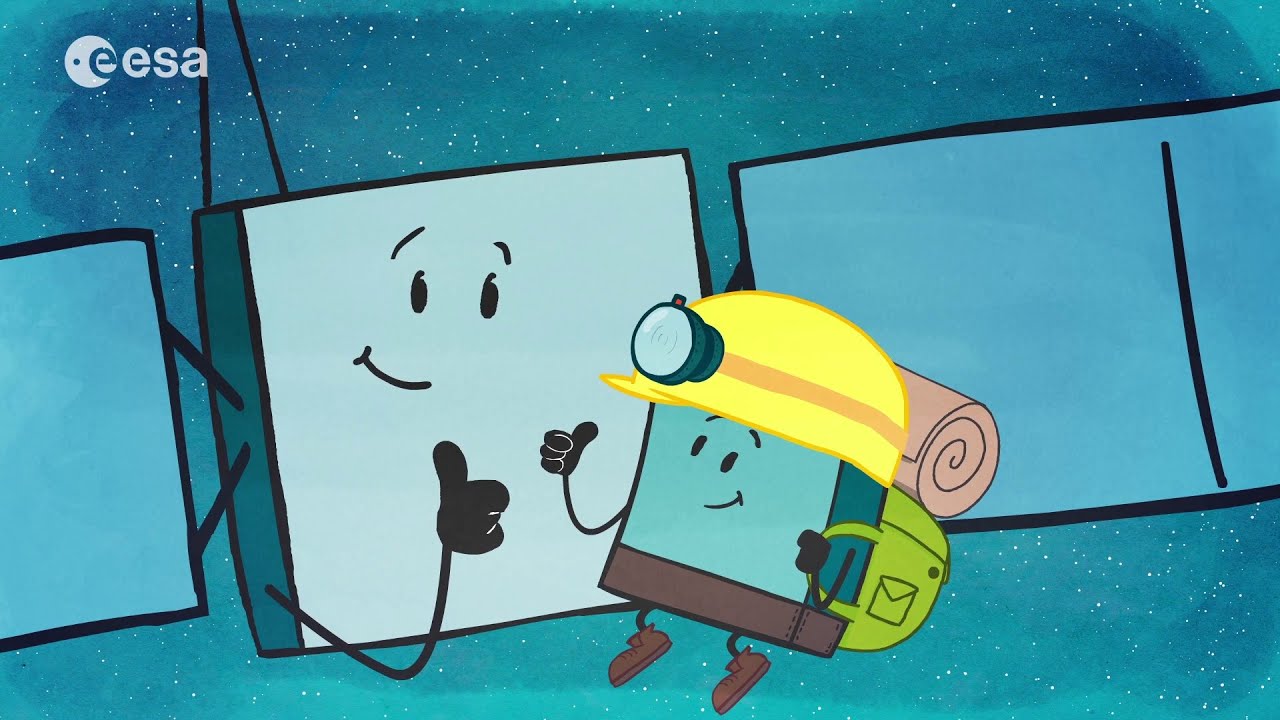
Als ze de kleine lettertjes van hun contract hebben gelezen.quote:Op woensdag 17 juni 2015 19:31 schreef LXIV het volgende:
[..]
Wat gemeen!
[ afbeelding ]
Weten ze dat zelf?

Niet meer aanwezig in dit forum.
17-06-2015
Komeetlander Philae mag voorzichtig weer aan het werk
Kometen Artist's impression van komeetlander Philae. (ESA)
De kleine komeetlander Philae wordt heel voorzichtig weer aan het werk gezet. Dat hebben wetenschappers van het Europese ruimteagentschap ESA woensdagochtend bekendgemaakt tijdens een persconferentie in Parijs. Maar voordat het zover is zal de lander, die afgelopen zaterdag na zeven maanden uit zijn ‘winterslaap’ kwam, grondig worden getest.
De eerste tekenen wijzen erop dat Philae in goede toestand verkeert. Maar dat betekent niet dat al zijn wetenschappelijke instrumenten direct aan de slag kunnen. In eerste instantie worden alleen Romap (meet magnetisch veld), Mupus (meet temperatuur) en Sesame (meet structuur komeetoppervlak met behulp van geluid) geactiveerd. Deze instrumenten verbruiken weinig stroom en zijn onbeweeglijk.
Dat laatste is van belang, omdat onduidelijk is hoe stabiel Philae momenteel staat. Slechts twee van zijn drie landingspoten maken contact met het oppervlak van komeet 67P/Churyumov-Gerasimenko.
Als volgende zijn de camera’s Civa en Rolis aan de beurt, gevolgd door Cosac en Ptolemy, de twee instrumenten die de samenstelling van het gas en stof op de komeet moeten onderzoeken. Pas als allerlaatste komen – mogelijk pas in juli – de röntgenspectrometer APXS en de ‘boor’ SD2 in actie.
Om de communicatie met Philae te vergemakkelijken, zal moederschip Rosetta weer wat dichter bij de komeet worden gebracht. Eerder moest Rosetta juist wat afstand nemen, omdat haar navigatiecamera stofdeeltjes van de komeet voor sterren begon aan te zien.
Rosetta zal het ijzige hemellichaam nu weer tot op 180 kilometer naderen – ongeveer 40 kilometer dichterbij dan de afgelopen weken. Maar als haar navigatiesysteem dat niet pikt, zal ze weer naar een veiligere hoogte worden gemanoeuvreerd.
(allesoversterrenkunde)
Komeetlander Philae mag voorzichtig weer aan het werk
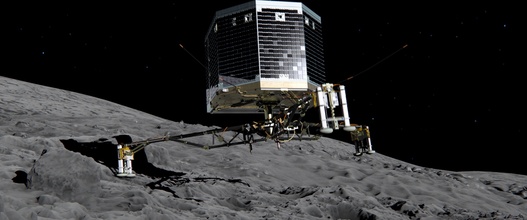
Kometen Artist's impression van komeetlander Philae. (ESA)
De kleine komeetlander Philae wordt heel voorzichtig weer aan het werk gezet. Dat hebben wetenschappers van het Europese ruimteagentschap ESA woensdagochtend bekendgemaakt tijdens een persconferentie in Parijs. Maar voordat het zover is zal de lander, die afgelopen zaterdag na zeven maanden uit zijn ‘winterslaap’ kwam, grondig worden getest.
De eerste tekenen wijzen erop dat Philae in goede toestand verkeert. Maar dat betekent niet dat al zijn wetenschappelijke instrumenten direct aan de slag kunnen. In eerste instantie worden alleen Romap (meet magnetisch veld), Mupus (meet temperatuur) en Sesame (meet structuur komeetoppervlak met behulp van geluid) geactiveerd. Deze instrumenten verbruiken weinig stroom en zijn onbeweeglijk.
Dat laatste is van belang, omdat onduidelijk is hoe stabiel Philae momenteel staat. Slechts twee van zijn drie landingspoten maken contact met het oppervlak van komeet 67P/Churyumov-Gerasimenko.
Als volgende zijn de camera’s Civa en Rolis aan de beurt, gevolgd door Cosac en Ptolemy, de twee instrumenten die de samenstelling van het gas en stof op de komeet moeten onderzoeken. Pas als allerlaatste komen – mogelijk pas in juli – de röntgenspectrometer APXS en de ‘boor’ SD2 in actie.
Om de communicatie met Philae te vergemakkelijken, zal moederschip Rosetta weer wat dichter bij de komeet worden gebracht. Eerder moest Rosetta juist wat afstand nemen, omdat haar navigatiecamera stofdeeltjes van de komeet voor sterren begon aan te zien.
Rosetta zal het ijzige hemellichaam nu weer tot op 180 kilometer naderen – ongeveer 40 kilometer dichterbij dan de afgelopen weken. Maar als haar navigatiesysteem dat niet pikt, zal ze weer naar een veiligere hoogte worden gemanoeuvreerd.
(allesoversterrenkunde)
Death Makes Angels of us all
And gives us wings where we had shoulders
Smooth as raven' s claws...
And gives us wings where we had shoulders
Smooth as raven' s claws...

twitter:ESA_de twitterde op vrijdag 19-06-2015 om 15:58:29 Große Freude im @ESA_Rosetta Kontrollraum im ESOC. Wir haben Telemetrie! #lifeonacomet http://t.co/YAOUwFiGMe reageer retweet
 Große Freude im @
Free Assange! Hack the Planet
[b]Op dinsdag 6 januari 2009 19:59 schreef Papierversnipperaar het volgende:[/b]
De gevolgen van de argumenten van de anti-rook maffia
[b]Op dinsdag 6 januari 2009 19:59 schreef Papierversnipperaar het volgende:[/b]
De gevolgen van de argumenten van de anti-rook maffia
gaaf nieuws, de nieuwsberichten van de ESA maar weer eens in de gaten gaan houden.
In a world without fences, who needs Windows and Gates!

Doet me een beetje denken aan deze:quote:
[..]
Wat gemeen!
[ afbeelding ]
Weten ze dat zelf?
Arm ding
The difference between the three Abrahamic religions:
- Christianity mumbling to the ceiling,
- Judaism mumbling to the wall,
- Islam mumbling to the floor.
- Christianity mumbling to the ceiling,
- Judaism mumbling to the wall,
- Islam mumbling to the floor.

Een update van vorige maand, hier wordt in redelijke Jip en Janneke-taal uitgelegd hoe het zit, dit snap ik zelfs 
[ Bericht 0% gewijzigd door Pek op 22-06-2015 08:00:50 ]

[ Bericht 0% gewijzigd door Pek op 22-06-2015 08:00:50 ]
The difference between the three Abrahamic religions:
- Christianity mumbling to the ceiling,
- Judaism mumbling to the wall,
- Islam mumbling to the floor.
- Christianity mumbling to the ceiling,
- Judaism mumbling to the wall,
- Islam mumbling to the floor.
Missie is extended tot september 2016 
Verder is er dit jaar in oktober een open dag bij ESTEC. Denk dat ik wel ga
Verder is er dit jaar in oktober een open dag bij ESTEC. Denk dat ik wel ga
Die is ook heel ergquote:Op maandag 22 juni 2015 07:11 schreef Pek het volgende:
[..]
Doet me een beetje denken aan deze:
[ afbeelding ]
Arm ding
 inderdaad.
Niet meer aanwezig in dit forum.
Yep! En het plan is om Rosetta aan het einde van de missie zelf op 67P te laten landen, als afsluiter. Rosetta en Philae weer samen.quote:

Klinkt interessant. Waar is dat? En post tegen die tijd ff een herinnering.quote:
Verder is er dit jaar in oktober een open dag bij ESTEC. Denk dat ik wel ga
Niet meer aanwezig in dit forum.
ESTEC is in Noordwijkquote:
[..]
Yep! En het plan is om Rosetta aan het einde van de missie zelf op 67P te laten landen, als afsluiter. Rosetta en Philae weer samen.
[..]
Klinkt interessant. Waar is dat? En post tegen die tijd ff een herinnering.
Meer info hier:
http://www.esa.int/Our_Ac(...)r_space_this_October
edit: ESTEC is dus ook de plek waar Rosetta is bedacht en getest etc.
[ Bericht 3% gewijzigd door Basekid_NZ op 23-06-2015 18:49:50 ]
twitter:philae20l4 twitterde op woensdag 24-06-2015 om 16:34:37 @ESA_Rosetta My first picture in 7 months! #lifeonacomet is amazing. http://t.co/rnhEcA5fgS reageer retweet
 @ESA_Rosetta My first picture in 7 months!
Free Assange! Hack the Planet
[b]Op dinsdag 6 januari 2009 19:59 schreef Papierversnipperaar het volgende:[/b]
De gevolgen van de argumenten van de anti-rook maffia
[b]Op dinsdag 6 januari 2009 19:59 schreef Papierversnipperaar het volgende:[/b]
De gevolgen van de argumenten van de anti-rook maffia
wat mooi zeg dat ik je post als eerste quote.quote:Op woensdag 24 juni 2015 16:53 schreef Papierversnipperaar het volgende:
[ afbeelding ]twitter:philae20l4 twitterde op woensdag 24-06-2015 om 16:34:37 @ESA_Rosetta My first picture in 7 months! #lifeonacomet is amazing. http://t.co/rnhEcA5fgS reageer retweet
Ik shuffel je woorden naar een hoogtepunt.
quote:[ afbeelding ]twitter:philae20l4 twitterde op woensdag 24-06-2015 om 16:34:37 @ESA_Rosetta My first picture in 7 months! #lifeonacomet is amazing. http://t.co/rnhEcA5fgS reageer retweet
Ik shuffel je woorden naar een hoogtepunt.
De rots waar ie tegenaan ligt? Een grindpad naar de volgende bushalte?quote:
Prachtig plaatje, maar waar kijken we eigenlijk naar?
Free Assange! Hack the Planet
[b]Op dinsdag 6 januari 2009 19:59 schreef Papierversnipperaar het volgende:[/b]
De gevolgen van de argumenten van de anti-rook maffia
[b]Op dinsdag 6 januari 2009 19:59 schreef Papierversnipperaar het volgende:[/b]
De gevolgen van de argumenten van de anti-rook maffia
Wat voor schaal hoort hierbij? Zitten we naar zandkorrels te kijken of naar stenen of naar rotsen?quote:[ afbeelding ]twitter:philae20l4 twitterde op woensdag 24-06-2015 om 16:34:37 @ESA_Rosetta My first picture in 7 months! #lifeonacomet is amazing. http://t.co/rnhEcA5fgS reageer retweet
"If you want to make God laugh, tell him about your plans"
Mijn reisverslagen
Mijn reisverslagen
Exposed water ice detected on comet’s surface

quote:24 June 2015
Using the high-resolution science camera on board ESA’s Rosetta spacecraft, scientists have identified more than a hundred patches of water ice a few metres in size on the surface of Comet 67P/Churyumov-Gerasimenko.
Rosetta arrived at the comet in August 2014 at a distance of about 100 km and eventually orbited the comet at 10 km or less, allowing high-resolution images of the surface to be acquired.
A new study just published in the journal Astronomy & Astrophysics focuses on an analysis of bright patches of exposed ice on the comet’s surface.
Based on observations of the gas emerging from comets, they are known to be rich in ices. As they move closer to the Sun along their orbits, their surfaces are warmed and the ices sublimate into gas, which streams away from the nucleus, dragging along dust particles embedded in the ice to form the coma and tail.
But some of the comet’s dust also remains on the surface as the ice below sublimates, or falls back on to the nucleus elsewhere, coating it with a thin layer of dusty material and leaving very little ice directly exposed on the surface. These processes help to explain why Comet 67P/Churyumov-Gerasimenko and other comets seen in previous flyby missions are so dark.
Despite this, Rosetta’s suite of instruments has already detected a variety of gases, including water vapour, carbon dioxide and carbon monoxide, thought to originate from frozen reservoirs below the surface.
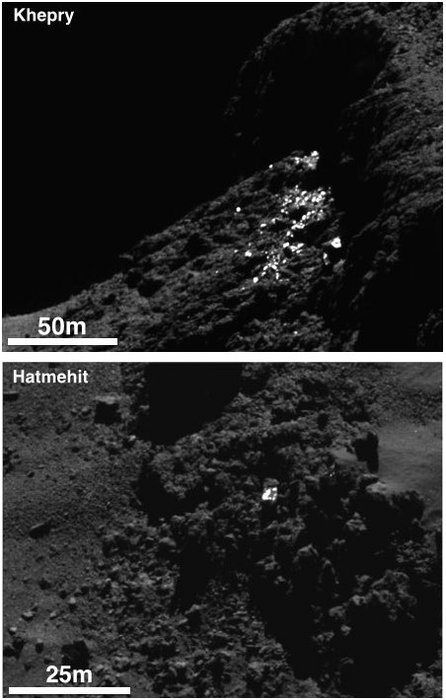
Now, using images taken with Rosetta’s OSIRIS narrow-angle camera last September, scientists have identified 120 regions on the surface of Comet 67P/Churyumov-Gerasimenko that are up to ten times brighter than the average surface brightness.
Some of these bright features are found in clusters, while others appear isolated, and when observed at high resolution, many of them appear to be boulders displaying bright patches on their surfaces.
The clusters of bright features, comprising a few tens of metre-sized boulders spread over several tens of metres, are typically found in debris fields at the base of cliffs. They are most likely the result of recent erosion or collapse of the cliff wall revealing fresher material from below the dust-covered surface.
By contrast, some of the isolated bright objects are found in regions without any apparent relation to the surrounding terrain. These are thought to be objects lifted up from elsewhere on the comet during a period of cometary activity, but with insufficient velocity to escape the gravitational pull of the comet completely.
In all cases, however, the bright patches were found in areas that receive relatively little solar energy, such as in the shadow of a cliff, and no significant changes were observed between images taken over a period of about a month. Furthermore, they were found to be bluer in colour at visible wavelengths compared with the redder background, consistent with an icy component.
“Water ice is the most plausible explanation for the occurrence and properties of these features,” says Antoine Pommerol of the University of Bern and lead author of the study.
“At the time of our observations, the comet was far enough from the Sun such that the rate at which water ice would sublimate would have been less than 1 mm per hour of incident solar energy. By contrast, if carbon dioxide or carbon monoxide ice had been exposed, it would have rapidly sublimated when illuminated by the same amount of sunlight. Thus we would not expect to see that type of ice stable on the surface at this time.”
The team also turned to laboratory experiments that tested the behaviour of water ice mixed with different minerals under simulated solar illumination in order to gain more insights into the process. They found that after a few hours of sublimation, a dark dust mantle a few millimetres thick was formed. In some places this acted to completely conceal any visible traces of the ice below, but occasionally larger dust grains or chunks would lift from the surface and move elsewhere, exposing bright patches of water ice.
“A 1 mm thick layer of dark dust is sufficient to hide the layers below from optical instruments,” confirms Holger Sierks, OSIRIS principal investigator at the Max Planck Institute for Solar System Research in Göttingen.
“The relatively homogeneous dark surface of the nucleus of Comet 67P/Churyumov-Gerasimenko, only punctuated by some metre-scale bright dots, can be explained by the presence of a thin dust mantle composed of refractory mineral and organic matter, with the bright spots corresponding to areas from which the dust mantle was removed, revealing a water-ice-rich subsurface below.”
The team also speculates about the timing of the formation of the icy patches. One hypothesis is that they were formed at the time of the last closest approach of the comet to the Sun, 6.5 years ago, with icy blocks ejected into permanently shadowed regions, preserving them for several years below the peak temperature needed for sublimation.
Another idea is that even at relatively large distances from the Sun, carbon dioxide and carbon monoxide driven-activity could eject the icy blocks. In this scenario, it is assumed that the temperature was not yet high enough for water sublimation, such that the water-ice-rich components outlive any exposed carbon dioxide or carbon monoxide ice.
“As the comet continues to approach perihelion, the increase in solar illumination onto the bright patches that were once in shadow should cause changes in their appearance, and we may expect to see new and even larger regions of exposed ice,” says Matt Taylor, ESA’s Rosetta project scientist.
“Combining OSIRIS observations made pre- and post-perihelion with other instruments will provide valuable insight into what drives the formation and evolution of such regions.”


<a href="http://www.vwkweb.nl/" rel="nofollow" target="_blank">[b]Vereniging voor weerkunde en klimatologie[/b]</a>
<a href="http://www.estofex.org/" rel="nofollow" target="_blank">[b]ESTOFEX[/b]</a>
<a href="http://www.estofex.org/" rel="nofollow" target="_blank">[b]ESTOFEX[/b]</a>
23-06-2015
Komeetlander Philae wordt herenigd met moederschip Rosetta
Een door de ESA geproduceerde verbeelding van komeetlander Philae (L) die zich losmaakt van moederschip Rosetta. © anp.
Wetenschap Rosetta en komeetlander Philae worden herenigd. Aan het eind van de missie, in september 2016, zal moederschip Rosetta een harde landing maken op de komeet waar Philae sinds november verblijft.
De missie zou aanvankelijk tot december van dit jaar duren, maar ruimtevaartorganisatie ESA maakte vandaag bekend dat ze wordt verlengd. Dit geeft onderzoekers de ruimte te zien of er verschillen bestaan in de hoeveelheid en het soort stof die de komeet uitstoot voor en na de passage van de zon. Op 13 augustus is komeet 67P/Churyumov-Gerasimenko het dichtst bij de zon.
Philae landt op de komeet. © anp.
De kleine lander heeft sinds enkele weken weer contact met de aarde, doordat er meer zonlicht op de panelen valt. Philae heeft lange tijd in slaapstand gestaan, omdat de accu's na de landing in november waren leeggeraakt. Dat kwam doordat het apparaat na zijn landing in een geul terecht was gekomen, waardoor hij grotendeels in de schaduw stond.
De verbinding tussen Rosetta en Philae (het moederschip heeft krachtiger antennes en zendt Philaes signalen door naar de aarde) is nog niet continu. Sinds Rosetta in een gunstiger baan is gebracht rond 67P is er vaker contact, maar de vluchtleiders van ESA werken nog aan een stabielere verbinding.
ESA hoopt dat met de wederopstanding het onderzoek naar komeet 67P kan worden uitgebreid, nu de lander vanaf het oppervlakte kan meten wat er gebeurt als de zon genaderd wordt en de temperaturen oplopen. Zodra er voldoende energie wordt opgewekt, zal ook een nieuwe poging worden gedaan in de komeet te boren, om zijn samenstelling te onderzoeken. Een eerste poging in november mislukte. In augustus zal 67P de zon het dichtst genaderd zijn en ESA heeft goede hoop dat Philae ten minste tot dat moment onderzoek zal kunnen doen
(HLN)
Komeetlander Philae wordt herenigd met moederschip Rosetta

Een door de ESA geproduceerde verbeelding van komeetlander Philae (L) die zich losmaakt van moederschip Rosetta. © anp.
Wetenschap Rosetta en komeetlander Philae worden herenigd. Aan het eind van de missie, in september 2016, zal moederschip Rosetta een harde landing maken op de komeet waar Philae sinds november verblijft.
De missie zou aanvankelijk tot december van dit jaar duren, maar ruimtevaartorganisatie ESA maakte vandaag bekend dat ze wordt verlengd. Dit geeft onderzoekers de ruimte te zien of er verschillen bestaan in de hoeveelheid en het soort stof die de komeet uitstoot voor en na de passage van de zon. Op 13 augustus is komeet 67P/Churyumov-Gerasimenko het dichtst bij de zon.

Philae landt op de komeet. © anp.
De kleine lander heeft sinds enkele weken weer contact met de aarde, doordat er meer zonlicht op de panelen valt. Philae heeft lange tijd in slaapstand gestaan, omdat de accu's na de landing in november waren leeggeraakt. Dat kwam doordat het apparaat na zijn landing in een geul terecht was gekomen, waardoor hij grotendeels in de schaduw stond.
De verbinding tussen Rosetta en Philae (het moederschip heeft krachtiger antennes en zendt Philaes signalen door naar de aarde) is nog niet continu. Sinds Rosetta in een gunstiger baan is gebracht rond 67P is er vaker contact, maar de vluchtleiders van ESA werken nog aan een stabielere verbinding.
ESA hoopt dat met de wederopstanding het onderzoek naar komeet 67P kan worden uitgebreid, nu de lander vanaf het oppervlakte kan meten wat er gebeurt als de zon genaderd wordt en de temperaturen oplopen. Zodra er voldoende energie wordt opgewekt, zal ook een nieuwe poging worden gedaan in de komeet te boren, om zijn samenstelling te onderzoeken. Een eerste poging in november mislukte. In augustus zal 67P de zon het dichtst genaderd zijn en ESA heeft goede hoop dat Philae ten minste tot dat moment onderzoek zal kunnen doen
(HLN)
Death Makes Angels of us all
And gives us wings where we had shoulders
Smooth as raven' s claws...
And gives us wings where we had shoulders
Smooth as raven' s claws...
[/quote]Lijkt me wel interessant om een filmpje te zien van hoe het er toen aan toe ging in de controlekamer. Denk niet dat ze wisten dat het precies nu zou gebeuren namenlijk.
Ik zie het al voor me dat een nachtdienst opeens een bliepje hoort en verbaasd naar zn scherm tuurt en dan verwoed gaat bellen en rode knoppen indrukt ofzo
[quote]
ik zit net het script even door te lezen van de nieuwe cartoon die komen gaat, en dit staat er inderdaad zo ongeveer in :
Philae wordt wakker en belt op naar Rosetta die bijna zijn van schrik zijn mobieltje laat vallen. Tegelijkertijd zie je 1 persoon in de controlekamer die zo'n bliepje hoort en naar zijn collega's gaan bellen. Die op dat tijdstip net hun tandjes staan te poetsen of als slapen of in de pub zit, En binnen no time weet de wereld het,,,,
Ik zie het al voor me dat een nachtdienst opeens een bliepje hoort en verbaasd naar zn scherm tuurt en dan verwoed gaat bellen en rode knoppen indrukt ofzo
[quote]
ik zit net het script even door te lezen van de nieuwe cartoon die komen gaat, en dit staat er inderdaad zo ongeveer in :
Philae wordt wakker en belt op naar Rosetta die bijna zijn van schrik zijn mobieltje laat vallen. Tegelijkertijd zie je 1 persoon in de controlekamer die zo'n bliepje hoort en naar zijn collega's gaan bellen. Die op dat tijdstip net hun tandjes staan te poetsen of als slapen of in de pub zit, En binnen no time weet de wereld het,,,,
Meer dan honderd plekjes met waterijs gevonden op komeet 67P
ESA’s Rosetta-ruimtesonde heeft meer dan honderd plekjes met waterijs gevonden op het oppervlak van komeet 67P/Churymov-Gerasimenko. Veel van deze plekken zijn niet groter dan een paar meter.
De foto’s van het oppervlak zijn gemaakt toen de afstand tussen Rosetta en het oppervlak circa tien kilometer was. Hierdoor kon de ruimtesonde zeer gedetailleerde foto’s van het komeetoppervlak maken.
Kometen zijn objecten met veel ijs. Naarmate een komeet dichter bij de zon in de buurt komt, wordt het oppervlak verwarmt, waardoor ijs en stofdeeltjes in gas sublimeert. Een deel van het stof blijft op het oppervlak liggen of valt terug op het oppervlak, wat verklaart waarom de meeste kometen een donkere kleur hebben.
In totaal hebben de instrumenten van Rosetta 120 regio’s op komeet 67P geïdentificeerd met waterijs. Deze gebieden zijn tien keer helderder dan de gemiddelde helderheid van het oppervlak van de komeet. Sommige plekjes met ijs bevinden zich dicht bij elkaar, terwijl er ook een paar solisten zijn aangetroffen.
Al het ijs bevindt zich op delen van de komeet waar minder zonlicht het oppervlak bereikt, bijvoorbeeld in een klif of in een schaduw. Ook troffen de wetenschappers geen veranderingen aan in foto’s die een maand later zijn gemaakt.
Waterijs of iets anders?
“Het is zeer aannemelijk dat het waterijs is en dus geen koolstofdioxideijs of koolstofmonoxideijs”, zegt onderzoeker Antoine Pommerol van de universiteit van Bern. “De laatste twee varianten zouden namelijk veel sneller sublimeren. In dat geval zou er niets te zien zijn op het oppervlak van komeet 67P.”
Het is jammer dat een laag stof een groot deel van het waterijs bedekt. “Een laagje stof met een dikte van één millimeter is al genoeg om het waterijs te verbergen voor onze optische instrumenten”, bevestigt wetenschapper Holger Sierks van het Max Planck Instituut.
Ontstaan van de ijsafzettingen
Wetenschappers speculeren nog over het ontstaan van deze plekjes met ijs. Een hypothese is dat de plekjes 6,5 jaar geleden zijn ontstaan, toen de afstand tussen de zon en de komeet het kleinst was. Omdat het in sommige regio’s permanent donker is, slaagden de ijsafzettingen erin om jarenlang te overleven op het oppervlak van komeet 67P.
(BRON; scientias.nl)
ESA’s Rosetta-ruimtesonde heeft meer dan honderd plekjes met waterijs gevonden op het oppervlak van komeet 67P/Churymov-Gerasimenko. Veel van deze plekken zijn niet groter dan een paar meter.
De foto’s van het oppervlak zijn gemaakt toen de afstand tussen Rosetta en het oppervlak circa tien kilometer was. Hierdoor kon de ruimtesonde zeer gedetailleerde foto’s van het komeetoppervlak maken.
Kometen zijn objecten met veel ijs. Naarmate een komeet dichter bij de zon in de buurt komt, wordt het oppervlak verwarmt, waardoor ijs en stofdeeltjes in gas sublimeert. Een deel van het stof blijft op het oppervlak liggen of valt terug op het oppervlak, wat verklaart waarom de meeste kometen een donkere kleur hebben.
In totaal hebben de instrumenten van Rosetta 120 regio’s op komeet 67P geïdentificeerd met waterijs. Deze gebieden zijn tien keer helderder dan de gemiddelde helderheid van het oppervlak van de komeet. Sommige plekjes met ijs bevinden zich dicht bij elkaar, terwijl er ook een paar solisten zijn aangetroffen.
Al het ijs bevindt zich op delen van de komeet waar minder zonlicht het oppervlak bereikt, bijvoorbeeld in een klif of in een schaduw. Ook troffen de wetenschappers geen veranderingen aan in foto’s die een maand later zijn gemaakt.
Waterijs of iets anders?
“Het is zeer aannemelijk dat het waterijs is en dus geen koolstofdioxideijs of koolstofmonoxideijs”, zegt onderzoeker Antoine Pommerol van de universiteit van Bern. “De laatste twee varianten zouden namelijk veel sneller sublimeren. In dat geval zou er niets te zien zijn op het oppervlak van komeet 67P.”
Het is jammer dat een laag stof een groot deel van het waterijs bedekt. “Een laagje stof met een dikte van één millimeter is al genoeg om het waterijs te verbergen voor onze optische instrumenten”, bevestigt wetenschapper Holger Sierks van het Max Planck Instituut.
Ontstaan van de ijsafzettingen
Wetenschappers speculeren nog over het ontstaan van deze plekjes met ijs. Een hypothese is dat de plekjes 6,5 jaar geleden zijn ontstaan, toen de afstand tussen de zon en de komeet het kleinst was. Omdat het in sommige regio’s permanent donker is, slaagden de ijsafzettingen erin om jarenlang te overleven op het oppervlak van komeet 67P.
(BRON; scientias.nl)
Veni, vidi, vodka.
541 images have been added to the NAVCAM archive image browser today!
They cover the period 22 November to 19 December 2014,
when Rosetta was approximately 20-30 km from the comet.
Browse them all here:
They cover the period 22 November to 19 December 2014,
when Rosetta was approximately 20-30 km from the comet.
Browse them all here:

<a href="http://www.vwkweb.nl/" rel="nofollow" target="_blank">[b]Vereniging voor weerkunde en klimatologie[/b]</a>
<a href="http://www.estofex.org/" rel="nofollow" target="_blank">[b]ESTOFEX[/b]</a>
<a href="http://www.estofex.org/" rel="nofollow" target="_blank">[b]ESTOFEX[/b]</a>
01-07-2015
Vreemde zinkgaten "groter dan een voetbalveld" op komeet die rond zon draait
Rosetta wist spectaculaire foto's te maken van de komeet. © Reuters/ESA.
sterrenkunde Enorme gaten waar de grond ineens is verdwenen. Zulke zinkgaten (sinkholes) blijken niet alleen voor te komen op Aarde, maar ook elders in de ruimte. Op komeet 67P/Churyumov-Gerasimenko bijvoorbeeld. Dat heeft de Nederlandse sterrenkundige Dennis Bodewits ontdekt, zo staat in de nieuwste editie van wetenschappelijke vakblad Nature.
© ap.
© ap.
© ap.
67P/Churyumov-Gerasimenko is een rotsblok dat al miljarden jaren rond de Zon draait. Het kreeg vorig jaar bezoek van de Europese sonde Rosetta en de onbemande verkenner Philae landde op het oppervlak, een historische prestatie. Met de Rosetta keek Bodewits, die werkt voor de University of Maryland, naar de komeet.
"De camera heeft vreemde ronde gaten gevonden op het oppervlak van komeet 67P. Sommige van deze gaten zijn net zo diep als breed: zo diep als de Domtoren (in Utrecht - Belga) en groter dan een voetbalveld", aldus Bodewits. Hoe dieper de gaten zijn, hoe jonger ze zijn.
Onder het oppervlak van de komeet zit ijs. Als dit verdwijnt, ontstaat er een holte en is er niets om het 'dak', het oppervlak van de komeet, overeind te houden. Dat zakt in en er blijft een groot gat achter. Het resterende ijs in het gat komt voor het eerst in het zonlicht te staan en verdwijnt ook. Na verloop van tijd slijten de randen van de gaten en valt er stof in.
Sinkholes waren eerder gevonden op Mars. Ze helpen wetenschappers om een beter beeld te krijgen; ze kunnen "onder het oppervlak kijken zonder ervoor te hoeven boren", aldus Bodewits.
(HLN)
Vreemde zinkgaten "groter dan een voetbalveld" op komeet die rond zon draait

Rosetta wist spectaculaire foto's te maken van de komeet. © Reuters/ESA.
sterrenkunde Enorme gaten waar de grond ineens is verdwenen. Zulke zinkgaten (sinkholes) blijken niet alleen voor te komen op Aarde, maar ook elders in de ruimte. Op komeet 67P/Churyumov-Gerasimenko bijvoorbeeld. Dat heeft de Nederlandse sterrenkundige Dennis Bodewits ontdekt, zo staat in de nieuwste editie van wetenschappelijke vakblad Nature.

© ap.

© ap.

© ap.
67P/Churyumov-Gerasimenko is een rotsblok dat al miljarden jaren rond de Zon draait. Het kreeg vorig jaar bezoek van de Europese sonde Rosetta en de onbemande verkenner Philae landde op het oppervlak, een historische prestatie. Met de Rosetta keek Bodewits, die werkt voor de University of Maryland, naar de komeet.
"De camera heeft vreemde ronde gaten gevonden op het oppervlak van komeet 67P. Sommige van deze gaten zijn net zo diep als breed: zo diep als de Domtoren (in Utrecht - Belga) en groter dan een voetbalveld", aldus Bodewits. Hoe dieper de gaten zijn, hoe jonger ze zijn.
Onder het oppervlak van de komeet zit ijs. Als dit verdwijnt, ontstaat er een holte en is er niets om het 'dak', het oppervlak van de komeet, overeind te houden. Dat zakt in en er blijft een groot gat achter. Het resterende ijs in het gat komt voor het eerst in het zonlicht te staan en verdwijnt ook. Na verloop van tijd slijten de randen van de gaten en valt er stof in.
Sinkholes waren eerder gevonden op Mars. Ze helpen wetenschappers om een beter beeld te krijgen; ze kunnen "onder het oppervlak kijken zonder ervoor te hoeven boren", aldus Bodewits.
(HLN)
Death Makes Angels of us all
And gives us wings where we had shoulders
Smooth as raven' s claws...
And gives us wings where we had shoulders
Smooth as raven' s claws...

Hoe weet je dat?quote:
Death Makes Angels of us all
And gives us wings where we had shoulders
Smooth as raven' s claws...
And gives us wings where we had shoulders
Smooth as raven' s claws...
Moest gelijk denken aanquote:
01-07-2015
Vreemde zinkgaten "groter dan een voetbalveld" op komeet die rond zon draait
© ap.

<a href="http://www.vwkweb.nl/" rel="nofollow" target="_blank">[b]Vereniging voor weerkunde en klimatologie[/b]</a>
<a href="http://www.estofex.org/" rel="nofollow" target="_blank">[b]ESTOFEX[/b]</a>
<a href="http://www.estofex.org/" rel="nofollow" target="_blank">[b]ESTOFEX[/b]</a>
hahaha dat plaatje ken ik nog jaquote:
Death Makes Angels of us all
And gives us wings where we had shoulders
Smooth as raven' s claws...
And gives us wings where we had shoulders
Smooth as raven' s claws...
06-07-2015
Astrobiologen speculeren over micro-organismen op Rosetta-komeet
Komeet Churyumov-Gerasimenko, in maart 2015 gefotografeerd door Rosetta. (ESA/Rosetta/NAVCAM)
Volgens astrobiologen van de Universiteit van Cardiff zouden er micro-organismen kunnen leven op komeet 67P/Churyumov-Gerasimenko - de komeet die in detail bestudeerd wordt door de Europese ruimtesonde Rosetta. Max Wallis en Chandra Wickramasinghe presenteren hun speculatieve ideeën hierover vandaag op de National Astronomy Meeting van de Royal Astronomical Society in Llandudno (Wales).
Wickramasinghe is een kleurrijke en door lang niet iedereen serieus genomen astronoom die al tientallen jaren lang (aanvankelijk samen met Fred Hoyle) theorieën over buitenaardse micro-organismen rondstrooit. Tot dusver zijn die nooit door precisiemetingen bevestigd. Of dat nu wél het geval zal zijn, valt zeer te betwijfelen.
Wallis en Wickramasinghe laten in ieder geval zien dat de waargenomen structuren en omstandigheden op de komeet (waarop veel complexe organische verbindingen voorkomen) goed in overeenstemming zijn met de aanwezigheid van micro-organismen. Die zouden zich bijvoorbeeld kunnen bevinden in spleten in het ijs. Ze zouden bovendien van invloed zijn op de acitviteit van de komeet. Wanneer hun cellen - naast water - ook een vorm van antivries bevatten (bijvoorbeeld ammoniak), zouden ze kunnen overleven bij temperaturen tot tientallen graden onder nul.
(allesoversterrenkunde)
Astrobiologen speculeren over micro-organismen op Rosetta-komeet
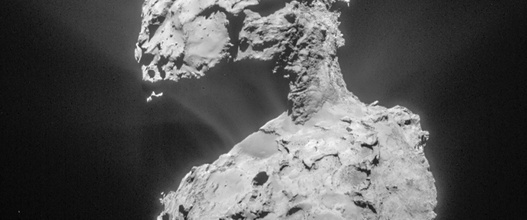
Komeet Churyumov-Gerasimenko, in maart 2015 gefotografeerd door Rosetta. (ESA/Rosetta/NAVCAM)
Volgens astrobiologen van de Universiteit van Cardiff zouden er micro-organismen kunnen leven op komeet 67P/Churyumov-Gerasimenko - de komeet die in detail bestudeerd wordt door de Europese ruimtesonde Rosetta. Max Wallis en Chandra Wickramasinghe presenteren hun speculatieve ideeën hierover vandaag op de National Astronomy Meeting van de Royal Astronomical Society in Llandudno (Wales).
Wickramasinghe is een kleurrijke en door lang niet iedereen serieus genomen astronoom die al tientallen jaren lang (aanvankelijk samen met Fred Hoyle) theorieën over buitenaardse micro-organismen rondstrooit. Tot dusver zijn die nooit door precisiemetingen bevestigd. Of dat nu wél het geval zal zijn, valt zeer te betwijfelen.
Wallis en Wickramasinghe laten in ieder geval zien dat de waargenomen structuren en omstandigheden op de komeet (waarop veel complexe organische verbindingen voorkomen) goed in overeenstemming zijn met de aanwezigheid van micro-organismen. Die zouden zich bijvoorbeeld kunnen bevinden in spleten in het ijs. Ze zouden bovendien van invloed zijn op de acitviteit van de komeet. Wanneer hun cellen - naast water - ook een vorm van antivries bevatten (bijvoorbeeld ammoniak), zouden ze kunnen overleven bij temperaturen tot tientallen graden onder nul.
(allesoversterrenkunde)
Death Makes Angels of us all
And gives us wings where we had shoulders
Smooth as raven' s claws...
And gives us wings where we had shoulders
Smooth as raven' s claws...
Er is weer contact met Philae
quote:→New communication with Philae – commands executed successfully
This report is provided by the German Aerospace Center, DLR.
The Philae lander communicated with the Rosetta orbiter again between 19:45 and 20:07 CEST on 9 July 2015 and transmitted measurement data from the COmet Nucleus Sounding Experiment by Radiowave Transmission (CONSERT) instrument. Although the connection failed repeatedly after that, it remained completely stable for those 12 minutes. “This sign of life from Philae proves to us that at least one of the lander’s communication units remains operational and receives our commands,” said Koen Geurts, a member of the lander control team at DLR Cologne.
The mood had been mixed over the last few days; Philae had not communicated with the team in the DLR Lander Control Center (LCC) since 24 June 2015. After an initial test command to turn on the power to CONSERT on 5 July 2015, the lander did not respond. Philae’s team began to wonder if the lander had survived on Comet 67P/Churyumov-Gerasimenko.
“We never gave up on Philae and remained optimistic,” said Geurts. There was great excitement when Philae ‘reported in’ on 13 June 2015 after seven months of hibernation and sent data about its health. The lander was ready to perform its tasks, 300 million kilometres away from Earth.
However, Philae has to communicate with the ground stations through Rosetta, which acts as a radio relay. Restrictions on the orbiter’s approach to and orbit around the comet have not permitted regular communication with the lander. The data sent on 24 June did not suggest that the lander had experienced technical difficulties. Now, Philae’s internal temperature of zero degrees Celsius gives the team hope that the lander can charge its batteries; this would make scientific work possible regardless of the ‘time of day’ on the comet.
The received data is currently being evaluated. “We can already see that the CONSERT instrument was successfully activated by the command we sent on 9 July,” explained Geurts. Even now, Philae is causing the team some puzzlement: “We do not yet have an explanation for why the lander has communicated now, but not over the past few days.”
The trajectory of the orbiter, for example, has not changed over the last three weeks. However, one thing is certain; Philae has survived the harsh conditions on the comet and is responding to commands from the LCC team. “This is extremely good news for us,” said Geurts.
<a href="http://www.vwkweb.nl/" rel="nofollow" target="_blank">[b]Vereniging voor weerkunde en klimatologie[/b]</a>
<a href="http://www.estofex.org/" rel="nofollow" target="_blank">[b]ESTOFEX[/b]</a>
<a href="http://www.estofex.org/" rel="nofollow" target="_blank">[b]ESTOFEX[/b]</a>
quote:

Even in t Nederlands
10-07-2015
Komeetlander Philae reageert op commando's
Artist's impression van komeetlander Philae. (ESA)
Na twee weken van stilte is er op 9 juli weer even verbinding geweest met de Europese komeetlander Philae. Het contact is gebruikt om meetgegevens van een van de instrumenten van Philae over te laten zenden. Er zit dus nog steeds leven in de komeetlander, maar de communicatie – via moederschip Rosetta – verloopt moeizaam.
Op 24 juni had Philae voor het laatst iets van zich laten horen. Toch werd op 5 juli bij wijze van test het commando naar hem verzonden om het instrument CONSERT in te schakelen. De lander gaf geen antwoord, maar heeft de opdracht blijkbaar wel uitgevoerd. CONSERT is een detector die radarsignalen van Rosetta opvangt nadat die door de komeetkern heen zijn gegaan.
Het is onduidelijk waarom Philae het ene moment wel communiceert en het andere moment niet — aan de omloopbaan van Rosetta is de afgelopen weken niets veranderd namelijk. Maar zeker is dat er nog steeds leven zit in de komeetlander.
(allesoversterrenkunde)
Death Makes Angels of us all
And gives us wings where we had shoulders
Smooth as raven' s claws...
And gives us wings where we had shoulders
Smooth as raven' s claws...
...
Death Makes Angels of us all
And gives us wings where we had shoulders
Smooth as raven' s claws...
And gives us wings where we had shoulders
Smooth as raven' s claws...
Ik zat laatst iets te bedenken:
Kan het zijn dat ze Rosetta in de buurt van Philea laten landen in de hoop dat er dan alsnog een hoop data kan worden overgebracht. Of is de landing van Rossetta op G76 alleen maar symbolisch?
Kan het zijn dat ze Rosetta in de buurt van Philea laten landen in de hoop dat er dan alsnog een hoop data kan worden overgebracht. Of is de landing van Rossetta op G76 alleen maar symbolisch?
Dat is puur symbolisch. De vereniging van moeder en kindquote:
Ik zat laatst iets te bedenken:
Kan het zijn dat ze Rosetta in de buurt van Philea laten landen in de hoop dat er dan alsnog een hoop data kan worden overgebracht. Of is de landing van Rossetta op G76 alleen maar symbolisch?
"Obviously we will have to try and get it close to Philae. That's more for emotional reasons"
Death Makes Angels of us all
And gives us wings where we had shoulders
Smooth as raven' s claws...
And gives us wings where we had shoulders
Smooth as raven' s claws...
Toch zou " de nek" van de komeet ook een interessante optie kunnen zijn voor de crash van rosetta. Dan heb je te maken met zwaartekracht vanuit verschillende richtingen (ook van opzij) op het laatste stukje.....
Geen idee overigens of er tegen die tijd nog metingen mogelijk zijn waarvan de resultaten nog naar aarde gestuurd kunnen worden...
Geen idee overigens of er tegen die tijd nog metingen mogelijk zijn waarvan de resultaten nog naar aarde gestuurd kunnen worden...

Deze foto is genomen op 7 juli op een afstand van 154 km
Death Makes Angels of us all
And gives us wings where we had shoulders
Smooth as raven' s claws...
And gives us wings where we had shoulders
Smooth as raven' s claws...
16-07-2015
Hoe gaat het eigenlijk met komeetlander Philae?
Geschreven door Tim Kraaijvanger op 16 juli 2015 om 09:52 uur
Het is alweer 27 dagen geleden dat er op Scientias.nl een artikel verscheen over Philae. De hoogste tijd voor een update. Is er al stabiel contact met de komeetlander?
Op 14 juni bevestigde de Europese ruimtevaartorganisatie dat er een signaal was ontvangen van de Philae-lander. De komeetlander arriveerde in november op de komeet 67P/Churyumov-Gerasimenko, maar sindsdien was er geen contact meer tussen Philae en de Rosetta-ruimtesonde. Vorige maand ontvingen de zonnepanelen van Philae voldoende energie om naar huis te bellen. Nu de komeet de zon nadert, zal Philae vaker in het zonlicht baden en dus ook regelmatiger contact kunnen opnemen met wetenschappers op aarde.
Het probleem op dit moment is dat de verbinding met Philae niet stabiel is. Er zijn al meerdere contactmomenten geweest met de komeetlander, maar de verbinding bleef niet lang genoeg in stand. Pas wanneer de verbinding stabiel is, kan Philae aan de slag. Dan kunnen de procedures voor zijn tien instrumenten namelijk geüpload worden. “Eerst zullen we de niet-mechanische instrumenten activeren”, zegt projectleider Stephan Ulamec. “Dat zijn de instrumenten die geen boor of hamer gebruiken.” Logisch, want deze instrumenten verbruiken meer energie en dat kan Philae nu nog niet aan.
Nu – ruim één maand na het eerste contact – is er weinig veranderd. Een woordvoerder van de Europese ruimtevaartorganisatie laat weten dat de verbinding nog steeds niet stabiel is. De verschillende teams gaan de situatie de komende weken analyseren en hopen dat Philae operationeel wordt tijdens het perihelium van komeet 67P.
Het perihelium
Perihelium?
De Rosetta-sonde kwam bij komeet 67P aan toen het object 540 miljoen kilometer van de zon verwijderd was. Op 13 juli was de afstand tot de zon nog maar 195 miljoen kilometer. Het perihelium is het punt in de baan van 67P dat het dichtst bij de zon ligt. Op 13 augustus 2015 is de afstand tussen komeet 67P en de zon het kleinst: 186 miljoen kilometer.
De komeet zal de komende weken transformeren. Bevroren ijs sublimeert, er ontstaan zinkgaten op de komeet en mogelijk vinden er uitbarstingen plaats. Wetenschappers voorspellen dat 67P in augustus en september het actiefst is. Na het perihelium vervolgt de komeet zijn reis naar de asteroïdengordel van het zonnestelsel.
De laatste kans
Aangezien Philae op het oppervlak rust van komeet 67P is het onbekend wat er met de komeetlander gaat gebeuren. Het is mogelijk dat de lander het perihelium niet overleeft, omdat er onvoorspelbare processen plaatsvinden op het oppervlak van de komeet. Het is te hopen dat ESA er snel in slaagt om stabiel contact te krijgen met Philae, want na 13 augustus is de kans klein dat hij nog aan het werk gaat. Dan ontvangt de lander dagelijks minder zonlicht.
(scientias.nl)
Hoe gaat het eigenlijk met komeetlander Philae?

Geschreven door Tim Kraaijvanger op 16 juli 2015 om 09:52 uur
Het is alweer 27 dagen geleden dat er op Scientias.nl een artikel verscheen over Philae. De hoogste tijd voor een update. Is er al stabiel contact met de komeetlander?
Op 14 juni bevestigde de Europese ruimtevaartorganisatie dat er een signaal was ontvangen van de Philae-lander. De komeetlander arriveerde in november op de komeet 67P/Churyumov-Gerasimenko, maar sindsdien was er geen contact meer tussen Philae en de Rosetta-ruimtesonde. Vorige maand ontvingen de zonnepanelen van Philae voldoende energie om naar huis te bellen. Nu de komeet de zon nadert, zal Philae vaker in het zonlicht baden en dus ook regelmatiger contact kunnen opnemen met wetenschappers op aarde.
Het probleem op dit moment is dat de verbinding met Philae niet stabiel is. Er zijn al meerdere contactmomenten geweest met de komeetlander, maar de verbinding bleef niet lang genoeg in stand. Pas wanneer de verbinding stabiel is, kan Philae aan de slag. Dan kunnen de procedures voor zijn tien instrumenten namelijk geüpload worden. “Eerst zullen we de niet-mechanische instrumenten activeren”, zegt projectleider Stephan Ulamec. “Dat zijn de instrumenten die geen boor of hamer gebruiken.” Logisch, want deze instrumenten verbruiken meer energie en dat kan Philae nu nog niet aan.
Nu – ruim één maand na het eerste contact – is er weinig veranderd. Een woordvoerder van de Europese ruimtevaartorganisatie laat weten dat de verbinding nog steeds niet stabiel is. De verschillende teams gaan de situatie de komende weken analyseren en hopen dat Philae operationeel wordt tijdens het perihelium van komeet 67P.

Het perihelium
Perihelium?
De Rosetta-sonde kwam bij komeet 67P aan toen het object 540 miljoen kilometer van de zon verwijderd was. Op 13 juli was de afstand tot de zon nog maar 195 miljoen kilometer. Het perihelium is het punt in de baan van 67P dat het dichtst bij de zon ligt. Op 13 augustus 2015 is de afstand tussen komeet 67P en de zon het kleinst: 186 miljoen kilometer.
De komeet zal de komende weken transformeren. Bevroren ijs sublimeert, er ontstaan zinkgaten op de komeet en mogelijk vinden er uitbarstingen plaats. Wetenschappers voorspellen dat 67P in augustus en september het actiefst is. Na het perihelium vervolgt de komeet zijn reis naar de asteroïdengordel van het zonnestelsel.
De laatste kans
Aangezien Philae op het oppervlak rust van komeet 67P is het onbekend wat er met de komeetlander gaat gebeuren. Het is mogelijk dat de lander het perihelium niet overleeft, omdat er onvoorspelbare processen plaatsvinden op het oppervlak van de komeet. Het is te hopen dat ESA er snel in slaagt om stabiel contact te krijgen met Philae, want na 13 augustus is de kans klein dat hij nog aan het werk gaat. Dan ontvangt de lander dagelijks minder zonlicht.
(scientias.nl)
Death Makes Angels of us all
And gives us wings where we had shoulders
Smooth as raven' s claws...
And gives us wings where we had shoulders
Smooth as raven' s claws...
Mijn fantasie slaat weer eens op hol....quote:
De laatste kans
Aangezien Philae op het oppervlak rust van komeet 67P is het onbekend wat er met de komeetlander gaat gebeuren. Het is mogelijk dat de lander het perihelium niet overleeft, omdat er onvoorspelbare processen plaatsvinden op het oppervlak van de komeet. Het is te hopen dat ESA er snel in slaagt om stabiel contact te krijgen met Philae, want na 13 augustus is de kans klein dat hij nog aan het werk gaat. Dan ontvangt de lander dagelijks minder zonlicht.
Dat Philae te kort licht krijgt is wel duidelijk. Die grindpadfoto heeft dat bevestigd denk ik. Maar eh, als er van alles gaat borrelen en bruisen op de komeet, is er dan ook niet een kans dat Philae van de plek wordt geblazen en alsnog op de pootjes terecht komt? #WishfulThinking.
Goede vraag, lijkt me niet geheel onmogelijk in eerste instantiequote:
[..]
Mijn fantasie slaat weer eens op hol....
Dat Philae te kort licht krijgt is wel duidelijk. Die grindpadfoto heeft dat bevestigd denk ik. Maar eh, als er van alles gaat borrelen en bruisen op de komeet, is er dan ook niet een kans dat Philae van de plek wordt geblazen en alsnog op de pootjes terecht komt? #WishfulThinking.
Death Makes Angels of us all
And gives us wings where we had shoulders
Smooth as raven' s claws...
And gives us wings where we had shoulders
Smooth as raven' s claws...
Weinig zonlicht betekent ook minder kans op borrelen en bruisen.quote:
[..]
Mijn fantasie slaat weer eens op hol....
Dat Philae te kort licht krijgt is wel duidelijk. Die grindpadfoto heeft dat bevestigd denk ik. Maar eh, als er van alles gaat borrelen en bruisen op de komeet, is er dan ook niet een kans dat Philae van de plek wordt geblazen en alsnog op de pootjes terecht komt? #WishfulThinking.
Géén kloon van tvlxd!
Weinig zonlicht op de panelen wil niet zeggen dat er weinig zonlicht in de directe omgeving is. Het kan best zijn dat ie met panelen en antenne naar beneden ligt. Maar het is natuurlijk ook mogelijk dat ie domweg in een sinkhole is gezakt.quote:
[..]
Weinig zonlicht betekent ook minder kans op borrelen en bruisen.
16-07-2015
Heeft Curiosity een continentale korst gevonden op Mars?
Geschreven door Tim Kraaijvanger op 16 juli 2015 om 17:04 uur
Het ChemChem-laserinstrument van NASA’s Curiosity-rover heeft enkele lichtgekleurde rotsen op Mars gevonden. Volgens wetenschappers is dit het eerste bewijs van een continentale korst op Mars.
Het oppervlak van de aarde bestaat uit een continentale korst (land) en een oceanische korst (onder water). De continentale korst wordt ook wel de continentale lithosfeer genoemd. Het grote verschil met de oceanische korst is dat een continentale lithosfeer dikker is, een lagere dichtheid heeft en veel ouder is.
Curiosity
“Lichtgekleurde kristallen hebben vaak een lagere dichtheid,” zegt Roger Wiens van het nationale laboratorium van Los Alamos. “Deze kristallen zijn in grote getallen aanwezig in stollingsgesteenten van continenten op aarde.”
Mars is een basaltachtige planeet met veel donkere stenen met een hoge dichtheid. Deze stenen vormen zich ook in de oceanische lithosfeer. De Curiosity-rover vond de lichtgekleurde stenen in de Gale-krater. Deze stenen zijn verrassend anders dan andere basaltachtige stenen op het oppervlak van de rode planeet. De lichte stenen bevatten veel veldspaat en een klein beetje kwarts. Ook de korst van de aarde bestaat voor een groot deel uit veldspaat, zoals kalium-aluminium, calcium-aluminium en natrium-aluminium silicaten.
De resultaten zijn deze week gepubliceerd in Nature Geoscience.
(scientias.nl)
Heeft Curiosity een continentale korst gevonden op Mars?

Geschreven door Tim Kraaijvanger op 16 juli 2015 om 17:04 uur
Het ChemChem-laserinstrument van NASA’s Curiosity-rover heeft enkele lichtgekleurde rotsen op Mars gevonden. Volgens wetenschappers is dit het eerste bewijs van een continentale korst op Mars.
Het oppervlak van de aarde bestaat uit een continentale korst (land) en een oceanische korst (onder water). De continentale korst wordt ook wel de continentale lithosfeer genoemd. Het grote verschil met de oceanische korst is dat een continentale lithosfeer dikker is, een lagere dichtheid heeft en veel ouder is.

Curiosity
“Lichtgekleurde kristallen hebben vaak een lagere dichtheid,” zegt Roger Wiens van het nationale laboratorium van Los Alamos. “Deze kristallen zijn in grote getallen aanwezig in stollingsgesteenten van continenten op aarde.”
Mars is een basaltachtige planeet met veel donkere stenen met een hoge dichtheid. Deze stenen vormen zich ook in de oceanische lithosfeer. De Curiosity-rover vond de lichtgekleurde stenen in de Gale-krater. Deze stenen zijn verrassend anders dan andere basaltachtige stenen op het oppervlak van de rode planeet. De lichte stenen bevatten veel veldspaat en een klein beetje kwarts. Ook de korst van de aarde bestaat voor een groot deel uit veldspaat, zoals kalium-aluminium, calcium-aluminium en natrium-aluminium silicaten.
De resultaten zijn deze week gepubliceerd in Nature Geoscience.
(scientias.nl)
Death Makes Angels of us all
And gives us wings where we had shoulders
Smooth as raven' s claws...
And gives us wings where we had shoulders
Smooth as raven' s claws...
quote:Komeetlander Philae weggegevallen
De komeetlander Philae laat niets meer van zich horen. Waarnemers van het Europese Ruimtevaartagentschap (ESA) hebben maandag laten weten dat het gevaarte sinds 9 juli onbereikbaar is.
Het ruimtelaboratorium Philae is ongeveer zo groot als een koelkast en landde in november op de komeet 67P/Tsjoerjoemov-Gerasimenko. Philae landde echter niet op de goede plek waardoor ze zonlicht mist die nodig is voor de energievoorziening. Toen de komeet dichterbij de zon geraakte, ontwaakte de komeetlander in juni, maar ESA-medewerkers vrezen nu dat iets de komeet in een nog nadeliger positie heeft gedrukt, mogelijk gasuitstoot.
Projectmanager Stephan Ulamec van het Duitse ruimtevaartcentrum DLR zei dat het wegvallen van Philae niet enkel kan worden verklaard door de positie van de zon ten opzichte van de komeet. Er moet dus nog iets aan de hand zijn. Een van de antennes zou onklaar zijn geraakt en een van de zenders zou het helemaal niet meer doen, maar de komeetlander verstuurt heel af toe nog wel nog wel data volgens Ulamec.
De sonde Rosetta probeert communicatie met de komeetlander te krijgen, maar dat wordt steeds moeilijker omdat de komeet richting de zon gaat. Dat gaat gepaard met veel stofwolken rond de komeet.
Bron: Telegraaf

Never in the entire history of calming down did anyone ever calm down after being told to calm down.
22-07-2015
Mogelijk geen contact met Philae door verschuiving
Philae laat al een tijd niets meer van zich horen en dat baart enige zorgen. De lander op komeet 67P/Churyumov-Gerasimenko heeft al sinds 9 juli geen contact meer gemaakt. Het lijkt erop dat een van de twee transmitters, die signalen naar aarde verzenden, defect is.
Philae is misschien wat verplaatst, waardoor de antenne van satteliet Rosetta wordt geblokkeerd. Rosetta, die voor het contact tussen de aarde en Philae zorgt, kan hierdoor geen informatie ontvangen van de lander.
Transmitter
‘We begrijpen nog niet helemaal was er aan de hand is met Philae,’ zegt Stephan Ulamec, leider van het Philae-project van de European Space Agency. Het lijkt erop dat een van de twee transmitters van het vaartuig een probleem heeft. Philae is geprogrammeerd om de transmitters afwisselend te gebruiken. Het team heeft nu de opdracht gegeven om maar één transmitter te gebruiken. Als Philae door zonne-energie genoeg is opgeladen, wordt het bericht hopelijk ontvangen.
Maar dit verklaart nog niet waar het probleem is ontstaan. Het patroon van zonlicht op de zonnepanelen veranderde tussen juni en juli. Het is duidelijk dat dit niet komt doordat de seizoenen op de komeet veranderen. Het kan wel betekenen dat Philae is verplaatst. De oorzaak hiervoor zou een gasuitstoot uit de komeet kunnen zijn. Daardoor kunnen de antennes geblokkeerd zijn geraakt, of wijzen ze nu in een andere richting.
Stof
De komeet nadert de zon waardoor de kern van de komeet opwarmt. Daardoor komen bevroren gassen vrij die stofdeeltjes met zich meenemen. Dit helpt de situatie voor Philae en Rosetta niet echt. De stofwolken verstoren Rosetta’s navigatiesysteem. Rosetta heeft daarom al een grotere baan om de komeet aangenomen. Hierdoor wordt het moeilijker om contact te maken, zo niet onmogelijk.
Frustrerend
Gelukkig heeft het team al wel data van Philae ontvangen. Maar tot er weer contact is met de lander, kan er geen nieuwe data binnenkomen. ‘Het is frustrerend dat we een werkende lander op de komeet hebben staan, maar er geen gebruik van kunnen maken’, zegt Ulamec.
Als het team opnieuw verbinding maakt, zullen ze Philae simpelere instrumenten laten gebruiken, zoals de camera en temperatuursensoren. Die kunnen zelfstandig hun werk doen. Het is moeilijker om boringen te verrichten, maar als er een langdurige verbinding ontstaat kan dat ook geprobeerd worden.
Compromis
Vanaf volgende week gaat Rosetta eigen wetenschappelijke observaties aan de komeet doen. De focus van de missie ligt dan minder op het contact maken. Toch hoopt Ulamec dat het team een goede compromis kan vinden tussen Rosetta’s onderzoek en contact maken met Philae.
Ondanks de situatie blijft het team optimistisch. Philae staat beschut opgesteld en dat biedt voordelen. De lander zal daardoor niet oververhit raken wanneer de komeet in zijn baan het dichtst bij de zon staat. Ulamec gelooft dat er tot september of oktober tijd is om contact te herstellen. Hierna zal de komeet verder van de zon af bewegen en kan Philae niet meer functioneren omdat het te donker is. De missie eindigt op 31 december 2015.
Altijd op de hoogte blijven van het laatste wetenschapsnieuws? Meld je nu aan voor de New Scientist nieuwsbrief.
(newscientist.nl)
Mogelijk geen contact met Philae door verschuiving
Philae laat al een tijd niets meer van zich horen en dat baart enige zorgen. De lander op komeet 67P/Churyumov-Gerasimenko heeft al sinds 9 juli geen contact meer gemaakt. Het lijkt erop dat een van de twee transmitters, die signalen naar aarde verzenden, defect is.
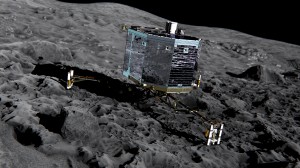
Philae is misschien wat verplaatst, waardoor de antenne van satteliet Rosetta wordt geblokkeerd. Rosetta, die voor het contact tussen de aarde en Philae zorgt, kan hierdoor geen informatie ontvangen van de lander.
Transmitter
‘We begrijpen nog niet helemaal was er aan de hand is met Philae,’ zegt Stephan Ulamec, leider van het Philae-project van de European Space Agency. Het lijkt erop dat een van de twee transmitters van het vaartuig een probleem heeft. Philae is geprogrammeerd om de transmitters afwisselend te gebruiken. Het team heeft nu de opdracht gegeven om maar één transmitter te gebruiken. Als Philae door zonne-energie genoeg is opgeladen, wordt het bericht hopelijk ontvangen.
Maar dit verklaart nog niet waar het probleem is ontstaan. Het patroon van zonlicht op de zonnepanelen veranderde tussen juni en juli. Het is duidelijk dat dit niet komt doordat de seizoenen op de komeet veranderen. Het kan wel betekenen dat Philae is verplaatst. De oorzaak hiervoor zou een gasuitstoot uit de komeet kunnen zijn. Daardoor kunnen de antennes geblokkeerd zijn geraakt, of wijzen ze nu in een andere richting.
Stof
De komeet nadert de zon waardoor de kern van de komeet opwarmt. Daardoor komen bevroren gassen vrij die stofdeeltjes met zich meenemen. Dit helpt de situatie voor Philae en Rosetta niet echt. De stofwolken verstoren Rosetta’s navigatiesysteem. Rosetta heeft daarom al een grotere baan om de komeet aangenomen. Hierdoor wordt het moeilijker om contact te maken, zo niet onmogelijk.
Frustrerend
Gelukkig heeft het team al wel data van Philae ontvangen. Maar tot er weer contact is met de lander, kan er geen nieuwe data binnenkomen. ‘Het is frustrerend dat we een werkende lander op de komeet hebben staan, maar er geen gebruik van kunnen maken’, zegt Ulamec.
Als het team opnieuw verbinding maakt, zullen ze Philae simpelere instrumenten laten gebruiken, zoals de camera en temperatuursensoren. Die kunnen zelfstandig hun werk doen. Het is moeilijker om boringen te verrichten, maar als er een langdurige verbinding ontstaat kan dat ook geprobeerd worden.
Compromis
Vanaf volgende week gaat Rosetta eigen wetenschappelijke observaties aan de komeet doen. De focus van de missie ligt dan minder op het contact maken. Toch hoopt Ulamec dat het team een goede compromis kan vinden tussen Rosetta’s onderzoek en contact maken met Philae.
Ondanks de situatie blijft het team optimistisch. Philae staat beschut opgesteld en dat biedt voordelen. De lander zal daardoor niet oververhit raken wanneer de komeet in zijn baan het dichtst bij de zon staat. Ulamec gelooft dat er tot september of oktober tijd is om contact te herstellen. Hierna zal de komeet verder van de zon af bewegen en kan Philae niet meer functioneren omdat het te donker is. De missie eindigt op 31 december 2015.
Altijd op de hoogte blijven van het laatste wetenschapsnieuws? Meld je nu aan voor de New Scientist nieuwsbrief.
(newscientist.nl)
Death Makes Angels of us all
And gives us wings where we had shoulders
Smooth as raven' s claws...
And gives us wings where we had shoulders
Smooth as raven' s claws...
