W&T Wetenschap & Technologie
Een plek om te discussiëren over wetenschappelijke onderwerpen, wetenschappelijke problemen, technologische projecten en grootse uitvindingen.



Linkdump:
Did life evolve in ice?quote:Matthew Levy, once a graduate student of Miller’s and now a molecular biologist at the Albert Einstein College of Medicine in New York City, recalls being handed one of the 25-year-old samples to work on. “I was scared,” he says. “I was thinking, these samples are older than I am.” Levy burned holes in his shirts over the next few weeks as he dissolved the samples with hydrochloric acid and ran them through an instrument called a high-performance liquid chromatograph to identify the chemicals that had formed. Red and green pens on the device traced out telltale peaks on a scrolling strip of paper. Those peaks corresponded to seven different amino acids and 11 types of nucleobases.
“What was remarkable,” Bada says, “is that the yield in these frozen experiments was better, for some compounds, than it was with room-temperature experiments.”
Siamo Tutti Antifascisti!

Ff tussendoor, maar wel serieus. Geloven jullie echt in die evolutie? Of mag ik dit niet in deze topic aan de orde brengen? Ik zie die ali kannibali topic ook niet meer.
Praise to the emptiness that blanks out existence. Existence:
This place made from our love for that emptiness!
This place made from our love for that emptiness!

Het is niet nodig om te "geloven" in evolutie, het bewijs spreekt voor zich.quote:Op dinsdag 5 februari 2008 12:02 schreef kazakx het volgende:
Ff tussendoor, maar wel serieus. Geloven jullie echt in die evolutie? Of mag ik dit niet in deze topic aan de orde brengen? Ik zie die ali kannibali topic ook niet meer.
Siamo Tutti Antifascisti!
Ik zal hier maar niet over in gaan anders krijg ik een boze trigger achter mijn rugquote:Op dinsdag 5 februari 2008 13:49 schreef wijsneus het volgende:
[..]
Het is niet nodig om te "geloven" in evolutie, het bewijs spreekt voor zich.

[ Bericht 0% gewijzigd door kazakx op 05-02-2008 15:24:45 ]
Praise to the emptiness that blanks out existence. Existence:
This place made from our love for that emptiness!
This place made from our love for that emptiness!
Het staat je vrij om vragen te stellen over evolutietheorie in dit topic. Het enige vereiste is dat je je een beetje hebt verdiept in biologie en evolutie. Aangezien jij in termen denkt als 'geloven in' lijkt me dat je eerst wel eens wat onderzoek mag doen.
Sceptisch zijn mag uiteraard, maar niet zonder een begrip van de bewijzen, de wetenschappelijke methode en de theorie opzich.
Sceptisch zijn mag uiteraard, maar niet zonder een begrip van de bewijzen, de wetenschappelijke methode en de theorie opzich.
Siamo Tutti Antifascisti!


Open der een topic over.quote:Op dinsdag 5 februari 2008 14:40 schreef kazakx het volgende:
[..]
Ik zal hier maar niet over in gaan anders krijg ik een boze trigger achter mijn rug
Health In Harmony is een non-profitorganisatie die regenwoudgemeenschappen helpt met gezondheidszorg en duurzame inkomens in ruil voor bosbescherming, en zo tegelijk klimaatverandering en armoede aanpakt. - https://www.healthinharmony.org/
Hier is het Ali topic. Gesloten wegens gebrek aan creationisten, maar misschien kun je in de FB vragen of het weer open mag.quote:Op dinsdag 5 februari 2008 12:02 schreef kazakx het volgende:
Ff tussendoor, maar wel serieus. Geloven jullie echt in die evolutie? Of mag ik dit niet in deze topic aan de orde brengen? Ik zie die ali kannibali topic ook niet meer.
Volkorenbrood: "Geen quotes meer in jullie sigs gaarne."
Of een verse reeks met verse vragen en argumenten?quote:Op dinsdag 5 februari 2008 20:47 schreef Monolith het volgende:
[..]
Hier is het Ali topic. Gesloten wegens gebrek aan creationisten, maar misschien kun je in de FB vragen of het weer open mag.
Now I'm walking on the sunnyside of the street
Dat wordt lastig. Creationisten hanteren al ongeveer 150 jaar dezelfde 'argumenten'.quote:Op dinsdag 5 februari 2008 21:05 schreef Invictus_ het volgende:
[..]
Of een verse reeks met verse vragen en argumenten?

Volkorenbrood: "Geen quotes meer in jullie sigs gaarne."

Hoi,
Einde creationisme, idee van Invictus_ en Monolith is beide prima,
Nu weer ontopic.
Met vriendelijke groeten,
Uw zieke mod.
Einde creationisme, idee van Invictus_ en Monolith is beide prima,
Nu weer ontopic.
Met vriendelijke groeten,
Uw zieke mod.


If true, mooi voorbeeldje van hoe ver symbiose doorgetrokken kan worden.quote:How Did Huge Dinosaurs Find Enough Food? Did Bacteria Aid Their Digestion?
ScienceDaily (Feb. 6, 2008) — Scientists from the University of Bonn are researching which plants giant dinosaurs could have lived off more than 100 million years ago. They want to find out how the dinosaurs were able to become as large as they did. In fact such gigantic animals should not have existed according to general rules of ecology.
...
Rest van het artikel...
Health In Harmony is een non-profitorganisatie die regenwoudgemeenschappen helpt met gezondheidszorg en duurzame inkomens in ruil voor bosbescherming, en zo tegelijk klimaatverandering en armoede aanpakt. - https://www.healthinharmony.org/
Eigenlijk was er vorige week nog een belangrijk bericht.
Namelijk het bericht van nieuwe radiometrische dateringen van Sahelanthropus tchadensis en Australopithecus bahrelghazali.
Sahelanthropus tchadensis, het fossiel TM-266 uit Tchaad (foto hierboven), ook wel bekend als "Toumaï"
is nu radiochronologisch gedateerd tussev 6.8 en 7.2 Miljoen jaar geleden. Het fossiel geeft een heel debat over de menselijke evolutie, en over de datering van de evolutionaire split tussen chimps en mensen die tot nu toe recenter werd gedateerd dan de ouderdom van dit fossiel. Moet de moleculaire klok worden aangepast,
een nieuwe calibratie? Of is dit fossiel verwant / contemporain aan de gezamelijke voorouder van Chimps en Mensen, of heeft deze vroege aap helemaal niets te maken met onze menselijke voorouderlijke afstamming? Het fossiel geeft veel vraagtekens.
Australopithecus Bahrelghazali, ook wel bekend als "Abel", is radiochronologisch gedateerd tussen 3.58 ± 0.27 miloen jaar geleden, en dat maakt dat fossiel contemporain met Australopithecus Afarensis.
Een link naar een van de vele artikelen over de recente nieuwe dateringen, en deze op
Anthropology.net
Namelijk het bericht van nieuwe radiometrische dateringen van Sahelanthropus tchadensis en Australopithecus bahrelghazali.

Sahelanthropus tchadensis, het fossiel TM-266 uit Tchaad (foto hierboven), ook wel bekend als "Toumaï"
is nu radiochronologisch gedateerd tussev 6.8 en 7.2 Miljoen jaar geleden. Het fossiel geeft een heel debat over de menselijke evolutie, en over de datering van de evolutionaire split tussen chimps en mensen die tot nu toe recenter werd gedateerd dan de ouderdom van dit fossiel. Moet de moleculaire klok worden aangepast,
een nieuwe calibratie? Of is dit fossiel verwant / contemporain aan de gezamelijke voorouder van Chimps en Mensen, of heeft deze vroege aap helemaal niets te maken met onze menselijke voorouderlijke afstamming? Het fossiel geeft veel vraagtekens.
Australopithecus Bahrelghazali, ook wel bekend als "Abel", is radiochronologisch gedateerd tussen 3.58 ± 0.27 miloen jaar geleden, en dat maakt dat fossiel contemporain met Australopithecus Afarensis.
Een link naar een van de vele artikelen over de recente nieuwe dateringen, en deze op
Anthropology.net
Huidige trend atmosf. CO2 Mauna Loa: 411 ppm ,10 jaar geleden: 387 ppm , 25 jaar geleden: 358 ppm
Voortaan maar uitkijken wat je op je haar spuit:
bronquote:Scientists in Japan have discovered a new species of bacteria that can live in hairspray, according to the results of a study published in the March issue of the International Journal of Systematic and Evolutionary Microbiology
"Contamination of cosmetic products is rare but some products may be unable to suppress the growth of certain bacteria," says Dr Bakir from the Japan Collection of Microorganisms, Saitama, Japan. "We discovered a new species of bacteria called Microbacterium hatanonis, which we found contaminates hairspray."
"We also found a related species, Microbacterium oxydans in hairspray which was originally isolated from hospital material. Microbacterium species have been identified in milk, cheese, beef, eggs and even in the blood of patients with leukaemia, on catheters and in bone marrow."
The scientists looked at the appearance and diet of the bacterium, then analysed its genome to show that it is an entirely new species. "It has been named in honour of Dr Kazunori Hatano, for his contribution to the understanding of the genus Microbacterium," says Dr Bakir. Microbacterium hatanonis is rod-shaped and grows best at 30°C and pH neutral.
Scientists now need to determine the clinical importance of the new species, as similar bacteria have been found to infect humans. "Further testing will establish whether the species is a threat to human health," says Dr Bakir. "We hope our study will benefit the formulation of hairspray to prevent contamination in the future."
Volkorenbrood: "Geen quotes meer in jullie sigs gaarne."

Monkeys challenge language theory
bronquote:Researchers have found that monkeys combine calls to make them meaningful in the same way that humans do.
It is hoped the St Andrews University study will provide fresh insights into the evolution of human language.
The researchers recorded the alarm calls of putty-nosed monkeys in Nigeria and noticed them combining noises to apparently convey different meanings.
It had been thought monkeys could only create new sounds to communicate rather than combining existing noises.
Scientists had thought that combining calls, as a human trait, only came about because the repertoire of noises had become so large.
However, the putty-nosed monkeys only have a small number of sounds, according to scientists.
Large repertoire
Dr Klaus Zuberbühler, of the university's school of psychology, said: "Our research has revealed some interesting parallels in the vocal behaviour of forest monkeys and this crucial feature of human language.
"At some point, according to the theory, it became more economical for humans to combine existing elements of communication, rather than adding new ones to a large repertoire.
"This is based on the notion that signals would be combined only once the number of them had grown sufficiently.
"Our research shows that these assumptions may not be correct."
In 2006, researchers from St Andrews found that monkeys produced different series of alarm calls in order to distinguish which predator they are responding to.
The latest research provides evidence that the various calls may contain at least three types of information - the event witnessed, the caller's identity, and whether he intends to travel, all of which were recognised by other monkeys.
Daher iſt die Aufgabe nicht ſowohl, zu ſehn was noch Keiner geſehn hat, als, bei Dem, was Jeder ſieht, zu denken was noch Keiner gedacht hat.
Evolution Gets a Boost: No Cost for Complexity
http://www.nature.com/nat(...)abs/nature06756.html
http://blog.wired.com/wiredscience/2008/03/creationism-tak.htmlquote:Even as creatures become complex, evolution doesn't get any harder.
The findings, published yesterday in Nature, shed doubt on a creationist criticism of evolution: that adaptation must rapidly slow as creatures grow more complicated, making them less able to adapt to changing conditions.
http://www.nature.com/nat(...)abs/nature06756.html
Siamo Tutti Antifascisti!
Science heeft net een special over genregulatie uit met o.a. een interessant artikel over de evolutie van regulatie in eukaryoten:
bronquote:Evolution of Eukaryotic Transcription Circuits
Brian B. Tuch, Hao Li, Alexander D. Johnson
The gradual modification of transcription circuits over evolutionary time scales is an important source of the diversity of life. Over the past decade, studies in animals have shown how seemingly small molecular changes in gene regulation can have large effects on morphology and physiology and how selective pressures can act on these changes. More recently, genome-wide studies, particularly those in single-cell yeasts, have uncovered evidence of extensive transcriptional rewiring, indicating that even closely related organisms regulate their genes using markedly different circuitries.
Volkorenbrood: "Geen quotes meer in jullie sigs gaarne."

bronquote:Evolution of complexity in RNA-like replicator systems
Background
The evolution of complexity is among the most important questions in biology. The evolution of complexity is often observed as the increase of genetic information or that of the organizational complexity of a system. It is well recognized that the formation of biological organization---be it of molecules or ecosystems---is ultimately instructed by the genetic information, whereas it is also true that the genetic information is functional only in the context of the organization. Therefore, to obtain a more complete picture of the evolution of complexity, we must study the evolution of both information and organization.
Results
Here we investigate the evolution of complexity in a simulated RNA-like replicator system. The simplicity of the system allows us to explicitly model the genotype-phenotype-interaction mapping of individual replicators, whereby we avoid preconceiving the functionality of genotypes (information) or the ecological organization of replicators in the model. In particular, the model assumes that interactions among replicators---to replicate or to be replicated---depend on their secondary structures and base-pair matching. The results showed that a population of replicators, originally consisting of one genotype, evolves to form a complex ecosystem of up to four species. During this diversification, the species evolve through acquiring unique genotypes with distinct ecological functionality. The analysis of this diversification reveals that parasitic replicators, which have been thought to destabilize the replicator's diversity, actually promote the evolution of diversity through generating a novel "niche" for catalytic replicators. This also makes the current replicator system extremely stable upon the evolution of parasites. The results also show that the stability of the system crucially depends on the spatial pattern formation of replicators. Finally, the evolutionary dynamics is shown to significantly depend on the mutation rate.
Conclusions
The interdependence of information and organization can play an important role for the evolution of complexity. Namely, the emergent ecosystem supplies a context in which a novel phenotype gains functionality. Realizing such a phenotype, novel genotypes can evolve, which, in turn , results in the evolution of more complex ecological organization. Hence, the evolutionary feedback between information and organization, and thereby the evolution of complexity.
Volkorenbrood: "Geen quotes meer in jullie sigs gaarne."
This view of life is trouwens ook een erg goede site die de basis van de wetenschap, evolutie en genetica behandelt.
Volkorenbrood: "Geen quotes meer in jullie sigs gaarne."
Darwin told us so: Researcher shows natural selection speeds up speciation
In the first experiment of its kind conducted in nature, a University of British Columbia evolutionary biologist has come up with strong evidence for one of Charles Darwin’s cornerstone ideas – adaptation to the environment accelerates the creation of new species.
http://www.physorg.com/news126351589.html
In the first experiment of its kind conducted in nature, a University of British Columbia evolutionary biologist has come up with strong evidence for one of Charles Darwin’s cornerstone ideas – adaptation to the environment accelerates the creation of new species.
http://www.physorg.com/news126351589.html
Siamo Tutti Antifascisti!
Een creationist zal zeggen "puh, micro-evolutie, het blijven wandelende takken"quote:Op donderdag 3 april 2008 12:14 schreef wijsneus het volgende:
Darwin told us so: Researcher shows natural selection speeds up speciation
In the first experiment of its kind conducted in nature, a University of British Columbia evolutionary biologist has come up with strong evidence for one of Charles Darwin’s cornerstone ideas – adaptation to the environment accelerates the creation of new species.
http://www.physorg.com/news126351589.html


Het lijkt me echt waanzinnig om zelf zo'n proef te kunnen doen en langzaam een populatie zien veranderen van kleur of grootte!
beter een knipoog dan een blauw oog
Het Howard Hughes Medical Institute heeft trouwens gratis DVDs o.a. over evolutie. Voor bestelling buiten Noord-Amerika moet je alleen wel eerst een mailtje sturen.
Volkorenbrood: "Geen quotes meer in jullie sigs gaarne."
Nog maar weer eens wat interessante papers:
bronquote:Wheeler, D.A. et al. (2008) The complete genome of an individual by massively parallel DNA sequencing. Nature, 452, 872-876.
The association of genetic variation with disease and drug response, and improvements in nucleic acid technologies, have given great optimism for the impact of 'genomic medicine'. However, the formidable size of the diploid human genome1, approximately 6 gigabases, has prevented the routine application of sequencing methods to deciphering complete individual human genomes. To realize the full potential of genomics for human health, this limitation must be overcome. Here we report the DNA sequence of a diploid genome of a single individual, James D. Watson, sequenced to 7.4-fold redundancy in two months using massively parallel sequencing in picolitre-size reaction vessels. This sequence was completed in two months at approximately one-hundredth of the cost of traditional capillary electrophoresis methods. Comparison of the sequence to the reference genome led to the identification of 3.3 million single nucleotide polymorphisms, of which 10,654 cause amino-acid substitution within the coding sequence. In addition, we accurately identified small-scale (2–40,000 base pair (bp)) insertion and deletion polymorphism as well as copy number variation resulting in the large-scale gain and loss of chromosomal segments ranging from 26,000 to 1.5 million base pairs. Overall, these results agree well with recent results of sequencing of a single individual2 by traditional methods. However, in addition to being faster and significantly less expensive, this sequencing technology avoids the arbitrary loss of genomic sequences inherent in random shotgun sequencing by bacterial cloning because it amplifies DNA in a cell-free system. As a result, we further demonstrate the acquisition of novel human sequence, including novel genes not previously identified by traditional genomic sequencing. This is the first genome sequenced by next-generation technologies. Therefore it is a pilot for the future challenges of 'personalized genome sequencing'.
bronquote:Gregory, T.R. (2008) Understanding evolutionary trees. Evolution: Education and Outreach, 1, 121-137.
Charles Darwin sketched his first evolutionary tree in 1837, and trees have remained a central metaphor in evolutionary biology up to the present. Today, phylogenetics—the science of constructing and evaluating hypotheses about historical patterns of descent in the form of evolutionary trees—has become pervasive within and increasingly outside evolutionary biology. Fostering skills in “tree thinking” is therefore a critical component of biological education. Conversely, misconceptions about evolutionary trees can be very detrimental to one’s understanding of the patterns and processes that have occurred in the history of life. This paper provides a basic introduction to evolutionary trees, including some guidelines for how and how not to read them. Ten of the most common misconceptions about evolutionary trees and their implications for understanding evolution are addressed.
bronquote:Islan, M. et al. (2008) Evolvability and hierarchy in rewired bacterial gene networks. Nature, 452, 840-845.
Sequencing DNA from several organisms has revealed that duplication and drift of existing genes have primarily moulded the contents of a given genome. Though the effect of knocking out or overexpressing a particular gene has been studied in many organisms, no study has systematically explored the effect of adding new links in a biological network. To explore network evolvability, we constructed 598 recombinations of promoters (including regulatory regions) with different transcription or sigma-factor genes in Escherichia coli, added over a wild-type genetic background. Here we show that approx95% of new networks are tolerated by the bacteria, that very few alter growth, and that expression level correlates with factor position in the wild-type network hierarchy. Most importantly, we find that certain networks consistently survive over the wild type under various selection pressures. Therefore new links in the network are rarely a barrier for evolution and can even confer a fitness advantage.
Volkorenbrood: "Geen quotes meer in jullie sigs gaarne."
Daar zitten zo te zien interessante dingen tussenquote:Op woensdag 9 april 2008 10:02 schreef Monolith het volgende:
Het Howard Hughes Medical Institute heeft trouwens gratis DVDs o.a. over evolutie. Voor bestelling buiten Noord-Amerika moet je alleen wel eerst een mailtje sturen.
 Enig idee hoe moeilijk ze doen over bestellingen van buiten de US?
Egregious professor of Cruel and Unusual Geography
Onikaan ni ov dovah
Onikaan ni ov dovah
Nog niet gemaild, maar waag een poging zou ik zeggen.quote:Op woensdag 16 april 2008 23:41 schreef ATuin-hek het volgende:
[..]
Daar zitten zo te zien interessante dingen tussen

Volkorenbrood: "Geen quotes meer in jullie sigs gaarne."

http://www.volkskrant.nl/(...)_aan_bodemvervuiling
quote:AMSTERDAM - Een bepaalde soort zandraket (een stoer onkruidje) weet dankzij een slimme genetische aanpassing in een omgeving met zware bodemverontreiniging te overleven, schrijven Duitse plantwetenschappers in de online editie van het tijdschrift Nature (20 april).
Het zandraketje Arabidopsis halleri kan, anders dan zijn meer bekende familielid, het modelplantje A. thaliana, grote concentraties van zink en cadmium in de bodem verdragen door die zware metalen op te slaan in zijn bladeren. Die kunnen zeer hoge concentraties van de giftige stoffen bevatten.
De Duitse onderzoekers vergeleken het dna van de twee onkruidjes en ontdekten dat de metaal-tolerante of extremofiele zandraket van een bepaald gen niet één maar drie kopieën bezit. Ook het regelmechanisme van het gen wijkt af.
Als dit verdriedubbelde gen van A. halleri naar A. thaliana wordt overgezet, verwerft ook die plant tolerantie voor de giftige metalen.
Het gen, HMA4 geheten, regelt de pompfunctie waardoor metaaldeeltjes door de wortels kunnen worden opgenomen. Volgens de onderzoekers is het gen oorspronkelijk ontstaan om tekorten aan deze metalen op te vangen.
De bijzondere mutatie van de verdriedubbeling van het gen heeft geleid tot de nieuwe eigenschap van ‘metaal hyperaccumulatie’. Die natuurlijke aanpassing stelt de zandraket in staat ook onder de extreme condities van met zware metalen vervuilde bodems te overleven, aldus de onderzoekers.
Free Assange! Hack the Planet
[b]Op dinsdag 6 januari 2009 19:59 schreef Papierversnipperaar het volgende:[/b]
De gevolgen van de argumenten van de anti-rook maffia
[b]Op dinsdag 6 januari 2009 19:59 schreef Papierversnipperaar het volgende:[/b]
De gevolgen van de argumenten van de anti-rook maffia
Over de evolutie van een nieuwe (lichaams)structuur in een populatie hagedissen binnen 30 generatiesquote:in 1971, scientists started an experiment. They took 5 male lizards and 5 female lizards of the species Podarcis sicula from a tiny Adriatic island called Pod Kopiste, 0.09km2, and they placed them on an even tinier island, Pod Mrcaru, 0.03km2, which was also inhabited by another lizard species, Podarcis melisellensis. Then a war broke out, the Croatian War of Independence, which went on and on and meant the little islands were completely neglected for 36 years, and nature took its course. When scientists finally returned to the island and looked around, they discovered that something very interesting had happened.
http://scienceblogs.com/p(...)ll_just_a_lizard.php
Siamo Tutti Antifascisti!
Opmerkelijk snelle evolutie bij hagedissen:
National Geographicquote:Italian wall lizards introduced to a tiny island off the coast of Croatia are evolving in ways that would normally take millions of years to play out, new research shows.
In just a few decades the 5-inch-long (13-centimeter-long) lizards have developed a completely new gut structure, larger heads, and a harder bite, researchers say.
In 1971, scientists transplanted five adult pairs of the reptiles from their original island home in Pod Kopiste to the tiny neighboring island of Pod Mrcaru, both in the south Adriatic Sea.
Genetic testing on the Pod Mrcaru lizards confirmed that the modern population of more than 5,000 Italian wall lizards are all descendants of the original ten lizards left behind in the 1970s.
Lizard Swarm
While the experiment was more than 30 years in the making, it was not by design, according to Duncan Irschick, a study author and biology professor at the University of Massachusetts, Amherst.
After scientists transplanted the reptiles, the Croatian War of Independence erupted, ending in the mid-1990s. The researchers couldn't get back to island because of the war, Irschick said.
In 2004, however, tourism began to open back up, allowing researchers access to the island laboratory.
"We didn't know if we would find a lizard there. We had no idea if the original introductions were successful," Irschick said.
What they found, however, was shocking. "The island was swarming with lizards," he said.
The findings were published in March in the journal Proceedings of the National Academy of Sciences.
Fast-Track Evolution
The new habitat once had its own healthy population of lizards, which were less aggressive than the new implants, Irschick said.
The new species wiped out the indigenous lizard populations, although how it happened is unknown, he said.
The transplanted lizards adapted to their new environment in ways that expedited their evolution physically, Irschick explained.
Pod Mrcaru, for example, had an abundance of plants for the primarily insect-eating lizards to munch on. Physically, however, the lizards were not built to digest a vegetarian diet.
Researchers found that the lizards developed cecal valves—muscles between the large and small intestine—that slowed down food digestion in fermenting chambers, which allowed their bodies to process the vegetation's cellulose into volatile fatty acids.
"They evolved an expanded gut to allow them to process these leaves," Irschick said, adding it was something that had not been documented before. "This was a brand-new structure."
Along with the ability to digest plants came the ability to bite harder, powered by a head that had grown longer and wider.
The rapid physical evolution also sparked changes in the lizard's social and behavioral structure, he said. For one, the plentiful food sources allowed for easier reproduction and a denser population.
The lizard also dropped some of its territorial defenses, the authors concluded.
Such physical transformation in just 30 lizard generations takes evolution to a whole new level, Irschick said.
It would be akin to humans evolving and growing a new appendix in several hundred years, he said.
"That's unparalleled. What's most important is how fast this is," he said.
While researchers do know the invader's impact on its reptile brethren, they do not know how the species impacts local vegetation or insects, a subject of future study, Irschick said.
Dramatic Changes
The study demonstrates that a lot of change happens in island environments, said Andrew Hendry, a biology professor at Montreal's McGill University.
What could be debated, however, is how those changes are interpreted—whether or not they had a genetic basis and not a "plastic response to the environment," said Hendry, who was not associated with the study.
There's no dispute that major changes to the lizards' digestive tract occurred. "That kind of change is really dramatic," he added.
"All of this might be evolution," Hendry said. "The logical next step would be to confirm the genetic basis for these changes."
Volkorenbrood: "Geen quotes meer in jullie sigs gaarne."
Erg benieuwd of ze nog genetisch compatible zijn, de ouder populatie en de nieuwe.
Siamo Tutti Antifascisti!
Wat dat betreft is het ook interessant om te kijken hoe het genotype van de hagedissen veranderd is. Een groter hoofd en stevigere kaken zijn geen zaken waar gigantische genetische veranderingen voor hoeven plaats te vinden. Die verandering in structuur van de maag daarentegen zou nog wel eens een probleem kunnen zijn. Die lijkt overigens grotendeels veroorzaakt te zijn doordat planten een veel groter deel van het dieet uitmaken. Hier een stukje uit de bijbehorende publicatie in PNAS:quote:Op woensdag 23 april 2008 21:37 schreef wijsneus het volgende:
Erg benieuwd of ze nog genetisch compatible zijn, de ouder populatie en de nieuwe.
quote:The relatively large fraction of leaves included into the diet of lizards in the introduced population of Pod Mrcˇaru has apparently also resulted in the evolution of cecal valves, a structure previously unreported for this species and rare in this family and scleroglossan lizards in general (13, 14, 18). Our data also add to the growing number of studies suggesting that the inclusion of plant matter into the diet of small temperate lizards may be more common than previously thought (21, 22). Moreover, our data show not only rapid, directional changes in quantitative phenotypic traits related to the inclusion of plant matter into the diet, but also the evolution of novel morphological structures on extremely short time scales. Although the presence of cecal valves and large heads in hatchlings and juveniles suggests a genetic basis for these differences, further studies investigating the potential role of phenotypic plasticity and/or maternal effects in the divergence between populations are needed.
Volkorenbrood: "Geen quotes meer in jullie sigs gaarne."
Nee - maar zoals Darwin al opmerkte: variaties kunnen fenotypisch enorm verschillen, maar toch perfect vruchtbaar zijn. De vraag is: is er speciatie opgetreden?
Siamo Tutti Antifascisti!
Dat bedoelde ik ook. De vraag is in hoeverre hier echt serieuze genetische verandering aan ten grondslag liggen, waardoor mogelijk geen vruchtbaar nageslacht kan ontstaan tussen hagedissen op dit eiland en de hagedissen uit de oorspronkelijke populatie of dat het bijvoorbeeld eerder een kwestie is van verschil in fenotypische expressie.quote:Op woensdag 23 april 2008 22:04 schreef wijsneus het volgende:
Nee - maar zoals Darwin al opmerkte: variaties kunnen fenotypisch enorm verschillen, maar toch perfect vruchtbaar zijn. De vraag is: is er speciatie opgetreden?
Volkorenbrood: "Geen quotes meer in jullie sigs gaarne."
5 volwassen paartjes als founder population.... Hier zal genetische drift zeker ook een rol gespeeld hebben bij de snelle fenotypische veranderingen.quote:In 1971, scientists transplanted five adult pairs of the reptiles from their original island home in Pod Kopiste to the tiny neighboring island of Pod Mrcaru, both in the south Adriatic Sea.
edit: toevoeging
Eigenlijk zou het een interessant project zijn om een deel van die nieuwe populatie weer af te zonderen samen met een deel van de oorspronkelijke populatie waaruit die 5 founder paartjes afkomstig waren.
[ Bericht 22% gewijzigd door barthol op 23-04-2008 23:31:03 ]
Huidige trend atmosf. CO2 Mauna Loa: 411 ppm ,10 jaar geleden: 387 ppm , 25 jaar geleden: 358 ppm
Klopt. 5 paartjes is ook wel een behoorlijke bottleneck populatie. Overigens ook wel interessant is dat omdat de "bevolkingsdichtheid" op dit eiland veel hoger is dan in de oorspronkelijke populatie, het gedrag ook is veranderd. De drift om een terittorium te verdedigen lijkt verdwenen.quote:Op woensdag 23 april 2008 23:18 schreef barthol het volgende:
[..]
5 volwassen paartjes als founder population.... Hier zal genetische drift zeker ook een rol gespeeld hebben bij de snelle fenotypische veranderingen.
Volkorenbrood: "Geen quotes meer in jullie sigs gaarne."
Wetenschap is een voortdurende discussie, discussie over interpretatie van onderzoeksresultaten, verrijkt met telkens nieuwe argumenten in de vorm van doorwrochte artikelen en uitvoerige verslagen van weer nieuw of aanvullend onderzoek. De dynamiek in de wetenschappelijke discussie is boeiend.
Het genetisch onderzoek naar de oorsprong en de ontwikkeling van de menselijke diversiteit en de verspreiding van de mensheid over de wereld is zo'n onderzoeksgebied wat volop in beweging is.
Ook boeiend dat het twee verschillende benaderingen heeft. Het onrzoek van het Mt-dna en het onderzoek van het Y-dna. En het geheel moet in de interpretatie ook ook gedragen worden door resultaten van paleo-antropologische en archeologische onderzoeksbevindingen.
Was er eerst qua interpretatie de tegenstelling tussen de multiregionale oorsprong hypothese en de enkele oorsprong hypothese, met steeds meer argumenten voor de laatste... Nu komen er nieuwe geluiden bij. De PaleoAfrican-AfraAsian hypothese.
Een hypothese die stelt dat de mensheid bijna gedivergeerd was in twee verschillende groepen die bijna 100.000 jaar in isolatie van elkaar geleefd hebben maar zich daarna (ca 50.000 jaar geleden) weer gedeeltelijk vermengd hebben. Dat wil zeggen. De groep Paleo-Afrikanen bestaat niet meer volgens de hypothese, maar wel nakomelingen van de vermenging van Paleo-Afrikanen en Afro-Aziaten enerzijds en nakomelingen van Afro-Aziaten (niet vermengd) anderzijds. Het is een nieuwe hypothese. Ik ben benieuwd naar de plaats die die nieuwe hypothese zich al dan niet gaat verwerven in het wetenschappelijke debat.
Artikelen:
BBC: Human line 'nearly split in two'
Dienekes: More support for the Afrasian/Palaeoafrican hypothesis
The American Journal of Human Genetics: abstract: The Dawn of Human Matrilineal Diversity
Associated Press: Study says near extinction threatened people 70,00 years ago
[ Bericht 1% gewijzigd door barthol op 25-04-2008 10:43:55 ]
Het genetisch onderzoek naar de oorsprong en de ontwikkeling van de menselijke diversiteit en de verspreiding van de mensheid over de wereld is zo'n onderzoeksgebied wat volop in beweging is.
Ook boeiend dat het twee verschillende benaderingen heeft. Het onrzoek van het Mt-dna en het onderzoek van het Y-dna. En het geheel moet in de interpretatie ook ook gedragen worden door resultaten van paleo-antropologische en archeologische onderzoeksbevindingen.
Was er eerst qua interpretatie de tegenstelling tussen de multiregionale oorsprong hypothese en de enkele oorsprong hypothese, met steeds meer argumenten voor de laatste... Nu komen er nieuwe geluiden bij. De PaleoAfrican-AfraAsian hypothese.
Een hypothese die stelt dat de mensheid bijna gedivergeerd was in twee verschillende groepen die bijna 100.000 jaar in isolatie van elkaar geleefd hebben maar zich daarna (ca 50.000 jaar geleden) weer gedeeltelijk vermengd hebben. Dat wil zeggen. De groep Paleo-Afrikanen bestaat niet meer volgens de hypothese, maar wel nakomelingen van de vermenging van Paleo-Afrikanen en Afro-Aziaten enerzijds en nakomelingen van Afro-Aziaten (niet vermengd) anderzijds. Het is een nieuwe hypothese. Ik ben benieuwd naar de plaats die die nieuwe hypothese zich al dan niet gaat verwerven in het wetenschappelijke debat.
Artikelen:
BBC: Human line 'nearly split in two'
Dienekes: More support for the Afrasian/Palaeoafrican hypothesis
The American Journal of Human Genetics: abstract: The Dawn of Human Matrilineal Diversity
Associated Press: Study says near extinction threatened people 70,00 years ago
[ Bericht 1% gewijzigd door barthol op 25-04-2008 10:43:55 ]
Huidige trend atmosf. CO2 Mauna Loa: 411 ppm ,10 jaar geleden: 387 ppm , 25 jaar geleden: 358 ppm
Nieuw ondersteunend bewijs voor de hypothese dat vogels afstammelingen zijn van dinosaurussen:
NY Timesquote:In the first analysis of proteins extracted from dinosaur bones, scientists say they have established more firmly than ever that the closest living relatives of the mighty predator Tyrannosaurus rex are modern birds.
The research, being published Friday in the journal Science, yielded the first molecular data confirming the widely held hypothesis of a close dinosaur-bird ancestry, the American scientific team reported. The link was previously suggested by anatomical similarities.
In fact, the scientists said, T. rex shared more of its genetic makeup with ostriches and chickens than with living reptiles, like alligators. On this basis, the research team has redrawn the family tree of major vertebrate groups, assigning the dinosaur a new place in evolutionary relationships.
Similar molecular tests on tissues from the extinct mastodon confirmed its close genetic link to the elephant, as had been suspected from skeletal affinities.
“Our results at the genetic level basically agree with what has been seen in skeletal data,” John M. Asara of Harvard said in a telephone interview. “There is more than a 90 percent probability that the grouping of T. rex with living birds is real.”
Dr. Asara and Lewis C. Cantley, both of Beth Israel Deaconess Medical Center and Harvard Medical School, processed the proteins from tissue recovered deep in bones of a 68 million-year-old T. rex excavated in 2003 by John R. Horner of Montana State University. Mary H. Schweitzer of North Carolina State University discovered the preserved soft tissues in the bones.
For the molecular study, Dr. Asara and Chris L. Organ, a researcher in evolutionary biology at Harvard, compared the dinosaur protein with similar protein from several dozen species of modern birds, reptiles and other animals.
Dr. Organ was the lead author of the journal report, which concluded that the molecular tests confirmed the prediction that extinct dinosaurs “would show a higher degree of similarity with birds than with other extant vertebrates.” The researchers said they planned to extend their investigations to include comparisons of T. rex protein with more species of birds, reptiles and other dinosaurs.
Dinosaur paleontologists were not surprised by the findings. An accumulation of fossil evidence in recent years had given them increasing confidence in their contention that birds descended from certain dinosaurs.
Volkorenbrood: "Geen quotes meer in jullie sigs gaarne."
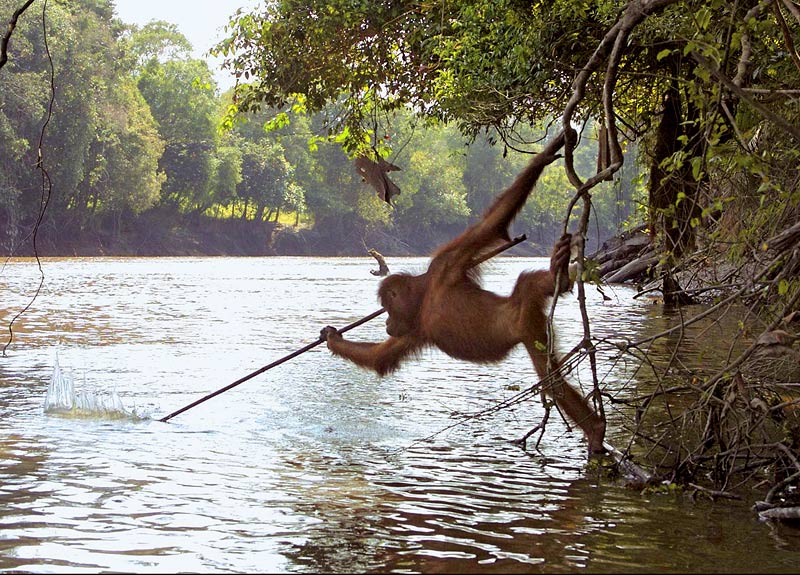
Even een mooie foto die ik jullie niet wil onthouden.
Een Orang-Oetan die een speer gebruikt om te vissen.
De foto is uit een artikel op primatology.net
In dat artikel staan ook links naar een aantal wetenschappelijke rapporten over het gebruik
van tools door Orang-Oetans.
Een Orang-Oetan die een speer gebruikt om te vissen.
De foto is uit een artikel op primatology.net
In dat artikel staan ook links naar een aantal wetenschappelijke rapporten over het gebruik
van tools door Orang-Oetans.
Huidige trend atmosf. CO2 Mauna Loa: 411 ppm ,10 jaar geleden: 387 ppm , 25 jaar geleden: 358 ppm
Leuke foto inderdaad. Overigens heeft de aap dit gedrag gekopieerd van dorpelingen in de buurt. Hij was alleen niet handig genoeg om daadwerkelijk bewegende vissen te vangen, maar na wat klooien bleek de speer wel geschikt om vissen uit de netten van de vissers te halen.quote:Op dinsdag 29 april 2008 22:40 schreef barthol het volgende:
Even een mooie foto die ik jullie niet wil onthouden.
Een Orang-Oetan die een speer gebruikt om te vissen.
[ afbeelding ]
De foto is uit een artikel op primatology.net
In dat artikel staan ook links naar een aantal wetenschappelijke rapporten over het gebruik
van tools door Orang-Oetans.
Volkorenbrood: "Geen quotes meer in jullie sigs gaarne."
Ja geweldig he, zulke foto's tegenkomen zijn voor mij een mooi moment van de dag.
Waar ik dan wel over ga denken is waar onze gezamelijke voorouders geleefd hebben
zo'n 15 tot 12 miljoen jaar geleden. Met de gibbons nu levend in ZO Azie en ook de
Orang-Oetans nu in ZO Azie. Ik weet dat In India de fossielen zijn gevonden van de
uitgestorven Sivapithecus en dat in de omgeving van Indochina eens de Gigantopithecus
heeft geleefd. Dat er ook fosielen van uitgestorven mensapen in Z.Europa zijn gevonden.
Ik merk dat ik nog geen gedetailleerd beeld heb van het Mioceen t.a.v. hoe de wereld er
toen uitzag en t.a.v. van de evolutie van de mens(achtige)-apen. Ook nog niet van hoe
die evolutie past in de periode die geassocieerd wordt met de uitstervingsgolf (Langhien).
[ Bericht 0% gewijzigd door barthol op 30-04-2008 00:59:04 ]
Waar ik dan wel over ga denken is waar onze gezamelijke voorouders geleefd hebben
zo'n 15 tot 12 miljoen jaar geleden. Met de gibbons nu levend in ZO Azie en ook de
Orang-Oetans nu in ZO Azie. Ik weet dat In India de fossielen zijn gevonden van de
uitgestorven Sivapithecus en dat in de omgeving van Indochina eens de Gigantopithecus
heeft geleefd. Dat er ook fosielen van uitgestorven mensapen in Z.Europa zijn gevonden.
Ik merk dat ik nog geen gedetailleerd beeld heb van het Mioceen t.a.v. hoe de wereld er
toen uitzag en t.a.v. van de evolutie van de mens(achtige)-apen. Ook nog niet van hoe
die evolutie past in de periode die geassocieerd wordt met de uitstervingsgolf (Langhien).
[ Bericht 0% gewijzigd door barthol op 30-04-2008 00:59:04 ]
Huidige trend atmosf. CO2 Mauna Loa: 411 ppm ,10 jaar geleden: 387 ppm , 25 jaar geleden: 358 ppm
Wow, kick ass foto man met die aap. Nog meer van zulk soort foto's iemand? Ik zou weleens een foto/ filmpje van een huilende olifant willen zien.
Niet een huilende, maar een schilderende olifant. Ook goed?quote:Op woensdag 7 mei 2008 11:55 schreef bigore het volgende:
Wow, kick ass foto man met die aap. Nog meer van zulk soort foto's iemand? Ik zou weleens een foto/ filmpje van een huilende olifant willen zien.
Siamo Tutti Antifascisti!
Het genoom van het vogelbekdier is inmiddels ook volledig in kaart gebracht. Zoals te lezen in de onderstaande abstract en conclusie is dat interessant voor het bestuderen van de evolutionaire geschiedenis van zoogdieren:
quote:We present a draft genome sequence of the platypus, Ornithorhynchus anatinus. This monotreme exhibits a fascinating combination of reptilian and mammalian characters. For example, platypuses have a coat of fur adapted to an aquatic lifestyle; platypus females lactate, yet lay eggs; and males are equipped with venom similar to that of reptiles. Analysis of the first monotreme genome aligned these features with genetic innovations. We find that reptile and platypus venom proteins have been co-opted independently from the same gene families; milk protein genes are conserved despite platypuses laying eggs; and immune gene family expansions are directly related to platypus biology. Expansions of protein, non-protein-coding RNA and microRNA families, as well as repeat elements, are identified. Sequencing of this genome now provides a valuable resource for deep mammalian comparative analyses, as well as for monotreme biology and conservation.
bronquote:The 18,527 protein-coding genes predicted from the platypus assembly fall within the range for therian genomes. Of particular interest are families of genes involved in biology that links monotremes to reptiles, such as egg-laying, vision and envenomation, as well as mammal-specific characters such as lactation, characters shared with marsupials such as antibacterial proteins, and platypus-specific characters such as venom delivery and underwater foraging. For instance, anatomical adaptations for chemoreception during underwater foraging are reflected in an unusually large repertoire of vomeronasal type 1 receptor genes. However, the repertoire of milk protein genes is typically mammalian, and the arrangement of milk protein genes seems to have been preserved since the last common ancestor of monotremes and therian mammals.
Since its initial description, the platypus has stood out as a species with a blend of reptilian and mammalian features, which is a characteristic that penetrates to the level of the genome sequence. The density and distribution of repetitive sequence, for example, reflects this fact. The high frequency of interspersed repeats in the platypus genome, although typical for mammalian genomes, is in contrast with the observed mean microsatellite coverage, which appears more reptilian. Additionally, the correlation of parent-of-origin-specific expression patterns in regions of reduced interspersed repeats in the platypus suggests that the evolution of imprinting in therians is linked to the accumulation of repetitive elements.
We find that the mixture of reptilian, mammalian and unique characteristics of the platypus genome provides many clues to the function and evolution of all mammalian genomes. The wealth of new findings and confirmation of existing knowledge immediately evident from the release of these data promise that the availability of the platypus genome sequence will provide the critically needed background to inspire rapid advances in other investigations of mammalian biology and evolution.
Volkorenbrood: "Geen quotes meer in jullie sigs gaarne."
De voorouders van de mensapen ontwikkelden zich in het Oligoceen in Afrika, dat toen nog een eilandcontinent was. Na de botsing van Afrika en Eurazië en de daarmee gepaard gaande gebergtevormingen en het droogvallen van de oostelijke arm van de Tethys (ongeveer ter hoogte van het tegenwoordige Syrië en Irak) in het vroege Mioceen (c. 20-18 miljoen jaar geleden) vonden er een aantal uitwisselingen van fauna tussen beide continenten plaats. In die periode verspreidde een deel van de fauna van Afrika, waaronder primaten, zich over tropisch Zuid-Azië. Zowel Gigantopithecus als de moderne Orang-Oetan (en de primitievere gibbons) zouden afstammen van deze vroege migratiegolven. In dezelfde tijd migreerden mensapen vanuit Afrika naar Zuid-Europa.quote:Op woensdag 30 april 2008 00:53 schreef barthol het volgende:
Ja geweldig he, zulke foto's tegenkomen zijn voor mij een mooi moment van de dag.
Waar ik dan wel over ga denken is waar onze gezamelijke voorouders geleefd hebben
zo'n 15 tot 12 miljoen jaar geleden. Met de gibbons nu levend in ZO Azie en ook de
Orang-Oetans nu in ZO Azie. Ik weet dat In India de fossielen zijn gevonden van de
uitgestorven Sivapithecus en dat in de omgeving van Indochina eens de Gigantopithecus
heeft geleefd. Dat er ook fosielen van uitgestorven mensapen in Z.Europa zijn gevonden.
Ik merk dat ik nog geen gedetailleerd beeld heb van het Mioceen t.a.v. hoe de wereld er
toen uitzag en t.a.v. van de evolutie van de mens(achtige)-apen. Ook nog niet van hoe
die evolutie past in de periode die geassocieerd wordt met de uitstervingsgolf (Langhien).
Aan het eind van het Mioceen werd het klimaat droger (een periode waarin ook de Middellandse Zee zelf droogviel) en ontstonden er woestijnen in de tussenliggende gebieden. De mensapen in Europa stierven uit. De Arabische Golf bleef zich verwijden, wat verdere uitwisseling bemoeilijkte. De evolutie van de voorouders van de mens in het late Mioceen en het Plioceen schijnt zich verder geïsoleerd te hebben afgespeeld in de toenmalige "woodlands" van Oost-Afrika, dat door de Grote Afrikaanse Slenk van het westelijke deel van Afrika was gescheiden, en door de Arabische Golf en de droge gebieden in het Midden-Oosten van Zuid-Azië.
Hoe een en ander precies samenhangt met de uitstervingsgolf in het Langhien weet ik niet, maar het midden-Mioceen was op het gebied van tectoniek, klimaat en biogeografie voor deze regio in elk geval een instabiele periode .
[ Bericht 0% gewijzigd door Iblardi op 08-05-2008 00:16:45 ]
Dit zijn overigens erg interessante filmpjes
Ondanks dat het door een particulier figuur is opgezet, maar toch vind ik het heel interessant en vooral duidelijke manier hoe hij het uitlegt. Vooral punt 2 vind ik erg interessant.


Ondanks dat het door een particulier figuur is opgezet, maar toch vind ik het heel interessant en vooral duidelijke manier hoe hij het uitlegt. Vooral punt 2 vind ik erg interessant.
There are dumb lies, smart lies and statistics/investigations.quote:Op woensdag 16 april 2008 23:18 schreef Monolith het volgende:
Nog maar weer eens wat interessante papers:
[..]
bron
[..]
bron
[..]
bron
Whats the point? We just disagree and have our own opinion!
The truth is somewhere (He knows, your "Father" knows, mine knows, maybe we fight for the same reason)
The best firms advertise the least...
Je hebt geen inhoudelijk commentaar?quote:Op zaterdag 10 mei 2008 01:35 schreef edcetera het volgende:
[..]
There are dumb lies, smart lies and statistics/investigations.
Whats the point? We just disagree and have our own opinion!
The truth is somewhere (He knows, your "Father" knows, mine knows, maybe we fight for the same reason)
Free Assange! Hack the Planet
[b]Op dinsdag 6 januari 2009 19:59 schreef Papierversnipperaar het volgende:[/b]
De gevolgen van de argumenten van de anti-rook maffia
[b]Op dinsdag 6 januari 2009 19:59 schreef Papierversnipperaar het volgende:[/b]
De gevolgen van de argumenten van de anti-rook maffia
Linkdump:
Het wetenschappelijk artikel
Cool!
http://www.reuters.com/article/scienceNews/idUSL132374120080514quote:A giant shrimp living on Australia's Great Barrier Reef can see a world beyond the rainbow that is invisible to other animals, scientists said on Wednesday.
Het wetenschappelijk artikel
Cool!
Putting the Fun back into Fundamentally Wrong since 1975.
"Yes, of course, I knew you would volunteer, Mr. Feynman, but I was wondering if there would be anybody else."
"Yes, of course, I knew you would volunteer, Mr. Feynman, but I was wondering if there would be anybody else."
