W&T Wetenschap & Technologie
Een plek om te discussiëren over wetenschappelijke onderwerpen, wetenschappelijke problemen, technologische projecten en grootse uitvindingen.



Nog maar weer eens wat interessante papers:
bronquote:Wheeler, D.A. et al. (2008) The complete genome of an individual by massively parallel DNA sequencing. Nature, 452, 872-876.
The association of genetic variation with disease and drug response, and improvements in nucleic acid technologies, have given great optimism for the impact of 'genomic medicine'. However, the formidable size of the diploid human genome1, approximately 6 gigabases, has prevented the routine application of sequencing methods to deciphering complete individual human genomes. To realize the full potential of genomics for human health, this limitation must be overcome. Here we report the DNA sequence of a diploid genome of a single individual, James D. Watson, sequenced to 7.4-fold redundancy in two months using massively parallel sequencing in picolitre-size reaction vessels. This sequence was completed in two months at approximately one-hundredth of the cost of traditional capillary electrophoresis methods. Comparison of the sequence to the reference genome led to the identification of 3.3 million single nucleotide polymorphisms, of which 10,654 cause amino-acid substitution within the coding sequence. In addition, we accurately identified small-scale (2–40,000 base pair (bp)) insertion and deletion polymorphism as well as copy number variation resulting in the large-scale gain and loss of chromosomal segments ranging from 26,000 to 1.5 million base pairs. Overall, these results agree well with recent results of sequencing of a single individual2 by traditional methods. However, in addition to being faster and significantly less expensive, this sequencing technology avoids the arbitrary loss of genomic sequences inherent in random shotgun sequencing by bacterial cloning because it amplifies DNA in a cell-free system. As a result, we further demonstrate the acquisition of novel human sequence, including novel genes not previously identified by traditional genomic sequencing. This is the first genome sequenced by next-generation technologies. Therefore it is a pilot for the future challenges of 'personalized genome sequencing'.
bronquote:Gregory, T.R. (2008) Understanding evolutionary trees. Evolution: Education and Outreach, 1, 121-137.
Charles Darwin sketched his first evolutionary tree in 1837, and trees have remained a central metaphor in evolutionary biology up to the present. Today, phylogenetics—the science of constructing and evaluating hypotheses about historical patterns of descent in the form of evolutionary trees—has become pervasive within and increasingly outside evolutionary biology. Fostering skills in “tree thinking” is therefore a critical component of biological education. Conversely, misconceptions about evolutionary trees can be very detrimental to one’s understanding of the patterns and processes that have occurred in the history of life. This paper provides a basic introduction to evolutionary trees, including some guidelines for how and how not to read them. Ten of the most common misconceptions about evolutionary trees and their implications for understanding evolution are addressed.
bronquote:Islan, M. et al. (2008) Evolvability and hierarchy in rewired bacterial gene networks. Nature, 452, 840-845.
Sequencing DNA from several organisms has revealed that duplication and drift of existing genes have primarily moulded the contents of a given genome. Though the effect of knocking out or overexpressing a particular gene has been studied in many organisms, no study has systematically explored the effect of adding new links in a biological network. To explore network evolvability, we constructed 598 recombinations of promoters (including regulatory regions) with different transcription or sigma-factor genes in Escherichia coli, added over a wild-type genetic background. Here we show that approx95% of new networks are tolerated by the bacteria, that very few alter growth, and that expression level correlates with factor position in the wild-type network hierarchy. Most importantly, we find that certain networks consistently survive over the wild type under various selection pressures. Therefore new links in the network are rarely a barrier for evolution and can even confer a fitness advantage.
Volkorenbrood: "Geen quotes meer in jullie sigs gaarne."
Daar zitten zo te zien interessante dingen tussenquote:Op woensdag 9 april 2008 10:02 schreef Monolith het volgende:
Het Howard Hughes Medical Institute heeft trouwens gratis DVDs o.a. over evolutie. Voor bestelling buiten Noord-Amerika moet je alleen wel eerst een mailtje sturen.
 Enig idee hoe moeilijk ze doen over bestellingen van buiten de US?
Egregious professor of Cruel and Unusual Geography
Onikaan ni ov dovah
Onikaan ni ov dovah
Nog niet gemaild, maar waag een poging zou ik zeggen.quote:Op woensdag 16 april 2008 23:41 schreef ATuin-hek het volgende:
[..]
Daar zitten zo te zien interessante dingen tussen

Volkorenbrood: "Geen quotes meer in jullie sigs gaarne."


http://www.volkskrant.nl/(...)_aan_bodemvervuiling
quote:AMSTERDAM - Een bepaalde soort zandraket (een stoer onkruidje) weet dankzij een slimme genetische aanpassing in een omgeving met zware bodemverontreiniging te overleven, schrijven Duitse plantwetenschappers in de online editie van het tijdschrift Nature (20 april).
Het zandraketje Arabidopsis halleri kan, anders dan zijn meer bekende familielid, het modelplantje A. thaliana, grote concentraties van zink en cadmium in de bodem verdragen door die zware metalen op te slaan in zijn bladeren. Die kunnen zeer hoge concentraties van de giftige stoffen bevatten.
De Duitse onderzoekers vergeleken het dna van de twee onkruidjes en ontdekten dat de metaal-tolerante of extremofiele zandraket van een bepaald gen niet één maar drie kopieën bezit. Ook het regelmechanisme van het gen wijkt af.
Als dit verdriedubbelde gen van A. halleri naar A. thaliana wordt overgezet, verwerft ook die plant tolerantie voor de giftige metalen.
Het gen, HMA4 geheten, regelt de pompfunctie waardoor metaaldeeltjes door de wortels kunnen worden opgenomen. Volgens de onderzoekers is het gen oorspronkelijk ontstaan om tekorten aan deze metalen op te vangen.
De bijzondere mutatie van de verdriedubbeling van het gen heeft geleid tot de nieuwe eigenschap van ‘metaal hyperaccumulatie’. Die natuurlijke aanpassing stelt de zandraket in staat ook onder de extreme condities van met zware metalen vervuilde bodems te overleven, aldus de onderzoekers.
Free Assange! Hack the Planet
[b]Op dinsdag 6 januari 2009 19:59 schreef Papierversnipperaar het volgende:[/b]
De gevolgen van de argumenten van de anti-rook maffia
[b]Op dinsdag 6 januari 2009 19:59 schreef Papierversnipperaar het volgende:[/b]
De gevolgen van de argumenten van de anti-rook maffia

Over de evolutie van een nieuwe (lichaams)structuur in een populatie hagedissen binnen 30 generatiesquote:in 1971, scientists started an experiment. They took 5 male lizards and 5 female lizards of the species Podarcis sicula from a tiny Adriatic island called Pod Kopiste, 0.09km2, and they placed them on an even tinier island, Pod Mrcaru, 0.03km2, which was also inhabited by another lizard species, Podarcis melisellensis. Then a war broke out, the Croatian War of Independence, which went on and on and meant the little islands were completely neglected for 36 years, and nature took its course. When scientists finally returned to the island and looked around, they discovered that something very interesting had happened.
http://scienceblogs.com/p(...)ll_just_a_lizard.php
Siamo Tutti Antifascisti!
Opmerkelijk snelle evolutie bij hagedissen:
National Geographicquote:Italian wall lizards introduced to a tiny island off the coast of Croatia are evolving in ways that would normally take millions of years to play out, new research shows.
In just a few decades the 5-inch-long (13-centimeter-long) lizards have developed a completely new gut structure, larger heads, and a harder bite, researchers say.
In 1971, scientists transplanted five adult pairs of the reptiles from their original island home in Pod Kopiste to the tiny neighboring island of Pod Mrcaru, both in the south Adriatic Sea.
Genetic testing on the Pod Mrcaru lizards confirmed that the modern population of more than 5,000 Italian wall lizards are all descendants of the original ten lizards left behind in the 1970s.
Lizard Swarm
While the experiment was more than 30 years in the making, it was not by design, according to Duncan Irschick, a study author and biology professor at the University of Massachusetts, Amherst.
After scientists transplanted the reptiles, the Croatian War of Independence erupted, ending in the mid-1990s. The researchers couldn't get back to island because of the war, Irschick said.
In 2004, however, tourism began to open back up, allowing researchers access to the island laboratory.
"We didn't know if we would find a lizard there. We had no idea if the original introductions were successful," Irschick said.
What they found, however, was shocking. "The island was swarming with lizards," he said.
The findings were published in March in the journal Proceedings of the National Academy of Sciences.
Fast-Track Evolution
The new habitat once had its own healthy population of lizards, which were less aggressive than the new implants, Irschick said.
The new species wiped out the indigenous lizard populations, although how it happened is unknown, he said.
The transplanted lizards adapted to their new environment in ways that expedited their evolution physically, Irschick explained.
Pod Mrcaru, for example, had an abundance of plants for the primarily insect-eating lizards to munch on. Physically, however, the lizards were not built to digest a vegetarian diet.
Researchers found that the lizards developed cecal valves—muscles between the large and small intestine—that slowed down food digestion in fermenting chambers, which allowed their bodies to process the vegetation's cellulose into volatile fatty acids.
"They evolved an expanded gut to allow them to process these leaves," Irschick said, adding it was something that had not been documented before. "This was a brand-new structure."
Along with the ability to digest plants came the ability to bite harder, powered by a head that had grown longer and wider.
The rapid physical evolution also sparked changes in the lizard's social and behavioral structure, he said. For one, the plentiful food sources allowed for easier reproduction and a denser population.
The lizard also dropped some of its territorial defenses, the authors concluded.
Such physical transformation in just 30 lizard generations takes evolution to a whole new level, Irschick said.
It would be akin to humans evolving and growing a new appendix in several hundred years, he said.
"That's unparalleled. What's most important is how fast this is," he said.
While researchers do know the invader's impact on its reptile brethren, they do not know how the species impacts local vegetation or insects, a subject of future study, Irschick said.
Dramatic Changes
The study demonstrates that a lot of change happens in island environments, said Andrew Hendry, a biology professor at Montreal's McGill University.
What could be debated, however, is how those changes are interpreted—whether or not they had a genetic basis and not a "plastic response to the environment," said Hendry, who was not associated with the study.
There's no dispute that major changes to the lizards' digestive tract occurred. "That kind of change is really dramatic," he added.
"All of this might be evolution," Hendry said. "The logical next step would be to confirm the genetic basis for these changes."
Volkorenbrood: "Geen quotes meer in jullie sigs gaarne."
Erg benieuwd of ze nog genetisch compatible zijn, de ouder populatie en de nieuwe.
Siamo Tutti Antifascisti!
Wat dat betreft is het ook interessant om te kijken hoe het genotype van de hagedissen veranderd is. Een groter hoofd en stevigere kaken zijn geen zaken waar gigantische genetische veranderingen voor hoeven plaats te vinden. Die verandering in structuur van de maag daarentegen zou nog wel eens een probleem kunnen zijn. Die lijkt overigens grotendeels veroorzaakt te zijn doordat planten een veel groter deel van het dieet uitmaken. Hier een stukje uit de bijbehorende publicatie in PNAS:quote:Op woensdag 23 april 2008 21:37 schreef wijsneus het volgende:
Erg benieuwd of ze nog genetisch compatible zijn, de ouder populatie en de nieuwe.
quote:The relatively large fraction of leaves included into the diet of lizards in the introduced population of Pod Mrcˇaru has apparently also resulted in the evolution of cecal valves, a structure previously unreported for this species and rare in this family and scleroglossan lizards in general (13, 14, 18). Our data also add to the growing number of studies suggesting that the inclusion of plant matter into the diet of small temperate lizards may be more common than previously thought (21, 22). Moreover, our data show not only rapid, directional changes in quantitative phenotypic traits related to the inclusion of plant matter into the diet, but also the evolution of novel morphological structures on extremely short time scales. Although the presence of cecal valves and large heads in hatchlings and juveniles suggests a genetic basis for these differences, further studies investigating the potential role of phenotypic plasticity and/or maternal effects in the divergence between populations are needed.
Volkorenbrood: "Geen quotes meer in jullie sigs gaarne."
Nee - maar zoals Darwin al opmerkte: variaties kunnen fenotypisch enorm verschillen, maar toch perfect vruchtbaar zijn. De vraag is: is er speciatie opgetreden?
Siamo Tutti Antifascisti!
Dat bedoelde ik ook. De vraag is in hoeverre hier echt serieuze genetische verandering aan ten grondslag liggen, waardoor mogelijk geen vruchtbaar nageslacht kan ontstaan tussen hagedissen op dit eiland en de hagedissen uit de oorspronkelijke populatie of dat het bijvoorbeeld eerder een kwestie is van verschil in fenotypische expressie.quote:Op woensdag 23 april 2008 22:04 schreef wijsneus het volgende:
Nee - maar zoals Darwin al opmerkte: variaties kunnen fenotypisch enorm verschillen, maar toch perfect vruchtbaar zijn. De vraag is: is er speciatie opgetreden?
Volkorenbrood: "Geen quotes meer in jullie sigs gaarne."
5 volwassen paartjes als founder population.... Hier zal genetische drift zeker ook een rol gespeeld hebben bij de snelle fenotypische veranderingen.quote:In 1971, scientists transplanted five adult pairs of the reptiles from their original island home in Pod Kopiste to the tiny neighboring island of Pod Mrcaru, both in the south Adriatic Sea.
edit: toevoeging
Eigenlijk zou het een interessant project zijn om een deel van die nieuwe populatie weer af te zonderen samen met een deel van de oorspronkelijke populatie waaruit die 5 founder paartjes afkomstig waren.
[ Bericht 22% gewijzigd door barthol op 23-04-2008 23:31:03 ]
Huidige trend atmosf. CO2 Mauna Loa: 411 ppm ,10 jaar geleden: 387 ppm , 25 jaar geleden: 358 ppm
Klopt. 5 paartjes is ook wel een behoorlijke bottleneck populatie. Overigens ook wel interessant is dat omdat de "bevolkingsdichtheid" op dit eiland veel hoger is dan in de oorspronkelijke populatie, het gedrag ook is veranderd. De drift om een terittorium te verdedigen lijkt verdwenen.quote:Op woensdag 23 april 2008 23:18 schreef barthol het volgende:
[..]
5 volwassen paartjes als founder population.... Hier zal genetische drift zeker ook een rol gespeeld hebben bij de snelle fenotypische veranderingen.
Volkorenbrood: "Geen quotes meer in jullie sigs gaarne."
Wetenschap is een voortdurende discussie, discussie over interpretatie van onderzoeksresultaten, verrijkt met telkens nieuwe argumenten in de vorm van doorwrochte artikelen en uitvoerige verslagen van weer nieuw of aanvullend onderzoek. De dynamiek in de wetenschappelijke discussie is boeiend.
Het genetisch onderzoek naar de oorsprong en de ontwikkeling van de menselijke diversiteit en de verspreiding van de mensheid over de wereld is zo'n onderzoeksgebied wat volop in beweging is.
Ook boeiend dat het twee verschillende benaderingen heeft. Het onrzoek van het Mt-dna en het onderzoek van het Y-dna. En het geheel moet in de interpretatie ook ook gedragen worden door resultaten van paleo-antropologische en archeologische onderzoeksbevindingen.
Was er eerst qua interpretatie de tegenstelling tussen de multiregionale oorsprong hypothese en de enkele oorsprong hypothese, met steeds meer argumenten voor de laatste... Nu komen er nieuwe geluiden bij. De PaleoAfrican-AfraAsian hypothese.
Een hypothese die stelt dat de mensheid bijna gedivergeerd was in twee verschillende groepen die bijna 100.000 jaar in isolatie van elkaar geleefd hebben maar zich daarna (ca 50.000 jaar geleden) weer gedeeltelijk vermengd hebben. Dat wil zeggen. De groep Paleo-Afrikanen bestaat niet meer volgens de hypothese, maar wel nakomelingen van de vermenging van Paleo-Afrikanen en Afro-Aziaten enerzijds en nakomelingen van Afro-Aziaten (niet vermengd) anderzijds. Het is een nieuwe hypothese. Ik ben benieuwd naar de plaats die die nieuwe hypothese zich al dan niet gaat verwerven in het wetenschappelijke debat.
Artikelen:
BBC: Human line 'nearly split in two'
Dienekes: More support for the Afrasian/Palaeoafrican hypothesis
The American Journal of Human Genetics: abstract: The Dawn of Human Matrilineal Diversity
Associated Press: Study says near extinction threatened people 70,00 years ago
[ Bericht 1% gewijzigd door barthol op 25-04-2008 10:43:55 ]
Het genetisch onderzoek naar de oorsprong en de ontwikkeling van de menselijke diversiteit en de verspreiding van de mensheid over de wereld is zo'n onderzoeksgebied wat volop in beweging is.
Ook boeiend dat het twee verschillende benaderingen heeft. Het onrzoek van het Mt-dna en het onderzoek van het Y-dna. En het geheel moet in de interpretatie ook ook gedragen worden door resultaten van paleo-antropologische en archeologische onderzoeksbevindingen.
Was er eerst qua interpretatie de tegenstelling tussen de multiregionale oorsprong hypothese en de enkele oorsprong hypothese, met steeds meer argumenten voor de laatste... Nu komen er nieuwe geluiden bij. De PaleoAfrican-AfraAsian hypothese.
Een hypothese die stelt dat de mensheid bijna gedivergeerd was in twee verschillende groepen die bijna 100.000 jaar in isolatie van elkaar geleefd hebben maar zich daarna (ca 50.000 jaar geleden) weer gedeeltelijk vermengd hebben. Dat wil zeggen. De groep Paleo-Afrikanen bestaat niet meer volgens de hypothese, maar wel nakomelingen van de vermenging van Paleo-Afrikanen en Afro-Aziaten enerzijds en nakomelingen van Afro-Aziaten (niet vermengd) anderzijds. Het is een nieuwe hypothese. Ik ben benieuwd naar de plaats die die nieuwe hypothese zich al dan niet gaat verwerven in het wetenschappelijke debat.
Artikelen:
BBC: Human line 'nearly split in two'
Dienekes: More support for the Afrasian/Palaeoafrican hypothesis
The American Journal of Human Genetics: abstract: The Dawn of Human Matrilineal Diversity
Associated Press: Study says near extinction threatened people 70,00 years ago
[ Bericht 1% gewijzigd door barthol op 25-04-2008 10:43:55 ]
Huidige trend atmosf. CO2 Mauna Loa: 411 ppm ,10 jaar geleden: 387 ppm , 25 jaar geleden: 358 ppm
Nieuw ondersteunend bewijs voor de hypothese dat vogels afstammelingen zijn van dinosaurussen:
NY Timesquote:In the first analysis of proteins extracted from dinosaur bones, scientists say they have established more firmly than ever that the closest living relatives of the mighty predator Tyrannosaurus rex are modern birds.
The research, being published Friday in the journal Science, yielded the first molecular data confirming the widely held hypothesis of a close dinosaur-bird ancestry, the American scientific team reported. The link was previously suggested by anatomical similarities.
In fact, the scientists said, T. rex shared more of its genetic makeup with ostriches and chickens than with living reptiles, like alligators. On this basis, the research team has redrawn the family tree of major vertebrate groups, assigning the dinosaur a new place in evolutionary relationships.
Similar molecular tests on tissues from the extinct mastodon confirmed its close genetic link to the elephant, as had been suspected from skeletal affinities.
“Our results at the genetic level basically agree with what has been seen in skeletal data,” John M. Asara of Harvard said in a telephone interview. “There is more than a 90 percent probability that the grouping of T. rex with living birds is real.”
Dr. Asara and Lewis C. Cantley, both of Beth Israel Deaconess Medical Center and Harvard Medical School, processed the proteins from tissue recovered deep in bones of a 68 million-year-old T. rex excavated in 2003 by John R. Horner of Montana State University. Mary H. Schweitzer of North Carolina State University discovered the preserved soft tissues in the bones.
For the molecular study, Dr. Asara and Chris L. Organ, a researcher in evolutionary biology at Harvard, compared the dinosaur protein with similar protein from several dozen species of modern birds, reptiles and other animals.
Dr. Organ was the lead author of the journal report, which concluded that the molecular tests confirmed the prediction that extinct dinosaurs “would show a higher degree of similarity with birds than with other extant vertebrates.” The researchers said they planned to extend their investigations to include comparisons of T. rex protein with more species of birds, reptiles and other dinosaurs.
Dinosaur paleontologists were not surprised by the findings. An accumulation of fossil evidence in recent years had given them increasing confidence in their contention that birds descended from certain dinosaurs.
Volkorenbrood: "Geen quotes meer in jullie sigs gaarne."
Even een mooie foto die ik jullie niet wil onthouden.
Een Orang-Oetan die een speer gebruikt om te vissen.
De foto is uit een artikel op primatology.net
In dat artikel staan ook links naar een aantal wetenschappelijke rapporten over het gebruik
van tools door Orang-Oetans.
Een Orang-Oetan die een speer gebruikt om te vissen.
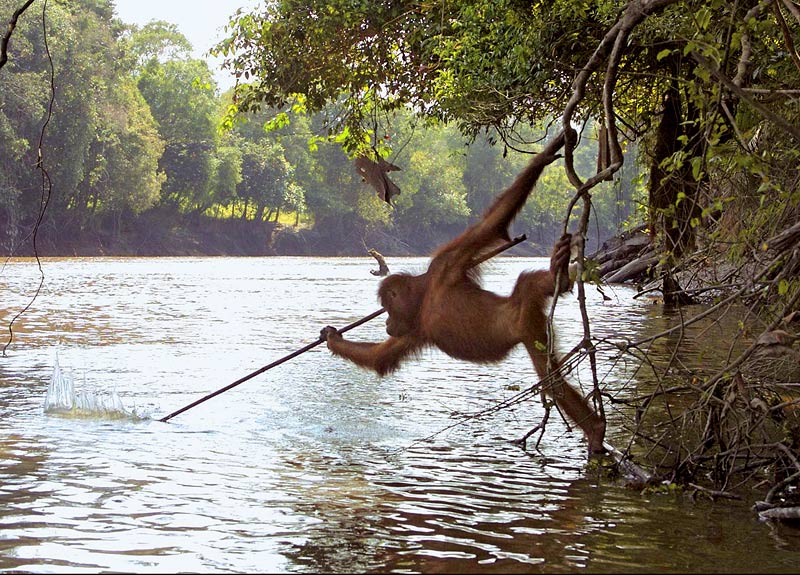
De foto is uit een artikel op primatology.net
In dat artikel staan ook links naar een aantal wetenschappelijke rapporten over het gebruik
van tools door Orang-Oetans.
Huidige trend atmosf. CO2 Mauna Loa: 411 ppm ,10 jaar geleden: 387 ppm , 25 jaar geleden: 358 ppm
Leuke foto inderdaad. Overigens heeft de aap dit gedrag gekopieerd van dorpelingen in de buurt. Hij was alleen niet handig genoeg om daadwerkelijk bewegende vissen te vangen, maar na wat klooien bleek de speer wel geschikt om vissen uit de netten van de vissers te halen.quote:Op dinsdag 29 april 2008 22:40 schreef barthol het volgende:
Even een mooie foto die ik jullie niet wil onthouden.
Een Orang-Oetan die een speer gebruikt om te vissen.
[ afbeelding ]
De foto is uit een artikel op primatology.net
In dat artikel staan ook links naar een aantal wetenschappelijke rapporten over het gebruik
van tools door Orang-Oetans.
Volkorenbrood: "Geen quotes meer in jullie sigs gaarne."
Ja geweldig he, zulke foto's tegenkomen zijn voor mij een mooi moment van de dag.
Waar ik dan wel over ga denken is waar onze gezamelijke voorouders geleefd hebben
zo'n 15 tot 12 miljoen jaar geleden. Met de gibbons nu levend in ZO Azie en ook de
Orang-Oetans nu in ZO Azie. Ik weet dat In India de fossielen zijn gevonden van de
uitgestorven Sivapithecus en dat in de omgeving van Indochina eens de Gigantopithecus
heeft geleefd. Dat er ook fosielen van uitgestorven mensapen in Z.Europa zijn gevonden.
Ik merk dat ik nog geen gedetailleerd beeld heb van het Mioceen t.a.v. hoe de wereld er
toen uitzag en t.a.v. van de evolutie van de mens(achtige)-apen. Ook nog niet van hoe
die evolutie past in de periode die geassocieerd wordt met de uitstervingsgolf (Langhien).
[ Bericht 0% gewijzigd door barthol op 30-04-2008 00:59:04 ]
Waar ik dan wel over ga denken is waar onze gezamelijke voorouders geleefd hebben
zo'n 15 tot 12 miljoen jaar geleden. Met de gibbons nu levend in ZO Azie en ook de
Orang-Oetans nu in ZO Azie. Ik weet dat In India de fossielen zijn gevonden van de
uitgestorven Sivapithecus en dat in de omgeving van Indochina eens de Gigantopithecus
heeft geleefd. Dat er ook fosielen van uitgestorven mensapen in Z.Europa zijn gevonden.
Ik merk dat ik nog geen gedetailleerd beeld heb van het Mioceen t.a.v. hoe de wereld er
toen uitzag en t.a.v. van de evolutie van de mens(achtige)-apen. Ook nog niet van hoe
die evolutie past in de periode die geassocieerd wordt met de uitstervingsgolf (Langhien).
[ Bericht 0% gewijzigd door barthol op 30-04-2008 00:59:04 ]
Huidige trend atmosf. CO2 Mauna Loa: 411 ppm ,10 jaar geleden: 387 ppm , 25 jaar geleden: 358 ppm
Wow, kick ass foto man met die aap. Nog meer van zulk soort foto's iemand? Ik zou weleens een foto/ filmpje van een huilende olifant willen zien.
Niet een huilende, maar een schilderende olifant. Ook goed?quote:Op woensdag 7 mei 2008 11:55 schreef bigore het volgende:
Wow, kick ass foto man met die aap. Nog meer van zulk soort foto's iemand? Ik zou weleens een foto/ filmpje van een huilende olifant willen zien.
Siamo Tutti Antifascisti!
Het genoom van het vogelbekdier is inmiddels ook volledig in kaart gebracht. Zoals te lezen in de onderstaande abstract en conclusie is dat interessant voor het bestuderen van de evolutionaire geschiedenis van zoogdieren:
quote:We present a draft genome sequence of the platypus, Ornithorhynchus anatinus. This monotreme exhibits a fascinating combination of reptilian and mammalian characters. For example, platypuses have a coat of fur adapted to an aquatic lifestyle; platypus females lactate, yet lay eggs; and males are equipped with venom similar to that of reptiles. Analysis of the first monotreme genome aligned these features with genetic innovations. We find that reptile and platypus venom proteins have been co-opted independently from the same gene families; milk protein genes are conserved despite platypuses laying eggs; and immune gene family expansions are directly related to platypus biology. Expansions of protein, non-protein-coding RNA and microRNA families, as well as repeat elements, are identified. Sequencing of this genome now provides a valuable resource for deep mammalian comparative analyses, as well as for monotreme biology and conservation.
bronquote:The 18,527 protein-coding genes predicted from the platypus assembly fall within the range for therian genomes. Of particular interest are families of genes involved in biology that links monotremes to reptiles, such as egg-laying, vision and envenomation, as well as mammal-specific characters such as lactation, characters shared with marsupials such as antibacterial proteins, and platypus-specific characters such as venom delivery and underwater foraging. For instance, anatomical adaptations for chemoreception during underwater foraging are reflected in an unusually large repertoire of vomeronasal type 1 receptor genes. However, the repertoire of milk protein genes is typically mammalian, and the arrangement of milk protein genes seems to have been preserved since the last common ancestor of monotremes and therian mammals.
Since its initial description, the platypus has stood out as a species with a blend of reptilian and mammalian features, which is a characteristic that penetrates to the level of the genome sequence. The density and distribution of repetitive sequence, for example, reflects this fact. The high frequency of interspersed repeats in the platypus genome, although typical for mammalian genomes, is in contrast with the observed mean microsatellite coverage, which appears more reptilian. Additionally, the correlation of parent-of-origin-specific expression patterns in regions of reduced interspersed repeats in the platypus suggests that the evolution of imprinting in therians is linked to the accumulation of repetitive elements.
We find that the mixture of reptilian, mammalian and unique characteristics of the platypus genome provides many clues to the function and evolution of all mammalian genomes. The wealth of new findings and confirmation of existing knowledge immediately evident from the release of these data promise that the availability of the platypus genome sequence will provide the critically needed background to inspire rapid advances in other investigations of mammalian biology and evolution.
Volkorenbrood: "Geen quotes meer in jullie sigs gaarne."
De voorouders van de mensapen ontwikkelden zich in het Oligoceen in Afrika, dat toen nog een eilandcontinent was. Na de botsing van Afrika en Eurazië en de daarmee gepaard gaande gebergtevormingen en het droogvallen van de oostelijke arm van de Tethys (ongeveer ter hoogte van het tegenwoordige Syrië en Irak) in het vroege Mioceen (c. 20-18 miljoen jaar geleden) vonden er een aantal uitwisselingen van fauna tussen beide continenten plaats. In die periode verspreidde een deel van de fauna van Afrika, waaronder primaten, zich over tropisch Zuid-Azië. Zowel Gigantopithecus als de moderne Orang-Oetan (en de primitievere gibbons) zouden afstammen van deze vroege migratiegolven. In dezelfde tijd migreerden mensapen vanuit Afrika naar Zuid-Europa.quote:Op woensdag 30 april 2008 00:53 schreef barthol het volgende:
Ja geweldig he, zulke foto's tegenkomen zijn voor mij een mooi moment van de dag.
Waar ik dan wel over ga denken is waar onze gezamelijke voorouders geleefd hebben
zo'n 15 tot 12 miljoen jaar geleden. Met de gibbons nu levend in ZO Azie en ook de
Orang-Oetans nu in ZO Azie. Ik weet dat In India de fossielen zijn gevonden van de
uitgestorven Sivapithecus en dat in de omgeving van Indochina eens de Gigantopithecus
heeft geleefd. Dat er ook fosielen van uitgestorven mensapen in Z.Europa zijn gevonden.
Ik merk dat ik nog geen gedetailleerd beeld heb van het Mioceen t.a.v. hoe de wereld er
toen uitzag en t.a.v. van de evolutie van de mens(achtige)-apen. Ook nog niet van hoe
die evolutie past in de periode die geassocieerd wordt met de uitstervingsgolf (Langhien).
Aan het eind van het Mioceen werd het klimaat droger (een periode waarin ook de Middellandse Zee zelf droogviel) en ontstonden er woestijnen in de tussenliggende gebieden. De mensapen in Europa stierven uit. De Arabische Golf bleef zich verwijden, wat verdere uitwisseling bemoeilijkte. De evolutie van de voorouders van de mens in het late Mioceen en het Plioceen schijnt zich verder geïsoleerd te hebben afgespeeld in de toenmalige "woodlands" van Oost-Afrika, dat door de Grote Afrikaanse Slenk van het westelijke deel van Afrika was gescheiden, en door de Arabische Golf en de droge gebieden in het Midden-Oosten van Zuid-Azië.
Hoe een en ander precies samenhangt met de uitstervingsgolf in het Langhien weet ik niet, maar het midden-Mioceen was op het gebied van tectoniek, klimaat en biogeografie voor deze regio in elk geval een instabiele periode .
[ Bericht 0% gewijzigd door Iblardi op 08-05-2008 00:16:45 ]
Dit zijn overigens erg interessante filmpjes
Ondanks dat het door een particulier figuur is opgezet, maar toch vind ik het heel interessant en vooral duidelijke manier hoe hij het uitlegt. Vooral punt 2 vind ik erg interessant.


Ondanks dat het door een particulier figuur is opgezet, maar toch vind ik het heel interessant en vooral duidelijke manier hoe hij het uitlegt. Vooral punt 2 vind ik erg interessant.
There are dumb lies, smart lies and statistics/investigations.quote:Op woensdag 16 april 2008 23:18 schreef Monolith het volgende:
Nog maar weer eens wat interessante papers:
[..]
bron
[..]
bron
[..]
bron
Whats the point? We just disagree and have our own opinion!
The truth is somewhere (He knows, your "Father" knows, mine knows, maybe we fight for the same reason)
The best firms advertise the least...
Je hebt geen inhoudelijk commentaar?quote:Op zaterdag 10 mei 2008 01:35 schreef edcetera het volgende:
[..]
There are dumb lies, smart lies and statistics/investigations.
Whats the point? We just disagree and have our own opinion!
The truth is somewhere (He knows, your "Father" knows, mine knows, maybe we fight for the same reason)
Free Assange! Hack the Planet
[b]Op dinsdag 6 januari 2009 19:59 schreef Papierversnipperaar het volgende:[/b]
De gevolgen van de argumenten van de anti-rook maffia
[b]Op dinsdag 6 januari 2009 19:59 schreef Papierversnipperaar het volgende:[/b]
De gevolgen van de argumenten van de anti-rook maffia
Linkdump:
Het wetenschappelijk artikel
Cool!
http://www.reuters.com/article/scienceNews/idUSL132374120080514quote:A giant shrimp living on Australia's Great Barrier Reef can see a world beyond the rainbow that is invisible to other animals, scientists said on Wednesday.
Het wetenschappelijk artikel
Cool!
Putting the Fun back into Fundamentally Wrong since 1975.
"Yes, of course, I knew you would volunteer, Mr. Feynman, but I was wondering if there would be anybody else."
"Yes, of course, I knew you would volunteer, Mr. Feynman, but I was wondering if there would be anybody else."

Bronquote:AMSTERDAM - Een mysterieuze mierensoort stelt wetenschappers en ongediertebestrijders in de Amerikaanse staat Texas voor raadsels. De insecten doen zich te goed aan computers, alarmsystemen en gasmeters.
'Crazy Rasberry Ants'. Zo is de nieuwe soort, vermoedelijk afkomstig uit een vrachtschip, gedoopt. ' Crazy' omdat de beesten niet netjes in het gelid lopen zoals de meeste van hun stamgenoten. En 'Rasberry' naar ongediertebestrijder Tom Rasberry, die als eerste ondervond hoe hardnekkig de nieuwe mierenplaag precies is.
Het gaat, aldus verschillende Amerikaanse media, om relatief kleine, harige mieren. Ze werden in 2002 voor het eerst ontdekt in havenstand Houston maar hebben zich inmiddels, bij gebrek aan natuurlijke vijanden, ontwikkeld tot een wijdverbreide plaag.
Ruimtevaartcentrum
Om voor wetenschappers nog duistere redenen eten de mieren allerlei elektronica; computers, alarmsystemen, meters, iPods en telefoonbedrading. Ongediertebestrijders worden overspoeld met meldingen van schade aan apparatuur door de insecten.
De mieren hebben al de pompen van een waterzuiveringsinstallatie weten te slopen. Reden tot grote zorg bij het NASA ruimtevaartcentrum in Houston, waar de mieren ook zijn gesignaleerd, en bij het plaatselijke vliegveld.
Een woordvoerder van de burgemeester van Houston laat aan de New York Times weten dat hij al een telefoontje uit Moskou heeft ontvangen. 'Ze wilden weten of het ruimtevaartcentrum bedreigd werd. Ik heb gezegd dat er geen problemen zijn.'
Bestrijding
De Crazy Rasberry Ants zijn volgens entomologen familie van mierensoorten in het Caribisch gebied. Ze bijten mensen, maar steken niet, zoals de beruchte vuurmieren van Texas wel doen. Die laatste eten ze overigens ook, en dat is het goede nieuws.
Het slechte nieuws is dat de mieren ongediertebestrijders voor veel grotere problemen stellen dan vuurmieren. Iedere kolonie heeft meerdere koninginnen, zodat het risico wordt gespreid. Het aas in gangbare mierenvallen eten ze niet.
Tot overmaat van ramp stapelen ze dode soortgenoten op elkaar om veilig over oppervlakken te lopen die zijn behandeld met pesticiden. Ongediertebestrijders hebben de milieu-autoriteiten dan ook gevraagd om uitbreiding van het arsenaal toegestane bestrijdingsmiddelen.
Free Assange! Hack the Planet
[b]Op dinsdag 6 januari 2009 19:59 schreef Papierversnipperaar het volgende:[/b]
De gevolgen van de argumenten van de anti-rook maffia
[b]Op dinsdag 6 januari 2009 19:59 schreef Papierversnipperaar het volgende:[/b]
De gevolgen van de argumenten van de anti-rook maffia
PLoSquote:Resurrection of DNA Function In Vivo from an Extinct Genome
There is a burgeoning repository of information available from ancient DNA that can be used to understand how genomes have evolved and to determine the genetic features that defined a particular species. To assess the functional consequences of changes to a genome, a variety of methods are needed to examine extinct DNA function. We isolated a transcriptional enhancer element from the genome of an extinct marsupial, the Tasmanian tiger (Thylacinus cynocephalus or thylacine), obtained from 100 year-old ethanol-fixed tissues from museum collections. We then examined the function of the enhancer in vivo. Using a transgenic approach, it was possible to resurrect DNA function in transgenic mice. The results demonstrate that the thylacine Col2A1 enhancer directed chondrocyte-specific expression in this extinct mammalian species in the same way as its orthologue does in mice. While other studies have examined extinct coding DNA function in vitro, this is the first example of the restoration of extinct non-coding DNA and examination of its function in vivo. Our method using transgenesis can be used to explore the function of regulatory and protein-coding sequences obtained from any extinct species in an in vivo model system, providing important insights into gene evolution and diversity.
Volkorenbrood: "Geen quotes meer in jullie sigs gaarne."
Dit is idd gewoon een heel bizar mierensoort. Ik heb er nu het eea overgelezen, omdat het me zo verbaast dat ze zo achter allerlei electronische apparatuur aangaan. Leuk met al die nukes die her en der staan verspreid in de States.quote:
Wat wel een voordeel is, is dat ze ook de Fire-ant niet overslaan als maaltijd, durf te wedden dat de Texanen daar niet geheel ontevreden overzijn, enkel nu moet je je afvragen of het medicijn niet erger is dan de kwaal.
Het zou hoe dan ook wel een bizarre evolutionaire vonst zijn, als er een mierensoort is dat kan leven op plastics, batterijzuur, siliconen, metaal, goud en wat je nog meer in electronica kan aantreffen.

Putting the Fun back into Fundamentally Wrong since 1975.
"Yes, of course, I knew you would volunteer, Mr. Feynman, but I was wondering if there would be anybody else."
"Yes, of course, I knew you would volunteer, Mr. Feynman, but I was wondering if there would be anybody else."
Niet meer dan logisch. Er is geen enkele reden waarom een diersoort die goud, elektronica en andere geraffineerde materialen eet niet zou bestaan. Maar vroeger waren die materialen er niet omdat er geen technologische beschaving was om die zaken te produceren. Dat soort diersoorten had vroeger dus geen kans om te overleven.quote:Op dinsdag 20 mei 2008 11:58 schreef Semisane het volgende:
[..]
Dit is idd gewoon een heel bizar mierensoort. Ik heb er nu het eea overgelezen, omdat het me zo verbaast dat ze zo achter allerlei electronische apparatuur aangaan. Leuk met al die nukes die her en der staan verspreid in de States.
Wat wel een voordeel is, is dat ze ook de Fire-ant niet overslaan als maaltijd, durf te wedden dat de Texanen daar niet geheel ontevreden overzijn, enkel nu moet je je afvragen of het medicijn niet erger is dan de kwaal.
Het zou hoe dan ook wel een bizarre evolutionaire vonst zijn, als er een mierensoort is dat kan leven op plastics, batterijzuur, siliconen, metaal, goud en wat je nog meer in electronica kan aantreffen.
Nu zijn die materialen er wel.
Free Assange! Hack the Planet
[b]Op dinsdag 6 januari 2009 19:59 schreef Papierversnipperaar het volgende:[/b]
De gevolgen van de argumenten van de anti-rook maffia
[b]Op dinsdag 6 januari 2009 19:59 schreef Papierversnipperaar het volgende:[/b]
De gevolgen van de argumenten van de anti-rook maffia
Nou ja, een reden zou zijn dat die materialen geen voedingstoffen bevatten of dat het omzetten van die materialen naar voedingstoffen meer energie kost dan het oplevert, daarbij, wij als mens creeën pas sinds zeer korte tijd plastics en "composite materials" stom genoeg weet ik even de Nederlandse benaming niet van dat soort materialen.quote:Op dinsdag 20 mei 2008 12:15 schreef Papierversnipperaar het volgende:
[..]
Niet meer dan logisch. Er is geen enkele reden waarom een diersoort die goud, elektronica en andere geraffineerde materialen eet niet zou bestaan. Maar vroeger waren die materialen er niet omdat er geen technologische beschaving was om die zaken te produceren. Dat soort diersoorten had vroeger dus geen kans om te overleven.
Nu zijn die materialen er wel.
 , te kort voor een evolutionaire verandering? Hoewel goud en andere "normale" metalen uiteraard wel natuurlijk voorkomen.
En uiteraard is er dat voorbeeld van die nylonetende bacterie, maar zou een mierensoort zich ook zo snel kunnen aanpassen? Nou ja blijkbaar wel...
Putting the Fun back into Fundamentally Wrong since 1975.
"Yes, of course, I knew you would volunteer, Mr. Feynman, but I was wondering if there would be anybody else."
"Yes, of course, I knew you would volunteer, Mr. Feynman, but I was wondering if there would be anybody else."
Aanwijzingen voor het ontstaan van coderende genen uit niet coderend DNA:
bronquote:Genetics, Vol. 179, 487-496, May 2008
De Novo Origination of a New Protein-Coding Gene in Saccharomyces cerevisiae
Jing Cai*,{dagger},1, Ruoping Zhao*,1, Huifeng Jiang*,{dagger} and Wen Wang*,2
ABSTRACT Origination of new genes is an important mechanism generating genetic novelties during the evolution of an organism. Processes of creating new genes using preexisting genes as the raw materials are well characterized, such as exon shuffling, gene duplication, retroposition, gene fusion, and fission. However, the process of how a new gene is de novo created from noncoding sequence is largely unknown. On the basis of genome comparison among yeast species, we have identified a new de novo protein-coding gene, BSC4 in Saccharomyces cerevisiae. The BSC4 gene has an open reading frame (ORF) encoding a 132-amino-acid-long peptide, while there is no homologous ORF in all the sequenced genomes of other fungal species, including its closely related species such as S. paradoxus and S. mikatae. The functional protein-coding feature of the BSC4 gene in S. cerevisiae is supported by population genetics, expression, proteomics, and synthetic lethal data. The evidence suggests that BSC4 may be involved in the DNA repair pathway during the stationary phase of S. cerevisiae and contribute to the robustness of S. cerevisiae, when shifted to a nutrient-poor environment. Because the corresponding noncoding sequences in S. paradoxus, S. mikatae, and S. bayanus also transcribe, we propose that a new de novo protein-coding gene may have evolved from a previously expressed noncoding sequence.
Volkorenbrood: "Geen quotes meer in jullie sigs gaarne."
Nieuwe fossiele aanwijzingen voor de evolutionaire oorsprong van kikkers en salamanders:
quote:A stem batrachian from the Early Permian of Texas and the origin of frogs and salamanders. Nature, 453, 515-518.
Anderson, J.S. et al. (2008)
The origin of extant amphibians (Lissamphibia: frogs, salamanders and caecilians) is one of the most controversial questions in vertebrate evolution, owing to large morphological and temporal gaps in the fossil record. Current discussions focus on three competing hypotheses: a monophyletic origin within either Temnospondyli or Lepospondyli or a polyphyletic origin with frogs and salamanders arising among temnospondyls and caecilians among the lepospondyls. Recent molecular analyses are also controversial, with estimations for the batrachian (frog–salamander) divergence significantly older than the palaeontological evidence supports. Here we report the discovery of an amphibamid temnospondyl from the Early Permian of Texas that bridges the gap between other Palaeozoic amphibians and the earliest known salientians and caudatans from the Mesozoic. The presence of a mosaic of salientian and caudatan characters in this small fossil makes it a key taxon close to the batrachian (frog and salamander) divergence. Phylogenetic analysis suggests that the batrachian divergence occurred in the Middle Permian, rather than the late Carboniferous as recently estimated using molecular clocks, but the divergence with caecilians corresponds to the deep split between temnospondyls and lepospondyls, which is congruent with the molecular estimates.
Volkorenbrood: "Geen quotes meer in jullie sigs gaarne."


Wat is eigenlijk een evolutionaire voordeel van het overgaan van het bevallen van 'slangjonkies' van eieren naar levend baren?
Levendbarend heeft oa als voordeel dat de omstandigheden (temperatuur bijv) veel nauwer gereguleerd zijn dan bij een ei. Dit (samen met andere dingen) zorgt er bijvoorbeeld voor dat het genoom van een zoogdier veel simpeler kan zijn dan dat van een reptiel.quote:Op donderdag 22 mei 2008 15:40 schreef Triggershot het volgende:
Wat is eigenlijk een evolutionaire voordeel van het overgaan van het bevallen van 'slangjonkies' van eieren naar levend baren?
Egregious professor of Cruel and Unusual Geography
Onikaan ni ov dovah
Onikaan ni ov dovah
Stabielere temperatuur in de moeder dan in de omgeving kan een mogelijk voordeel zijn:quote:Op donderdag 22 mei 2008 15:40 schreef Triggershot het volgende:
Wat is eigenlijk een evolutionaire voordeel van het overgaan van het bevallen van 'slangjonkies' van eieren naar levend baren?
bronquote:Phylogenetic transitions from oviparity to viviparity in reptiles generally have occurred in cold climates, apparently driven by selective advantages accruing from maternal regulation of incubation temperature. But why, then, are viviparous reptiles so successful in tropical climates? Viviparity might enhance fitness in the tropics via the same pathway as in the temperate zone, if pregnant female reptiles in the tropics maintain more stable temperatures than are available in nests (Shine's maternal manipulation hypothesis). Alternatively, viviparity might succeed in the tropics for entirely different reasons than apply in the temperate zone. Our data support the maternal manipulation hypothesis. In a laboratory thermal gradient, pregnant death adders (Acanthophis praelongus) from tropical Australia maintained less variable body temperatures (but similar mean temperatures) than did nonpregnant females. Females kept at a diel range of 25–31°C (as selected by pregnant females) gave birth earlier and produced larger offspring (greater body length and head size) than did females kept at 23–33°C (as selected by nonpregnant snakes). Larger body size enhanced offspring recapture rates (presumably reflecting survival rates) in the field. Thus, even in the tropics, reproducing female reptiles manipulate the thermal regimes experienced by their developing embryos in ways that enhance the fitness of their offspring. This similarity across climatic zones suggests that a single general hypothesis—maternal manipulation of thermal conditions for embryogenesis—may explain the selective advantage of viviparity in tropical as well as cold-climate reptiles.
of bijvoorbeeld bij amfibieën opdrogend water waardoor de larvale fase niet echt handig was:
bronquote:What ecological factors might have contributed to the transition to viviparity? The evolution of viviparity has been attributed to selective forces such as environmental factors or biotic traits (e.g. Neill 1964; Packard et al. 1977; Tinkle and Gibbons 1977; Shine and Bull 1979; Shine 1985; Guillette 1993; Qualls and Shine 1998). Since this evolutionary step completely removes the aquatic stage, the obvious responsible agent of this microevolutionary event could be the absence of water in which to lay the larvae, a plausible scenario in some of the islands (Galán 2003). Interestingly, ‘Cíes’ originates for some authors from the Latin ‘siccus’, which means ‘dry’ (González-Alemparte 2003), and today water is scarce in these islands. The lack of available surface water in karstic limestone substrates has also been suggested as the main cause that promotes viviparity in the Cantabric Mountain S. s. bernardezi populations (Garcia-Paris et al. 2003). However, the presence of another amphibian [Lissotriton boscai (Lataste, 1979)] in all water bodies in Ons Island suggests that water limitation was not so drastic at least in Ons. On the other hand, the newts Lissotriton helveticus (Razoumowsky, 1789) and Triturus marmoratus (Latreille, 1800) which are present on the closest coast do not occur in the islands, perhaps due to the absence of favourable habitats, and L. boscai is found only in two islands of the National Park (Ons and Salvora, but not Cíes).
Er is niet echt een eenduidig voordeel aan te wijzen, maar zoals bijna altijd in evolutionaire context zijn er in verschillende omgevingen verschillende voordelen. Levende geboorte is ook vele malen onafhankelijk geëvolueerd. Daarnaast is er ook niet echt sprake van een 'harde scheiding' tussen óf eieren leggen óf levende geboorte, maar zijn ook allerlei tussenvormen bekend.
Volkorenbrood: "Geen quotes meer in jullie sigs gaarne."
Voetsporen van een kudde(?) dinosaurussen ontdekt in Jemen:
BBCquote:Dinosaur footprints made 150 million years ago in the bedrock of what is now Yemen are the first to be discovered in the Arabian Peninsula, say scientists.
The two separate trackways were made by a herd of 11 sauropods, and a lone two-legged plant-eating dinosaur belonging to the ornithopod family.
They went unnoticed for so long because they were covered by rubble and debris.
The fossil record in the area is very sparse, with only a handful of dinosaur remains known to science.
A Yemeni journalist stumbled upon the first set of impressions in the village of Madar north of the capital Sana'a.
They were later classified as belonging to an ornithopod, a large, common, two-legged dinosaur that flourished from the Late Triassic Period to the Late Cretaceous Period.
In 2006, a geologist at Sana'a University in Yemen made a further discovery - a set of round and elephant-like footprints from a different dinosaur family, the giant four-legged long-necked sauropods.
Dr Anne Schulp of the Maastricht Museum of Natural History in the Netherlands went out to Yemen to help in the investigation. He said the tracks were "beautifully preserved".
"The nice thing about the sauropod tracks is that we've got a herd of them, 11 individuals all walking in the same direction," Dr Schulp told BBC News.
"It's actually a group consisting of different-sized animals, so we've got old ones and we've got some younger dinosaurs as well, so different age-groups of dinosaurs were living together here."
Only a few dinosaur fossils have been reported so far from the Arabian Peninsula, including isolated bones from Oman and possible fragments of a long-necked dinosaur from Yemen.
"It's the first time we've found dinosaur trackways in the Arab Peninsula so it really is a first," said Dr Schulp.
"It's a bit of data from a place that we really don't know much about yet. There is a lot of potential for more discoveries."
Palaeontologist Dr Paul Barrett of London's Natural History Museum said the findings, published in the journal PLoS One, considerably expand our knowledge of Middle Eastern dinosaurs.
"Dinosaur material is exceptionally rare in this part of the world, and is represented by only a handful of fragmentary fossils," he said.
"As a result, we know virtually nothing about the animals that once roamed this area. This discovery shows that several different kinds of dinosaur were abundant in the region and starts to fill a large gap in our knowledge of what was going on in the Middle East during the age of the dinosaurs."
Volkorenbrood: "Geen quotes meer in jullie sigs gaarne."
Nog even een interessante linkdump met een hele verzameling video's van presentaties op een symposium:
linkje.quote:Session 1: Archaean Chemistry and Earliest Fossils
* The RNA World and the Molecular Origins of Life Gerald F. Joyce, The Scripps Research Institute
* The Origins of Cellular Life Jack W. Szostak, Harvard Medical School
* Can the Distribution of Protein Domains Shed Light on the Tree of Life Russell F. Doolittle, University of California, San Diego
* The Earliest Life on Earth Roger Buick, University of Washington
* Proterozoic Life and Environments Andrew H. Knoll, Harvard University
Session 2: Cells, Cellular Evolution and Protein History
* The Tree of Life and Major Transitions in Cell Evolution Thomas Cavalier-Smith, University of Oxford
* The Origin of Eukaryotes Eugene V. Koonin, National Center for Biotechnology Information, National Institutes of Health
* Barking up the Wrong Tree: The Dangers of Reification in Molecular Phylogenetics and Systematics W. Ford Doolittle, Dalhousie University
* RNA Interference May Provide a Window on the RNA-to-DNA World Transition Phillip A. Sharp, Massachusetts Institute of Technology
Evening Lecture, 6 – 7 p.m.
Feeding and Gloating for More: The Challenge of the New Creationism Jerry A. Coyne, The University of Chicago
Session 3: Development of Eukaryotic Genetic Capacity and Multicellularity
* The Deep Evolutionary History of Eukaryotes Andrew Roger, Dalhousie University
* Demonstrating the Sufficiency of Microevolutionary Processes David Penny, Massey University
* Genes and Development: A Comparison of Human and Amphioxus Genomes Peter W.H. Holland, University of Oxford
* Cnidaria and the Evolution of the Bilaterian Body Plans: Insights from an Outgroup Ulrich Technau, University of Vienna
Session 4: Human Evolution through the Lens of DNA Sequences
* Evolution of Human Populations L. Luca Cavalli-Sforza, Stanford University School of Medicine
* Accelerated Evolution in the Human Genome Katherine S. Pollard, University of California, Davis
* Probing Human Brain Evolution at the Genetic Level Bruce T. Lahn, The University of Chicago
* A Neanderthal Perspective on Human Origins Fairfield Osborn Memorial Lecture , Svante Pääbo, Max Planck Institute for Evolutionary Anthropology
Volkorenbrood: "Geen quotes meer in jullie sigs gaarne."
http://www.artificialevolution.utwente.nl/
Is wellicht ook interessant. Ik weet alleen nog niet of ik er zelf heen ga.
Is wellicht ook interessant. Ik weet alleen nog niet of ik er zelf heen ga.
Egregious professor of Cruel and Unusual Geography
Onikaan ni ov dovah
Onikaan ni ov dovah
In afwachting van het originele artikel van Science:
Met name binnen het 'origins of life' vakgebied zijn er diegenen die vermoeden dat het leven niet in zee, maar in de aardkorst ontstaan is, als gevolg van chemische reacties tussen gesteenten, met stabiele warmte-bronnen in de buurt. Deze vondst bevestigt in ieder geval dat archaisch leven op zulke grote diepte mogelijk is.
Bronquote:Leven op 1600 meter onder zeebodem
AMSTERDAM - Oceaanonderzoekers hebben bijzondere kolonies van bacteriën ontdekt op een diepte van 1626 meter onder de oceaanbodem, dieper dan ooit tevoren is vastgesteld. Dat hebben ze bekend gemaakt in het wetenschappelijk tijdschrift Science (23 mei).
De bacteriën zijn aangetroffen in 111 miljoen jaar oude sedimenten bij boringen in de Atlantische Oceaan in de buurt van Newfoundland. Het gaat om zogeheten prokaryoten, een evolutionair vroeg type organismen zonder celkern.
De stofwisseling van de micro-organismen lijkt geheel aangepast aan de extreme omstandigheden van hun thermisch actieve biotoop, waar temperaturen heersen van 60 tot 100 graden Celsius en hoge concentraties aanwezig zijn van methaan en andere koolwaterstoffen. Ze leven van de anaerobe oxidatie van methaan.
De Franse en Britse onderzoekers vermoeden dat het gaat om populaties van Archaea of oerbacteriën. Genetisch blijken ze verwant met de bekende thermofiele (hitteminnende) bacteriën uit vulkanische heetwaterbronnen.
De ontdekking is een nieuwe aanwijzing dat er een complete biosfeer bestaat diep in de aardkorst onder de oceanen. Volgens de onderzoekers leeft tweederde van alle prokaryoten ter wereld in afzettingen onder de zeebodem.
Met name binnen het 'origins of life' vakgebied zijn er diegenen die vermoeden dat het leven niet in zee, maar in de aardkorst ontstaan is, als gevolg van chemische reacties tussen gesteenten, met stabiele warmte-bronnen in de buurt. Deze vondst bevestigt in ieder geval dat archaisch leven op zulke grote diepte mogelijk is.
'Nuff said
Richard Lenski publiceert binnenkort over het langdurige onderzoek naar de evolutie van E. Coli in zijn laboratorium. Het is een beetje een lang verhaal, maar zeker de moeite waard om te lezen:
Blog post van Carl Zimmerquote:One of the most important experiments in evolution is going on right now in a laboratory in Michigan State University. A dozen flasks full of E. coli are sloshing around on a gently rocking table. The bacteria in those flasks has been evolving since 1988--for over 44,000 generations. And because they've been so carefully observed all that time, they've revealed some important lessons about how evolution works.
The experiment was launched by MSU biologist Richard Lenski. I wrote about Lenski's work last year in the New York Times, and in more detail my new book Microcosm. Lenski started off with a single microbe. It divided a few times into identical clones, from which Lenski started 12 colonies. He kept each of these 12 lines in its own flask. Each day he and his colleagues provided the bacteria with a little glucose, which was gobbled up by the afternoon. The next morning, the scientists took a small sample from each flask and put it in a new one with fresh glucose. And on and on and on, for 20 years and running.
Based on what scientists already knew about evolution, Lenski expected that the bacteria would experience natural selection in their new environment. In each generation, some of the microbes would mutate. Most of the mutations would be harmful, killing the bacteria or making them grow more slowly. Others would be beneficial allowing them to breed faster in their new environment. They would gradually dominate the population, only to be replaced when a new mutation arose to produce an even fitter sort of microbe.
Lenski used a simple but elegant method to find out if this would happen. He froze some of the original bacteria in each line, and then froze bacteria every 500 generations. Whenever he was so inclined, he could go back into this fossil record and thaw out some bacteria, bringing them back to life. By putting the newest bacteria in his lines in a flask along with their ancestors, for example, he could compare how well the bacteria had adapted to the environment he had created.
Over the generations, in fits and starts, the bacteria did indeed evolve into faster breeders. The bacteria in the flasks today breed 75% faster on average than their original ancestor. Lenski and his colleagues have pinpointed some of the genes that have evolved along the way; in some cases, for example, the same gene has changed in almost every line, but it has mutated in a different spot in each case. Lenski and his colleagues have also shown how natural selection has demanded trade-offs from the bacteria; while they grow faster on a meager diet of glucose, they've gotten worse at feeding on some other kinds of sugars.
Last year Lenski was elected to the National Academy of Sciences. This week he is publishing an inaugural paper in the Proceedings of the National Academy of Sciences with his student Zachary Blount and postdoc Christina Borland. Lenski told me about the discovery behind the paper when I first met him a few years ago. He was clearly excited, but he wasn't ready to go public. There were still a lot of tests to run to understand exactly what had happened to the bacteria.
Now they're sure. Out of the blue, their bacteria had abandoned Lenski's their glucose-only diet and had evolved a new way to eat.
After 33,127 generations Lenski and his students noticed something strange in one of the colonies. The flask started to turn cloudy. This happens sometimes when contaminating bacteria slip into a flask and start feeding on a compound in the broth known as citrate. Citrate is made up of carbon, hydrogen, and oxygen; it's essentially the same as the citric acid that makes lemons tart. Our own cells produce citrate in the long chain of chemical reactions that lets us draw energy from food. Many species of bacteria can eat citrate, but in an oxygen-rich environment like Lenski's lab, E. coli can't. The problem is that the bacteria can't pull the molecule in through their membranes. In fact, their failure has long been one of the defining hallmarks of E. coli as a species.
If citrate-eating bacteria invade the flasks, however, they can feast on the abundant citrate, and their exploding population turns the flask cloudy. This has only happened rarely in Lenski's experiment, and when it does, he and his colleagues throw out the flask and start the line again from its most recently frozen ancestors.
But in one remarkable case, however, they discovered that a flask had turned cloudy without any contamination. It was E. coli chowing down on the citrate. The researchers found that when they put the bacteria in pure citrate, the microbes could thrive on it as their sole source of carbon.
In nature, there have been a few reports of E. coli that can feed on citrate. But these oddballs all acquired a ring of DNA called a plasmid from some other species of bacteria. Lenski selected a strain of E. coli for his experiments that doesn't have any plasmids, there were no other bacteria in the experiment, and the evolved bacteria remain plasmid-free. So the only explanation was that this one line of E. coli had evolved the ability to eat citrate on its own.
Blount took on the job of figuring out what happened. He first tried to figure out when it happened. He went back through the ancestral stocks to see if they included any citrate-eaters. For the first 31,000 generations, he could find none. Then, in generation 31,500, they made up 0.5% of the population. Their population rose to 19% in the next 1000 generations, but then they nearly vanished at generation 33,000. But in the next 120 generations or so, the citrate-eaters went berserk, coming to dominate the population.
This rise and fall and rise suggests that the evolution of citrate-eating was not a one-mutation affair. The first mutation (or mutations) allowed the bacteria to eat citrate, but they were outcompeted by some glucose-eating mutants that still had the upper hand. Only after they mutated further did their citrate-eating become a recipe for success.
The scientists wondered if other lines of E. coli carried some of these invisible populations of weak citrate-eaters. They didn't. This was quite remarkable. As I said earlier, Lenski's research has shown that in many ways, evolution is repeatable. The 12 lines tend to evolve in the same direction. (They even tend to get plump, for reasons yet to be understood.) Often these parallel changes are the result of changes to the same genes. And yet when it comes to citrate-eating, evolution seems to have produced a fluke.
To gauge the flukiness of the citrate-eaters, Blount and Lenski replayed evolution. They grew new populations from 12 time points in the 33,000-generations of pre-citrate-eating bacteria. They let the bacteria evolve for thousands of generations, monitoring them for any signs of citrate-eating. They then transferred the bacteria to Petri dishes with nothing but citrate to eat. All told, they tested 40 trillion cells. Here's a movie of what that looks like...
ut of that staggering hoard of bacteria, only a handful of citrate-eating mutants arose. None of the original ancestors or early predecessors gave rise to citrate-eaters; only later stages in the line could--mostly from 27,000 generations or beyond. Still, even among these later E. coli, the odds of evolving into a citrate-eater was staggeringly low, on the order of one-in-a-trillion.
Now the scientists must determine the precise genetic steps these bacteria took to evolve from glucose-eaters to citrate-eaters. In order to eat a particular molecule, E. coli needs a special channel in its membranes through which to draw it. It's possible, for example, that a channel dedicated to some other molecule mutated into a form that could also take in citrate. Later mutations could have fine-tuned it so that it could suck in citrate quickly.
If E. coli is defined as a species that can't eat citrate, does that mean that Lenski's team has witnessed the origin of a new species? The question is actually murkier than it seems, because the traditional concept of species doesn't fit bacteria very comfortably. (For the details, check out my new article on Scientific American, "What is a Species?") In nature, E. coli swaps lots of genes with other species. In just the past 15 years or so, for example, one disease-causing strain of E. coli acquired hundreds of genes not found in closely related E. coli strains. (See my recent article in Slate.) Another hallmark of E. coli is its ability to break down lactose, the sugar in milk. But several strains have lost the ability to break it down. (In fact, these strains were originally given a different name--Shigella--until scientists realized that they were just weird strains of E. coli.)
Nevertheless, Lenski and his colleagues have witnessed a significant change. And their new paper makes clear that just because the odds of such a significant change are incredibly rare doesn't mean that it can't happen. Natural selection, in fact, ensures that sometimes it does. And, finally, it demonstrates that after twenty years, Lenski's invisible dynasty still has some surprises in store.
Volkorenbrood: "Geen quotes meer in jullie sigs gaarne."

20 jaar al! God dacht vast, die man is ook wel eens toe aan een verzetje, laat ik eens even een leuke ingreep aan het ontwerp doen!quote:Op dinsdag 3 juni 2008 15:49 schreef Monolith het volgende:
Richard Lenski publiceert binnenkort over het langdurige onderzoek naar de evolutie van E. Coli in zijn laboratorium. Het is een beetje een lang verhaal, maar zeker de moeite waard om te lezen:
[..]
Blog post van Carl Zimmer
Daher iſt die Aufgabe nicht ſowohl, zu ſehn was noch Keiner geſehn hat, als, bei Dem, was Jeder ſieht, zu denken was noch Keiner gedacht hat.
quote:Op dinsdag 3 juni 2008 15:49 schreef Monolith het volgende:
Richard Lenski publiceert binnenkort over het langdurige onderzoek naar de evolutie van E. Coli in zijn laboratorium. Het is een beetje een lang verhaal, maar zeker de moeite waard om te lezen:
[..]
Blog post van Carl Zimmer

Free Assange! Hack the Planet
[b]Op dinsdag 6 januari 2009 19:59 schreef Papierversnipperaar het volgende:[/b]
De gevolgen van de argumenten van de anti-rook maffia
[b]Op dinsdag 6 januari 2009 19:59 schreef Papierversnipperaar het volgende:[/b]
De gevolgen van de argumenten van de anti-rook maffia
De publicatie van Lenski in PNAS staat nu ook online:
PNASquote:Historical contingency and the evolution of a key innovation in an experimental population of Escherichia coli
Zachary D. Blount, Christina Z. Borland, and Richard E. Lenski
The role of historical contingency in evolution has been much debated, but rarely tested. Twelve initially identical populations of Escherichia coli were founded in 1988 to investigate this issue. They have since evolved in a glucose-limited medium that also contains citrate, which E. coli cannot use as a carbon source under oxic conditions. No population evolved the capacity to exploit citrate for >30,000 generations, although each population tested billions of mutations. A citrate-using (Cit+) variant finally evolved in one population by 31,500 generations, causing an increase in population size and diversity. The long-delayed and unique evolution of this function might indicate the involvement of some extremely rare mutation. Alternately, it may involve an ordinary mutation, but one whose physical occurrence or phenotypic expression is contingent on prior mutations in that population. We tested these hypotheses in experiments that "replayed" evolution from different points in that population's history. We observed no Cit+ mutants among 8.4 x 10¹² ancestral cells, nor among 9 x 10¹² cells from 60 clones sampled in the first 15,000 generations. However, we observed a significantly greater tendency for later clones to evolve Cit+, indicating that some potentiating mutation arose by 20,000 generations. This potentiating change increased the mutation rate to Cit+ but did not cause generalized hypermutability. Thus, the evolution of this phenotype was contingent on the particular history of that population. More generally, we suggest that historical contingency is especially important when it facilitates the evolution of key innovations that are not easily evolved by gradual, cumulative selection.
Volkorenbrood: "Geen quotes meer in jullie sigs gaarne."
Voor de matlabbers onder ons  Ik ben atm bezig met een genetisch algoritme om een MRI bias field correctie te berekenen voor FLAIR scans. Is best leuk om mee te spelen Geeft een aardig gevoel over hoe krachtig een evolutionaire aanpak kan zijn.
Als het goed is wordt mijn werk onderdeel van een publicatie. Zal kijken of ik die tegen die tijd hier kan linken
Ik ben atm bezig met een genetisch algoritme om een MRI bias field correctie te berekenen voor FLAIR scans. Is best leuk om mee te spelen Geeft een aardig gevoel over hoe krachtig een evolutionaire aanpak kan zijn.Als het goed is wordt mijn werk onderdeel van een publicatie. Zal kijken of ik die tegen die tijd hier kan linken
Egregious professor of Cruel and Unusual Geography
Onikaan ni ov dovah
Onikaan ni ov dovah
Ook PZ doet een duit in het zakje: Historical contingency in the evolution of E. coli
Siamo Tutti Antifascisti!
Klinkt interessant, ben benieuwd. Die bias fields zijn toch signalen die MRI scans (en dus in dit specifieke geval FLAIR scans) kunnen verstoren?quote:Op woensdag 11 juni 2008 12:24 schreef ATuin-hek het volgende:
Voor de matlabbers onder ons
Als het goed is wordt mijn werk onderdeel van een publicatie. Zal kijken of ik die tegen die tijd hier kan linken
Ook wel interessant is dit artikeltje uit de NYT:
quote:Evolution’s recipe for making a brain more complex has long seemed simple enough. Just increase the number of nerve cells, or neurons, and the interconnections between them. A human brain, for instance, is three times the volume of a chimpanzee’s.
A whole new dimension of evolutionary complexity has now emerged from a cross-species study led by Dr. Seth Grant at the Sanger Institute in England.
Dr. Grant looked at the interconnections between neurons, known as synapses, which until now have been regarded as a standard feature of neurons.
But in fact the synapses get considerably more complex going up the evolutionary scale, Dr. Grant and colleagues reported online Sunday in Nature Neuroscience. In worms and flies, the synapses mediate simple forms of learning, but in higher animals they are built from a much richer array of protein components and conduct complex learning and pattern recognition, Dr. Grant said.
The finding may open a new window into how the brain operates. “One of the biggest questions in neuroscience is to answer what are the design principles by which the human brain is constructed, and this is one of those principles,” Dr. Grant said.
If the synapses are thought of as the chips in a computer, then brainpower is shaped by the sophistication of each chip, as well as by their numbers. “From the evolutionary perspective, the big brains of vertebrates not only have more synapses and neurons, but each of these synapses is more powerful — vertebrates have big Internets with big computers and invertebrates have small Internets with small computers,” Dr. Grant said.
He included yeast cells in his cross-species survey and found that they contain many proteins equivalent to those in human synapses, even though yeast is a single-celled microbe with no nervous system. The yeast proteins, used for sensing changes in the environment, suggest that the origin of the nervous system, or at least of synapses, began in this way.
The computing capabilities of the human brain may lie not so much in its neuronal network as in the complex calculations that its synapses perform, Dr. Grant said. Vertebrate synapses have about 1,000 different proteins, assembled into 13 molecular machines, one of which is built from 183 different proteins.
These synapses are not standard throughout the brain, Dr. Grant’s group has found; each region uses different combinations of the 1,000 proteins to fashion its own custom-made synapses.
Each synapse can presumably make sophisticated calculations based on messages reaching it from other neurons. The human brain has about 100 billion neurons, interconnected at 100 trillion synapses.
The roots of several mental disorders lie in defects in the synaptic proteins, more than 50 of which have been linked to diseases like schizophrenia, Dr. Grant said.
Dr. Edward Ziff, a synapse expert at New York University, said Dr. Grant’s work was the first in which synapses had been analyzed from a cross-species perspective. “I would say this work is unique,” he said. “Grant’s been a leader in making this type of analysis and he deserves a lot of credit for it, although a certain amount of guesswork is involved.”
Volkorenbrood: "Geen quotes meer in jullie sigs gaarne."
Zoiets jaquote:Op donderdag 12 juni 2008 01:35 schreef Monolith het volgende:
[..]
Klinkt interessant, ben benieuwd. Die bias fields zijn toch signalen die MRI scans (en dus in dit specifieke geval FLAIR scans) kunnen verstoren?
De sterkte van het signaal dat van een bepaalde voxel komt hangt oa af van de magneetsterkte op die positie. Ideaal gezien is dit uniform, maar in de praktijk helaas niet.FLAIR scans hebben gelukkig het voordeel dat er maar 1 piek zit in het histogram. Mijn algoritme zoekt een benadering van het bias field zodat deze piek zo scherp mogelijk wordt
De mate van scherpte is dus de mate van fitness.
Egregious professor of Cruel and Unusual Geography
Onikaan ni ov dovah
Onikaan ni ov dovah
Dat kan ik nog wel volgen. Zelf nog wel eens ooit iets soortgelijks gedaan met betrekking tot image matching in het algemeen, dat was alleen meer op basis van neurale netwerken. Bovendien is image matching nogal een subjectief iets.quote:Op donderdag 12 juni 2008 11:45 schreef ATuin-hek het volgende:
[..]
Zoiets ja
FLAIR scans hebben gelukkig het voordeel dat er maar 1 piek zit in het histogram. Mijn algoritme zoekt een benadering van het bias field zodat deze piek zo scherp mogelijk wordt
Volkorenbrood: "Geen quotes meer in jullie sigs gaarne."
Ik ben idd ook met zoiets bezigquote:Op donderdag 12 juni 2008 11:57 schreef Monolith het volgende:
[..]
Dat kan ik nog wel volgen. Zelf nog wel eens ooit iets soortgelijks gedaan met betrekking tot image matching in het algemeen, dat was alleen meer op basis van neurale netwerken. Bovendien is image matching nogal een subjectief iets.
Doe samen met de begeleiders een poging om MS laesies automatisch te segmenteren. Komt ook registratie etc. bij kijken.
Egregious professor of Cruel and Unusual Geography
Onikaan ni ov dovah
Onikaan ni ov dovah
Nadeel bij het trainen van neurale netwerken in Matlab is wel dat je per sessie weer gezellig een kwartier tot half uur koffie kunt gaan drinken.quote:Op donderdag 12 juni 2008 13:44 schreef ATuin-hek het volgende:
[..]
Ik ben idd ook met zoiets bezig
Wat is precies het segmenteren in de context van laesies eigenlijk?
Volkorenbrood: "Geen quotes meer in jullie sigs gaarne."
MS patienten krijgen in de loop van de tijd een soort lidtekens in de witte massa in de hersenen (en centraal zenuwstelsel).quote:Op donderdag 12 juni 2008 15:26 schreef Monolith het volgende:
[..]
Nadeel bij het trainen van neurale netwerken in Matlab is wel dat je per sessie weer gezellig een kwartier tot half uur koffie kunt gaan drinken.
Wat is precies het segmenteren in de context van laesies eigenlijk?

Zoiets dus.
Nou moet atm een radioloog handmatig al de plakjes van een scan doorzoeken en handmatig aangeven waar die plekken zitten. Dat proberen wij en 27 andere teams nu te automatiseren
Begin september wordt een congres over medical imaging gehouden in New York. Van al die 27 teams wordt daar gekeken wiens methode het beste werkt En dan nu het on topic gedeelte
Ik gebruik dus een genetisch algoritme om het bias field te corrigeren. Dat doe ik door een populatie van willekeurige modellen te genereren. Elk model bestaat uit een 9x9 grid met willekeurige waarden tussen 0.5 en 1.5. Het script pakt telkens 3 willekeurige modellen uit de pool. Deze worden tot het formaat van een plak uit de dataset geïnterpoleerd en vermenigvuldigt met die zelfde plak. Het model dat het minst scherpe histogram oplevert wordt gewist en vervangen door een gemuteerde kruising van de 2 anderen. Stop ze alle 3 de pool weer in en herhaal dit (geïnspireerd op het "Evolution is a blind watchmaker" filmpje
)Het zijn uiteindelijk maar een paar regels code maar verbazend effectief. De kracht van evolutie
Dat levert dit op
voor:

na:

Na is wel iets donkerder, maar dat is voor de classifier niet zo erg. Dat wordt ergens nog een keer genormaliseerd voor alle proefpersonen. Het is grotendeels egaal. Dat is nu even belangrijker
Egregious professor of Cruel and Unusual Geography
Onikaan ni ov dovah
Onikaan ni ov dovah
Ben benieuwd hoe jullie het doen in vergelijking met de andere teams. Houd ons op de hoogte zou ik zeggen.
Volkorenbrood: "Geen quotes meer in jullie sigs gaarne."
Interessant dit alles, maar ik kan er nauwelijks op reageren, slechts meelezen.
Soms besef ik hoe weinig ik weet van heel veel dingen, zoals nu bij het meelezen.
Ik heb wel dat ik ook heel erg in de potentie van evolutionaire principes geloof.
Groet
Soms besef ik hoe weinig ik weet van heel veel dingen, zoals nu bij het meelezen.
Ik heb wel dat ik ook heel erg in de potentie van evolutionaire principes geloof.
Groet
Huidige trend atmosf. CO2 Mauna Loa: 411 ppm ,10 jaar geleden: 387 ppm , 25 jaar geleden: 358 ppm
Interessant artikel in Science:
Sciencequote:Natural Selection Shapes Genome-Wide Patterns of Copy-Number Polymorphism in Drosophila melanogaster
J. J. Emerson, Margarida Cardoso-Moreira, Justin O. Borevitz, Manyuan Long
The role that natural selection plays in governing the locations and early evolution of copy-number mutations remains largely unexplored. We used high-density full-genome tiling arrays to create a fine-scale genomic map of copy-number polymorphisms (CNPs) in Drosophila melanogaster. We inferred a total of 2658 independent CNPs, 56% of which overlap genes. These include CNPs that are likely to be under positive selection, most notably high-frequency duplications encompassing toxin-response genes. The locations and frequencies of CNPs are strongly shaped by purifying selection, with deletions under stronger purifying selection than duplications. Among duplications, those overlapping exons or introns, as well as those falling on the X chromosome, seem to be subject to stronger purifying selection.
Volkorenbrood: "Geen quotes meer in jullie sigs gaarne."
Ik snap veel, maar dit is me iets te technisch. Kan je dit vertalen in Jip en Janneketaal?quote:Op vrijdag 20 juni 2008 18:09 schreef Monolith het volgende:
Interessant artikel in Science:
[..]
Science
Free Assange! Hack the Planet
[b]Op dinsdag 6 januari 2009 19:59 schreef Papierversnipperaar het volgende:[/b]
De gevolgen van de argumenten van de anti-rook maffia
[b]Op dinsdag 6 januari 2009 19:59 schreef Papierversnipperaar het volgende:[/b]
De gevolgen van de argumenten van de anti-rook maffia
Ik zal morgen eens een poging wagen als ik tijd heb. Nu eerst maar eens naar de kroeg.quote:Op vrijdag 20 juni 2008 18:12 schreef Papierversnipperaar het volgende:
[..]
Ik snap veel, maar dit is me iets te technisch. Kan je dit vertalen in Jip en Janneketaal?
Volkorenbrood: "Geen quotes meer in jullie sigs gaarne."
CNPs hebben te maken met kopieen van bepaalde DNA sequenties in een genoom. Hier een korte definitie:
Het artikel gaat over de invloed van natuurlijke selectie op die CNPs. Er wordt ten eerste gemeld dat er een sterke filterende werking is t.o.v. deleties dan duplicaties en verder dat er op bepaalde posities in een genoom een sterkere filterende werking is t.o.v. CNPs waaronder dus onder andere in het X chromosoom.quote:Differences in the numbers of copies of large DNA segments are an abundant source of genetic variation in humans (1, 2), mice (3), and flies (4). Because CNPs can create new genes, change gene dosage, reshape gene structures, and/or modify the elements that regulate gene expression, understanding their evolution is at the very heart of understanding how such structural changes in the genome contribute to the phenotypic evolution of organisms.
Volkorenbrood: "Geen quotes meer in jullie sigs gaarne."
Stoute bijen:
PubMedquote:The all-female worker caste of the honey bee (Apis mellifera) is effectively barren in that workers refrain from laying eggs in the presence of a fecund queen. The mechanism by which workers switch off their ovaries in queenright colonies is pheromonally cued, but there is genetically-based variation among individuals: some workers have high thresholds for ovary activation, while for others the response threshold is lower. Genetic variation for threshold response by workers to ovary-suppressing cues is most evident in "anarchist" colonies in which mutant patrilines have a proportion of workers that activate their ovaries and lay eggs, despite the presence of a queen. In this study we use a selected anarchist line to create a backcross queenright colony that segregated for high and low levels of ovary activation. We used 191 informative microsatellite loci, covering all 16 linkage groups to identify QTLs for ovary activation and test the hypothesis that anarchy is recessively inherited. We reject this hypothesis, but identify four QTLs that together explain approximately 25% of the phenotypic variance for ovary activation in our mapping population. They provide the first molecular evidence for the existence of quantitative loci that influence selfish cheating behavior in a social animal.
Volkorenbrood: "Geen quotes meer in jullie sigs gaarne."
Omdat we trichromatische waarneming hebben. D.w.z. dat het menselijk oog drie soorten receptoren heeft die respectievelijk gevoelig zijn voor blauw, groen en rood. Deze zorgen simpel gezegd gezamenlijk voor de manier waarop wij kleuren waarnemen. Sommige insecten hebben vier soorten receptoren en kunnen daardoor ook ultraviolet waarnemen.quote:Op dinsdag 24 juni 2008 23:39 schreef Triggershot het volgende:
Waarom ziet de mens eigenlijk in kleur?
Volkorenbrood: "Geen quotes meer in jullie sigs gaarne."
Veel dieren hebben betere overlevingskansen als ze kleur zien omdat ze eetbare zaken beter kunnen onderscheiden. Veel planten en dieren zijn felgekleurd om aan te geven dat ze giftig zijn of juist (seksueel) aantrekkelijk.quote:Op dinsdag 24 juni 2008 23:39 schreef Triggershot het volgende:
Waarom ziet de mens eigenlijk in kleur?
Free Assange! Hack the Planet
[b]Op dinsdag 6 januari 2009 19:59 schreef Papierversnipperaar het volgende:[/b]
De gevolgen van de argumenten van de anti-rook maffia
[b]Op dinsdag 6 januari 2009 19:59 schreef Papierversnipperaar het volgende:[/b]
De gevolgen van de argumenten van de anti-rook maffia
Morgen een artikel in Nature over de evolutionaire transitie van vis naar viervoeter aldus Per Ahlberg. Ben benieuwd.
Volkorenbrood: "Geen quotes meer in jullie sigs gaarne."
Naturequote:Ventastega curonica and the origin of tetrapod morphology
Per E. Ahlberg, Jennifer A. Clack, Ervi macrns Luks caronevic carons, Henning Blom & Ivars Zupincedils caron
The gap in our understanding of the evolutionary transition from fish to tetrapod is beginning to close thanks to the discovery of new intermediate forms such as Tiktaalik roseae. Here we narrow it further by presenting the skull, exceptionally preserved braincase, shoulder girdle and partial pelvis of Ventastega curonica from the Late Devonian of Latvia, a transitional intermediate form between the 'elpistostegids' Panderichthys and Tiktaalik and the Devonian tetrapods (limbed vertebrates) Acanthostega and Ichthyostega. Ventastega is the most primitive Devonian tetrapod represented by extensive remains, and casts light on a part of the phylogeny otherwise only represented by fragmentary taxa: it illuminates the origin of principal tetrapod structures and the extent of morphological diversity among the transitional forms.
Volkorenbrood: "Geen quotes meer in jullie sigs gaarne."
Hoi, ik heb een vraagje.
Ik ben de laatste tijd wat aan het lezen over evolutie, en nu vraag ik me af of Darwinisme nou wel of niet falsifieerbaar is. Ik heb deze FAQ van Talkorigins gelezen, maar ik ben er nog niet helemaal uit. Misschien dat het nog even moet bezinken, maar klopt het dat het wel of niet falsifieerbaar zijn van Darwinisme in weze staat of valt bij welke definitie van falsifieerbaarheid je aanhangt?
Ik ben de laatste tijd wat aan het lezen over evolutie, en nu vraag ik me af of Darwinisme nou wel of niet falsifieerbaar is. Ik heb deze FAQ van Talkorigins gelezen, maar ik ben er nog niet helemaal uit. Misschien dat het nog even moet bezinken, maar klopt het dat het wel of niet falsifieerbaar zijn van Darwinisme in weze staat of valt bij welke definitie van falsifieerbaarheid je aanhangt?
Ten eerste is 'darwinisme' een beetje een vreemde term. Ik neem aan dat je de evolutionaire biologie bedoelt. Dat is echter een vakgebied met een zeer uitgebreide verzameling feiten, hypotheses en theorieën.Misschien kun je duidelijker aangeven bij welke aspecten jij problemen ziet met betrekking tot falsificatie?quote:Op donderdag 26 juni 2008 11:53 schreef Terecht het volgende:
Hoi, ik heb een vraagje.
Ik ben de laatste tijd wat aan het lezen over evolutie, en nu vraag ik me af of Darwinisme nou wel of niet falsifieerbaar is. Ik heb deze FAQ van Talkorigins gelezen, maar ik ben er nog niet helemaal uit. Misschien dat het nog even moet bezinken, maar klopt het dat het wel of niet falsifieerbaar zijn van Darwinisme in weze staat of valt bij welke definitie van falsifieerbaarheid je aanhangt?
Volkorenbrood: "Geen quotes meer in jullie sigs gaarne."
Wel, ik sprak laatst iemand die zei dat de evolutietheorie niet falsifieerbaar is. Toen ben ik eens op zoek gegaan wat daar nou van waar is, maar van de Talkorigins FAQ ben ik nog niet echt veel wijzer gewordenquote:Op donderdag 26 juni 2008 12:02 schreef Monolith het volgende:
[..]
Ten eerste is 'darwinisme' een beetje een vreemde term. Ik neem aan dat je de evolutionaire biologie bedoelt. Dat is echter een vakgebied met een zeer uitgebreide verzameling feiten, hypotheses en theorieën.Misschien kun je duidelijker aangeven bij welke aspecten jij problemen ziet met betrekking tot falsificatie?
. Als ik het goed begrepen heb, ligt het vooral aan welke criteria je aan het begrip falsifieerbaarheid wilt toekennen of evolutionaire biologie (Darwinian evolution?) falsifieerbaar is of niet.. Klopt dit, of zit ik er gruwelijk naast? Misschien is de vraagstelling wel iets te algemeen, maar zo bekend ben ik niet met de wetenschap achter evolutie  .
.
Om te refereren aan het Tiktaalik-gerelateerde beest in de post van Monolith: uit de evolutietheorie werd voorspeld dat er dieren zouden moeten zijn geweest die intermediair waren tussen vis en vierpotig landdier. Men kon zelfs aangeven in wat voor aardlagen die dan gevonden zouden moeten worden. Dat is een voorspelling die gefalsificeerd kan worden: als het beest in eerdere of latere aardlagen op zou duiken, dan klopt er iets niet. Idem dito: één konijn in het precambrium en de hele handel mag op de schop.
Lijkt mij toch best falsificeerbaar, toch?
Lijkt mij toch best falsificeerbaar, toch?
'Nuff said

In een simpele voorstelling van zaken wordt wel gezegd: evolutie is survival of the fittest, en degenen die overleven zijn de fittest. Dat levert niet veel op. Of, iets specifieker, evolutie voorspelt dat die soorten die het best aangepast zijn overleven, en daarom stellen we dat de soorten die nu leven het best aangepast zijn.
En dat laatste lijkt misschien een cirkel. Want de soorten die nu leven zijn omdat ze het best aangepast de overlevenden, en ze zijn dus het best aangepast. Nu is dat laatste niet helemaal waar, want evolutie zegt wel zeker iets over de type soorten die je zou kunnen aantreffen. En het is ook gedetailleerder. We verwachten niet dat er wezens rondlopen met de klauwen van een luipaard, de vleugels van een vogel en de snuit van een vis. Ook verwachten we geen nageslacht van een koe en een leeuw. Ook valt niet te verwachten dat er twee populaties met beesten zijn die in dezelfde niche leven, maar waar de ene soort op alle fronten beter is dan de andere soort: die eerst soort concurreert de tweede soort eruit – als zoiets gebeurt is dit een heel tijdelijke situatie.
En dan is er ook het voorbeeld van Doffy, hoe je evolutietheorie wel degelijk kunt gebruiken om voorspellingen te doen.
En dat laatste lijkt misschien een cirkel. Want de soorten die nu leven zijn omdat ze het best aangepast de overlevenden, en ze zijn dus het best aangepast. Nu is dat laatste niet helemaal waar, want evolutie zegt wel zeker iets over de type soorten die je zou kunnen aantreffen. En het is ook gedetailleerder. We verwachten niet dat er wezens rondlopen met de klauwen van een luipaard, de vleugels van een vogel en de snuit van een vis. Ook verwachten we geen nageslacht van een koe en een leeuw. Ook valt niet te verwachten dat er twee populaties met beesten zijn die in dezelfde niche leven, maar waar de ene soort op alle fronten beter is dan de andere soort: die eerst soort concurreert de tweede soort eruit – als zoiets gebeurt is dit een heel tijdelijke situatie.
En dan is er ook het voorbeeld van Doffy, hoe je evolutietheorie wel degelijk kunt gebruiken om voorspellingen te doen.
Daher iſt die Aufgabe nicht ſowohl, zu ſehn was noch Keiner geſehn hat, als, bei Dem, was Jeder ſieht, zu denken was noch Keiner gedacht hat.
Thx voor de opheldering . Degene waarmee ik sprak zei dus ook dat evolutie een self-fulfilling prophecy is, maar dat ligt dus heel wat genuanceerder.
. Degene waarmee ik sprak zei dus ook dat evolutie een self-fulfilling prophecy is, maar dat ligt dus heel wat genuanceerder.
De tegenstanders zijn op zoek naar iets om een bepaald doel te bereiken. Evolutie heeft geen doel en daarom valt er niet veel te voorspellen. Het is een heel eenvoudig mechanisme en voor veel mensen is dat geen bevredigende verklaring voor "het wonder van het leven". Maar dat is een emotioneel/principieel standpunt, geen wetenschap.quote:Op donderdag 26 juni 2008 13:40 schreef Terecht het volgende:
Thx voor de opheldering
Free Assange! Hack the Planet
[b]Op dinsdag 6 januari 2009 19:59 schreef Papierversnipperaar het volgende:[/b]
De gevolgen van de argumenten van de anti-rook maffia
[b]Op dinsdag 6 januari 2009 19:59 schreef Papierversnipperaar het volgende:[/b]
De gevolgen van de argumenten van de anti-rook maffia
quote:Op donderdag 26 juni 2008 12:19 schreef Terecht het volgende:
[..]
Wel, ik sprak laatst iemand die zei dat de evolutietheorie niet falsifieerbaar is. Toen ben ik eens op zoek gegaan wat daar nou van waar is, maar van de Talkorigins FAQ ben ik nog niet echt veel wijzer geworden
Dat zal die persoon ongetwijfeld van een of ander creationistisch websiteje geplukt hebben en ik gok niet dat hij zelf erg veel kennis van wetenschapsfilosofie heeft. Falsficatie is een handig hulpmiddel omdat de wetenschap haar theorieën op inductieve wijze opstelt. Dat wil zeggen dat men bijvoorbeeld in een aantal observaties een patroon herkent en hier een min of meer universeel geldende hypothese voor opstelt. Als we bijvoorbeeld opmerken dat een voorwerp van 1 kilo, een voorwerp van 10 kilo en een voorwerp van 100 kilo allemaal met dezelfde versnelling vallen, dan kunnen we de algemenere hypothese opstellen dat elk object ongeacht de massa met dezelfde versnelling valt. Dat is natuurlijk iets dat nooit volledig te testen valt. Deze hypothese doet echter de voorspelling dat wanneer ik een experiment uitvoer door een object te laten vallen en de versnelling meet deze aan een bepaalde waarde moet voldoen. Dat is dus de mogelijkheid om te falsificeren.
Ik gok dat betreffende persoon problemen heeft met het feit dat de evolutionaire biologie zich niet alleen bezighoudt met hoe evolutie op dit moment plaatsvindt, maar ook met hoe de hele geschiedenis van het leven heeft plaatsgevonden. Dat laatste kun je natuurlijk niet in een experiment testen. De theorie en mechanismen doen echter wel degelijk voorspellingen die gefalsificeerd kunnen worden. Dit zijn ten eerste al heel concrete voorspellingen over het verloop van de fossiele geschiedenis. Als er een fossiel van een homo sapiens wordt gevonden die 500 miljoen jaar oud blijkt te zijn, dan heeft de huidige evolutionaire biologie toch een aardig probleem.
Volkorenbrood: "Geen quotes meer in jullie sigs gaarne."

Hier is overigens een discussie met de auteur van betreffende publicatie aan de gang waarin hij het een en ander uitlegt / verheldert.quote:
Volkorenbrood: "Geen quotes meer in jullie sigs gaarne."
Net nadat Tiklaaktik twee nieuwe gaten heeft gemaakt om op te vullen met 'missing links', is er al weer eentje gedicht. Jammer genoeg zijn er nu weer twee nieuwe gaten...
Hopeloze business, dat evolutie...
Hopeloze business, dat evolutie...
Siamo Tutti Antifascisti!
