NWS Nieuws & Achtergronden
Discussieer hier diepgaander over de actualiteiten.



Enfin, de lang verwachte bailout van Fannie en Freddie lijkt enigszins gestalte te krijgen.
quote:U.S. Rescue Seen at Hand for 2 Mortgage Giants
Senior officials from the Bush administration and the Federal Reserve on Friday called in top executives of Fannie Mae and Freddie Mac, the mortgage finance giants, and told them that the government was preparing to place the two companies under federal control, officials and company executives briefed on the discussions said.
The plan, which would place the companies into a conservatorship, was outlined in separate meetings with the chief executives at the office of the companies’ new regulator. The executives were told that, under the plan, they and their boards would be replaced and shareholders would be virtually wiped out, but that the companies would be able to continue functioning with the government generally standing behind their debt, people briefed on the discussions said.
It is not possible to calculate the cost of any government bailout, but the huge potential liabilities of the companies could cost taxpayers tens of billions of dollars and make any rescue among the largest in the nation’s history.
The drastic effort follows the bailout this year of Bear Stearns, the investment bank, as government officials continue to grapple with how to stem the credit crisis and housing crisis that have hobbled the economy. With Bear Stearns, the government provided guarantees, and the bulk of its assets were transferred to JPMorgan Chase, leaving shareholders with a nominal amount.
Under a conservatorship, the common and preferred shares of Fannie and Freddie would be reduced to little or nothing, and any losses on mortgages they own or guarantee could be paid by taxpayers. Shareholders have already lost billions of dollars as the stocks have plunged more than 80 percent this year.
A conservatorship would operate much like a pre-packaged bankruptcy, similar to what smaller companies use to clean up their books and then emerge with stronger balance sheets. It would allow for uninterrupted operation of the companies, crucial players in the diminished mortgage market, where they are now responsible for nearly 70 percent of new loans.
The executives were told that the government had been planning to announce the decision as early as Sunday, before the Asian markets reopen, the officials said.
For months, administration officials have grappled with the steady erosion of the books of the two mortgage finance giants. A fierce behind-the-scenes debate among policy makers has been waged over whether to seize the companies or let them work out their problems. Even after the companies are put under government control, debates will continue over whether they should be independent and how they should operate over the long term.
The declines in the housing and financial markets apparently forced the administration’s hand. With foreign governments increasingly skittish about holding billions of dollars in securities issued by the companies, no sign that their losses will abate any time soon, and the inability of the companies to raise new capital, the administration apparently decided it would be better to act now rather than closer to the presidential election in two months.
Just five weeks ago, President Bush signed a law to give the administration the authority to inject billions of dollars into the companies through investments or loans. In proposing the legislation, Treasury Secretary Henry M. Paulson Jr. said that he had no plan to provide loans or investments, and that merely giving the government the authority to backstop the companies would provide a strong shot of confidence to the markets. But the thin capital reserves that have kept the two companies afloat have continued to erode as the housing market has steadily declined and the number of foreclosures has soared.
As their problems have deepened — and the marketplace has come to expect some sort of government rescue — both companies have found it difficult to raise new capital to absorb future losses. In recent weeks, Mr. Paulson has been reaching out to foreign governments that hold billions of dollars of Fannie and Freddie securities to reassure them that the United States stands behind the companies.
In issuing their quarterly financial statements last month, the two companies reported huge losses and predicted that home prices would fall more than previously projected.
The debt securities the companies issue to finance their operations are widely owned by mutual funds, pension funds, foreign governments and big companies.
Officials said the participants at the meetings included Mr. Paulson, Ben S. Bernanke, the chairman of the Fed, and James Lockhart, the head of both the old and new agency that regulates the companies. The companies were represented by Daniel H. Mudd, the chief executive of Fannie Mae, and Richard F. Syron, chief executive of Freddie Mac. Also participating was H. Rodgin Cohen, the chairman of the law firm Sullivan & Cromwell, who was representing Fannie.
Officials and executives briefed on the meetings said that Mr. Mudd and Mr. Syron were told that they would have to leave the companies.
Spokesmen at the two companies did not return telephone calls seeking comment.
The meetings reflected the reality that senior administration officials did not believe they could wait for some kind of financial tipping point, as happened with Bear Stearns, which was saved from insolvency in March by government intervention after its stock plummeted and lenders withheld their capital.
Instead, Mr. Paulson has struggled to navigate through potentially conflicting goals — stabilizing the financial markets, making mortgages more widely available in a tightening credit environment, and protecting taxpayers from possibly enormous losses.
Publicly, administration officials have tried to bolster the companies because the nation’s mortgage system relies on their continued ability to purchase mortgages from commercial lenders and pull the housing markets out of their slump.
But privately, senior officials have been critical of top executives at the companies, particularly Freddie Mac. They have raised concerns about major risks to taxpayers of a bailout of companies whose executives have received huge compensation packages. Mr. Syron, for instance, collected more than $38 million in compensation since he joined the company in 2003.
Although Mr. Syron promised regulators earlier this year that he would raise $5.5 billion from investors, he has failed to make good on that promise — even as Fannie Mae raised more than $7 billion. Mr. Syron was slated to step down from the chief executive position last year, but that was delayed when his appointed successor, Eugene McQuade, chose to leave the company.
With the possible removal of the top management and the board, it is no longer clear who would appoint new management.
Mr. Paulson had hoped that merely having the authority to bail out the two companies, which Congress provided in its recent housing bill, would be enough to calm the markets, but if anything anxiety has been increasing. The clearest measure of that anxiety has been the gradually widening spread between interest rates on Fannie- or Freddie-backed mortgage securities and rates for Treasury securities, making home mortgages more expensive. The stock prices of the companies have also plunged.
After stock markets closed on Friday, the shares of Fannie and Freddie plummeted. Fannie was trading around $5.50, down from $70 a year ago. Freddie was trading at about $4, down from about $65 a year ago.
With Fannie and Freddie guaranteeing $5 trillion in mortgage-backed securities, and a big share of those held by central banks and investors around the world, Mr. Paulson appears to have decided that the stakes are too high to take chances.
The Treasury Department is required by the new law to obtain agreement from the boards of Fannie and Freddie for a capital infusion. The exception is if the companies’ regulator, Mr. Lockhart, determines that the companies are insolvent or deeply undercapitalized it could take the companies over anyway.
Charles Calomiris, a professor of economics at Columbia Business School, said delaying a rescue would only increase the risks and costs.
“The last thing you want to do is give a distressed borrower more time, because when people are in distress they tend to take a lot of risks,” he said. “You don’t want zombie institutions floating around with time on their hands.”


Met zulke hoge verplichte verkoop cijfers , en achterstanden is het ook wel te verklaren dat die 2 verstrekkers gered moeten worden.quote:HUIZENCRISIS VS WOEKERT VOORT
Toename gedwongen huizenverkopen
5 september 2008, 17:36 uur | FD.nl
Het aantal gedwongen huizenverkopen in de Verenigde Staten is in het tweede kwartaal verder gestegen. Dat maakte de vereniging van Amerikaanse hypotheekbanken (MBA) vrijdag bekend.
'Het totaal aantal gedwongen verkopen stijgt nog steeds, omdat de situatie in de hardst geraakte staten steeds erger wordt', aldus MBA-hoofdeconoom Jay Brinkmann.
Verplichte huisverkoop groeit snel in de VS 14 augustus 2008
JPMorgan ziet nog geen einde aan de crisis 13 augustus 2008
Paulson: 'Huizenmarkt VS blijft zwak' 11 augustus 2008
Lees ook het dossier Kredietcrisis
Het toegenomen aantal gedwongen huizenverkopen in Florida en Californië overschaduwde volgens Brinkmann een afname in de staten Texas, Massachusetts en Maryland.
Achterstallige betalingen
Volgens de hypotheekbanken was in het tweede kwartaal 2,75 % van de Amerikaanse hypotheekleningen betrokken in een proces tot gedwongen verkoop. In het eerste kwartaal was dat 2,5 %. Bij ruim 6 % van de hypotheken was sprake van achterstallige betalingen. Dat is het hoogste percentage sinds het begin van de metingen in 1979.


Als die twee FM omvallen dan krijgt onze ouwe APG / ABP ook een zware dreunquote:Op zaterdag 6 september 2008 09:23 schreef Basp1 het volgende:
[..]
Met zulke hoge verplichte verkoop cijfers , en achterstanden is het ook wel te verklaren dat die 2 verstrekkers gered moeten worden.
Een paar jaar geleden heeft de SP daar zelfs nog kamervragen over gesteldquote:Op zaterdag 6 september 2008 11:05 schreef henkway het volgende:
[..]
Als die twee FM omvallen dan krijgt onze ouwe APG / ABP ook een zware dreun

Iedereen meed Fannie Mae toen al als de pest (vanwege de boekhoud fraudes) maar het ABP had grote posities daarin. Toen ging Jan Marijnissen kamervragen stellen of dat nu wel verstandig was.
"If you want to make God laugh, tell him about your plans"
Mijn reisverslagen
Mijn reisverslagen
Het is toch wat met die kritische linksenquote:Op zaterdag 6 september 2008 11:10 schreef SeLang het volgende:
[..]
Een paar jaar geleden heeft de SP daar zelfs nog kamervragen over gesteld
Iedereen meed Fannie Mae toen al als de pest (vanwege de boekhoud fraudes) maar het ABP had grote posities daarin. Toen ging Jan Marijnissen kamervragen stellen of dat nu wel verstandig was.

En wat waren de rechtse standaard antwoorden op die vragen.
waren LPF'ersquote:Op zaterdag 6 september 2008 11:26 schreef Basp1 het volgende:
[..]
Het is toch wat met die kritische linksen
En wat waren de rechtse standaard antwoorden op die vragen.
quote:Vragen van de leden Van As en
Hermans (beiden LPF) aan de
staatssecretaris van Sociale Zaken en
Werkgelegenheid over risicovolle
beleggingen van het ABP.
1
Bent u bekend met het artikel
van Willem Middelkoop,
financieel/economisch redacteur van
RTL-Z, waarin hijschrij ft over
mogelijk zeer risicovolle beleggingen
van het ABP ter waarde van meer dan
8 miljard euro (12% van de
obligatieportefeuille) in de producten
van Fannie Mae en Freddie Mac in de
VS?1
2
Bent u bekend met het artikel in de
Financial Times dat er mogelijk 25
miljard aan verliezen in de boeken
van bovengenoemde bedrijven zijn
verwerkt?
3
Bent u bekend met de
waarschuwingen van de Amerikaanse
minister van Financiën, John Snow,
Alan Greenspan en William Poole van
de Federal Reserve en Gregory
Mankiw van de Council of Economic
Advisers aangaande de financiële
situatie bijeerder genoemde
instellingen? Zo ja, wat vindt hij
hiervan?
4
Bent u bekend met het feit dat de
Federal Reserve oproept om
kredietlijnen ter waarde van 2.25
miljard van de overheid naar Fannie
Mae en Freddie Mac te stoppen?
Verandert dit mogelijk iets aan de
risico’s die het ABP loopt?
5
Bent u bekend met het feit dat de
PGGM beleggingen in Fannie Mae en
Freddie Mac juist heeft afgebouwd?
6
Is er een verklaring waarom het ABP
haar posities in de twee bedrijven
juist heeft vergroot?
7
Zijn er bij u nog meer Nederlandse
pensioenfondsen bekend die in
Fannie Mae en Freddie Mac
beleggen?
8
Wat is uw reactie op bovengenoemde
problematiek en wat denkt u te gaan
doen aan deze situatie, wanneer
mogelijk de pensioenen van vele
Nederlanders onnodig gevaar lopen?
Antwoord
Antwoord van staatssecretaris Rutte
(Sociale Zaken en Werkgelegenheid).
(Ontvangen 17 juni 2004)
1
Ja.
2
Ja.
3
Nee.
4
Nee. Het beleggingsbeleid van het
ABP en van enig ander
pensioenfonds behoort niet tot de
verantwoordelijkheid van de overheid
en wordt dus ook niet door de
overheid gevolgd. Het is mijdan ook
niet bekend welke beleggingsrisico’s
het ABP loopt.
5
Nee. Het beleggingsbeleid van het
PGGM en van enig ander
pensioenfonds behoort niet tot de
verantwoordelijkheid van de overheid
en wordt dus ook niet door de
overheid gevolgd.
6, 7 en 8
De overheid is niet verantwoordelijk
voor het beleggingsbeleid van de
Nederlandse pensioenfondsen. De
overheid heeft dan ook geen inzicht
in de beleggingsportefeuilles van de
pensioenfondsen. Het staat de
pensioenfondsen vrijzelf hun
beleggingsbeleid te bepalen en de
beleggingsportefeuille samen te
stellen. De eis die de wetgever stelt is
dat de beleggingen op een solide
wijze geschieden. De Pensioen en
Verzekeringskamer (PVK) ziet daar op
toe. De toezichthouder beoordeelt
onder meer of er sprake is van een
voldoende spreiding van de
beleggingsrisico, of het
beleggingsbeleid past bijde situatie
van het fonds en of het fonds prudent
bezig is. De toezichthouder heeft de
middelen om indien nodig een
pensioenfonds te corrigeren. De PVK
opereert onafhankelijk van de
overheid en de overheid kan zich niet
bemoeien met het individuele
toezicht op pensioenfondsen.
Tot slot heb ik te uwer informatie als
bijlage bijgevoegd de informatie van
het ABP die dit fonds op haar website
heeft staan over de beleggingen in
Fannie Mae en Freddie Mac.
Life sucks
http://www.blikopdebeurs.com/weblog1/pivot/entry.php?id=95quote:BREAKING NEWS -- 'Ingreep Fannie en Freddie nabij'
Zaterdag 06 September 2008 at 2:13 pm
De Amerikaanse overheid staat op het punt om hypotheekreuzen Fannie Mae en Freddie Mac onder staatscontrole te plaatsen. Dat meldt The Washington Post. Beide CEO’s worden ontslagen en de bedrijven krijgen miljarden dollars.
Dat filmpje is een jaar oudquote:Op zaterdag 6 september 2008 13:50 schreef henkway het volgende:
"If you want to make God laugh, tell him about your plans"
Mijn reisverslagen
Mijn reisverslagen
quote:Weer een Amerikaanse bank failliet
In de VS heeft de Silver State Bank zijn deuren moeten sluiten. Het is de elfde Amerikaanse bank die de dupe is van de kredietcrisis. De bank heeft 17 vestigingen in Arizona en Nevada. In de raad van bestuur van de Silver State Bank zat tot voor kort een zoon van presidentskandidaat John McCain. Andrew McCain legde zijn functie in juli neer.
Heb een leuke toepasselijke video geplaatst: 'Take A Load Off Fannie' ;-)
http://www.blikopdebeurs.com/weblog1/pivot/entry.php?id=95
http://www.blikopdebeurs.com/weblog1/pivot/entry.php?id=95

quote:Government takes over control of Freddie, Fannie
The U.S. Treasury Dept. said Sunday it is placing troubled mortgage giants Freddie Mac and Fannie Mae under conservatorship by the Federal Housing Finance Agency. Under the plan, the FHFA will assume the power of the board, and the two firms' cheif executives will resign after a transitional period. Treasury Secretary Henry Paulson said: "Based on what we have learned about these institutions over the last four weeks ... and given the condition of financial markets today, I concluded that it would not have been in the best interest of the taxpayers for Treasury to simply make an equity investment" rather than take over the firms outright.

*snif*quote:

me man zn pensioenfonds!
Your mind don't know how you're taking all the shit you see
Dont believe anyone but most of all dont believe me
God damn right it's a beautiful day Uh-huh
Dont believe anyone but most of all dont believe me
God damn right it's a beautiful day Uh-huh
Hoewel dit wel erg links klinkt: ik ben voorstander van nationalisatie van instituten die 'niet mogen omvallen'.
Tot nu toe is het in de USA zo dat de belastingbetaler de risicos loopt terwijl de private sector profiteert als het eventueel goedkomt. (zie Bear Stearns: als alles goedkomt dan heeft JP Morgan de deal van de eeuw gedaan, maar als het fout gaat is de rekening voor de belastingbetaler).
In de UK hebben ze het beter gedaan: Northern Rock is genationalseerd, dus mocht het ooit goedkomen dan is de winst in elk geval ook voor de schatkist.
Tot nu toe is het in de USA zo dat de belastingbetaler de risicos loopt terwijl de private sector profiteert als het eventueel goedkomt. (zie Bear Stearns: als alles goedkomt dan heeft JP Morgan de deal van de eeuw gedaan, maar als het fout gaat is de rekening voor de belastingbetaler).
In de UK hebben ze het beter gedaan: Northern Rock is genationalseerd, dus mocht het ooit goedkomen dan is de winst in elk geval ook voor de schatkist.
"If you want to make God laugh, tell him about your plans"
Mijn reisverslagen
Mijn reisverslagen

Maar dat is nu net het grote verschil tussen de VS en de meeste Europese landen. In de VS regeert het geld. In Europa regeert het verstand vaker.quote:Op zondag 7 september 2008 18:16 schreef SeLang het volgende:
Hoewel dit wel erg links klinkt: ik ben voorstander van nationalisatie van instituten die 'niet mogen omvallen'.
Tot nu toe is het in de USA zo dat de belastingbetaler de risicos loopt terwijl de private sector profiteert als het eventueel goedkomt. (zie Bear Stearns: als alles goedkomt dan heeft JP Morgan de deal van de eeuw gedaan, maar als het fout gaat is de rekening voor de belastingbetaler).
In de UK hebben ze het beter gedaan: Northern Rock is genationalseerd, dus mocht het ooit goedkomen dan is de winst in elk geval ook voor de schatkist.
Dat is juist goed, en één van de redenen waarom er nu wordt ingegrepen.quote:
Fannie en Freddy garanderen de CDO's waarin persioenfondsen hebben belegd. Als de Amerikaanse overheid zou accepteren dat die garanties zomaar zouden wegvallen dan zou iedereen Amerikaanse obligaties als de pest gaan mijden en dan was de ramp niet te overzien. Daarom lag deze stap ook geheel in de verwachting.
Beleggers in de aandelen Fannie en Freddy die zijn wel waarschijnlijk wel hun geld kwijt (zoals het hoort), al heb ik nog niet de details gezien dus ik weet het niet zeker.
"If you want to make God laugh, tell him about your plans"
Mijn reisverslagen
Mijn reisverslagen
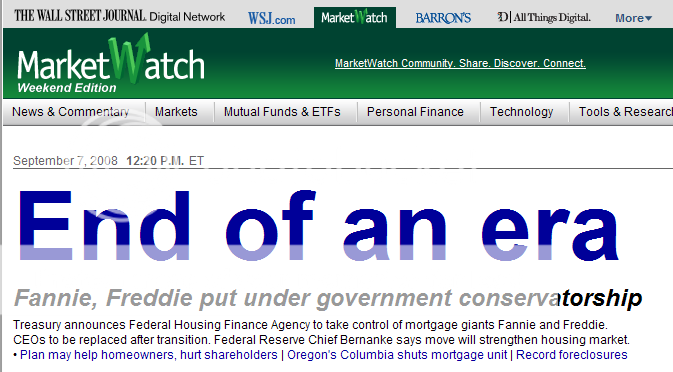
mooi screenshot, deze dag is in feite het financiele 911quote:Op zondag 7 september 2008 18:24 schreef ItaloDancer het volgende:
[ afbeelding ]
Alle details op www.marketwatch.com

Communisme onder Bush, wie had dat ooit gedacht...
President Camacho
TV series: Boardwalk Empire | Burn Notice | Dexter | Game of Thrones | Impractical Jokers | Luther | Sherlock | Sons of Anarchy
TV series: Boardwalk Empire | Burn Notice | Dexter | Game of Thrones | Impractical Jokers | Luther | Sherlock | Sons of Anarchy
Paar jaar terug hadden ze ook wat gekloot met SEC filings.
Iig, in feite waren ze allang genationaliseerd, kijk maar naar de yield op hun senior securities. Maargoed, nu zal Congress er pas echt op duiken en de moral hazard in het systeem weer met een paar maten vergroten, ze leren het nooit. Ook jammer dat ze Bush hebben tegengewerkt de afgelopen jaren om Fannie en Freddie te verkleinen.
Iig, in feite waren ze allang genationaliseerd, kijk maar naar de yield op hun senior securities. Maargoed, nu zal Congress er pas echt op duiken en de moral hazard in het systeem weer met een paar maten vergroten, ze leren het nooit. Ook jammer dat ze Bush hebben tegengewerkt de afgelopen jaren om Fannie en Freddie te verkleinen.
