WGR Werk, Geldzaken, Recht en de Beurs
Hier kun je alles kwijt over sollicitaties, werksituaties, belastingen, (handelen op) de beurs, hypotheken, beleggingen en salarissen, arbeidscontracten of geschillen met je (huis)baas. Alles over werk, geldzaken en recht dus.



Commentaar overbodigquote:OPEC considers cutting oil production
Sunday September 7, 1:34 pm ET
By George Jahn, Associated Press Writer
OPEC ministers consider options including output cuts as oil prices fall
VIENNA, Austria (AP) -- With oil prices off nearly 30 percent from their highs of almost $150 a barrel, OPEC oil ministers are considering what was unthinkable just a few weeks ago -- cutting back output to prop up the price of crude.
No one is predicting much of a cutback -- if any at all. Still, such a move would not even have been thought of with oil prices setting record after record back in July.
But the bull run appears to have paused, if not ended, which means a new look at options for Tuesday's meeting of the 13 ministers at OPEC's Vienna headquarters.
Since crude surged to a record $147.27 a barrel on July 11, it has tumbled by over $40, or more than 27 percent. Back then, OPEC's main concern was pushing back against arguments from the U.S. and other key consumers that an output increase was needed to end rocketing prices. Oil ministers insisted there was adequate supply to meet demand, and blamed speculators and a weak U.S. dollar for crude's stellar rise.
But now, the greenback has strengthened, world demand has decreased due to creaky economies, traders' appetites for commodities have cooled -- and suddenly the market appears to have turned bearish. Oil markets, however, will also be keeping a close eye on Hurricane Ike, which on Sunday was an extremely dangerous Category 4 storm projected to move into the oil-producing Gulf of Mexico after passing over Cuba.
Light, sweet crude for October delivery fell $1.66 to settle at $106.23 a barrel Friday on the New York Mercantile Exchange -- its lowest close since early April.
The downward spiral has led to calls from OPEC price hawk Iran -- the group's second-largest producer -- to reduce output from the nearly 30.5 million barrels a day being pumped last month by the organization's members.
Not far behind is Venezuela. While moderating recent demands for immediate output cuts, Venezuelan Oil Minister Rafael Ramirez has drawn the line at $100 per barrel of oil. Anything below that should serve as a wake-up call for OPEC to tighten the spigots, he says -- sentiment that is shared by other OPEC members.
Still, a major cutback is unlikely without Saudi compliance, and the Saudis -- de-facto OPEC policy setters who are now producing nearly a third of total OPEC output -- have given no hint they favor that option. Saudi Oil Minister Ali Naimi has instead talked about a floor of $80 as the red line for action.
OPEC has reason to be cautious.
Despite their precipitous fall, prices remain 14 percent higher this year than in 2007, and a barrel of benchmark crude still fetches four times what it did five years ago.
Any OPEC move Tuesday to pare back output would send a howl of protest from the U.S. and other major consumers, and give a larger platform to Republican presidential candidate John McCain and Barack Obama, his Democratic counterpart, to call for reduced dependence on foreign oil.
Additionally, OPEC understands that high prices drive down demand and will likely try to find a balance between high profits and a price that the market can accept.
In a forecast last month, OPEC predicted that the world's forecast appetite for oil for this year overall will have fallen by 30,000 barrels a day and noted that world demand growth next year will be "the lowest since 2002." And on Wednesday, the U.S Energy Administration reported a 3.5 percent drop for products including gasoline and other oil-based products compared with last year.
Such factors have led some experts to predict OPEC would opt for no change.
"The ministers will hold the status quo (although) there is going to be the usual jawboning from the usual suspects" for a cutback, said oil analyst and trader Stephen Schork. Even now, "oil is by no means cheap and that is certainly adding a lot of pressure to the (world's) economies -- the smarter ones, the Saudis, the Qataris the Kuwaitis are aware of this."
Others think that OPEC, which accounts for about 40 percent of world oil production, will compromise between doing nothing -- thereby chancing a further erosion in prices -- and slashing boldly -- thereby risking skyrocketing prices and an ensuing fallback in demand.
That middle way would mean agreeing to pare away at overproduction without reducing the overall output quota of 27.3 million barrels a day set in November for the 10 OPEC members under production limits.
Energy analyst Catherine Hunter of Global Insight estimates overproduction at between 600,000 and 800,000 barrels a day and says this is the likely "first target of cuts." And because most of the extra production comes from Saudi wells, such a move could be easily accepted by most OPEC members.
"Ultimately, OPEC wants to know what the market will bear," she wrote in a recent analysis, adding that with the world's developed economies expected to perform poorly -- and a resulting overspill to East Asian markets -- "the answer may well be, not much."
Chip Hodge, portfolio manager with MFC Global Investment Management, also thinks that if OPEC issues a call for cuts it will be in overproduction, adding the organization has little additional wiggle room.
"Oil prices are still higher than where they were a year ago," he said. "They just don't have much to complain about."

"If you want to make God laugh, tell him about your plans"
Mijn reisverslagen
Mijn reisverslagen


De dollar stijgt als de olie zakt... In euro's zal de grafiek minder extreem stijgen/dalen.quote:Op dinsdag 2 september 2008 19:33 schreef Bulletdodger het volgende:
[..]
Hopelijk... Zien we daar aan de pomp nog wat van?
censuur :O

Light Sweet Crude Oil op dit moment $104 per vat, rond de 73,75 euro.
Brent is al onder de $100 gezakt samen met Urals & Forties. (Klik)
Verder is de nieuwe IPM van het EIA uit. http://www.eia.doe.gov/ipm/supply.html
Niet veel speciaals te melden. Mei 2008 blijft staan als de maand waarin het meeste olie is gewonnen, en waarin het totale olieaanbod het hoogste lag, voorlopig.
EIA Report on Hurricane Impacts on U.S. Energy
Guardian: Angola: blood oil and western hypocrisy
Will rising fuel costs reverse globalization?
Brent is al onder de $100 gezakt samen met Urals & Forties. (Klik)
Verder is de nieuwe IPM van het EIA uit. http://www.eia.doe.gov/ipm/supply.html
Niet veel speciaals te melden. Mei 2008 blijft staan als de maand waarin het meeste olie is gewonnen, en waarin het totale olieaanbod het hoogste lag, voorlopig.
EIA Report on Hurricane Impacts on U.S. Energy
Guardian: Angola: blood oil and western hypocrisy
Dan nu de hamvraag; waar hechten we meer waarde aan, het stoppen van misdaden tegen de mensheid in Afrika, of het laten rijden van onze auto's?quote:Western powers are selective in their censure of African regimes guilty of misrule, while ignoring those countries with oil, or who are allies in the US "war on terror". For example, Robert Mugabe has been rightly pilloried by the west for running Zimbabwe into the ground. Yet Mugabe's great ally, Angola's Eduardo dos Santos, whose ruling MPLA is going into a parliamentary election today, has an equally appalling record of autocratic rule. But Angola's fabulous oil wealth has silenced western criticisms of the regime's terrible human rights abuses.
[..]
It is now clear that oil wealth protects African dictators from international pressure to democratise.
[..]
Unless the west tackles these obvious blindspots, their criticisms of African misrule, although desperately needed, will ring hollow.
Will rising fuel costs reverse globalization?
quote:[..]
A subject of lively debate among economists and business analysts today is the effect of rising oil prices on globalization. Rising oil prices translate into higher fuel costs, and that in turn drives up shipping costs. Ninety per cent of global demand for crude is based on the need for transportation fuels. In a world of triple-digit oil prices, could it cost less to manufacture products more expensively at home rather than ship cheaper products half way around the world? Could rising oil prices slow, stall, or even reverse the trend of globalization?
[..]
Rising oil prices provide a powerful case for proximity. Mexico should become more attractive for outsourcing manufacturing of goods where transportation to market is a substantial part of the cost, such as heavy industrial equipment, furniture and clothing. By the same reasoning, the U.S. should become even more attractive to Canada as an export market.
[..]
The problem is not the occupation, but how people deal with it.
OPEC verlaagt olieproductie
Uitgegeven: 10 september 2008 07:27
WENEN - De Organisatie voor Olie Exporterende Landen (OPEC) heeft besloten de olieproductie de komende veertig dagen met 520.000 vaten per dag te verminderen.
Dit maakte de organisatie woensdagochtend vroeg bekend na overleg in de Oostenrijkse hoofdstad Wenen, waar de OPEC is gevestigd.
De reductie komt op een moment dat de prijs voor een vat olie sterk daalt. Met de vermindering gaat de productiehoeveelheid weer naar het niveau van september vorig jaar.
OPEC-president Chakib Khelil kondigde aan dat de organisatie er streng op zal toezien dat de lidstaten niet meer produceren dan afgesproken.
Lidmaatschap
De OPEC maakte verder bekend dat Indonesië heeft besloten zijn lidmaatschap van de organisatie op te schorten. Van de OPEC zijn nu nog twaalf landen lid.
(c) ANP
bron: nu.nl
ik snap het nut hiervan niet, vindh et zowiezo ook lame dat de brandstofprijs aan de pomp niet mee naar beneden gaat, maar wel meteen omhoog gaat als de prijs omhoog gaat.
Uitgegeven: 10 september 2008 07:27
WENEN - De Organisatie voor Olie Exporterende Landen (OPEC) heeft besloten de olieproductie de komende veertig dagen met 520.000 vaten per dag te verminderen.
Dit maakte de organisatie woensdagochtend vroeg bekend na overleg in de Oostenrijkse hoofdstad Wenen, waar de OPEC is gevestigd.
De reductie komt op een moment dat de prijs voor een vat olie sterk daalt. Met de vermindering gaat de productiehoeveelheid weer naar het niveau van september vorig jaar.
OPEC-president Chakib Khelil kondigde aan dat de organisatie er streng op zal toezien dat de lidstaten niet meer produceren dan afgesproken.
Lidmaatschap
De OPEC maakte verder bekend dat Indonesië heeft besloten zijn lidmaatschap van de organisatie op te schorten. Van de OPEC zijn nu nog twaalf landen lid.
(c) ANP
bron: nu.nl
ik snap het nut hiervan niet, vindh et zowiezo ook lame dat de brandstofprijs aan de pomp niet mee naar beneden gaat, maar wel meteen omhoog gaat als de prijs omhoog gaat.
Je snapt het nut ervan niet? Dat is toch niet zo moeilijk.  olieprijs daalt, vraag daalt --> inkomsten OPEC-landen dalen fors.
Productie verminderen --> olieprijs stijgt --> inkomsten stijgen.
olieprijs daalt, vraag daalt --> inkomsten OPEC-landen dalen fors.Productie verminderen --> olieprijs stijgt --> inkomsten stijgen.

Toch fijn dat je met samenwerken toch een monopolie positie kan innemen en de vrije markt gewoon een dikke vinger kan geven.quote:Op woensdag 10 september 2008 09:34 schreef ItaloDancer het volgende:
Je snapt het nut ervan niet? Dat is toch niet zo moeilijk.
Productie verminderen --> olieprijs stijgt --> inkomsten stijgen.


Wie mailt dit topic even naar haar?

Op donderdag 28 augustus 2008 14:34 schreef Breathtaking het volgende:
:9~
:9~
Olie uit Dubai & Oman is nu ook onder de $100 gezakt. (Klik)
Democrats look to more drilling
Oil ends at 5-month low on OPEC talk
Hurricane destroys oil infrastructure; oil price falls
Democrats look to more drilling
Gulf workers evacuate offshore facilities, againquote:WASHINGTON - With public opinion shifting toward offshore drilling, Democrats are looking to defuse the volatile election issue by allowing oil companies for the first time to explore off the Atlantic and Gulf coasts from Virginia to Florida — but only if they foot the bill for new alternative energy programs.
House Speaker Nancy Pelosi, who not long ago staunchly opposed lifting any of the offshore drilling bans, said Tuesday she now supports an energy package that would including drilling in federal waters off the southeastern coast. She is planning a vote that could come as early as Friday.
Shell agrees landmark 4.0 bln-dlr gas deal with Iraqquote:Less than two weeks after evacuating thousands of offshore workers from production platforms and other facilities, Exxon Mobil Corp., Royal Dutch Shell and others were again removing workers from their posts Tuesday as Hurricane Ike approached.
Mooi, niet meer affakkelen.quote:BAGHDAD (AFP) - Royal Dutch Shell will form a gas venture with energy-rich Iraq worth up to four billion dollars, the oil ministry said Tuesday of the first Western oil major to do a deal with the central government since the 2003 invasion.
The venture to capture unwanted gas burned off during oil production, for domestic consumption and export, is expected to be signed in Baghdad next month, ministry spokesman Assem Jihad told AFP.
Oil ends at 5-month low on OPEC talk
En nog wat opinie;quote:NEW YORK (CNNMoney.com) -- Oil prices fell Tuesday, as investors believed OPEC will keep production at current levels, and as Hurricane Ike lost strength over Cuba.
U.S. crude for October delivery settled down $3.08 to $103.26 a barrel, the lowest close since April 1, when oil ended the day at $100.98 a barrel.
[..]
Slumping global energy demand has caused the price of crude to fall sharply from the record-high $147.27 a barrel, set on July 11.
[..]
As of Tuesday, 79.4% of crude oil production and 64.2% of natural gas production in the Gulf of Mexico remained shut from Gustav, according to the Department of Energy.
Hurricane destroys oil infrastructure; oil price falls
quote:Sometimes you just have to stand in awe and wonder before the all-knowing wisdom of The Market. Common sense would say: Hurricane Gustav (even considering the fact that it never achieved its advertised category 4 status before landfall) is likely to result in 40% of US Gulf of Mexico oil production being taken off-line for 30 days, with longer outages for some rigs, terminals, and refineries; therefore, given the fact that fuel supplies in the US are already tight, this is a good time to load up on oil futures.
But Noooooo. That’s not how the market works. Because the expectation of storm damage was higher, Monday’s trading was actually dominated by a sell-off.
This tells us just how important the market and price signals are in helping us prepare for the inevitable decline in world oil production. To wit: not very
[..]
Moral of the story: In the task of waking humanity up to the plight of resource depletion, the market is not very helpful, even if it occasionally does give useful warning signs. It’s a bit like the broken clock that tells perfect time twice a day.
The problem is not the occupation, but how people deal with it.

Het mooiste is dat de mens er keer op keer intrapt.quote:Op woensdag 10 september 2008 09:42 schreef Basp1 het volgende:
Toch fijn dat je met samenwerken toch een monopolie positie kan innemen en de vrije markt gewoon een dikke vinger kan geven.
The Hick from French Lick
The camera always points both ways. In expressing the subject, you also express yourself.
The camera always points both ways. In expressing the subject, you also express yourself.
Nieuw Oil Market Report van het IEA is uit. http://omrpublic.iea.org/ (Volledige versie is pas later beschikbaar)
De hoogtepunten:
De hoogtepunten:
quote:August global oil supply fell by 1.0 mb/d to 86.8 mb/d on North Sea maintenance, the BTC pipeline outage and lower OPEC supply. Non-OPEC output is revised by -180 kb/d for 2008 and by -85 kb/d for 2009, with hurricane outages impeding 2H08 supply. Non-OPEC growth including OPEC NGL is now 580 kb/d in 2008 and 1.56 mb/d in 2009.
OPEC crude supply in August fell by 195 kb/d to 32.5 mb/d on field and pipeline outages in Iraq, Angola, Libya and Nigeria, while effective spare capacity rose from 1.5 mb/d to 1.9 mb/d. The ‘call’ on OPEC is revised up to 32.2 mb/d for 3Q08 and 31.7 mb/d for 4Q08. This report went to press ahead of the OPEC 9 September meeting in Vienna.
Hurricane activity in the US Gulf of Mexico results in a 1.4 mb/d downward revision to US refinery crude throughput in September, to an average of 13.9 mb/d. Global September crude runs could decline by 1.3 mb/d from August. OECD crude runs are forecast to average 37.4 mb/d in September, their lowest level since October 2002.
OECD stocks rose by 47 mb in July to 2,646 mb. A large, unseasonal crude build from a revised June base and weaker demand leave end-July OECD cover at 54.5 days. Higher OECD end-June stocks now imply a 380 kb/d OECD stockbuild in 2Q08 versus last month’s estimate of flat second-quarter stocks, and a seasonal 2Q average build of 0.9 mb/d.
Forecast global oil demand has been lowered for both 2008 and 2009, following weaker deliveries in the OECD. World demand averages 86.8 mb/d in 2008 (+0.8% or +0.7 mb/d versus 2007 and 100 kb/d lower than previously estimated) and 87.6 mb/d in 2009 (+1.0% or +0.9 mb/d year-on-year and 140 kb/d lower than in our last report).
Benchmark crude futures continued their downward slide in August, approaching $100/bbl in early September, as fundamentals eased. Weaker OECD demand and higher stocks dominated sentiment, while markets have so far shrugged off Hurricanes Gustav and Ike, though the latter could yet defer post-Gustav supply recovery.
The problem is not the occupation, but how people deal with it.
Als het zou functioneren ja.... maar de OPEC is eigenlijk al vanaf halverwege de jaren 70 een Saoedische 'lame duck' die niet veel meer kan doen als 'achter' de olieprijs-ontwikkelingen aanlopen en te pogen wat 'correcties' aan overtollige marktprijs-fluctuaties door te voeren, veelal succesloos.quote:Op woensdag 10 september 2008 09:42 schreef Basp1 het volgende:
[..]
Toch fijn dat je met samenwerken toch een monopolie positie kan innemen en de vrije markt gewoon een dikke vinger kan geven.
De olieprijs heeft eerder steeds minder te doen met 'aanbod', maar is vooral 'vraag-gedreven' ... op dit moment zijn vooruitzichten over economisch ontwikklingen en toekomstige vraag naar olie (-verwachtingen) de prijsdrijvers .... de 'aanbod-kant' lijkt behoorlijk irrelevant t zijn voor prijs-ontwikkeling (daarom hebben die 'stormen' weinig invloed, de reserve's zijn genoeg op peil)
"Whatever you feel like: Life’s not one color, nor are you my only reader" - Ausonius, Epigrammata 25
Ze verdien wel nu helemaal goudgeld de olie maatschappijen.
Toen de olieprijs steeg ging de prijs aan de pomp aardig snel mee omhoog.
Nu is de olie prijs al een tijd gedaald en ik betaal nu nog steeds 1.49 aan de pomp.
Toen de olieprijs steeg ging de prijs aan de pomp aardig snel mee omhoog.
Nu is de olie prijs al een tijd gedaald en ik betaal nu nog steeds 1.49 aan de pomp.
............................
Aangezien er bar weinig informatie over oliegebruik via onze eigen overheid te verkrijgen is, hier een kleine inventarisatie. IEA staat voor International Energy Agency, EIA voor Energy Information Administration, NAM voor Nederlandse Aardolie Maatschappij. Aanvullingen zijn meer dan welkom.
Nederland & Aardolie
"In 2004 haalde Nederland 39% van al haar energie uit olie"
-IEA
Consumptie (EIA)
2007: 987.750 bpd
2006: 1.010.904 bpd
2005: 1.021.384 bpd
2004: 947.866 bpd
Productie
Ruwe Olie Productie: 39.900 bpd (2007, EIA)
Totale Olie Productie: 88.950 bpd (2007, EIA)
Olie-import: 898.800 bpd (2007, EIA)
Olie-Import Jan - Mei 2008 (EIA)
(miljoen vaten)
1.033 0.912 1.225 0.818 1.005
Waarvan van de OPEC
0.774 0.391 0.668 0.554 0.640
Waarvan uit Irak
0.065 0.021 0.033 0.000 0.055
(In miljoenen vaten)
Jun 2007 115,9
Sep 2007 122,9
Dec 2007 116,6
Mrt 2008 126,5
Raffinaderijen
Capaciteit
10.000 bpd Smid + Hollander Raffinaderij Amsterdam
80.000 bpd Kuwait Petroleum Europoort Rotterdam
400.000 bpd Netherlands Refining Co. (BP) Europoort
195.000 bpd ExxonMobil Refining + Supply Co. Botlek
416.000 bpd Shell Pernis Refinery
160.000 bpd Total Refinery Netherlands Vlissingen
Raffinaderij-gebruik (IEA)
Jun 2008 960.000 bpd (79%)
http://tonto.eia.doe.gov/country/country_energy_data.cfm?fips=NL
http://en.wikipedia.org/w(...)ries#The_Netherlands
http://omrpublic.iea.org/currentissues/full.pdf
http://www.iea.org/textbase/nppdf/free/2006/SR_Netherlands.pdf
http://www.eia.doe.gov/emeu/ipsr/t314.xls
http://www.eia.doe.gov/ipm/imports.html
Nederland & Aardolie
"In 2004 haalde Nederland 39% van al haar energie uit olie"
-IEA
Consumptie (EIA)
2007: 987.750 bpd
2006: 1.010.904 bpd
2005: 1.021.384 bpd
2004: 947.866 bpd
Productie
Ruwe Olie Productie: 39.900 bpd (2007, EIA)
Totale Olie Productie: 88.950 bpd (2007, EIA)
quote:Dankzij de hoge olieprijs en met nieuwe technieken, wordt ons Drentse Schoonebeek weer een rendabele oliewinplaats. Het veld sloot in 1996, maar wordt opnieuw in gebruik genomen. De verwachting is dat er de komende 25 jaar nog tot zo'n 120 miljoen vaten aan de bodem ontfutseld kunnen worden.
[..]
Er zitten een miljard vaten in de grond waarvan er tot 1996 250 miljoen naar boven zijn gehaald. Met nieuwe efficiënte en schone technieken kan de nogal taaie en stroperige donkere smurrie er weer uitgepompt worden.
Bron
Importquote:Waar zit de olie in Nederland? De meeste olie zit in Zuidoost-Drenthe. Dit veld staat te boek als het Schoonebeek-olieveld. Plaatsen als Schoonebeek en Coevorden zijn bekend geworden door de oliewinning en in vroegere tijden stonden daar honderden jaknikkers. In 2007 heeft de NAM besloten opnieuw olie te gaan winnen in het Schoonebeek-veld. Naar verwachting zal in 2010 de nieuwe oliewinning een feit zijn.
Daarnaast wordt op dit moment nog olie gewonnen in de omgeving van Rotterdam en op de Noordzee.
[..]
Offshore olie wordt elke 14 dagen naar de raffinaderij in Pernis gebracht. Olie uit de omgeving Rotterdam gaat via een pijpleiding naar Pernis. Olie uit Schoonebeek gaat via een pijpleiding naar de raffinaderij in Lingen (Duitsland).
Bron: NAM
Olie-import: 898.800 bpd (2007, EIA)
Olie-Import Jan - Mei 2008 (EIA)
(miljoen vaten)
1.033 0.912 1.225 0.818 1.005
Waarvan van de OPEC
0.774 0.391 0.668 0.554 0.640
Waarvan uit Irak
0.065 0.021 0.033 0.000 0.055
Voorraad (IEA)quote:De grootste opslagtanks staan op de punt van de Maasvlakte en zijn van de Maasvlakte Olie Terminal (MOT). De MOT is een samenwerking tussen BP Raffinaderij, Esso Nederland, Koeweit Petroleum, Vopak Maasvlakte Terminal, Shell Nederland en Total Opslag. Alle opslagtanks van de MOT hebben een gezamenlijke capaciteit van 4.000.000 m³.
Bron: Wikipedia
(In miljoenen vaten)
Jun 2007 115,9
Sep 2007 122,9
Dec 2007 116,6
Mrt 2008 126,5

Raffinaderijen
Capaciteit
10.000 bpd Smid + Hollander Raffinaderij Amsterdam
80.000 bpd Kuwait Petroleum Europoort Rotterdam
400.000 bpd Netherlands Refining Co. (BP) Europoort
195.000 bpd ExxonMobil Refining + Supply Co. Botlek
416.000 bpd Shell Pernis Refinery
160.000 bpd Total Refinery Netherlands Vlissingen
Raffinaderij-gebruik (IEA)
Jun 2008 960.000 bpd (79%)
Bronnenquote:Waarvoor wordt olie gebruikt? Meer dan 86% van de totale aardolieconsumptie in Nederland wordt besteed aan brandstof voor industrie, transport en verwarming van gebouwen.
Bron: NAM
http://tonto.eia.doe.gov/country/country_energy_data.cfm?fips=NL
http://en.wikipedia.org/w(...)ries#The_Netherlands
http://omrpublic.iea.org/currentissues/full.pdf
http://www.iea.org/textbase/nppdf/free/2006/SR_Netherlands.pdf
http://www.eia.doe.gov/emeu/ipsr/t314.xls
http://www.eia.doe.gov/ipm/imports.html
The problem is not the occupation, but how people deal with it.

Dat is oud nieuws, auto verkopen of op LPG gaan rijden.quote:Op woensdag 10 september 2008 14:28 schreef sander89 het volgende:
Ze verdien wel nu helemaal goudgeld de olie maatschappijen.
Toen de olieprijs steeg ging de prijs aan de pomp aardig snel mee omhoog.
Nu is de olie prijs al een tijd gedaald en ik betaal nu nog steeds 1.49 aan de pomp.
*****Kraak........
Vat olie nu $101.
Hurricane Ike hits heart of U.S. oil sector
Benzinevoorraden VS zitten aan de onderkant, niet het beste moment nu Gustav & Ike wat raffinaderijen hebben stilgelegd rondom de Golf. Meer info bij The Oil Drum. Olieprijzen gaan hierdoor niet omhoog aangezien er minder ruwe olie wordt gekocht door de raffinaderijen die stil liggen. Benzinetekorten in de VS zijn echter al een feit.
North Carolina: Gas Woes Continue From Hurricane Ike
Michigan: Ike causes gas hikes, panic at pump
Texas: Gas stations run short amid rush to fill up
Tennessee: EPA boosts gas supply in Southeast; Knoxville running low
Missouri: Local Motorists Rush to Pumps Ahead of Ike
Georgia: Gas prices on the way back up, especially in Albany
Tot zover het land van de free en home of the brave.
Alitalia 'running out of fuel' Lekker stoer doen tegenover het Venezuelaanse volk en dan toch maar olie verkopen aan zijn 'aartsvijand' omdat ze anders gewoon geen geld meer hebben.
The Simple Solutions
Brazil plans to build 50 more nuclear power plants
Oil shale development seems always just over horizo
Hurricane Ike hits heart of U.S. oil sector
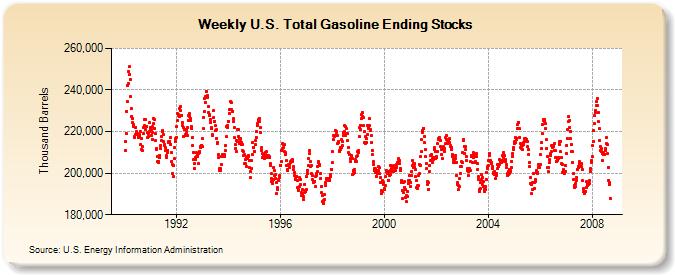
Benzinevoorraden VS zitten aan de onderkant, niet het beste moment nu Gustav & Ike wat raffinaderijen hebben stilgelegd rondom de Golf. Meer info bij The Oil Drum. Olieprijzen gaan hierdoor niet omhoog aangezien er minder ruwe olie wordt gekocht door de raffinaderijen die stil liggen. Benzinetekorten in de VS zijn echter al een feit.
North Carolina: Gas Woes Continue From Hurricane Ike
Michigan: Ike causes gas hikes, panic at pump
Texas: Gas stations run short amid rush to fill up
Tennessee: EPA boosts gas supply in Southeast; Knoxville running low
Missouri: Local Motorists Rush to Pumps Ahead of Ike
Georgia: Gas prices on the way back up, especially in Albany
Tot zover het land van de free en home of the brave.
Alitalia 'running out of fuel'
Venezuela seeks to lower tone in US diplomatic spatquote:Italy's national airline, Alitalia, may have to cancel some flights because of a lack of funds to buy fuel, a top official has warned.
[..]
Prime Minister Silvio Berlusconi blamed "political" motives for the failure.
Wat een schreeuwlelijk is het ook.quote:CARACAS, Sept 13 (Reuters) - Venezuelan President Hugo Chavez sought to lower the tone of a diplomatic spat with the United States, saying he doesn't plan to take more steps against his country's biggest oil customer.
[..]
Lekker stoer doen tegenover het Venezuelaanse volk en dan toch maar olie verkopen aan zijn 'aartsvijand' omdat ze anders gewoon geen geld meer hebben.The Simple Solutions
En zo is het maar net. Er is genoeg olie. Nieuwe technologie 'komt wel langs'. Zuiniger zijn is voor idioten. Slimme gozer, die Ron Ewart.quote:By Ron Ewart
[..]
How is it that only politicians can take the laws of physics, economics and the principles of freedom and liberty and screw them up so badly?
[..]
The simple solution ......... We have more than enough oil on our own shores within our economic and environmentally sensitive grasp to meet our daily needs and be free of foreign blackmail. Drill for it now and put it in our cars as rapidly as we can. Build more refineries to process that oil. Cut gasoline grades down to about five, no more. Build nuclear and natural gas fired power plants. Convert coal to oil. Stop subsidies for ethanol and other uneconomic idiotic solutions and let them die a rapid death before these boon doggles drive our taxes up dramatically and drive our food prices out of reach of the average family, where we end up going hungry so a radical environmentalist or a government employee can feel good about him or herself for “saving the planet”. And stop this crazy idea of conserving energy. We don’t need to conserve, we have all the energy we need, if we will just go get it. We need to expand our opportunities and horizons, not limit them. Limits are for losers and whiners. Of course we need to continue working on economic energy solutions to replace crude oil. And in spite of what the so-called experts tell you, we are no where near “peak” oil. But new, economic technology will come along if we just let the power of our industry and capitalism operate efficiently and without impediments and constant second-guessing from an out-of-control, heavy-handed, stupid government that screws up everything it touches.
Brazil plans to build 50 more nuclear power plants
Russia tries to raise oil productionquote:RIO DE JANEIRO, Sept. 12 (Xinhua) -- Mines and Energy Minister Edison Lobao announced Friday Brazil plans to build 50 to 60 nuclear power plants in half a century, with each having capacity of 1,000 megawatts.
"The general idea is to build one plant per year," he said during a visit to the construction site of Brazil's third nuclear power plant, Angra 3.
'oil-fueled economic boom'. Dat is hetzelfde als de high van cocaïne, het is even leuk, maar nadien ben je er slechter aan toe & verslaafd.quote:MOSCOW (AP) — Home to abundant oil reserves, Russia rarely worried about where the next barrel would come from — until now.
With analysts expecting production to fall this year for the first time in a decade, Russian companies are pushing to find new oil in remote regions such as the Arctic Shelf and East Siberia — but their efforts are hampered by crippling taxes that give the government much of the recent gains from high oil prices.
[..]
The prospering energy industry in Russia has been crucial to the career of Prime Minister Vladimir Putin, who as president oversaw an eight-year, oil-fueled economic boom which improved the lives of many ordinary Russians and helped restore national self-confidence.
Oil shale development seems always just over horizo
Nuclear output could as much as double by 2030-IAEAquote:[..]
A former government petroleum expert offered a concise explanation: The oil companies don’t really want it.
Energy companies “are not excessively interested in bringing in a new field so long as, by gradually increasing the price, they can stimulate production in the older regions,” Dr. David T. Day said.
And even though gasoline prices have gotten prohibitively high “for all but the rich” — according to the newspaper that carried Day’s remarks — the oil companies are only interested in maintaining their own profit margins, which they are doing just fine the way things are, Day said. He added, “It’s not surprising, then, that the oil companies hesitate to bring in a new and practicably inexhaustible supply of crude petroleum from oil shales.”
Oh, by the way, I should mention here that Dr. Day made these remarks nearly 90 years ago.
[..]
As I have written in countless editorials, the primary obstacle blocking commercial oil shale development is technological, not political maneuvering or corporate conspiring. The oil companies have not yet demonstrated they can successfully recover fuel from oil shale on a large scale in a way that is economically feasible. That was true in 1920 and it’s true today.
I don’t know whether those technological impediments will ever be overcome. Certainly, a few companies are working hard, attempting to do just that. Shell, in particular, has demonstrated it can successfully recover the oil from shale — at what the company says is a net energy gain — on a small scale. But transferring its very complicated technology into the scale necessary for commercial production remains uncertain.
Maar Nederland niet hoor.quote:VIENNA, Sept 11 (Reuters) - Nuclear power production could as much as double by 2030 as countries seek relief from rising fossil fuel costs and a remedy against global warming, the International Atomic Energy Agency said on Thursday.
The problem is not the occupation, but how people deal with it.

Jep, dat is wat een globale recessie doet...
The problem is not the occupation, but how people deal with it.

