ONZ Onzin voor je leven!
Vrolijkheid troef in dit lieve forum vol humor.



hahah wat een naam 
Op donderdag 22 mei 2008 10:28 schreef Spittie het volgende:
swarma spam hoer
Op maandag 4 mei 2009 16:09 schreef Broekpaling het volgende:
Swarmahoer, deleting your posts while users are still writing them.
Op maandag 4 mei 2009 16:09 schreef Broekpaling het volgende:
Swarmahoer, deleting your posts while users are still writing them.

Hahaha dat id  !!!!
!!!!
!!!!
Wij vormen tezamen gezellig een schaar.
Sportief zijn wij allen en voor elkaar.
Ons doel en ons streven is vriendschap en vree
Aan ons de victorie aan RKC!
Sportief zijn wij allen en voor elkaar.
Ons doel en ons streven is vriendschap en vree
Aan ons de victorie aan RKC!
Volgens mij is de data op die kaart ook nog echt. 
Op de naam na uiteraard. Vond hem via google.
Niet erg uiteraard.
Op de naam na uiteraard. Vond hem via google.
Niet erg uiteraard.


http://www.scambuster419.co.uk/
vroeger stonden hier 'doe-het-invullen-zelf' bewijzen van betaling op.
vroeger stonden hier 'doe-het-invullen-zelf' bewijzen van betaling op.
om even een leuk voorbeeld erbij te halen, dit is de beste scambust i've seen yet:
http://www.scambuster419.co.uk/aristocratii.htm
je zou er een boek van kunnen maken
http://www.scambuster419.co.uk/aristocratii.htm
je zou er een boek van kunnen maken
Kijk eens wat een enige word art brief
Ik moet even geld overmaken. Nou dan gaan we dat maar doen zometeen.
Ik moet even geld overmaken. Nou dan gaan we dat maar doen zometeen.

altijd via western union money transfer
regel even zo'n blanko betaalbewijsje, vul in, zeg dat er computerstoringen waren maar dat waarschijnlijk wel gelukt was. stuur dat bewijsje mee en je kan weer een stuk of 10 mailtjes verder
regel even zo'n blanko betaalbewijsje, vul in, zeg dat er computerstoringen waren maar dat waarschijnlijk wel gelukt was. stuur dat bewijsje mee en je kan weer een stuk of 10 mailtjes verder
Mooi dit hé. Ook een tijd geleden al die scambust gezien van die stuntman, die negers allemaal stunts doen
Wij vormen tezamen gezellig een schaar.
Sportief zijn wij allen en voor elkaar.
Ons doel en ons streven is vriendschap en vree
Aan ons de victorie aan RKC!
Sportief zijn wij allen en voor elkaar.
Ons doel en ons streven is vriendschap en vree
Aan ons de victorie aan RKC!
Ja die ben ik aan het zoeken nu. Waar ie vroeger stond staat ie niet meer. Jij nog een linkje?quote:Op woensdag 18 juni 2008 11:45 schreef ottoaanmnstokkos het volgende:
altijd via western union money transfer
regel even zo'n blanko betaalbewijsje, vul in, zeg dat er computerstoringen waren maar dat waarschijnlijk wel gelukt was. stuur dat bewijsje mee en je kan weer een stuk of 10 mailtjes verder
http://www.scambuster419.co.uk/blankreceipts.htmquote:Op woensdag 18 juni 2008 11:55 schreef Armageddon het volgende:
[..]
Ja die ben ik aan het zoeken nu. Waar ie vroeger stond staat ie niet meer. Jij nog een linkje?
asje

Dank je
Ik ga eerst gewoon dat formulier van hem invullen met een fake MTCN nummer. Gaat ie voor jan lul naar de bank.
Ik ga eerst gewoon dat formulier van hem invullen met een fake MTCN nummer. Gaat ie voor jan lul naar de bank.
en nadat hij er 2-3x is geweest, zeggen dat je geen vertrouwen in hem hebt en in western union en dat je het via een andere manier wilt doen. dan stellen ze 'moneygramm' voor en daarvan staat er ook alvast een blanko bewijsquote:Op woensdag 18 juni 2008 12:36 schreef Armageddon het volgende:
Dank je
Ik ga eerst gewoon dat formulier van hem invullen met een fake MTCN nummer. Gaat ie voor jan lul naar de bank.
Heb hem deze gestuurd nu.quote:Op woensdag 18 juni 2008 12:47 schreef ottoaanmnstokkos het volgende:
[..]
en nadat hij er 2-3x is geweest, zeggen dat je geen vertrouwen in hem hebt en in western union en dat je het via een andere manier wilt doen. dan stellen ze 'moneygramm' voor en daarvan staat er ook alvast een blanko bewijs
ff wachten http://www.xs4all.nl/~monno/jpg/negers/poa2.pdf
quote:Op dinsdag 17 juni 2008 10:18 schreef Armageddon het volgende:
Gaarne niet de naam op het ID in het topic hier vermelden. Ik dank u.
[..]
[ afbeelding ]
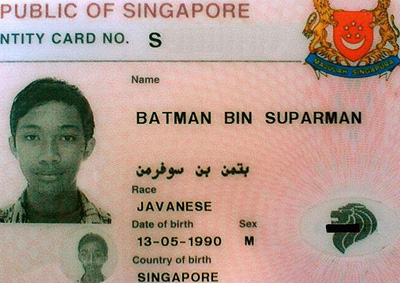
Laat het feest beginnen.quote:Op woensdag 18 juni 2008 12:56 schreef Armageddon het volgende:
[..]
Heb hem deze gestuurd nu.
http://www.xs4all.nl/~monno/jpg/negers/poa2.pdf

hmmm andere naam en zulks dan op de ID kaart lijkt me niet echt snugger ofwel?quote:Op woensdag 18 juni 2008 12:56 schreef Armageddon het volgende:
[..]
Heb hem deze gestuurd nu.
http://www.xs4all.nl/~monno/jpg/negers/poa2.pdf
Wat nou andere naam?quote:Op woensdag 18 juni 2008 13:11 schreef koemleit het volgende:
[..]
hmmm andere naam en zulks dan op de ID kaart lijkt me niet echt snugger ofwel?


Zo, nog even een andre neger blij gemaakt met een dode mus.
http://www.xs4all.nl/~monno/jpg/negers/wu.pdf
http://www.xs4all.nl/~monno/jpg/negers/wu.pdf
bij invullen van die formulieren goed kijken naar een al ingevuld formulier, soms moet je wel iets invullen bij het 'only agents' vakje.quote:Op woensdag 18 juni 2008 13:47 schreef Armageddon het volgende:
Zo, nog even een andre neger blij gemaakt met een dode mus.
http://www.xs4all.nl/~monno/jpg/negers/wu.pdf
Western Union
The oldest, and possibly still the best method of making scammers humiliate themselves. Western Union is a real method of transferring money around the globe and is very popular with 419 scammers, as it enables them to collect large amounts of money without having to give details of a bank account to their victims. All the scammer has to do to collect money that is transferred to them via Western Union is to visit their local Western Union agent, give them the ten-digit money transfer control number (MTCN) of the transfer and answer a test question, which is information they will have been given by their victim. They may also have to provide some form of identification when they collect the money.
Gilbert has used Western Union more often than any other method to “send money” to 419 scammers. When he first started scambusting, all the scammers would ask for was the MTCN of the transfer and the answer to the test question, and they would happily trot off to their local Western Union agent with any old ten-digit number and a made-up question and answer. However, the scammers seem to be getting wise to scambusters tricking them over fake Western Union payments, because they now always ask for a scanned copy of the receipt before they will trot off to the agent.
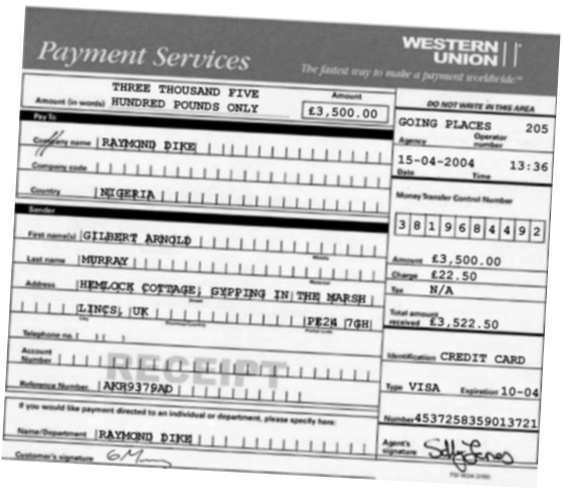
In order to counter this, Gilbert has taken to forging Western Union receipts and sending them to scammers. You can find examples of Gilbert’s forged Western Union receipts throughout the scambusts in this website, and an example appears below:
(Click to enlarge)
One disadvantage of “sending money” to scammers via Western Union is that the scammer can use the Western Union website to check whether a transfer has actually been made, simply by typing in the MTCN of the transfer. If this doesn’t exist, the scammer immediately becomes suspicious. To get around this problem, you may notice that whenever Gilbert tells a scammer that he has made a transfer via Western Union there is always some sort of technical problem with the Western Union computer system. That’s usually enough to persuade the scammer to head off to the Western Union agent with their forged receipt to face the usual humiliation.
Interestingly, some Western Union agents recognise Gilbert’s receipts as forgeries immediately (resulting in an angry email from the scammer demanding to know why they have been sent a forged receipt), whereas others don’t seem to realise that the receipts are forged.
Scammers seem to be slightly less keen to use Western Union nowadays, partly because Western Union has started to take steps to reduce the amount of advance fee fraud that is carried out using its network. There are now warnings about the dangers of 419 fraud in most, if not all, Western Union agents, and Western Union have reduced the amount of money that can be sent to individuals in certain countries in which 419 fraud is rife. However, if every other method of money transfer fails, scammers will always resort to using Western Union, even if it means asking their victims to transfer the money in four or five separate lots. And all other methods inevitably do fail whenever Gilbert’s involved.
It is worth remembering that the Western Union money transfer system is used for thousands of completely legitimate transactions every day, and Western Union does not condone advance fee fraud in any way. It is unfortunate that the nature of Western Union transactions make them attractive to 419 scammers. However, Western Union does take commission on each transfer that goes through their system, whether legitimate or not, so they do profit from advance fee fraud. Some have argued that Western Union could do more to warn individuals about the dangers of advance fee fraud at the point at which they make transfers, and that doing so would make life even harder for the 419 scammers that abuse the Western Union system.
Click here to access a blank Western Union receipt that you can use yourself.
The oldest, and possibly still the best method of making scammers humiliate themselves. Western Union is a real method of transferring money around the globe and is very popular with 419 scammers, as it enables them to collect large amounts of money without having to give details of a bank account to their victims. All the scammer has to do to collect money that is transferred to them via Western Union is to visit their local Western Union agent, give them the ten-digit money transfer control number (MTCN) of the transfer and answer a test question, which is information they will have been given by their victim. They may also have to provide some form of identification when they collect the money.
Gilbert has used Western Union more often than any other method to “send money” to 419 scammers. When he first started scambusting, all the scammers would ask for was the MTCN of the transfer and the answer to the test question, and they would happily trot off to their local Western Union agent with any old ten-digit number and a made-up question and answer. However, the scammers seem to be getting wise to scambusters tricking them over fake Western Union payments, because they now always ask for a scanned copy of the receipt before they will trot off to the agent.
In order to counter this, Gilbert has taken to forging Western Union receipts and sending them to scammers. You can find examples of Gilbert’s forged Western Union receipts throughout the scambusts in this website, and an example appears below:
(Click to enlarge)
One disadvantage of “sending money” to scammers via Western Union is that the scammer can use the Western Union website to check whether a transfer has actually been made, simply by typing in the MTCN of the transfer. If this doesn’t exist, the scammer immediately becomes suspicious. To get around this problem, you may notice that whenever Gilbert tells a scammer that he has made a transfer via Western Union there is always some sort of technical problem with the Western Union computer system. That’s usually enough to persuade the scammer to head off to the Western Union agent with their forged receipt to face the usual humiliation.
Interestingly, some Western Union agents recognise Gilbert’s receipts as forgeries immediately (resulting in an angry email from the scammer demanding to know why they have been sent a forged receipt), whereas others don’t seem to realise that the receipts are forged.
Scammers seem to be slightly less keen to use Western Union nowadays, partly because Western Union has started to take steps to reduce the amount of advance fee fraud that is carried out using its network. There are now warnings about the dangers of 419 fraud in most, if not all, Western Union agents, and Western Union have reduced the amount of money that can be sent to individuals in certain countries in which 419 fraud is rife. However, if every other method of money transfer fails, scammers will always resort to using Western Union, even if it means asking their victims to transfer the money in four or five separate lots. And all other methods inevitably do fail whenever Gilbert’s involved.
It is worth remembering that the Western Union money transfer system is used for thousands of completely legitimate transactions every day, and Western Union does not condone advance fee fraud in any way. It is unfortunate that the nature of Western Union transactions make them attractive to 419 scammers. However, Western Union does take commission on each transfer that goes through their system, whether legitimate or not, so they do profit from advance fee fraud. Some have argued that Western Union could do more to warn individuals about the dangers of advance fee fraud at the point at which they make transfers, and that doing so would make life even harder for the 419 scammers that abuse the Western Union system.
Click here to access a blank Western Union receipt that you can use yourself.

Ha K. K K leuk gevonden
Maar geen reatie terug inmiddels? Iemand al langs het kantoor geweest om het geld op te pikken?
Maar geen reatie terug inmiddels? Iemand al langs het kantoor geweest om het geld op te pikken?
Please don't sit on my imaginary friend
Ome Arna, ik heb er nog 2, ze zitten in je PM.
Succes!
Succes!
Op zondag 3 oktober 2010 20:58 schreef gewoonfaye het volgende:
retuow82 is mijn nieuwe held
retuow82 is mijn nieuwe held
Armageddon ik heb je een PM gestuurd vanwege een chinees die zich aanbiedt met een hoop dollars.
Please don't sit on my imaginary friend
En van mij heb je ook je tweede gehad.
O.m.e. Arma, scambuster op afroep
O.m.e. Arma, scambuster op afroep
There is no better way of exercising the imagination than the study of law.
No poet ever interpreted nature as freely as a lawyer interprets truth.
Jean Giraudoux, "Tiger at the Gates"
No poet ever interpreted nature as freely as a lawyer interprets truth.
Jean Giraudoux, "Tiger at the Gates"
Mocht je de smaak weer te pakken krijgen stuur ik je er nog een toe.
12,5 procent van 10 komma 8 milj US dollars binnen 7 dagen, is dat niet aanlokkelijk?
12,5 procent van 10 komma 8 milj US dollars binnen 7 dagen, is dat niet aanlokkelijk?
Please don't sit on my imaginary friend

DR.SAMUEL PIKOLI.
DEPARTMENT OF MINERALS AND ENERGY,
PRETORIA, SOUTH AFRICA.
ATTN: SIR / MADAM
CONFIDENTIAL & URGENT
It is my great pleasure to write you this letter on behalf of my colleagues. Your information was given to me by a member of the South African Export Promotion Council (SAEPC) who was with the Government delegation on a trip to your country for a bilateral conference talk to encourage foreign investors.
I have decided to seek a confidential co-operation with you in the execution of the deal hereunder for the benefit of all parties and hope you will keep it confidential because of the nature of this business.
Within the Department of Minerals & Energy where I work as a Director of Audit and Project Implementation and with the co-operation of two other top officials, we have in our possession an overdue payment in US funds.
The said funds represent certain percentage of the total contract value executed on behalf of my Department by a foreign contracting firm, which we the officials over-invoiced to the amount of US$26.500,000.00 (Twenty-Six Million Five Hundred Thousand US Dollars). Though the actual contract cost has been paid to the original contractor, leaving the excess balance unclaimed.
Since the present elected Government is determined to pay foreign contractors all debts owed, so as to maintain good relationship with foreign governments and non-government agencies, we included our bills for approvals with the Department of Finance and the South Africa Reserve Bank (SARB). We are seeking your assistance to front as beneficiary of the unclaimed funds, since we are not allowed to operate foreign accounts.
Details and change of beneficiary information upon application for claim to reflect payment and approvals will be secured on behalf of you/your Company.
I have the authority of my partners involved to propose that should you be willing to assist us in this transaction your share as compensation will be US$6.625m (25%), while my colleagues and I receive US$17.225m (65%) and the balance of US$2.650m (10%) for taxation and miscellaneous expenses incurred.
The business is completely safe and secure, provided you treat it with utmost confidentiality. It does not matter whether you/your Company does contract projects, as a transfer of powers will be secured in favour of you/your Company.
Also, your area of specialization is not a hindrance to the successful execution of this transaction.
I have reposed my confidence in you and hope that you will not disappoint us.
Thanks for your co-operation.
Regards,
DR.SAMUEL PIKOLI.
N.B Please
email your confidential Telephone and Fax number to enable me contact you for further clarifications.
DEPARTMENT OF MINERALS AND ENERGY,
PRETORIA, SOUTH AFRICA.
ATTN: SIR / MADAM
CONFIDENTIAL & URGENT
It is my great pleasure to write you this letter on behalf of my colleagues. Your information was given to me by a member of the South African Export Promotion Council (SAEPC) who was with the Government delegation on a trip to your country for a bilateral conference talk to encourage foreign investors.
I have decided to seek a confidential co-operation with you in the execution of the deal hereunder for the benefit of all parties and hope you will keep it confidential because of the nature of this business.
Within the Department of Minerals & Energy where I work as a Director of Audit and Project Implementation and with the co-operation of two other top officials, we have in our possession an overdue payment in US funds.
The said funds represent certain percentage of the total contract value executed on behalf of my Department by a foreign contracting firm, which we the officials over-invoiced to the amount of US$26.500,000.00 (Twenty-Six Million Five Hundred Thousand US Dollars). Though the actual contract cost has been paid to the original contractor, leaving the excess balance unclaimed.
Since the present elected Government is determined to pay foreign contractors all debts owed, so as to maintain good relationship with foreign governments and non-government agencies, we included our bills for approvals with the Department of Finance and the South Africa Reserve Bank (SARB). We are seeking your assistance to front as beneficiary of the unclaimed funds, since we are not allowed to operate foreign accounts.
Details and change of beneficiary information upon application for claim to reflect payment and approvals will be secured on behalf of you/your Company.
I have the authority of my partners involved to propose that should you be willing to assist us in this transaction your share as compensation will be US$6.625m (25%), while my colleagues and I receive US$17.225m (65%) and the balance of US$2.650m (10%) for taxation and miscellaneous expenses incurred.
The business is completely safe and secure, provided you treat it with utmost confidentiality. It does not matter whether you/your Company does contract projects, as a transfer of powers will be secured in favour of you/your Company.
Also, your area of specialization is not a hindrance to the successful execution of this transaction.
I have reposed my confidence in you and hope that you will not disappoint us.
Thanks for your co-operation.
Regards,
DR.SAMUEL PIKOLI.
N.B Please
email your confidential Telephone and Fax number to enable me contact you for further clarifications.
disclaimer
Net een mailtje binnen gekregen
Zal ik er op in gaan of nietquote:Dear Friend,
I am Mr. Shu Chun Pao. I work with Bank SinoPac, formerly known as International Bank of Taipei in Taiwan as Executive Vice President & Head of Division, Accounting Division.I have an obscure business deal of $17.300,000.00 to share with you.
Should you be interested? Please get back to me with my email so that I can provide you with more details of this operation.
Email: XXXXX@hotmail.com
Your earliest response to this letter will be appreciated.
Regards,
Mr.Shu-Chun Pao
Deze gaat voor mij even in de ijskast. Ben op het moment van baan aan het switchen dus moet een hoop afronden en voorbereiden.
Jammer, ik had er weer een voor je
There is no better way of exercising the imagination than the study of law.
No poet ever interpreted nature as freely as a lawyer interprets truth.
Jean Giraudoux, "Tiger at the Gates"
No poet ever interpreted nature as freely as a lawyer interprets truth.
Jean Giraudoux, "Tiger at the Gates"
Probeer het anders zelf eens. Is lachen hoor. Gewoon even een gmail accountje aanmaken. Dan is je IP ook meteen verborgen.
From the Desk Of:
Prof Charles Soludo
Executive Governor (CBN)
IMMEDIATE PAYMENT
REF: CBN/IRD/CBX/021/06
[OFFICE OF THE GOVERNOR]
DIRECT LINE : +234-80-30-99-2543.
EMAIL:executivegovernorcbn20008@yahoo.com
We have this on 18th day of Jun, 2008 received a payment credit instruction from the federal Government of Nigeria to credit your account with your full contract funds from the Nigerian reserve account with our bank.
This is to notify you that you funds has been programmed for immediate release into your nominated account but we can not transfer this funds direct to your nominated bank account, because we are having a little problem with International Monetary Fund (IMF) so our method of payment is by Diplomatic Courier Service Be inform that every arrangement regarding your cash payment through diplomatic services has been made; note that your funds have been package like a consignment
Be informing that the Diplomatic Agency has to move down to your Country in order to deliver the Consignment to your doorstep.
Note that as soon as the Diplomatic arrive to your Country they will give you a call immediately to enable you help them to get (Yellow Tag Paper).
You have to help the diplomats to get (yellow Tag Paper) so that the customs and immigration will not stop them in Airport, for security reason you are advice to follow the rules and regulation of the diplomats for easy collection of the consignment, you have to welcome the diplomatic agent, to enable them deliver the Consignment to you immediately, be inform that as soon as the diplomatic obtain the above name certificate they will deliver the Consignment to your door step
To remind you that the diplomats has a transit to Poland and finally to arrive at your Country as the last destination on their diplomatic travel route this week, I want you to send your direct mobile phone and your home address to me immediately, so that as soon as the diplomatic arrive in State they will call you immediately to notify you. call me immediately.
YOURS SINCERELY,
Your Full Name: ______________________________
Your Complete Address (Physical Address with Zip Code not
P.O.BOX) :___________________________
Name of City of Residence:_______________________________
Country:____________________________________
Direct Telephone Number:____________________________________
Mobile Number:____________________________________
Number:___________________________________
Occupation:_______________________________
SEND YOUR RESPONSE TO THE BANK DIRECT EMAIL CONTACT( executivegovernorcbn20008@yahoo.com)
PROFESSOR CHARLES C. SOLUDO,
GOVERNOR, CENTRAL BANK OF NIGERIA (CBN)
NOTE: RESPONSE SHOULD BE MADE IMMEDIATELY BEFORE IT WILL BE TOO LATE FOR YOU.
Prof Charles Soludo
Executive Governor (CBN)
IMMEDIATE PAYMENT
REF: CBN/IRD/CBX/021/06
[OFFICE OF THE GOVERNOR]
DIRECT LINE : +234-80-30-99-2543.
EMAIL:executivegovernorcbn20008@yahoo.com
We have this on 18th day of Jun, 2008 received a payment credit instruction from the federal Government of Nigeria to credit your account with your full contract funds from the Nigerian reserve account with our bank.
This is to notify you that you funds has been programmed for immediate release into your nominated account but we can not transfer this funds direct to your nominated bank account, because we are having a little problem with International Monetary Fund (IMF) so our method of payment is by Diplomatic Courier Service Be inform that every arrangement regarding your cash payment through diplomatic services has been made; note that your funds have been package like a consignment
Be informing that the Diplomatic Agency has to move down to your Country in order to deliver the Consignment to your doorstep.
Note that as soon as the Diplomatic arrive to your Country they will give you a call immediately to enable you help them to get (Yellow Tag Paper).
You have to help the diplomats to get (yellow Tag Paper) so that the customs and immigration will not stop them in Airport, for security reason you are advice to follow the rules and regulation of the diplomats for easy collection of the consignment, you have to welcome the diplomatic agent, to enable them deliver the Consignment to you immediately, be inform that as soon as the diplomatic obtain the above name certificate they will deliver the Consignment to your door step
To remind you that the diplomats has a transit to Poland and finally to arrive at your Country as the last destination on their diplomatic travel route this week, I want you to send your direct mobile phone and your home address to me immediately, so that as soon as the diplomatic arrive in State they will call you immediately to notify you. call me immediately.
YOURS SINCERELY,
Your Full Name: ______________________________
Your Complete Address (Physical Address with Zip Code not
P.O.BOX) :___________________________
Name of City of Residence:_______________________________
Country:____________________________________
Direct Telephone Number:____________________________________
Mobile Number:____________________________________
Number:___________________________________
Occupation:_______________________________
SEND YOUR RESPONSE TO THE BANK DIRECT EMAIL CONTACT( executivegovernorcbn20008@yahoo.com)
PROFESSOR CHARLES C. SOLUDO,
GOVERNOR, CENTRAL BANK OF NIGERIA (CBN)
NOTE: RESPONSE SHOULD BE MADE IMMEDIATELY BEFORE IT WILL BE TOO LATE FOR YOU.
Minds are like parachutes. They only function when open.
Vanmorgen een verse in mijn mailbox:
Edit: even een jpegje van de tekst gemaakt.
[ Bericht 93% gewijzigd door Levitation op 27-06-2008 14:35:27 ]

Edit: even een jpegje van de tekst gemaakt.
[ Bericht 93% gewijzigd door Levitation op 27-06-2008 14:35:27 ]
Dit is mijn uitspraak en daar zult u het mee moeten doen.
***Levi was here***
***Levi was here***
Hee Arma, als je slim bent, maak je ff een plaatje van de mails. Zo kunnen ze niet op tekst zoeken.
Goed bezig trouwens.
Goed bezig trouwens.
Is definitief vertrokken na een ban voor het opstaan tegen slechteriken
Ik ben ook ff bezig geweest met zo'n scammer. Kun je niet gewoon €0,01 overmaken naar Western Union? Dan heb je een echt MTCN nummer en gaan ze ook voor niks heen. Of kunnen ze dan via de website van WU zien hoeveel je hebt overgemaakt?
Mag een Fobo melding ook? 
Lorem ipsum dolor sit amet, consectetuer adipiscing elit. Vivamus posuere.
Fusce vulputate dolor id augue. Maecenas sapien metus, consectetuer quis,
commodo eget, vehicula sed, elit.
Fusce vulputate dolor id augue. Maecenas sapien metus, consectetuer quis,
commodo eget, vehicula sed, elit.
Je vergeet dan de transactiekosten. Die zijn minimaal 5-10 euro.quote:Op vrijdag 27 juni 2008 17:18 schreef Keramiekplaatser het volgende:
Ik ben ook ff bezig geweest met zo'n scammer. Kun je niet gewoon €0,01 overmaken naar Western Union? Dan heb je een echt MTCN nummer en gaan ze ook voor niks heen. Of kunnen ze dan via de website van WU zien hoeveel je hebt overgemaakt?
The best firms advertise the least...
Soms zit het mee, soms zit het neger.
Op vrijdag 14 mei 2021 @ 23:33 schreef Joopklepzeiker: Zonder twijfel is @vogeltjesdans de grootste smaakmaker en intelligentste persoon van heel KLB.
Jammer, 5 Euro zijn die klootzakken natuurlijk niet waard. En bovendien is 5 euro een weekloon in Nigeria.quote:Op maandag 30 juni 2008 04:10 schreef edcetera het volgende:
[..]
Je vergeet dan de transactiekosten. Die zijn minimaal 5-10 euro.
Niet voor die mafkezen, ze verdienen met hun scams een riant loon voor Nigeriaanse begrippen.quote:Op maandag 30 juni 2008 10:52 schreef Keramiekplaatser het volgende:
[..]
Jammer, 5 Euro zijn die klootzakken natuurlijk niet waard. En bovendien is 5 euro een weekloon in Nigeria.
Ik merk echter, dat ze niet meer zo snel in de zeik kunnen worden met die brieven. De meest recente oplichting gaat via Marktplaats. Heb wel zin om ze daar te naaien.
The best firms advertise the least...
nog noooooooooit last gehad van mailtjes
¨°o.O O.o° ¨°o.O O.o° ¨°o.O O.o° ¨°o.O O.o° ¨°o.O O.o° ¨°o.O O.o° ¨°o.O O.o° ¨°o.O O.o° ¨°o.O
Arma is daar slim genoeg voor, alleen sommige mensen die die scam's hier aandragen nietquote:Op vrijdag 27 juni 2008 14:25 schreef Karrs het volgende:
Hee Arma, als je slim bent, maak je ff een plaatje van de mails. Zo kunnen ze niet op tekst zoeken.
Goed bezig trouwens.

Ik ben op deze ingegaan, ik mail al een paar dagen met hem.quote:Op donderdag 26 juni 2008 07:57 schreef Fipotje het volgende:
Net een mailtje binnen gekregen
[..]
Zal ik er op in gaan of niet
Hij wil dat ik hier in Nederland een nieuwe bankrekening open en dat ik 1 open bij de Bristol City Bank.
De Bristol City Bank bestaat niet eens, maar ik moest contact opnemen met het mailadres wat hij me stuurde (dus dat heb ik maar gedaan, maar nog geen reactie).
|
|
