WKN Weer, Klimaat en Natuurrampen
Lees alles over het onstuimige weer op onze planeet, volg orkanen en tornado's, zie hoe vulkanen uitbarsten en hoe Moeder Aarde beeft bij een aardbeving. Alles over de verwoestende kracht van onze planeet en tal van andere natuurverschijnselen.



schijnt maar een kleintje te zijn, hooguit wat lichtspectakel in noorden van zweden..
booring.... wij willen een dikke X KLasse zonnevlam
booring.... wij willen een dikke X KLasse zonnevlam


In zuid- en midden-Noorwegen is het waarschijnlijk morgen te zien, indien het al donker tenminste (ze weten nog niet precies hoe snel de materie zich beweegt). Zal morgenavond eens opletten (ik woon nl op 63 graden hoog  ) en indien mogelijk (het is nogal bewolkt en morgen zou het ook weer regenen) fotos maken.
) en indien mogelijk (het is nogal bewolkt en morgen zou het ook weer regenen) fotos maken.
I'm surrounded by morons!
TRV geboekt 2027: Indonesië
TRV geboekt 2026: Peru, Nederland, Washington, Hammerfest, Leuven, Kopenhagen, Nederland, St. Maarten, Malta, Nederland, Barcelona-Napoli/Rome
TRV 2025:Zuid-Amerika, Nederland, Chicago, Washington, Nederland, Kroatië, Slovenië, Parijs/Brussel/Nijmegen/Kopenhagen, Griekenland, Nederland, Nederland, Oslo
TRV geboekt 2027: Indonesië
TRV geboekt 2026: Peru, Nederland, Washington, Hammerfest, Leuven, Kopenhagen, Nederland, St. Maarten, Malta, Nederland, Barcelona-Napoli/Rome
TRV 2025:Zuid-Amerika, Nederland, Chicago, Washington, Nederland, Kroatië, Slovenië, Parijs/Brussel/Nijmegen/Kopenhagen, Griekenland, Nederland, Nederland, Oslo
De mass ejection komt zo rond de 2 a 3 dagen later hier bij de aarde aan
Op dit moment weing te zien....
Op dit moment weing te zien....
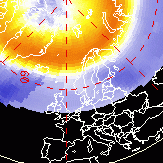
<a href="http://www.vwkweb.nl/" rel="nofollow" target="_blank">[b]Vereniging voor weerkunde en klimatologie[/b]</a>
<a href="http://www.estofex.org/" rel="nofollow" target="_blank">[b]ESTOFEX[/b]</a>
<a href="http://www.estofex.org/" rel="nofollow" target="_blank">[b]ESTOFEX[/b]</a>

Want dat wil ik echt niet.quote:Op maandag 2 augustus 2010 16:58 schreef luckyb1rd het volgende:
schijnt maar een kleintje te zijn, hooguit wat lichtspectakel in noorden van zweden..
booring.... wij ik willen een dikke X KLasse zonnevlam
Als het niet met een hamer te repareren is, is het een elektrisch probleem.
De Aarde kan vanaf vandaag geraakt worden door een zonnestorm, na grote explosies van de zon gedurende het voorbije weekend. Dat zeggen ruimtewetenschappers tegenover New Scientist.
De activiteit werd het voorbije weekend door verschillende satellieten waargenomen, waaronder de nieuwe Solar Dynamics Observatory van de Nasa. Die registreerde schokgolven die vanuit de zon recht richting Aarde de ruimte werden ingestuurd, meldt New Scientist.
Poollicht
Volgens experts kan deze golf vanaf vandaag onze planeet bereiken, en daar het natuurlijke magnetische schild rondom de Aarde verstoren. Naar verwachting zal dit mooie vertoningen van het poollicht tot gevolg hebben, maar er zijn ook minder fraaie gevolgen mogelijk. Wetenschappers hebben er al voor gewaarschuwd dat een grote zonne-eruptie funest kan zijn voor satellieten en wereldwijd communicatienetwerken kan verstoren.
Volgens Nasa kan een zware 'ruimtestorm' zelfs tot stroompannes leiden, al is het erg onwaarschijnlijk dat de storm die ons vandaag bereikt zo zwaar is. Eerder dit jaar stelden ruimtespecialisten dat ze een sterke stijging van magnetische energie verwachten eens de zon uit een 'diepe sluimering' ontwaakt, ergens rond 2013.
"Wonderbaarlijk vuurwerk"
In hoeverre de jongste uitbarsting een invloed kan hebben op onze communicatiesystemen, is onduidelijk. Maar dat ze uitzonderlijk is, staat vast. "De zon stak een wonderbaarlijk vuurwerk af", zegt de Britse experte Lucie Green van het Mullard Space Science Laboratory in Surrey. "Dit was een zeer zeldzame gebeurtenis: twee bijna gelijktijdige uitbarstingen op verschillende locaties werden richting de Aarde gelanceerd. Zulke uitbarstingen komen voor als enorme magnetische structuren in de zonne-atmosfeer hun stabiliteit verliezen en niet langer worden vastgehouden door de zwaartekracht van de zon. Vergelijk het met een gespannen veer die ineens wordt losgelaten."
"Beide uitbarstingen lijken onze kant uit te komen, maar ze kunnen aan verschillende snelheden reizen", vervolgt Green. "De kans is groot dat we er grote en langdurige effecten van zullen zien, zoals het noorderlicht." (hlnsydney/tw)
De activiteit werd het voorbije weekend door verschillende satellieten waargenomen, waaronder de nieuwe Solar Dynamics Observatory van de Nasa. Die registreerde schokgolven die vanuit de zon recht richting Aarde de ruimte werden ingestuurd, meldt New Scientist.
Poollicht
Volgens experts kan deze golf vanaf vandaag onze planeet bereiken, en daar het natuurlijke magnetische schild rondom de Aarde verstoren. Naar verwachting zal dit mooie vertoningen van het poollicht tot gevolg hebben, maar er zijn ook minder fraaie gevolgen mogelijk. Wetenschappers hebben er al voor gewaarschuwd dat een grote zonne-eruptie funest kan zijn voor satellieten en wereldwijd communicatienetwerken kan verstoren.
Volgens Nasa kan een zware 'ruimtestorm' zelfs tot stroompannes leiden, al is het erg onwaarschijnlijk dat de storm die ons vandaag bereikt zo zwaar is. Eerder dit jaar stelden ruimtespecialisten dat ze een sterke stijging van magnetische energie verwachten eens de zon uit een 'diepe sluimering' ontwaakt, ergens rond 2013.
"Wonderbaarlijk vuurwerk"
In hoeverre de jongste uitbarsting een invloed kan hebben op onze communicatiesystemen, is onduidelijk. Maar dat ze uitzonderlijk is, staat vast. "De zon stak een wonderbaarlijk vuurwerk af", zegt de Britse experte Lucie Green van het Mullard Space Science Laboratory in Surrey. "Dit was een zeer zeldzame gebeurtenis: twee bijna gelijktijdige uitbarstingen op verschillende locaties werden richting de Aarde gelanceerd. Zulke uitbarstingen komen voor als enorme magnetische structuren in de zonne-atmosfeer hun stabiliteit verliezen en niet langer worden vastgehouden door de zwaartekracht van de zon. Vergelijk het met een gespannen veer die ineens wordt losgelaten."
"Beide uitbarstingen lijken onze kant uit te komen, maar ze kunnen aan verschillende snelheden reizen", vervolgt Green. "De kans is groot dat we er grote en langdurige effecten van zullen zien, zoals het noorderlicht." (hlnsydney/tw)
Op zaterdag 28 juni 2014 @ 18:18 schreef Marie30 het volgende: Zo lief. :) Kusje :*
Op donderdag 14 juli 2016 @ 23:45 schreef GGMM het volgende: Het is altijd bijzonder gezellig als banaantje er is. :)
Op donderdag 14 juli 2016 @ 23:45 schreef GGMM het volgende: Het is altijd bijzonder gezellig als banaantje er is. :)
Mijn vraag is; wanneer kunnen we van dit schouwspel buiten iets zien?
Op zaterdag 28 juni 2014 @ 18:18 schreef Marie30 het volgende: Zo lief. :) Kusje :*
Op donderdag 14 juli 2016 @ 23:45 schreef GGMM het volgende: Het is altijd bijzonder gezellig als banaantje er is. :)
Op donderdag 14 juli 2016 @ 23:45 schreef GGMM het volgende: Het is altijd bijzonder gezellig als banaantje er is. :)


Op 538 was er aan het eind van de dag een of andere sterrekundige die beweerde van wel, dus ik ga vannacht wel buiten staan hopend op iets mooisquote:Op dinsdag 3 augustus 2010 12:00 schreef Scrummie het volgende:
Wij in NL? Ik gok van helemaal niet...
Are we not savages, innately destined to maim and kill?
Blame it on the environment, heredity or evolution: we're still responsible
Our intelligence may progress at geometric rates
Yet socially we remain belligerent neonates
Blame it on the environment, heredity or evolution: we're still responsible
Our intelligence may progress at geometric rates
Yet socially we remain belligerent neonates
Er is een KLEINE KANS .... Maar ik denk dat er niks komtquote:Op dinsdag 3 augustus 2010 23:11 schreef YuckFou het volgende:
[..]
Op 538 was er aan het eind van de dag een of andere sterrekundige die beweerde van wel, dus ik ga vannacht wel buiten staan hopend op iets moois
Hoezo niet..... die van 2003 heb je ook overleeft.quote:
[ Bericht 32% gewijzigd door -CRASH- op 03-08-2010 23:18:14 ]
<a href="http://www.vwkweb.nl/" rel="nofollow" target="_blank">[b]Vereniging voor weerkunde en klimatologie[/b]</a>
<a href="http://www.estofex.org/" rel="nofollow" target="_blank">[b]ESTOFEX[/b]</a>
<a href="http://www.estofex.org/" rel="nofollow" target="_blank">[b]ESTOFEX[/b]</a>
Het is bewolkt hier, niks te zien.
I'm surrounded by morons!
TRV geboekt 2027: Indonesië
TRV geboekt 2026: Peru, Nederland, Washington, Hammerfest, Leuven, Kopenhagen, Nederland, St. Maarten, Malta, Nederland, Barcelona-Napoli/Rome
TRV 2025:Zuid-Amerika, Nederland, Chicago, Washington, Nederland, Kroatië, Slovenië, Parijs/Brussel/Nijmegen/Kopenhagen, Griekenland, Nederland, Nederland, Oslo
TRV geboekt 2027: Indonesië
TRV geboekt 2026: Peru, Nederland, Washington, Hammerfest, Leuven, Kopenhagen, Nederland, St. Maarten, Malta, Nederland, Barcelona-Napoli/Rome
TRV 2025:Zuid-Amerika, Nederland, Chicago, Washington, Nederland, Kroatië, Slovenië, Parijs/Brussel/Nijmegen/Kopenhagen, Griekenland, Nederland, Nederland, Oslo
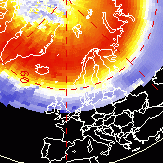
Tis nu wel een heftigge storm
<a href="http://www.vwkweb.nl/" rel="nofollow" target="_blank">[b]Vereniging voor weerkunde en klimatologie[/b]</a>
<a href="http://www.estofex.org/" rel="nofollow" target="_blank">[b]ESTOFEX[/b]</a>
<a href="http://www.estofex.org/" rel="nofollow" target="_blank">[b]ESTOFEX[/b]</a>
Wat kan ik hieruit opmaken? De aarde wordt dus wel geraakt door die flare? Ik keek net nog hoopvol naar buiten, maar zie niksquote:Op woensdag 4 augustus 2010 00:06 schreef -CRASH- het volgende:
Tis nu wel een heftigge storm
[ afbeelding ]
 Zal voor zover ik het begrijp ook wel niet gaan gebeuren. Jammer, want ik wil dat noorderlicht heel graag nog een keer zien. Dan maar een vakantie naar Scandinavië boeken..
Alle Urkers het land uit! Deporteer de burgemeester! Hier werken wij aan uw afzinking!!
De flare is aangekomen idd
<a href="http://www.vwkweb.nl/" rel="nofollow" target="_blank">[b]Vereniging voor weerkunde en klimatologie[/b]</a>
<a href="http://www.estofex.org/" rel="nofollow" target="_blank">[b]ESTOFEX[/b]</a>
<a href="http://www.estofex.org/" rel="nofollow" target="_blank">[b]ESTOFEX[/b]</a>
Hier iets ten oosten van Tilburg kleurt de Noordelijke hemel iets rood, zelfde als deze foto, alleen minder hevig:
http://www.spaceweather.c(...)10-1-_1280878430.jpg
http://www.spaceweather.c(...)10-1-_1280878430.jpg
Alle Urkers het land uit! Deporteer de burgemeester! Hier werken wij aan uw afzinking!!
Twitter de Twit..... TwitterPoollicht.nl
<a href="http://www.vwkweb.nl/" rel="nofollow" target="_blank">[b]Vereniging voor weerkunde en klimatologie[/b]</a>
<a href="http://www.estofex.org/" rel="nofollow" target="_blank">[b]ESTOFEX[/b]</a>
<a href="http://www.estofex.org/" rel="nofollow" target="_blank">[b]ESTOFEX[/b]</a>
http://www.vg.no/protokoll/?pid=723 <-- fotos uit Noorwegen, beetje naar onder scrollen en dan zie je de fotos. Klikken voor een grotere versie.
I'm surrounded by morons!
TRV geboekt 2027: Indonesië
TRV geboekt 2026: Peru, Nederland, Washington, Hammerfest, Leuven, Kopenhagen, Nederland, St. Maarten, Malta, Nederland, Barcelona-Napoli/Rome
TRV 2025:Zuid-Amerika, Nederland, Chicago, Washington, Nederland, Kroatië, Slovenië, Parijs/Brussel/Nijmegen/Kopenhagen, Griekenland, Nederland, Nederland, Oslo
TRV geboekt 2027: Indonesië
TRV geboekt 2026: Peru, Nederland, Washington, Hammerfest, Leuven, Kopenhagen, Nederland, St. Maarten, Malta, Nederland, Barcelona-Napoli/Rome
TRV 2025:Zuid-Amerika, Nederland, Chicago, Washington, Nederland, Kroatië, Slovenië, Parijs/Brussel/Nijmegen/Kopenhagen, Griekenland, Nederland, Nederland, Oslo


Oordeel zelfquote:Op woensdag 4 augustus 2010 09:19 schreef Frutsel het volgende:
Vanavond nieuwe kansen hoorde ik net?
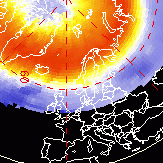
http://www.poollicht.be/
Poollicht chat Op dit moment is er niet veel te chatten.
Maar als er echt wat komt dan loopy het er storm....
Er zijn op dit moment GEEN poollicht kansen
[ Bericht 3% gewijzigd door -CRASH- op 04-08-2010 23:01:48 ]
<a href="http://www.vwkweb.nl/" rel="nofollow" target="_blank">[b]Vereniging voor weerkunde en klimatologie[/b]</a>
<a href="http://www.estofex.org/" rel="nofollow" target="_blank">[b]ESTOFEX[/b]</a>
<a href="http://www.estofex.org/" rel="nofollow" target="_blank">[b]ESTOFEX[/b]</a>

quote:Big solar flare captured on photo
One of the fastest big solar eruptions in years has been observed streaking away from the sun at more than 2.2 million mph by two NASA spacecraft.
The flare occurred Aug. 1 and created a massive sun eruption called a coronal mass ejection that struck Earth's magnetic field Tuesday, creating dazzling aurora displays. NASA's twin STEREO spacecraft recorded the eruption and beamed images of the sun storm back to Earth. ( Photo of the sun eruption.)
The material ejected from the sun was seen speeding toward Earth at more than 1,000 kilometers per second, or just over 2.2 million mph. Another wave from the event was expected to hit Earth's magnetic field on Wednesday. NASA's two STEREO spacecraft, which monitor the sun's weather in 3-D, also recorded a video of the sun eruption.
"These kinds of eruptions are one of the first signs that the sun is waking up and heading toward another solar maximum expected in the 2013 time frame," NASA officials said in a statement. The sun goes through a regular 11-year activity cycle. The last solar maximum occurred in 2001 and its recent extreme solar minimum was particularly weak and long-lasting, the space agency added.
Coronal mass ejections are eruptions of charged particles from the sun that stream out over several hours. They can contain several billion tons of plasma and expand away from the sun at speeds of up to 1 million mph. At such speeds, they can cross the 93 million-mile gulf between the Earth and sun in two to four days.
The material belched from the sun during the Aug. 1 flare is not expected to cause any disturbances on Earth other than creating spectacular auroras. Auroras are created when charged particles are caught by Earth's magnetic field and interact with the atmosphere above the poles.
The Aug. 1 solar flare was a moderate C-class flare. The coronal mass ejection it set off created a strong so-called geomagnetic storm that lasted nearly 12 hours enough time for auroras to spread from Europe to North America, NASA officials said in a statement.
Stronger solar storms could cause adverse impacts to space-based assets and technological infrastructure on Earth.
Konden we nu maar de achterkant van de zon zien.
Daar krioelt het van degrote zonnevlekken als ik het plaatje moet geloven....
Daar krioelt het van degrote zonnevlekken als ik het plaatje moet geloven....

<a href="http://www.vwkweb.nl/" rel="nofollow" target="_blank">[b]Vereniging voor weerkunde en klimatologie[/b]</a>
<a href="http://www.estofex.org/" rel="nofollow" target="_blank">[b]ESTOFEX[/b]</a>
<a href="http://www.estofex.org/" rel="nofollow" target="_blank">[b]ESTOFEX[/b]</a>
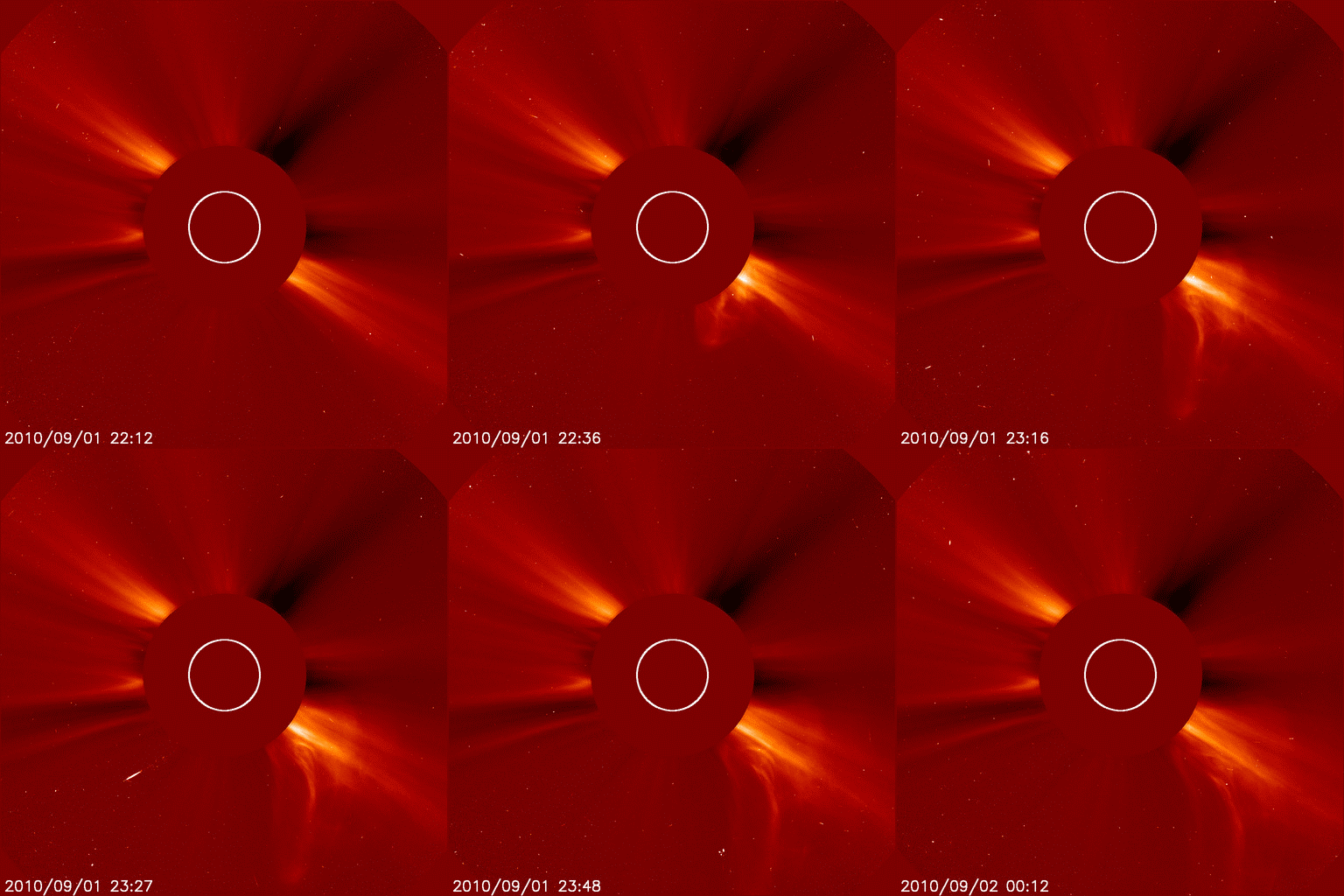
For the second day in a row NASA's STEREO-A spacecraft has detected a strong solar flare on the far side of the sun. Click here to view the flash of extreme UV radiation, which peaked at 21:55 UT on Sept. 1st. The blast also hurled a coronal mass ejection (CME) over the sun's southwestern limb:
The cloud is heading in the general direction of Saturn and poses no threat to Earth. Like the similar flare reported yesterday,
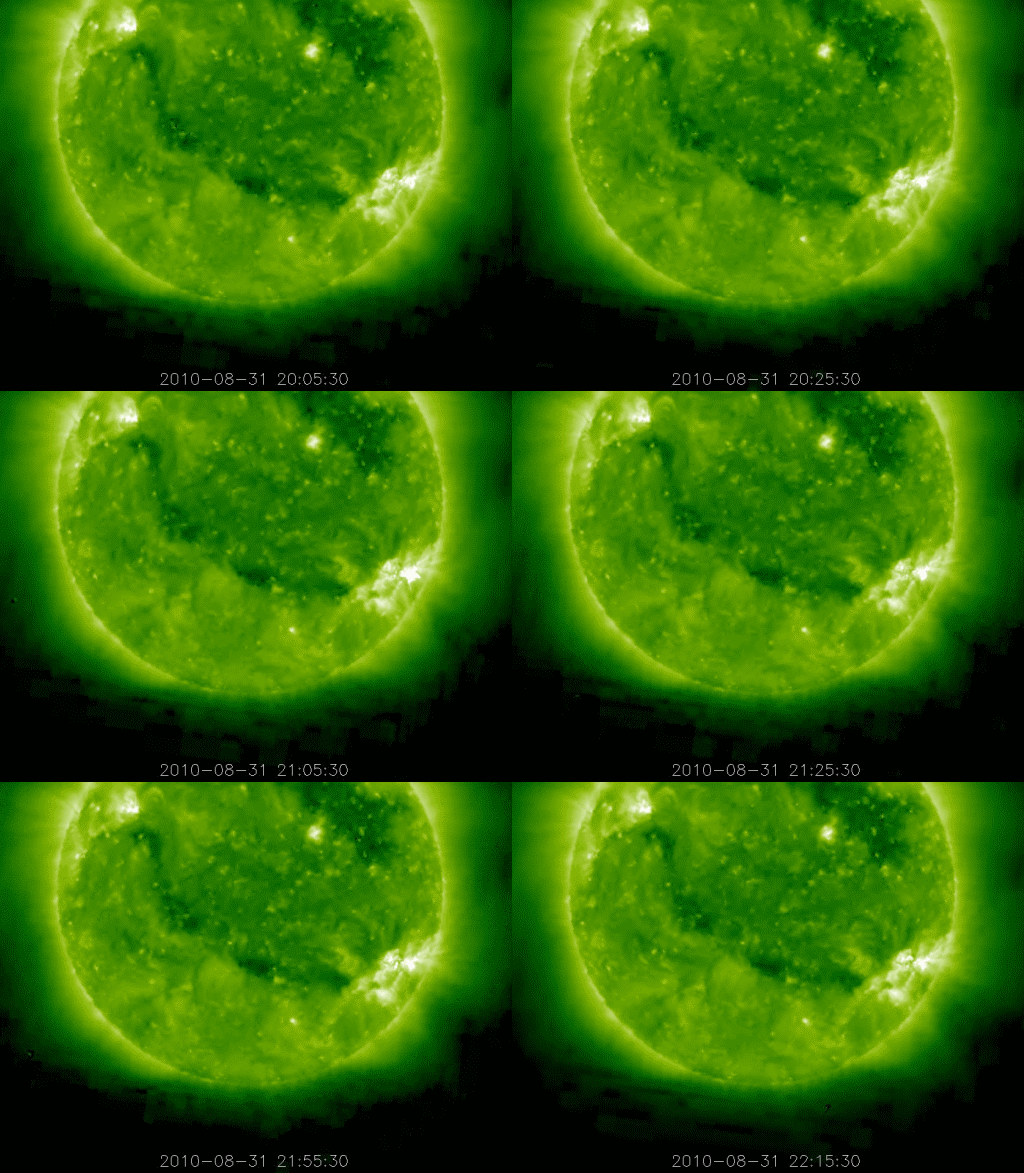
today's event was centered on old sunspot group 1100. Solar rotation will turn this active region back toward Earth for possible geoeffective action in about 7 to 9 days. Stay tuned!
In een week weer kansen dus op zonnnevlammen richting aarde
Solar Probe+ to Plunge Directly into Sun's Atmosphere
Sept. 2, 2010: NASA's daring plan to visit the sun took a giant leap forward today with the selection of five key science investigations for the Solar Probe+ spacecraft.
Slated to launch no later than 2018, the smart car-sized spacecraft will plunge directly into the atmosphere of the sun, aiming to solve some of the biggest mysteries of solar physics. Today's announcement means that researchers can begin building sensors for unprecedented in situ measurements of the solar system's innermost frontier.
"Solar Probe+ is going where no spacecraft has gone before," says Lika Guhathakurta, Solar Probe+ program scientist at NASA HQ. "For the first time, we'll be able to 'touch, taste and smell' the sun."
Last year, NASA invited top researchers around the world to submit proposals detailing possible science investigations for the pioneering spacecraft. Thirteen proposals were received and five have been selected:
--SWEAP,
the Solar Wind Electrons Alphas and Protons Investigation: The most abundant particles in the solar wind are electrons, protons and helium ions. SWEAP will count these particles and measure their properties, even "sweeping up" some of them in a special Solar Probe Cup for direct analysis. The principal investigator is Justin C. Kasper of the Smithsonian Astrophysical Observatory in Cambridge, Mass.
An artist's concept of Solar Probe+, heat shield up and solar panels folded. [more] --WISPR, the Wide-field Imager for Solar Probe Plus: WISPR is a telescope that will make 3D images of the sun's atmosphere similar to medical CAT scans. WISPR can actually see the solar wind, allowing it to image clouds and shock waves as they approach and pass the spacecraft. This telescope is an important complement to the spacecraft's in situ instruments, which sample the plasmas that WISPR images. The principal investigator is Russell Howard of the Naval Research Laboratory in Washington, DC.
--FIELDS,
The Fields Investigation for Solar Probe Plus: This instrument will make direct measurements of electric and magnetic fields, radio emissions, and shock waves which course through the sun's atmospheric plasma. FIELDS also turns Solar Probe Plus into a giant dust detector, registering voltage signatures when specks of space dust hit the spacecraft’s antenna. The principal investigator is Stuart Bale of the University of California in Berkeley.
--ISIS,
Integrated Science Investigation of the Sun: The ISIS EPI-Hi and EPI-Lo instruments will monitor electrons, protons and ions which are accelerated to high energies by shock waves in the sun's atmosphere. These are the very same particles that pose a threat to astronauts in space, disable satellites, and ionize Earth's upper atmosphere.
--Solar Probe+ Observatory Scientist:
This was a proposal not for an instrument, but for a person. The principal investigator, Marco Velli, becomes the mission's Observatory Scientist. In the years ahead, he will become deeply familiar with the spacecraft and its construction, helping to ensure that adjacent in situ instruments do not interfere with one another as they sample the solar environment. He will also guide the mission's "big picture" science investigations after Solar Probe+ enters the sun's atmosphere.
"The sensors we've selected to ride aboard Solar Probe+ are designed to solve some of the biggest mysteries of solar physics," says Dick Fisher, head of NASA's Heliophysics Division in Washington DC.
Solar Probe+ passes Venus en route to the sun. [animations] Why is the sun's atmosphere is so much hotter than its surface? And what propels the solar wind?
"We've been struggling with these questions for decades," says Fisher. "Solar Probe+ should finally provide some answers."
Solar Probe+ will likely discover new mysteries, too, in a realm that no other spacecraft has dared enter. At closest approach, Solar Probe+ will be 7 million km or 9 solar radii from the sun. There, the spacecraft's carbon-composite heat shield must withstand temperatures as high as 2000 degrees C and survive blasts of radiation that would quickly disable other missions. From these near distances inside the sun’s atmosphere, the solar disk will loom 23 times wider than it does in the skies of Earth.
"What will we find there?" wonders Guhathakurta. "This is truly unexplored territory." By design, Solar Probe's winning instruments are sufficiently versatile to investigate many different kinds of phenomena. Whatever comes along--be it electric or magnetic, high- or low-energy, wavy or turbulent--they should be able to measure it.
"The possibilities for discovery," she says, "are off the charts."
Author: Dr. Tony Phillips | Credit: Science@NASA
[/quote]
Sept. 2, 2010: NASA's daring plan to visit the sun took a giant leap forward today with the selection of five key science investigations for the Solar Probe+ spacecraft.
Slated to launch no later than 2018, the smart car-sized spacecraft will plunge directly into the atmosphere of the sun, aiming to solve some of the biggest mysteries of solar physics. Today's announcement means that researchers can begin building sensors for unprecedented in situ measurements of the solar system's innermost frontier.
"Solar Probe+ is going where no spacecraft has gone before," says Lika Guhathakurta, Solar Probe+ program scientist at NASA HQ. "For the first time, we'll be able to 'touch, taste and smell' the sun."

Last year, NASA invited top researchers around the world to submit proposals detailing possible science investigations for the pioneering spacecraft. Thirteen proposals were received and five have been selected:
--SWEAP,
the Solar Wind Electrons Alphas and Protons Investigation: The most abundant particles in the solar wind are electrons, protons and helium ions. SWEAP will count these particles and measure their properties, even "sweeping up" some of them in a special Solar Probe Cup for direct analysis. The principal investigator is Justin C. Kasper of the Smithsonian Astrophysical Observatory in Cambridge, Mass.
An artist's concept of Solar Probe+, heat shield up and solar panels folded. [more] --WISPR, the Wide-field Imager for Solar Probe Plus: WISPR is a telescope that will make 3D images of the sun's atmosphere similar to medical CAT scans. WISPR can actually see the solar wind, allowing it to image clouds and shock waves as they approach and pass the spacecraft. This telescope is an important complement to the spacecraft's in situ instruments, which sample the plasmas that WISPR images. The principal investigator is Russell Howard of the Naval Research Laboratory in Washington, DC.
--FIELDS,
The Fields Investigation for Solar Probe Plus: This instrument will make direct measurements of electric and magnetic fields, radio emissions, and shock waves which course through the sun's atmospheric plasma. FIELDS also turns Solar Probe Plus into a giant dust detector, registering voltage signatures when specks of space dust hit the spacecraft’s antenna. The principal investigator is Stuart Bale of the University of California in Berkeley.
--ISIS,
Integrated Science Investigation of the Sun: The ISIS EPI-Hi and EPI-Lo instruments will monitor electrons, protons and ions which are accelerated to high energies by shock waves in the sun's atmosphere. These are the very same particles that pose a threat to astronauts in space, disable satellites, and ionize Earth's upper atmosphere.
--Solar Probe+ Observatory Scientist:
This was a proposal not for an instrument, but for a person. The principal investigator, Marco Velli, becomes the mission's Observatory Scientist. In the years ahead, he will become deeply familiar with the spacecraft and its construction, helping to ensure that adjacent in situ instruments do not interfere with one another as they sample the solar environment. He will also guide the mission's "big picture" science investigations after Solar Probe+ enters the sun's atmosphere.
"The sensors we've selected to ride aboard Solar Probe+ are designed to solve some of the biggest mysteries of solar physics," says Dick Fisher, head of NASA's Heliophysics Division in Washington DC.
Solar Probe+ passes Venus en route to the sun. [animations] Why is the sun's atmosphere is so much hotter than its surface? And what propels the solar wind?
"We've been struggling with these questions for decades," says Fisher. "Solar Probe+ should finally provide some answers."
Solar Probe+ will likely discover new mysteries, too, in a realm that no other spacecraft has dared enter. At closest approach, Solar Probe+ will be 7 million km or 9 solar radii from the sun. There, the spacecraft's carbon-composite heat shield must withstand temperatures as high as 2000 degrees C and survive blasts of radiation that would quickly disable other missions. From these near distances inside the sun’s atmosphere, the solar disk will loom 23 times wider than it does in the skies of Earth.
"What will we find there?" wonders Guhathakurta. "This is truly unexplored territory." By design, Solar Probe's winning instruments are sufficiently versatile to investigate many different kinds of phenomena. Whatever comes along--be it electric or magnetic, high- or low-energy, wavy or turbulent--they should be able to measure it.
"The possibilities for discovery," she says, "are off the charts."
Author: Dr. Tony Phillips | Credit: Science@NASA
[/quote]
<a href="http://www.vwkweb.nl/" rel="nofollow" target="_blank">[b]Vereniging voor weerkunde en klimatologie[/b]</a>
<a href="http://www.estofex.org/" rel="nofollow" target="_blank">[b]ESTOFEX[/b]</a>
<a href="http://www.estofex.org/" rel="nofollow" target="_blank">[b]ESTOFEX[/b]</a>
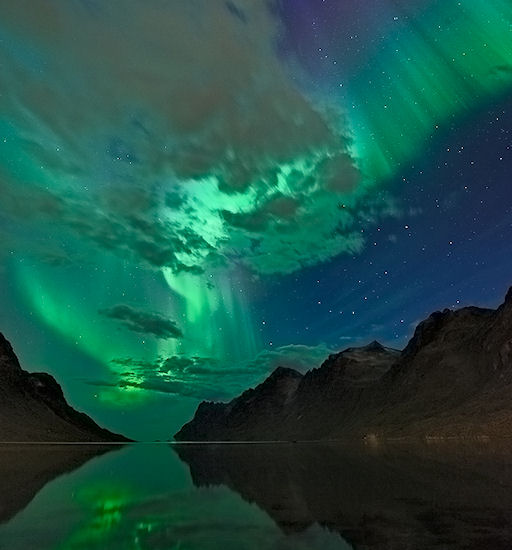
Prachtige foto's weer van het Noorderlicht van gisteren uit Noorwegen
Zie ook:
Geen zonnevlekken na 2016: Kleine ijstijd op komst?
Zie ook:
Geen zonnevlekken na 2016: Kleine ijstijd op komst?
