W&T Wetenschap & Technologie
Een plek om te discussiëren over wetenschappelijke onderwerpen, wetenschappelijke problemen, technologische projecten en grootse uitvindingen.



"73P/Schwassmann-Wachmann 3 is approaching Earth--and fast"quote:Op maandag 17 april 2006 12:54 schreef Frutsel het volgende:
Nog een interessant stuk over een komeet die de aarde in mei passeert en die in stukken gevallen is. (zie ook de Frontpage waarop één of andere gast beweert dat delen er van op 25-5 gaan inslaan)
http://science.nasa.gov/headlines/y2006/24mar_73p.htm
Weet nie of het een apart topic waardig is en waar het anders in zou moeten

says amateur astronomer Guillaume Poulin (Mont-Mégantic Observatory)
who made this movie of fragment B traveling 36,000 mph on April 11th.
Not shown in Poulin's movie are 19 other fragments of the comet also heading our way.
The swarm will pass only 6 million miles from Earth on May 12th-14th, providing a
marvelous view to anyone with a backyard telescope:
Lees Verder....
[ Bericht 32% gewijzigd door -CRASH- op 17-04-2006 14:41:14 ]
<a href="http://www.vwkweb.nl/" rel="nofollow" target="_blank">[b]Vereniging voor weerkunde en klimatologie[/b]</a>
<a href="http://www.estofex.org/" rel="nofollow" target="_blank">[b]ESTOFEX[/b]</a>
<a href="http://www.estofex.org/" rel="nofollow" target="_blank">[b]ESTOFEX[/b]</a>


Kunnen we die kometen hier in Nederland ook zien?

LastFM
03/06 Maccabees - 10/06 Gaslight Anthem - 18/06 Oi Vai Voi - 20/06 Green Beats - 24/06 Ghinzu - 18/07 Extrema Outdoor
03/06 Maccabees - 10/06 Gaslight Anthem - 18/06 Oi Vai Voi - 20/06 Green Beats - 24/06 Ghinzu - 18/07 Extrema Outdoor
quote:Op maandag 17 april 2006 14:47 schreef -skippybal- het volgende:
Kunnen we die kometen hier in Nederland ook zien?

How to Spot a Crumbling Comet
How bright will the comet get?
Nobody can quite say for sure. While it was much brighter than normal at its return in 2000, it was only about 1/6 as bright as it appeared after its 1995 breakup. This fading trend is likely to continue for 2006, but counteracting this is the fact that the comet will approach Earth very closely during mid May. So it still should get at least as bright as fifth magnitude, making it an easy binocular object, as well as making it dimly visible to the unaided eye.
<a href="http://www.vwkweb.nl/" rel="nofollow" target="_blank">[b]Vereniging voor weerkunde en klimatologie[/b]</a>
<a href="http://www.estofex.org/" rel="nofollow" target="_blank">[b]ESTOFEX[/b]</a>
<a href="http://www.estofex.org/" rel="nofollow" target="_blank">[b]ESTOFEX[/b]</a>


(SPACE.com) -- Three medium-sized planets of roughly the same mass as Neptune have been discovered around a nearby sun-like star, scientists announced today.
The planets were discovered around HD 69830, a star slightly less massive than the sun located 41 light-years away in the constellation Puppis (the Stern), using the ultra-precise HARPS spectrograph on the European Southern Observatory's 3.6-meter La Silla telescope in Chile.
The finding, detailed in the May 18 issue of the journal Nature, marks a first for astronomers because previously discovered multi-planet solar systems besides our own contain at least one giant, Jupiter-sized planet.
"For the first time, we have discovered a planetary system composed of several Neptune-mass planets," said study team member Christophe Lovis of the Geneva Observatory in Switzerland.
The setup is similar to our own solar system in many ways: The outermost planet is located just within the star's habitable zone, where temperatures are moderate enough for liquid water to form, and the system also contains an asteroid belt.
The newly discovered planets have masses of about 10, 12 and 18 times that of Earth and they zip around the star in rapid orbits of about 9, 32 and 197 days, respectively.
Based on their distances from the star, two inner worlds nearest the star are rocky planets similar to Mercury, the scientists suspect. The outermost planet is thought to have a solid core of rock and ice and is shrouded by a thick gas envelope.
Recent observations by NASA's Spitzer Space Telescope last year revealed that HD 69830 also hosts an asteroid belt, making it the only other sun-like star known to have one.
When the asteroid belt was found, it was suspected that there might be an unseen planet that was shepherding the asteroids; it now seems that there is more than one shepherd. The researchers think the asteroid belt could lie between the two outermost planets or beyond the third planet.
The planets have not been photographed. They were found using the Doppler, or "wobble," technique, in which astronomers infer the presence of a planet by measuring the gravitational influence it exerts on its parent star. This technique was used to find most of the more than 180 planets so far discovered.
In the early years of planet hunting, the wobble technique was sensitive enough to spot only large, massive planets because they produce more significant stellar wobbles. However, the technique has since been refined to the point where lower-mass planets can now be detected
The planets were discovered around HD 69830, a star slightly less massive than the sun located 41 light-years away in the constellation Puppis (the Stern), using the ultra-precise HARPS spectrograph on the European Southern Observatory's 3.6-meter La Silla telescope in Chile.
The finding, detailed in the May 18 issue of the journal Nature, marks a first for astronomers because previously discovered multi-planet solar systems besides our own contain at least one giant, Jupiter-sized planet.
"For the first time, we have discovered a planetary system composed of several Neptune-mass planets," said study team member Christophe Lovis of the Geneva Observatory in Switzerland.
The setup is similar to our own solar system in many ways: The outermost planet is located just within the star's habitable zone, where temperatures are moderate enough for liquid water to form, and the system also contains an asteroid belt.
The newly discovered planets have masses of about 10, 12 and 18 times that of Earth and they zip around the star in rapid orbits of about 9, 32 and 197 days, respectively.
Based on their distances from the star, two inner worlds nearest the star are rocky planets similar to Mercury, the scientists suspect. The outermost planet is thought to have a solid core of rock and ice and is shrouded by a thick gas envelope.
Recent observations by NASA's Spitzer Space Telescope last year revealed that HD 69830 also hosts an asteroid belt, making it the only other sun-like star known to have one.
When the asteroid belt was found, it was suspected that there might be an unseen planet that was shepherding the asteroids; it now seems that there is more than one shepherd. The researchers think the asteroid belt could lie between the two outermost planets or beyond the third planet.
The planets have not been photographed. They were found using the Doppler, or "wobble," technique, in which astronomers infer the presence of a planet by measuring the gravitational influence it exerts on its parent star. This technique was used to find most of the more than 180 planets so far discovered.
In the early years of planet hunting, the wobble technique was sensitive enough to spot only large, massive planets because they produce more significant stellar wobbles. However, the technique has since been refined to the point where lower-mass planets can now be detected
STS-121 at the Pad: NASA's Discovery Shuttle Reaches Launch Site
[sup]By Tariq Malik Staff Writer posted: 19 May 2006 06:28 am ET[/sup
This story was updated at 9:30 p.m. EDT.
CAPE CANAVERAL, Fla. – The space shuttle Discovery is back at the launch pad as workers prepare the spaceplane for NASA’s second orbiter mission since the 2003 Columbia accident.
A massive crawler carrier hauled Discovery and its mobile launch platform up to Pad 29B at the Kennedy Space Center (KSC) here more than seven hours after leaving the shelter of NASA’s Vehicle Assembly Building (VAB) at about 12:45 p.m. EDT (1645 GMT).
“It’s a fabulous feeling to see that we’re rolling Discovery back to the launch pad for our next launch attempt,” NASA’s shuttle program manager Wayne Hale told reporters after riding with the orbiter as it left the VAB. “I think we’re on a really good path to make that July 1 window opening day.”
Lees verder.....
[sup]By Tariq Malik Staff Writer posted: 19 May 2006 06:28 am ET[/sup

This story was updated at 9:30 p.m. EDT.
CAPE CANAVERAL, Fla. – The space shuttle Discovery is back at the launch pad as workers prepare the spaceplane for NASA’s second orbiter mission since the 2003 Columbia accident.
A massive crawler carrier hauled Discovery and its mobile launch platform up to Pad 29B at the Kennedy Space Center (KSC) here more than seven hours after leaving the shelter of NASA’s Vehicle Assembly Building (VAB) at about 12:45 p.m. EDT (1645 GMT).
“It’s a fabulous feeling to see that we’re rolling Discovery back to the launch pad for our next launch attempt,” NASA’s shuttle program manager Wayne Hale told reporters after riding with the orbiter as it left the VAB. “I think we’re on a really good path to make that July 1 window opening day.”
Lees verder.....
<a href="http://www.vwkweb.nl/" rel="nofollow" target="_blank">[b]Vereniging voor weerkunde en klimatologie[/b]</a>
<a href="http://www.estofex.org/" rel="nofollow" target="_blank">[b]ESTOFEX[/b]</a>
<a href="http://www.estofex.org/" rel="nofollow" target="_blank">[b]ESTOFEX[/b]</a>
Hm. Het is de Amerikanen niet gelukt. Nu maar hopen dat we het hier in Europa kunnen laten werken! ESA wil dit óók gaan testen, voordat ze de MSR gaan lanceren...
Spacecraft collision due to catalogue of errors
A failed NASA mission, in which a spacecraft crashed into a satellite instead of autonomously docking with it, suffered serious problems with its navigation systems, according to a summary report on the the official investigation, released on Monday.
The $110 million DART mission – Demonstration of Autonomous Rendezvous Technology – went awry in April 2005. At the time of the crash, reads the report: “DART was flying toward [the satellite] at 1.5 metres per second while its navigational system thought it was 130 metres away and retreating at 0.3 metres per second.”
 ESA wil dit óók gaan testen, voordat ze de MSR gaan lanceren...
Spacecraft collision due to catalogue of errors
A failed NASA mission, in which a spacecraft crashed into a satellite instead of autonomously docking with it, suffered serious problems with its navigation systems, according to a summary report on the the official investigation, released on Monday.
The $110 million DART mission – Demonstration of Autonomous Rendezvous Technology – went awry in April 2005. At the time of the crash, reads the report: “DART was flying toward [the satellite] at 1.5 metres per second while its navigational system thought it was 130 metres away and retreating at 0.3 metres per second.”
Here we are, Cronenberg Morty! A reality where everyone in the world got genetically Cronenberged. We'll fit right in, Cronenberg Morty. It'll be like we never even left Cronenberg World.
Had ik deze hier al neergeplempt? Ik heb d'r ook doorheen mogen kruipen om de besturing van de upper stage te controleren, zo'n 7 dagen voor de lancering...
 Ik heb d'r ook doorheen mogen kruipen om de besturing van de upper stage te controleren, zo'n 7 dagen voor de lancering...

Here we are, Cronenberg Morty! A reality where everyone in the world got genetically Cronenberged. We'll fit right in, Cronenberg Morty. It'll be like we never even left Cronenberg World.
GUILTYquote:Op dinsdag 23 mei 2006 00:07 schreef Phooka het volgende:
Had ik deze hier al neergeplempt? Ik heb d'r ook doorheen mogen kruipen om de besturing van de upper stage te controleren, zo'n 7 dagen voor de lancering...
[afbeelding]
 GUILTY
<a href="http://www.vwkweb.nl/" rel="nofollow" target="_blank">[b]Vereniging voor weerkunde en klimatologie[/b]</a>
<a href="http://www.estofex.org/" rel="nofollow" target="_blank">[b]ESTOFEX[/b]</a>
<a href="http://www.estofex.org/" rel="nofollow" target="_blank">[b]ESTOFEX[/b]</a>
En Voyager 2 laat ook nog wat van zich " horen "
Voyager 2 Detects Odd Shape of Solar System's Edge
By Ker Than Staff Writer posted: 23 May 2006 03:54 pm ET
Voyager 2 could pass beyond the outermost layer of our solar system, called the "termination shock," sometime within the next year, NASA scientists announced at a media teleconference today.
The milestone, which comes about a year after Voyager 1's crossing, comes earlier than expected and suggests to scientists that the edge of the shock is about one billion miles closer to the Sun in the southern region of the solar system than in the north.
Lees verder....
Voyager 2 Detects Odd Shape of Solar System's Edge
By Ker Than Staff Writer posted: 23 May 2006 03:54 pm ET

Voyager 2 could pass beyond the outermost layer of our solar system, called the "termination shock," sometime within the next year, NASA scientists announced at a media teleconference today.
The milestone, which comes about a year after Voyager 1's crossing, comes earlier than expected and suggests to scientists that the edge of the shock is about one billion miles closer to the Sun in the southern region of the solar system than in the north.
Lees verder....
<a href="http://www.vwkweb.nl/" rel="nofollow" target="_blank">[b]Vereniging voor weerkunde en klimatologie[/b]</a>
<a href="http://www.estofex.org/" rel="nofollow" target="_blank">[b]ESTOFEX[/b]</a>
<a href="http://www.estofex.org/" rel="nofollow" target="_blank">[b]ESTOFEX[/b]</a>
Hahaha - hm. Ach ja, ik mis Frans Guyana... Naast de lanceerbasis zijn er ook veel andere interessante zaken, daar.quote:
 Naast de lanceerbasis zijn er ook veel andere interessante zaken, daar.
Here we are, Cronenberg Morty! A reality where everyone in the world got genetically Cronenberged. We'll fit right in, Cronenberg Morty. It'll be like we never even left Cronenberg World.
LIVE Coverage: Delta 4 Rocket Poised to Launch GOES-N Weather Satellitequote:Op dinsdag 23 mei 2006 23:08 schreef Phooka het volgende:
[..]
Hahaha - hm. Ach ja, ik mis Frans Guyana... Naast de lanceerbasis zijn er ook veel andere interessante zaken, daar.
UH...... Je gaat toch niet naar Cape Canaveral hé

<a href="http://www.vwkweb.nl/" rel="nofollow" target="_blank">[b]Vereniging voor weerkunde en klimatologie[/b]</a>
<a href="http://www.estofex.org/" rel="nofollow" target="_blank">[b]ESTOFEX[/b]</a>
<a href="http://www.estofex.org/" rel="nofollow" target="_blank">[b]ESTOFEX[/b]</a>
Nee, niet direct. De Amerikanen plaatsen veel te veel restricties op buitenlandse werknemers in de ruimtevaartindustrie, ook omdat het vrijwel allemaal onder export control valt. Overigens is dat een grote hindernis voor elke vorm van samenwerking. Maar goed, het volstaat om te zeggen dat het me niet plezierig werken lijkt...quote:Op woensdag 24 mei 2006 22:47 schreef -CRASH- het volgende:
[..]
LIVE Coverage: Delta 4 Rocket Poised to Launch GOES-N Weather Satellite
UH...... Je gaat toch niet naar Cape Canaveral hé
Here we are, Cronenberg Morty! A reality where everyone in the world got genetically Cronenberged. We'll fit right in, Cronenberg Morty. It'll be like we never even left Cronenberg World.
Leuke dingen van de Mars Exploration Program Analysis group
http://mepag.jpl.nasa.gov/Mars_Science_Links.html
http://mepag.jpl.nasa.gov/Mars_Science_Links.html
Here we are, Cronenberg Morty! A reality where everyone in the world got genetically Cronenberged. We'll fit right in, Cronenberg Morty. It'll be like we never even left Cronenberg World.
Ik post dit bericht maar hier omdat dit het juiste topic hiervoor is
Op 1 juli 2006 zal na ruim een jaar opnieuw de Space shuttle Discovery gelanceerd worden. Wat verwachten jullie van deze missie en zullen er opnieuw problemen zijn met het hitteschild?
Klik hier voor meer informatie over deze missie.
Op 1 juli 2006 zal na ruim een jaar opnieuw de Space shuttle Discovery gelanceerd worden. Wat verwachten jullie van deze missie en zullen er opnieuw problemen zijn met het hitteschild?
Klik hier voor meer informatie over deze missie.
Nu ja, het kan, hè, dat er weer problemen komen. Overigens hebben ze nu wel een nieuw stuk gereedschap van NEPTEC aan boord, geloof ik.quote:Op maandag 29 mei 2006 20:02 schreef Freek99 het volgende:
Op 1 juli 2006 zal na ruim een jaar opnieuw de Space shuttle Discovery gelanceerd worden. Wat verwachten jullie van deze missie en zullen er opnieuw problemen zijn met het hitteschild?
Ik heb eigenlijk nog niet nagedacht over m'n verwachtingen. Ik raak een beetje gedesillusioneerd wat betreft de Amerikaanse ruimtevaart... Ze schrappen erg veel mooie projecten, en ook de CEV laat erg lang op zich wachten. Ws. wordt het ding óók nog te zwaar en te duur...
Here we are, Cronenberg Morty! A reality where everyone in the world got genetically Cronenberged. We'll fit right in, Cronenberg Morty. It'll be like we never even left Cronenberg World.
Astronomers on Earth will have ringside seats to a face-off between two of the biggest storms in the solar system.
In one corner will be Jupiter's Great Red Spot, a behemoth of a tempest that is twice as large as Earth and whose 350 miles per hour winds have been whirling for hundreds of years.
Its contender will be Oval BA, also known as "Red Jr.," a young six-year storm that is only half Great Red's size but whose winds are just as fierce.
The two are approaching each other now and are expected to have their closest approach on the Fourth of July, according to Amy Simon-Miller, an astronomer at Goddard Space Flight Center in Maryland who has been monitoring the storms.
"There won't be a head-on collision," Simon-Miller said. "The Great Red Spot is not going to 'eat' Oval BA or anything like that."
However, the storms' outer bands are expected to pass close to one another and it's anybody's guess what will happen when they do.
This isn't the first time that such an encounter has happened. In fact, the two storms typically pass each other every two years or so.
Similar encounters happened in 2002 and 2004, but they were very anti-climactic. Aside from some "roughing" around the edges, both storms came out unscathed.
This time might be different, however, said Simon-Miller. Red Jr. could revert to its original color and change from red to white. From 2000 to 2005, Red Jr. was actually white and no different form the many other small "white ovals" circling the planet.
But in 2006, astronomers noticed a change: a red vortex formed inside the storm, the same color as the powerful Great Red Spot. Scientists believe the color change was a sign that the storm was intensifying.
Scientists think the Great Red Spot could push Oval BA toward a southern jet stream on the planet during their upcoming encounter. The jet stream blows against Oval BA's counterclockwise rotation and could slow its spin, possibly changing the storm's color back to white.
The color of the Great Red Spot itself is a mystery. According to one popular theory, the storm dredges up material from deep inside Jupiter's atmosphere, lofting it above the highest clouds where ultraviolet rays from the Sun turn color-changing compounds, called "chromophores," red.
In one corner will be Jupiter's Great Red Spot, a behemoth of a tempest that is twice as large as Earth and whose 350 miles per hour winds have been whirling for hundreds of years.
Its contender will be Oval BA, also known as "Red Jr.," a young six-year storm that is only half Great Red's size but whose winds are just as fierce.
The two are approaching each other now and are expected to have their closest approach on the Fourth of July, according to Amy Simon-Miller, an astronomer at Goddard Space Flight Center in Maryland who has been monitoring the storms.
"There won't be a head-on collision," Simon-Miller said. "The Great Red Spot is not going to 'eat' Oval BA or anything like that."
However, the storms' outer bands are expected to pass close to one another and it's anybody's guess what will happen when they do.
This isn't the first time that such an encounter has happened. In fact, the two storms typically pass each other every two years or so.
Similar encounters happened in 2002 and 2004, but they were very anti-climactic. Aside from some "roughing" around the edges, both storms came out unscathed.
This time might be different, however, said Simon-Miller. Red Jr. could revert to its original color and change from red to white. From 2000 to 2005, Red Jr. was actually white and no different form the many other small "white ovals" circling the planet.
But in 2006, astronomers noticed a change: a red vortex formed inside the storm, the same color as the powerful Great Red Spot. Scientists believe the color change was a sign that the storm was intensifying.
Scientists think the Great Red Spot could push Oval BA toward a southern jet stream on the planet during their upcoming encounter. The jet stream blows against Oval BA's counterclockwise rotation and could slow its spin, possibly changing the storm's color back to white.
The color of the Great Red Spot itself is a mystery. According to one popular theory, the storm dredges up material from deep inside Jupiter's atmosphere, lofting it above the highest clouds where ultraviolet rays from the Sun turn color-changing compounds, called "chromophores," red.

NASA Targets July 1 for STS-121 Launch
17 June 2006, 3:44 p.m. EDT
CAPE CANAVERAL, Fla.
The space shuttle Discovery will launch on July 1
at 3:48:15 p.m. EDT (1948:15 GMT), NASA said Saturday.
The date came after a two-day Flight Readiness Review meeting here at
NASA’s Kennedy Space Center (KSC) spaceport.
Despite some debate, and two conditional ‘No-Go’ decisions by senior officials,
shuttle managers and engineers gave Discovery the go-ahead for NASA’s STS-121 mission.
17 June 2006, 3:44 p.m. EDT
CAPE CANAVERAL, Fla.
The space shuttle Discovery will launch on July 1
at 3:48:15 p.m. EDT (1948:15 GMT), NASA said Saturday.
The date came after a two-day Flight Readiness Review meeting here at
NASA’s Kennedy Space Center (KSC) spaceport.
Despite some debate, and two conditional ‘No-Go’ decisions by senior officials,
shuttle managers and engineers gave Discovery the go-ahead for NASA’s STS-121 mission.
<a href="http://www.vwkweb.nl/" rel="nofollow" target="_blank">[b]Vereniging voor weerkunde en klimatologie[/b]</a>
<a href="http://www.estofex.org/" rel="nofollow" target="_blank">[b]ESTOFEX[/b]</a>
<a href="http://www.estofex.org/" rel="nofollow" target="_blank">[b]ESTOFEX[/b]</a>

In dat jaar dat de Discovery stil gestaan heeft hadden ze haar op z'n minst een keer kunnen wassen.

Deze foto is van 23 mei 2006.
Wat zien die dingen er gebruikt uit zeg!
Okay, ik heb het even aangepast:
Orbiter: Discovery
Missie: STS-121
Lancering: 1 juli 2006
Tijd: 21:49 uur (NL)
Plaats: Lanceerplatform 39B,
Kennedy Space Center, Florida
Landing: 13 juli 2006, 17:01 uur (NL)
Het zijn de Nederlandse tijden
[ Bericht 76% gewijzigd door Freek99 op 23-06-2006 09:40:26 ]
Orbiter: Discovery
Missie: STS-121
Lancering: 1 juli 2006
Tijd: 21:49 uur (NL)
Plaats: Lanceerplatform 39B,
Kennedy Space Center, Florida
Landing: 13 juli 2006, 17:01 uur (NL)
Het zijn de Nederlandse tijden

[ Bericht 76% gewijzigd door Freek99 op 23-06-2006 09:40:26 ]
Dit valt onder spam. Twee post erboven staat al in bericht tijden, maar in het engels. Je kan ook gewoon tijdhier zetten ipv je sitequote:Op donderdag 22 juni 2006 11:45 schreef Freek99 het volgende:
Voor de mensen die niet weten op welke tijd Space Shuttle Discovery vertrekt en waar de lancering live te volgen is: klik hier
Edit: is aangepast
[ Bericht 2% gewijzigd door AstroNova op 24-06-2006 12:47:14 ]
Spacecraft Set for Moon Impact Sept. 3
Mission managers today said they’ve started to move the lunar-orbiting SMART-1 spacecraft into position for a Sept. 3 crash landing. The thruster firings will prevent the mission from ending before a little more science can be squeezed out.
As European Space Agency officials put it: “The recently started maneuver campaign aims to avoid having the spacecraft intersect with the Moon at a disadvantageous time from the scientific point of view.”
The impact has been planned for months, but was slated for Sept. 1 or 2. One goal of the moves announced today is to make sure the craft hits the Moon at a spot and time that will allow astronomers to watch it to see what’s kicked up.
“The shift in date, time and location for Moon intersection is … optimized to favor scientific observations from Earth,” said Gerhard Schwehm, ESA’s SMART-1 Mission Manager. “Projections based on the current orbit indicated that the spacecraft, if left as is, would impact the Moon on the far side, away from ground contact and visibility. The new location is on the Moon’s near-side, at mid-southern latitudes.”
Earth Surrounded by Giant Fizzy Bubbles
By Robert Roy Britt
Senior Science Writer
posted: 20 June 2006
12:00 pm ET
The space above you is fizzing with activity as bubbles of superhot gas constantly grow and pop around Earth, scientists announced today.
Astronomers found the activity up where Earth's magnetic field meets a constant stream of particles flowing out from the Sun.
While space is commonly called a vacuum, in fact there is gas everywhere, albeit not as dense as the air you breathe.
Lees verder....
[ Bericht 20% gewijzigd door -CRASH- op 23-06-2006 19:44:24 ]
Mission managers today said they’ve started to move the lunar-orbiting SMART-1 spacecraft into position for a Sept. 3 crash landing. The thruster firings will prevent the mission from ending before a little more science can be squeezed out.
As European Space Agency officials put it: “The recently started maneuver campaign aims to avoid having the spacecraft intersect with the Moon at a disadvantageous time from the scientific point of view.”
The impact has been planned for months, but was slated for Sept. 1 or 2. One goal of the moves announced today is to make sure the craft hits the Moon at a spot and time that will allow astronomers to watch it to see what’s kicked up.
“The shift in date, time and location for Moon intersection is … optimized to favor scientific observations from Earth,” said Gerhard Schwehm, ESA’s SMART-1 Mission Manager. “Projections based on the current orbit indicated that the spacecraft, if left as is, would impact the Moon on the far side, away from ground contact and visibility. The new location is on the Moon’s near-side, at mid-southern latitudes.”
Earth Surrounded by Giant Fizzy Bubbles
By Robert Roy Britt
Senior Science Writer
posted: 20 June 2006
12:00 pm ET
The space above you is fizzing with activity as bubbles of superhot gas constantly grow and pop around Earth, scientists announced today.
Astronomers found the activity up where Earth's magnetic field meets a constant stream of particles flowing out from the Sun.
While space is commonly called a vacuum, in fact there is gas everywhere, albeit not as dense as the air you breathe.
Lees verder....
[ Bericht 20% gewijzigd door -CRASH- op 23-06-2006 19:44:24 ]
<a href="http://www.vwkweb.nl/" rel="nofollow" target="_blank">[b]Vereniging voor weerkunde en klimatologie[/b]</a>
<a href="http://www.estofex.org/" rel="nofollow" target="_blank">[b]ESTOFEX[/b]</a>
<a href="http://www.estofex.org/" rel="nofollow" target="_blank">[b]ESTOFEX[/b]</a>
Deze Close encounters: Asteroiden op ramkoers is nu ook Centraal... voor alle nieuwsberichten / documentatie / onderzoeken of resultaten over Asteroides / Kometen
Morgen is de kans dat het weer niet doorgaat 60%.quote:Op zaterdag 1 juli 2006 22:03 schreef -CRASH- het volgende:
[..]
En ze zijn nog niet weg
vanwege de onweers wolken in de buurt.
Te volgen op Nasa TV
door dezelfde weersomstandigheden
[ Bericht 37% gewijzigd door -CRASH- op 01-07-2006 22:40:28 ]
<a href="http://www.vwkweb.nl/" rel="nofollow" target="_blank">[b]Vereniging voor weerkunde en klimatologie[/b]</a>
<a href="http://www.estofex.org/" rel="nofollow" target="_blank">[b]ESTOFEX[/b]</a>
<a href="http://www.estofex.org/" rel="nofollow" target="_blank">[b]ESTOFEX[/b]</a>
Hoe laat zou die nu moeten vertrekken?? Weer even op Nasa TV kijken

LastFM
03/06 Maccabees - 10/06 Gaslight Anthem - 18/06 Oi Vai Voi - 20/06 Green Beats - 24/06 Ghinzu - 18/07 Extrema Outdoor
03/06 Maccabees - 10/06 Gaslight Anthem - 18/06 Oi Vai Voi - 20/06 Green Beats - 24/06 Ghinzu - 18/07 Extrema Outdoor

48 uur uitgesteld

LastFM
03/06 Maccabees - 10/06 Gaslight Anthem - 18/06 Oi Vai Voi - 20/06 Green Beats - 24/06 Ghinzu - 18/07 Extrema Outdoor
03/06 Maccabees - 10/06 Gaslight Anthem - 18/06 Oi Vai Voi - 20/06 Green Beats - 24/06 Ghinzu - 18/07 Extrema Outdoor
IImpact of Foam Crack On Shuttle Launch Still Uncertain
Image of the external fuel tank area showing the liquid oxygen feedline bracket.
The location of the foam crack is circled in red.
Credit: NASA
Shuttle's Foam Crack Could Delay Launch

Image of the external fuel tank area showing the liquid oxygen feedline bracket.
The location of the foam crack is circled in red.
Credit: NASA
Shuttle's Foam Crack Could Delay Launch
<a href="http://www.vwkweb.nl/" rel="nofollow" target="_blank">[b]Vereniging voor weerkunde en klimatologie[/b]</a>
<a href="http://www.estofex.org/" rel="nofollow" target="_blank">[b]ESTOFEX[/b]</a>
<a href="http://www.estofex.org/" rel="nofollow" target="_blank">[b]ESTOFEX[/b]</a>
Een aantal minuten geleden een Iridiumsattaliet gekiekt.
Zag hem net iets te laat.....
23:18
Zag hem net iets te laat.....
23:18
<a href="http://www.vwkweb.nl/" rel="nofollow" target="_blank">[b]Vereniging voor weerkunde en klimatologie[/b]</a>
<a href="http://www.estofex.org/" rel="nofollow" target="_blank">[b]ESTOFEX[/b]</a>
<a href="http://www.estofex.org/" rel="nofollow" target="_blank">[b]ESTOFEX[/b]</a>

Ik weet niet of deze al eens genoemd is, maar hier vind je echt alle info over de Apollo-vluchten, de techniek, vluchtschema's, enz. enz.
www.project-apollo.info
In het Nederlands, dus leest ook lekker weg
[ Bericht 24% gewijzigd door #ANONIEM op 15-07-2006 15:07:07 ]
www.project-apollo.info
In het Nederlands, dus leest ook lekker weg
[ Bericht 24% gewijzigd door #ANONIEM op 15-07-2006 15:07:07 ]
Twee 'planeten zonder ster' ontdekt
Sterrenkundigen hebben twee bijzondere planeten ontdekt. Terwijl de meeste planeten om een ster draaien, doen deze twee dat om elkaar. De ontdekking staat in het Britse blad New Scientist.
Verrassing
De sterrenkundigen zijn verrast door de vondst en weten niet precies hoe dergelijke hemellichamen hebben kunnen ontstaan. De planeten liggen op ongeveer 400 lichtjaren van de aarde.
Afstand
De tussenliggende afstand is ongeveer 240 keer zo groot als die tussen de aarde en de zon. De planeten zijn gevonden met behulp van een telescoop in Chili.
Sterrenkundigen hebben twee bijzondere planeten ontdekt. Terwijl de meeste planeten om een ster draaien, doen deze twee dat om elkaar. De ontdekking staat in het Britse blad New Scientist.
Verrassing
De sterrenkundigen zijn verrast door de vondst en weten niet precies hoe dergelijke hemellichamen hebben kunnen ontstaan. De planeten liggen op ongeveer 400 lichtjaren van de aarde.
Afstand
De tussenliggende afstand is ongeveer 240 keer zo groot als die tussen de aarde en de zon. De planeten zijn gevonden met behulp van een telescoop in Chili.
Toen ik het eerst het bericht las dacht ik aan een paar bruine dwergen.....quote:Op vrijdag 4 augustus 2006 08:23 schreef Frutsel het volgende:
Twee 'planeten zonder ster' ontdekt
Sterrenkundigen hebben twee bijzondere planeten ontdekt. Terwijl de meeste planeten om een ster draaien, doen deze twee dat om elkaar. De ontdekking staat in het Britse blad New Scientist.
Verrassing
De sterrenkundigen zijn verrast door de vondst en weten niet precies hoe dergelijke hemellichamen hebben kunnen ontstaan. De planeten liggen op ongeveer 400 lichtjaren van de aarde.
Afstand
De tussenliggende afstand is ongeveer 240 keer zo groot als die tussen de aarde en de zon. De planeten zijn gevonden met behulp van een telescoop in Chili.
Oddball Objects: Neither Stars or Planets
<a href="http://www.vwkweb.nl/" rel="nofollow" target="_blank">[b]Vereniging voor weerkunde en klimatologie[/b]</a>
<a href="http://www.estofex.org/" rel="nofollow" target="_blank">[b]ESTOFEX[/b]</a>
<a href="http://www.estofex.org/" rel="nofollow" target="_blank">[b]ESTOFEX[/b]</a>
quote:SPACE.com Exclusive: Spectacular Meteor Shower Possible for 2007
A spectacular meteor shower might be in the offing late next summer, SPACE.com has learned.
It may not last very long, but could produce a bevy of bright, swift shooting stars for favorably positioned skywatchers. The prediction is found in a technical report, co-authored by two astronomers who are targeting Sept. 1, 2007 as the date for the potential display.
The meteors are called "Aurigids" because they appear to fan-out from the constellation of Auriga, the Charioteer.
At least a strong shower
Meteor showers occur whenever we ride into the dusty debris left behind in a comet's orbit. The debris left behind by Kiess, a comet last seen in 1911, is what produces the Aurigids. The comet takes approximately 2,500 years to orbit the Sun, but there are also dense trails of dust traveling along its orbit. Earth has had glancing blows in the past with a few of these dust trails in 1935, 1986 and 1994.
In 2007, however, the Earth is expected to pass very close to the center of a dust trail, which astronomers Esko Lyytinen of Finland and Peter Jenniskens of NASA's SETI Institute in California said, should result in "a spectacularly rich shower of bright meteors."
Verder lezen klik bovenstaande link

<a href="http://www.vwkweb.nl/" rel="nofollow" target="_blank">[b]Vereniging voor weerkunde en klimatologie[/b]</a>
<a href="http://www.estofex.org/" rel="nofollow" target="_blank">[b]ESTOFEX[/b]</a>
<a href="http://www.estofex.org/" rel="nofollow" target="_blank">[b]ESTOFEX[/b]</a>
Nederlands berichtje over mogelijke meteorenregenquote:Op donderdag 17 augustus 2006 21:04 schreef -CRASH- het volgende:
SPACE.com Exclusive: Spectacular Meteor Shower Possible for 2007
*knip*

quote:NASA's Spitzer Digs Up Troves of Possible Solar Systems in Orion
For Release: August 14, 2006
Spitser Image Gallery
Astronomers have long scrutinized the vast and layered clouds of the Orion nebula, an industrious star-making factory visible to the naked eye in the sword of the famous hunter constellation. Yet, Orion is still full of secrets.
A new image from NASA's Spitzer Space Telescope probes deep into the clouds of dust that permeate the nebula and its surrounding regions. The striking false-color picture shows pinkish swirls of dust speckled with stars, some of which are orbited by disks of planet-forming dust.
Spitzer, with its powerful infrared vision, was able to unearth nearly 2,300 such planet-forming disks in the Orion cloud complex, a collection of turbulent star-forming clouds that includes the well-known Orion nebula.
The disks -- made of gas and dust that whirl around young suns -- are too small and distant to be seen by visible-light telescopes; however, the infrared glow of their warm dust is easily spotted by Spitzer's infrared detectors. Each disk has the potential to form planets and its own solar system.
"This is the most complete census of young stars with disks in the Orion cloud complex," said Dr. Thomas Megeath of the University of Toledo, Ohio, who led the research. "Basically, we have a census of potential solar systems, and we want to know how many are born in the cities, how many in small towns, and how many out in the countryside."
A look at Orion's demographics reveals that the potential solar systems populate a variety of environments. Megeath and his colleagues found that about 60 percent of the disk-sporting stars in the Orion cloud complex inhabit its bustling "cities," or clusters, containing hundreds of young stars. About 15 percent reside in small outer communities, and a surprising 25 percent prefer to go it alone, living in isolation.
Prior to the Spitzer observations, scientists thought that up to 90 percent of young stars, both with and without disks, dwelled in cities like those of Orion.
"The Orion image shows that many stars also appear to form in isolation or in groups of just a few stars," said team member Dr. John Stauffer of NASA's Spitzer Science Center at the California Institute of Technology in Pasadena. "These new data may help us to determine the type of environment in which our sun formed."
Astronomers do not know whether our middle-aged sun grew up in the stellar equivalent of the city or countryside, though most favor a large city scenario. Newborn stars like the ones in Orion tend to drift away from their siblings over time, so it is hard to trace an adult star's origins.
Megeath and his colleagues estimate that about 60 to 70 percent of the stars in the Orion cloud complex have disks. "It is an interesting question why this number isn't 100 percent. Eventually, we may be able to understand why some stars don't have disks," said Megeath.
Spitzer's infrared vision also dug up 200 stellar embryos in the Orion cloud complex, most of which had never been seen before. Stellar embryos are still too young to have developed disks.
The Orion cloud complex is about 1,450 light-years from Earth and spans about 240 light-years of space. Spitzer's wide field of view allowed it to survey most of the complex, an area of the sky equivalent to 28 full moons. The featured image shows a slice of this survey, the equivalent of four full moons-worth of sky, and includes the Orion nebula itself.
NASA's Jet Propulsion Laboratory, Pasadena, Calif., manages the Spitzer Space Telescope mission for NASA's Science Mission Directorate, Washington. Science operations are conducted at the Spitzer Science Center. Caltech manages JPL for NASA. Spitzer's infrared array camera, which made the observations, was built by NASA's Goddard Space Flight Center, Greenbelt, Md. The instrument's principal investigator is Dr. Giovanni Fazio of the Harvard-Smithsonian Center for Astrophysics.

<a href="http://www.vwkweb.nl/" rel="nofollow" target="_blank">[b]Vereniging voor weerkunde en klimatologie[/b]</a>
<a href="http://www.estofex.org/" rel="nofollow" target="_blank">[b]ESTOFEX[/b]</a>
<a href="http://www.estofex.org/" rel="nofollow" target="_blank">[b]ESTOFEX[/b]</a>
Geplant is 6 Septemberquote:Op donderdag 31 augustus 2006 16:27 schreef the_disheaver het volgende:
is het al bekend wanneer STS-115 (atlantis) de lucht in gaat?
---------------------------------------------------------------------------------------
quote:SMART-1 to Crash the Moon
August 30, 2006: Amateur astronomers, grab your telescopes. A spaceship is about to crash into the Moon, and you may be able to see the impact.
The spacecraft: SMART-1, a lunar orbiter belonging to the European Space Agency (ESA).
The impact site: Lacus Excellentiae (The Lake of Excellence), an ancient, 100-mile wide crater in the Moon's southern hemisphere.
The time to watch: Saturday, September 2nd at 10:41 p.m. PDT (Sept. 3rd, 0541 UT).
Right: The impact site, with current moon phase shown. Updated daily. Image courtesy: ESA.
Why is SMART-1 crashing? There's nothing wrong with the spacecraft, which is wrapping up a successful 3-year mission to the Moon. SMART-1's main job was to test a European-built ion engine. It worked beautifully, propelling the craft in 2003 on a unique spiral path from Earth to the Moon. From lunar orbit, SMART-1 took thousands of high-resolution pictures and made mineral maps of the Moon's terrain. One of its most important discoveries was a "Peak of Eternal Light," a mountaintop near the Moon's north pole in constant, year-round sunlight. Peaks of Eternal Light are prime real estate for solar-powered Moon bases.
But now SMART-1 is running low on fuel. It has to come down sometime—and soon—so ESA mission scientists decided to crash it in a place where the crash can be seen from Earth and studied.
When SMART-1 hits the ground, it will explode in a flash of light. This won't be the sort of explosion we'd see on Earth. The Moon has no oxygen to support fire or combustion. Instead, the flash will be caused by rocks and soil made so hot by the impact that they suddenly glow.
The area will be in complete darkness at the moment of impact, so much the better to see the flash. How bright will it be? No one knows. Estimates range from 7th to 15th magnitude. In other words, it might be bright enough for backyard telescopes--or so dim that even big professional observatories won't see a thing. The only way to find out is to look. Observing tips may be found here (ALPO), here (ESA) and, in many languages, here (REA Brazil).
"We'll be watching," says Bill Cooke, the head of NASA's Meteoroid Environment Office at the Marshall Space Flight Center in Huntsville, Alabama. "Measuring the brightness of SMART-1's impact is important to our research."
His group at the Marshall Space Flight Center has spent the last year watching things hit the Moon—not spacecraft, but meteoroids. "The Moon is under constant bombardment from meteoroids," says Cooke. "They hit the ground and explode just like SMART-1 will do." The Moon actually sparkles, slowly and faintly, as one space rock after another hits the ground.
Above: Possible SMART-1 impact times and coordinates. Image courtesy: ESA.
Cooke's group has a knack for this kind of work: Using only two small telescopes, they've spotted eight meteoroid impacts this year, almost doubling the number of confirmed sightings in all of the history of astronomy before 2006. Cooke attributes their success to improvements in digital video cameras, which they use to record the brief flashes.
Lunar impacts interest NASA greatly. Astronauts are going back to the Moon and "we need to know what kind of danger meteoroids pose to both people and Moon bases," explains Cooke. How often do they hit? And what kind of damage do they do?
Think of SMART-1 as a controlled, man-made meteoroid impact, he says. "We know exactly how much kinetic energy SMART-1 packs. And, if all goes well, we're going to see how bright a flash it makes. This will help us interpret our meteoroid data."
When SMART-1 hits, it won't plunge straight into the ground. "The spacecraft will enter Lacus Excellentiae at a shallow angle, only a few degrees from horizontal," notes Cooke. For this reason, it will gouge a long, narrow crater, about a meter wide and many meters long. The grazing impact should kick up a plume of debris—no one knows how high. If it rises high enough, the plume might catch some sunlight and become visible to telescopes on Earth. The chances of this, however, are slim. The main event is the flash of heat and light at the "point" of impact.
Another side-effect of the shallow approach is uncertainty about when, exactly, SMART-1 will strike. The spacecraft is due to glide low over the floor of Lacus Excellentiae several times on Sept. 3rd. Mission controllers believe it will hit on orbit number 2890 at 0541 UT. But it could equally well hit one orbit earlier or one orbit later. Possibilities are summarized in the table, above. The nominal impact time favors observers in western parts of North America and across the Pacific Ocean. Depending on when SMART-1 hits, however, almost anyone could catch the flash.


[ Bericht 0% gewijzigd door -CRASH- op 31-08-2006 23:27:50 ]
<a href="http://www.vwkweb.nl/" rel="nofollow" target="_blank">[b]Vereniging voor weerkunde en klimatologie[/b]</a>
<a href="http://www.estofex.org/" rel="nofollow" target="_blank">[b]ESTOFEX[/b]</a>
<a href="http://www.estofex.org/" rel="nofollow" target="_blank">[b]ESTOFEX[/b]</a>
Geslaagde impact.....
quote:LUNAR FLASH:
Europe's SMART-1 spacecraft crashed into the Moon this morning at 0542 UT. The resulting flash was too faint for most backyard telescopes, but a team of astronomers using the big 3.6m CFH telescope in Hawaii did photograph the explosion:
Credit: Canada-France-Hawaii Telescope / 2006 More Images
The flash in this animation is an infrared flash. It shows heat generated by the spacecraft's 4500 mph impact into the lunar surface near the edge of Lacus Excellentiae (34.4 S, 46.2 W).
Lacus Excellentiae was in darkness when SMART-1 hit--the better to see the flash. Tomorrow, however, the sun will come up, illuminating the impact site. Amateur and professional astronomers will scour the area for additional signs of the crash.
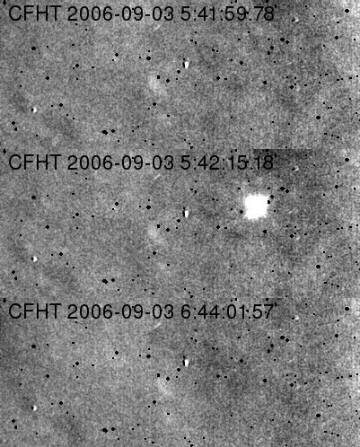
<a href="http://www.vwkweb.nl/" rel="nofollow" target="_blank">[b]Vereniging voor weerkunde en klimatologie[/b]</a>
<a href="http://www.estofex.org/" rel="nofollow" target="_blank">[b]ESTOFEX[/b]</a>
<a href="http://www.estofex.org/" rel="nofollow" target="_blank">[b]ESTOFEX[/b]</a>
<a href="http://www.vwkweb.nl/" rel="nofollow" target="_blank">[b]Vereniging voor weerkunde en klimatologie[/b]</a>
<a href="http://www.estofex.org/" rel="nofollow" target="_blank">[b]ESTOFEX[/b]</a>
<a href="http://www.estofex.org/" rel="nofollow" target="_blank">[b]ESTOFEX[/b]</a>


<a href="http://www.vwkweb.nl/" rel="nofollow" target="_blank">[b]Vereniging voor weerkunde en klimatologie[/b]</a>
<a href="http://www.estofex.org/" rel="nofollow" target="_blank">[b]ESTOFEX[/b]</a>
<a href="http://www.estofex.org/" rel="nofollow" target="_blank">[b]ESTOFEX[/b]</a>
Pluto is niet meer...... voortaan heet het 134340
Pluto is Now Just a Number
Pluto is Now Just a Number
<a href="http://www.vwkweb.nl/" rel="nofollow" target="_blank">[b]Vereniging voor weerkunde en klimatologie[/b]</a>
<a href="http://www.estofex.org/" rel="nofollow" target="_blank">[b]ESTOFEX[/b]</a>
<a href="http://www.estofex.org/" rel="nofollow" target="_blank">[b]ESTOFEX[/b]</a>
wow intressante topic dit hier veel bij te lezen
 veel bij te lezen
Leef en laat leven, alles mag niks moet.
http://wildpassion.be
http://wildpassion.be
http://wildpassion.be
http://wildpassion.be
http://wildpassion.be
http://wildpassion.be
Surprises from the Edge of the Solar System
Sept. 21, 2006: Almost every day, the great antennas of NASA's Deep Space Network turn to a blank patch of sky in the constellation Ophiuchus. Pointing at nothing, or so it seems, they invariably pick up a signal, faint but full of intelligence. The source is beyond Neptune, beyond Pluto, on the verge of the stars themselves.
It's Voyager 1. The spacecraft left Earth in 1977 on a mission to visit Jupiter and Saturn. Almost 30 years later, with the gas giants long ago seen and done, Voyager 1 is still going and encountering some strange things.
Lees verder.....

Sept. 21, 2006: Almost every day, the great antennas of NASA's Deep Space Network turn to a blank patch of sky in the constellation Ophiuchus. Pointing at nothing, or so it seems, they invariably pick up a signal, faint but full of intelligence. The source is beyond Neptune, beyond Pluto, on the verge of the stars themselves.
It's Voyager 1. The spacecraft left Earth in 1977 on a mission to visit Jupiter and Saturn. Almost 30 years later, with the gas giants long ago seen and done, Voyager 1 is still going and encountering some strange things.
Lees verder.....
<a href="http://www.vwkweb.nl/" rel="nofollow" target="_blank">[b]Vereniging voor weerkunde en klimatologie[/b]</a>
<a href="http://www.estofex.org/" rel="nofollow" target="_blank">[b]ESTOFEX[/b]</a>
<a href="http://www.estofex.org/" rel="nofollow" target="_blank">[b]ESTOFEX[/b]</a>
NASA Loses Contact With Mars Global Surveyor
NASA's Mars Global Surveyor (MGS) spacecraft has failed to check in with Earth for the fifth straight day in a row, after losing contact during a routine adjustment of its solar array.
On Nov. 2, MGS mangers sent commands for the spacecraft to adjust the position of one of its solar power arrays to better track the sun. Returning data indicated a problem with the motor that moves the array, so a backup motor and control circuitry were switched on.
No signal was received on Nov. 3 and 4, but a weak signal was received on Nov. 5, suggesting the spacecraft had switched to a safe mode and was awaiting further instructions from Earth. The signal cut out completely later that day and nothing has been heard since.
Lees Verder....
Dat is geen goed teken......
NASA's Mars Global Surveyor (MGS) spacecraft has failed to check in with Earth for the fifth straight day in a row, after losing contact during a routine adjustment of its solar array.
On Nov. 2, MGS mangers sent commands for the spacecraft to adjust the position of one of its solar power arrays to better track the sun. Returning data indicated a problem with the motor that moves the array, so a backup motor and control circuitry were switched on.
No signal was received on Nov. 3 and 4, but a weak signal was received on Nov. 5, suggesting the spacecraft had switched to a safe mode and was awaiting further instructions from Earth. The signal cut out completely later that day and nothing has been heard since.
Lees Verder....
Dat is geen goed teken......
<a href="http://www.vwkweb.nl/" rel="nofollow" target="_blank">[b]Vereniging voor weerkunde en klimatologie[/b]</a>
<a href="http://www.estofex.org/" rel="nofollow" target="_blank">[b]ESTOFEX[/b]</a>
<a href="http://www.estofex.org/" rel="nofollow" target="_blank">[b]ESTOFEX[/b]</a>

Als je het artikel goed doorleest hebben ze het over mei 2006, dus die komeet is allang voorbij.quote:Op maandag 17 april 2006 14:34 schreef -CRASH- het volgende:
[..]
"73P/Schwassmann-Wachmann 3 is approaching Earth--and fast"
[afbeelding]
says amateur astronomer Guillaume Poulin (Mont-Mégantic Observatory)
who made this movie of fragment B traveling 36,000 mph on April 11th.
Not shown in Poulin's movie are 19 other fragments of the comet also heading our way.
The swarm will pass only 6 million miles from Earth on May 12th-14th, providing a
marvelous view to anyone with a backyard telescope:
Lees Verder....
quote:Op vrijdag 10 november 2006 21:51 schreef Schonedal het volgende:
[..]
Als je het artikel goed doorleest hebben ze het over mei 2006, dus die komeet is allang voorbij.

<a href="http://www.vwkweb.nl/" rel="nofollow" target="_blank">[b]Vereniging voor weerkunde en klimatologie[/b]</a>
<a href="http://www.estofex.org/" rel="nofollow" target="_blank">[b]ESTOFEX[/b]</a>
<a href="http://www.estofex.org/" rel="nofollow" target="_blank">[b]ESTOFEX[/b]</a>
Ik had wel verwacht dat die foto's al hier zouden staan, maar kennelijk waren er nog meer interessante plaatjes. Nog ff wachten dusquote:Op vrijdag 10 november 2006 21:30 schreef Frutsel het volgende:
zag net beelden op CNN van een mega-hurricane op saturnus...
interessante foto's!
Update, Nov. 21, 4 p.m. PST:quote:Op vrijdag 10 november 2006 19:14 schreef -CRASH- het volgende:
NASA Loses Contact With Mars Global Surveyor
NASA's Mars Global Surveyor (MGS) spacecraft has failed to check in with Earth for the fifth straight day in a row, after losing contact during a routine adjustment of its solar array.
On Nov. 2, MGS mangers sent commands for the spacecraft to adjust the position of one of its solar power arrays to better track the sun. Returning data indicated a problem with the motor that moves the array, so a backup motor and control circuitry were switched on.
No signal was received on Nov. 3 and 4, but a weak signal was received on Nov. 5, suggesting the spacecraft had switched to a safe mode and was awaiting further instructions from Earth. The signal cut out completely later that day and nothing has been heard since.
Lees Verder....
Dat is geen goed teken......
Mars Global Surveyor Mission Ends In Triumph

<a href="http://www.vwkweb.nl/" rel="nofollow" target="_blank">[b]Vereniging voor weerkunde en klimatologie[/b]</a>
<a href="http://www.estofex.org/" rel="nofollow" target="_blank">[b]ESTOFEX[/b]</a>
<a href="http://www.estofex.org/" rel="nofollow" target="_blank">[b]ESTOFEX[/b]</a>
|
|
