POL Politiek
Discussies en diepgaande gesprekken over de politiek in de breedste zin van het woord kun je hier voeren.



Xi jinping is ook geblokkeerd in de zoekfunctie samen met een paar andere termen.quote:Op maandag 30 september 2024 14:53 schreef Gimmick het volgende:
[..]
Prima joh. Kun jij mij zo'n kritisch item aanwijzen op de frontpage van Weibo? https://m.weibo.cn/
Als ik zoekt op '习近平' krijg je nul resultaten. 580 miljoen gebruikers, maar de zoekmachine geeft niets terug als je zoekt op de naam van de president.
https://m.weibo.cn/search(...)A0%E8%BF%91%E5%B9%B3
Bijvoorbeeld: https://m.weibo.cn/status/5039306808755661
🇨🇳🇻🇳🇱🇦🇨🇺🇰🇵🇷🇺☭


Dus op mijn vraag om met een voorbeeld te komen van kritiek op Weibo's frontpage kom je met een bericht uit mei met nul reacties en 1 forward waarvan dit de kritiek is?quote:Op maandag 30 september 2024 15:25 schreef Mikeytt het volgende:
[..]
Xi jinping is ook geblokkeerd in de zoekfunctie samen met een paar andere termen.
Bijvoorbeeld: https://m.weibo.cn/status/5039306808755661
[ x ]
Ik ben nog niet heel erg onder de indruk van de mate van kritiek op de Chinese overheid.quote:Idiots are gathering together again. We criticize the government and society in order to make them better, so that we can get more protection, services and a better living environment. The same is true for the emerging industry of live streaming. We should take standardized management seriously in order to develop healthily, so as to provide more space for the survival of ordinary people. Otherwise, will we allow some monsters to destroy this industry?
Everyone can do what they want and say what they want. Why must everyone be unified? If you want to criticize the root causes of social problems, you require everyone to criticize. If you don’t want to criticize the vulgar and obscene phenomena in live streaming, you don’t allow others to criticize. Is there a possibility that one person can’t do everything, and only when different people do different things can the whole society be better?
In addition, who can the future development of society rely on if not ordinary people? Times create heroes, and ordinary people create times.
Where does this evil trend come from when people always stand in line, divide camps, oppose and put big hats on others?
I am a black hole shitting into the void

quote:Op zaterdag 28 september 2024 19:36 schreef Peppert het volgende:
We zullen dit maar de vierde week noemen. Ik ben toch thuis uit mijn neus aan het vreten: geen sport en werk op zaterdag. Iets eerder dan 1 oktober voor de geïnteresseerden. Als dit soort spam niet gewenst is dan hoor ik het graag. Een of twee reacties en ik houd natuurlijk mee op. Zo niet dan een nieuwe update rond 15 oktober.We zullen dit maar de vijfde week noemen. Ik probeer het zoveel mogelijk te houden bij wat ze al aan het uitvoeren zijn en laat plannen op papier zoveel mogelijk links liggen. De volgende update rond 15 november.SPOILEROm spoilers te kunnen lezen moet je zijn ingelogd. Je moet je daarvoor eerst gratis Registreren. Ook kun je spoilers niet lezen als je een ban hebt.SPOILEROm spoilers te kunnen lezen moet je zijn ingelogd. Je moet je daarvoor eerst gratis Registreren. Ook kun je spoilers niet lezen als je een ban hebt.2. Ze zijn sinds 2013 bezig met de lancering van Gaofen observatiesatellieten in de ruimte. Deze week ook weer de plaatsing van een Gaofen observatiesatelliet in de ruimte. Volgens Wiki gaat het om een constellatie van 35/36 Gaofen observatiesatellieten in de ruimte. Daarnaast hebben ze ook nog een andere serie genaamd Yaogan observatiesatellieten. In totaal dus rond de 144/145 Yaogan observatiesatellieten en 35/36 Gaofen observatiesatellieten in de ruimte voor een totaal van grofweg 180.
https://en.wikipedia.org/wiki/Gaofen
https://en.wikipedia.org/wiki/Yaogan3. Een van de denktanks die ik hoog in het vaandel heb staan is CSET. Ze hebben een onderzoek gedaan naar de Chinese Academie van Wetenschappen (CAS). Die geven veruit het meest uit aan basisonderzoek in het land: $8.8 miljard dollar in 2023. Dat is goed voor 30% van de uitgaven aan basisonderzoek in het land in 2023.quote:China launches new Gaofen-12 remote sensing satellite
China added a fifth Gaofen-12 satellite to its national Earth observation system Tuesday, while providing no details regarding its capabilities. A Long March 4C rocket lifted off at 7:45 p.m. (2345 UTC) from Jiuquan Satellite Launch Center in the Gobi Desert. The Shanghai Academy of Spaceflight Technology (SAST) confirmed launch success and revealed the payload to be Gaofen-12 (05).
The satellite successfully entered its predetermined orbit, according to the SAST statement. It is likely to join the four existing Gaofen-12 satellites in roughly circular 630-kilometer-altitude orbits inclined by 98 degrees, indicating a sun-synchronous orbit.
The Gaofen-12 (05) (“High resolution-12 (05)”) satellite is nominally part of the civilian China High-resolution Earth Observation System (CHEOS). CHEOS satellites are equipped with different imaging technologies such as optical, infrared and synthetic aperture radar (SAR).
The first Gaofen satellite was launched in 2013. The CHEOS system aims to provide all-time, all-weather Earth observation coverage. Commercial Chinese Earth observation constellations, notably optical and SAR, have since emerged in China, adding to comprehensive remote sensing coverage.
Chinese state media reported the Gaofen-12 (05) satellite will be used in a variety of fields including land surveys, urban planning, road network design, crop yield estimation and disaster relief.
The lack of publicly available information, however, suggests the satellite could be in part intended for military customers. It could also be a civilian counterpart to a Yaogan satellite used for military applications.
Resolution capabilities and other information has been published for lower numbered Gaofen series satellites. However, information for Gaofen satellites numbered 8 and above has not been openly released, suggesting the satellites are for national defense purposes.
Gaofen-11 satellites are believed to have an aperture of around 1.5 meters. They are able to deliver optical imagery at a resolution on the order of 10 centimeters, according to the Chinese Society for Geodesy, Photogrammetry and Cartography.
Tuesday’s mission was China’s 49th orbital launch attempt of 2024. It followed the launch of a second group of 18 satellites for the Qianfan/Thousand megaconstellation. The project aims to put around 14,000 flat panel communications satellites into low Earth orbit.
China is preparing to send the Shenzhou-19 crewed mission to the Tiangong space station around the end of October. Three as yet unknown astronauts will join the Shenzhou-18 crew aboard Tiangong and take over residency of the space station. The Tianzhou-8 cargo resupply mission is expected to follow in November, launching on a Long March 7 rocket from Wenchang.
Bron: https://spacenews.com/chi(...)e-sensing-satellite/
Basisonderzoek heeft als eerste doel om kennis te vergaren en niet als eerste prioriteit productontwikkeling. Wat maakt CSET zo sterk. Wel, het heeft natuurlijk een Amerikaanse agenda maar ze proberen het landschap in China te begrijpen en niet af te doen als Mordor en ze proberen buiten de bubbel te kijken waar we allemaal in leven door taal, politiek, cultuur en media.
4. Kritiek van Zhang Junping richting de Chinese overheid over haar S&T (science & technology) beleid. Hij staat aan het hoofd van de Shanghai Key Lab voor intelligente informatieverwerking. Een van de paar honderd staatslabs. Een vertaling van zijn kritiek. Het is een goede bron: want hij heeft een bovengemiddelde IQ en is 'slachtoffer/ervaringsdeskundige' met betrekking tot het S&T beleid in dat land: dag in dag uit, jaar in jaar uit.
Een van zijn kritiekpunten is de reviewers van de National Natural Science Foundation of China (NSFC) die de aanvragen voor financiering moeten goedkeuren aanvragen voor onderzoek naar nieuwe ideeën grotendeels afkeuren. Een andere kritiekpunt het duurt maanden om die aanvragen te regelen: veel administratieve rompslomp. De reviewers keuren ook eerder aanvragen goed van onderzoeksteams waar ze goede connecties mee hebben en minder bekende of onbekende teams maken door het missen van die connecties geen kans. De evaluatieperiode is volgens hem ook tekort met 1-3 jaar. Dr. Xiankang Dou is de president van de NSFC sinds april 2023 en hij zit ook in de bestuursraad van de ministerie van wetenschap en technologie.
Goed, hopelijk bereikt het Ding Xuexiang die over het S&T en onderwijsbeleid in het land gaat. De ministers van wetenschap/technologie en onderwijs, Yin Hejun en Huai Jinpeng, leggen verantwoording aan hem af. De ivoren toren van Zhongnanhai als burger bereiken is niet makkelijk. Ze leven in hun eigen microcosm in Beijing.5. Ze zijn al sinds 2020 een herbruikbare experimentele 'ruimtevliegtuig' aan het testen. Dit jaar was de derde test met een duur van 267 dagen (14 december 2023 - 6 september 2024).quote:1. Funding allocation
Although numerous research projects have been completed and are being worked on in China, truly groundbreaking results are relatively rare. One reason is that funding rarely reaches smaller, lesser-known teams that are more likely to produce original work. Large, established teams often dominate project funding, making it difficult for small teams to compete.
In contrast, for example, the team at U.S. startup OpenAI had fewer than 100 people when ChatGPT was launched in late 2022, yet their results were transformative.
2. Project allocations
Original scientific research often involves trial and error, much like Archimedes’ famous eureka moment. However, the project application process in China tends to require applicants to predict successful outcomes from the start, which limits the possibility for innovation.
Furthermore, the rigid format of project applications consumes valuable time, with researchers needing months to craft proposals. A more efficient approach might be to evaluate teams based on their track record, supporting those with strong past performance.
3. Feasibility of proposals
The current project application system doesn’t encourage originality. While China’s National Natural Science Foundation includes a category for originality, submitting proposals under this label is risky. Reviewers are often skeptical of unfamiliar ideas. As a result, applicants tend to play it safe, basing proposals on existing research to ensure approval. This conservative approach stifles the development of bold, innovative ideas.
4. Short evaluation periods
China’s research evaluations are typically short-term, with assessments often conducted every one to three years. This short timeline discourages researchers from pursuing long-term, high-impact projects that might not yield immediate results. Consequently, many published papers have low citation rates, and their innovations are often limited to minor adjustments or imitations.
5. Time costs
In past discussions on how to effectively pursue graduate studies, I’ve mentioned the concept of “time quotient,” which relates to the total time dedicated to research and its efficiency. Time is the same for everyone, after all, each day has 24 hours, but one significant challenge in China’s research environment is the number of miscellaneous tasks. For scholars with exceptional abilities, there’s also the likelihood of being promoted into administrative roles, which means they need to further optimize their research time to maintain high-quality output.
6. Graduate enrollment expansion
In recent years, the ratio of graduate students to undergraduates has risen significantly, with some universities reaching a 1:2 ratio. This reflects an overall improvement in the education quality of China’s population, but it also brings challenges.
First, the number of professors has not increased proportionally. This phenomenon likely applies to mentoring graduate students as well; the more students a professor supervises, the more their mentoring quality might decline, as their time is limited. Second, concerning the quality of students, Professor Ma Zhen from Fudan University once remarked that the enrollment expansion allows some students without adequate research capabilities to enter graduate programs. Third, the increased number of graduate students leads to greater pressure in the job market. To secure employment, many students prioritize short-term research projects or even seek non-research-related work.
7. Pre-university education
It’s also worth revisiting the issue of pre-university education in China’s middle and high schools. It’s no secret that in the race to gain admission to prestigious universities, quality education has been sacrificed for exam-oriented education. To ensure students achieve high scores, many top schools follow formulaic teaching methods tailored to the needs of the college entrance exam.
As a result, there’s little time for extracurricular content, ensuring learning efficiency. However, this focus on exams indirectly leads to students lacking broader perspectives and a wider knowledge base, potentially resulting in high exam scores but low research capabilities — ultimately hampering the production of original academic work.
8. Evaluation criteria
In November 2018, the Ministry of Education issued a notice aimed at curbing the overreliance on quantitative metrics in research evaluations. Six years later, have the issues been resolved? While some positive changes have been made, we must be cautious.
Overall, while the number of researchers in China is now among the highest in the world, and the research environment has improved significantly compared to the past, challenges remain in fostering truly original work. I sincerely hope that within the next decade, China can produce more innovative and original research, with tangible results that benefit the nation.
https://en.wikipedia.org/(...)erimental_spacecraftquote:China's secretive reusable spaceplane lands after 267 days in orbit
China's experimental reusable spaceplane returned to Earth late Thursday, completing its third orbital mission.
State media Xinhua issued a brief report on Sept. 5 (Eastern), confirming the spacecraft's return to Earth. The report provided no images, nor information regarding the mission and its landing site.
The "success of the experiment demonstrates the growing maturity of China's reusable spacecraft technologies, which will pave the way for more convenient and affordable round-trip methods for the peaceful use of space in the future," the report read.
China launched the spacecraft from Jiuquan spaceport on a Long March 2F rocket for the third time Dec. 14. That event took place two weeks ahead of the launch of the U.S. X-37B spaceplane on a Falcon Heavy rocket into an undisclosed orbit. China's spaceplane is thought to be analogous to the X-37B. Astrophysicist and space watcher Jonathan McDowell estimates the spacecraft would have passed over the expected Lop Nur landing site in Xinjiang Autonomous Region, northwestern China, at around 9:10 p.m. Eastern, Sept. 5.
Observations of the spacecraft's maneuvers in orbit suggested the spacecraft was preparing for a return to Earth. In late July, amateur optical astronomy revealed images of the spacecraft in orbit. The landing marked the completion of the spaceplane's third mission. At 267 days, it was similar in duration to the second mission, which lasted 276 days. The initial flight in 2020 lasted two days.
Rendezvous and proximity operations
All missions have involved releasing a small satellite or object into orbit. The second and third missions have seen the main spacecraft appear to conduct rendezvous and proximity operations (RPO) with the object it released. The third flight saw RPOs conducted in June.
While it is unclear if the spaceplane briefly retrieved and re-released the object, their close approach suggests intentional proximity operations. The second mission also involved RPOs. Such operations could be useful for retrieving, repairing and maintaining friendly satellites, or potentially nefarious counterspace operations against an adversary's spacecraft. China has maintained strict secrecy around the mission. The country's space authorities have not released images nor descriptions of the spacecraft.
The short Chinese reports on the mission state that the spacecraft is for reusable technology verification and space science experiments, and will "provide technical support for the peaceful use of space." The orbital reusable spacecraft is intended to work in conjunction with a reusable suborbital first stage. This suborbital craft, which uses vertical takeoff and horizontal landing, was first tested in 2021. A second mission flew in August 2022.
The China Aerospace Science and Technology Corporation (CASC), which developed the spacecraft, announced plans for a fully reusable, two-stage-to-orbit (TSTO) space transportation system before the first launch. In 2022, CASC's spaceplane project received national funding from the Natural Science Foundation of China. The system's development fits into a broader trend of China pushing to increase its access to space and developing reusable solutions for spaceflight. The amount of time between landing and the next launch of the vehicle could provide some insight into progress on reusability.
Bron: https://spacenews.com/chi(...)r-267-days-in-orbit/
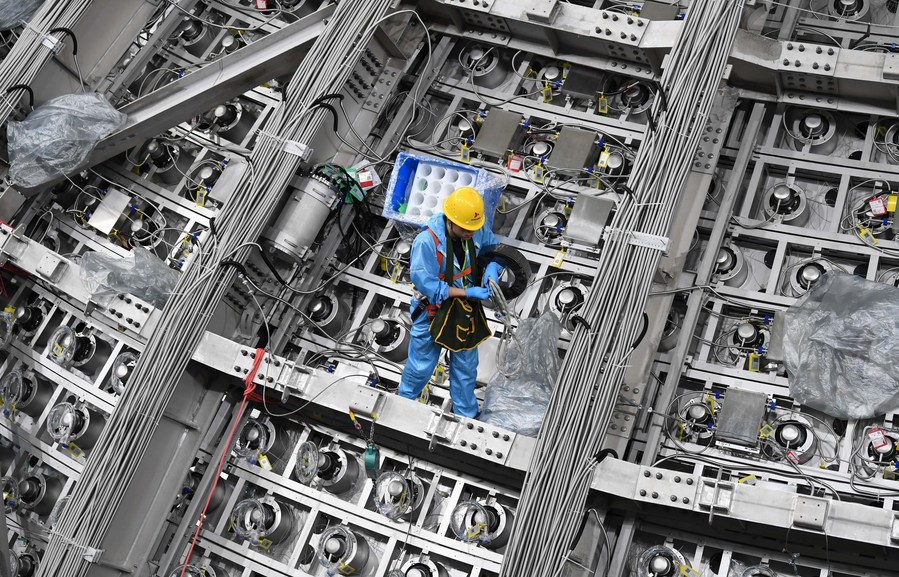
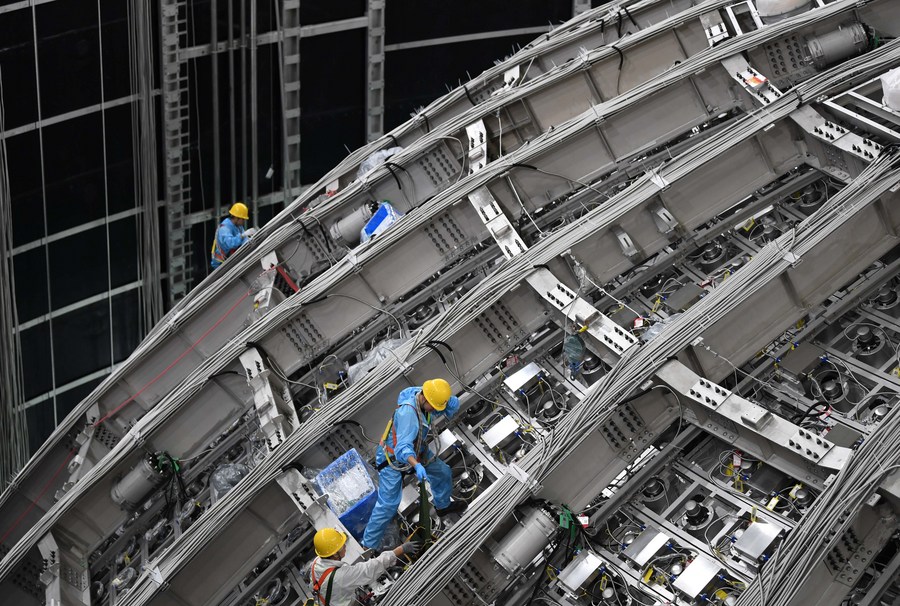
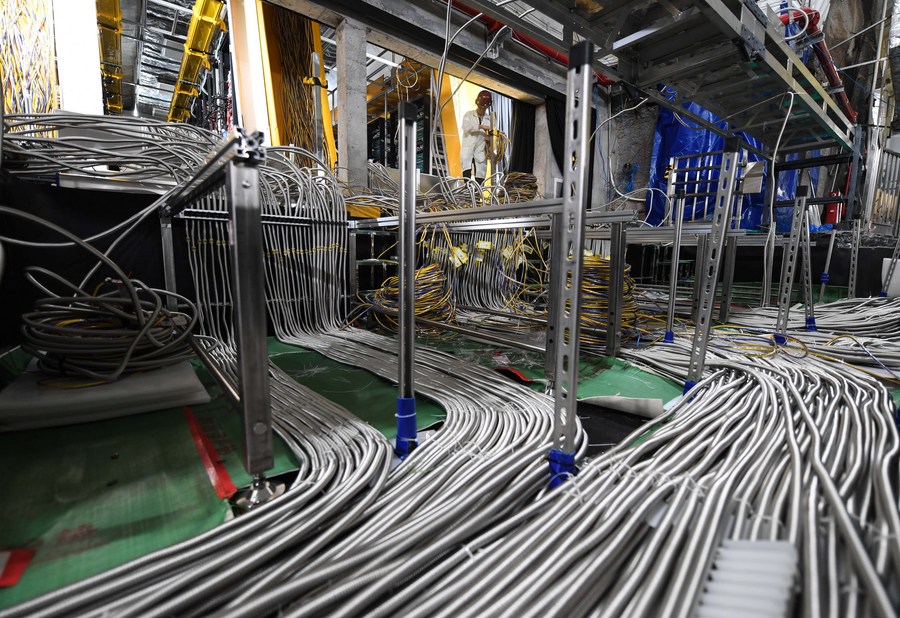
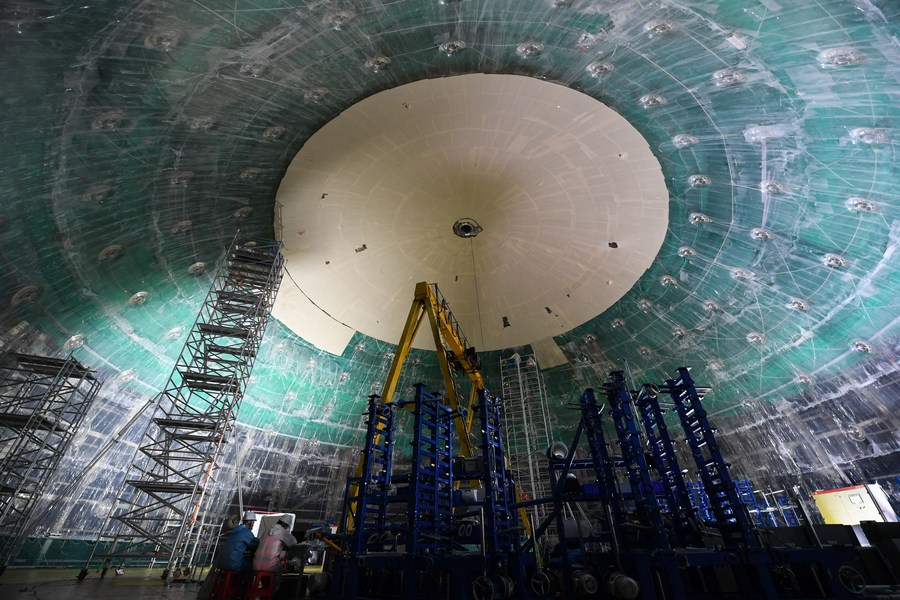
6. Een 700 meter ondergrondse lab met een kostenplaatje van 300 miljoen dollar om onderzoek te doen naar neutrino's is al sinds 10 januari 2015 in aanbouw en ze zijn nog steeds bezig met de constructie. Het is 100% over tijd want in een artikel van 2020 hadden ze het over afronding constructie eind 2022. Ik heb nog nooit van neutrino's gehoord. Deze neutrinolab wordt in de tweede helft van 2025 in gebruik genomen.
https://en.wikipedia.org/(...)Neutrino_ObservatoryFoto's van de constructie van deze neutrinolab:quote:Inside the underground lab in China tasked with solving a physics mystery
A giant sphere 700 m (2,300 ft) underground with thousands of light-detecting tubes will be sealed in a 12-storey cylindrical pool of water in coming months for an experiment that will shine new light on elusive subatomic particles known as neutrinos.
After years of construction, the $300 million Jiangmen Underground Neutrino Observatory (JUNO) in China's southern Guangdong province will soon start gathering data on neutrinos, a product of nuclear reactions, to help solve one of the biggest mysteries in particle physics.
Every second, trillions of extremely small neutrinos pass through matter, including the human body. In mid-flight, a neutrino, of which there are three known varieties, could transform into other types. Determining which types are the lightest and the heaviest would offer clues to subatomic processes during the early days of the universe and to explaining why matter is the way it is.
To that end, Chinese physicists and collaborating scientists from all over the world will analyse the data on neutrinos emitted by two nearby Guangdong nuclear power plants for up to six years. JUNO would also be able to observe neutrinos from the sun, gaining a real-time view of solar processes. It could also study neutrinos given off by the radioactive decay of uranium and thorium in the Earth to better understand mantle convection driving tectonic plates.
Due to go operational in the latter half of 2025, JUNO will outpace the far larger Deep Underground Neutrino Experiment (DUNE) under construction in the United States. DUNE, backed by the Long-Baseline Neutrino Facility (LBNF) under the U.S. Department of Energy's (DOE) top particle physics laboratory, Fermilab, will come online around 2030.
The race to understand neutrinos and advance the study of particle physics, which has transformed medical imaging technologies and developed new energy sources, intensified when the DOE abruptly cut funding for U.S. institutes collaborating on JUNO. It instead focused on building DUNE, which has since been plagued by delays and budget overruns, with costs skyrocketing to more than $3 billion.
"China had supported Fermilab's LBNF at the time, but later the cooperation could not continue," Wang Yifang, chief scientist and project manager of JUNO, told Reuters during a recent government-backed media tour of the facility.
"Around 2018-2019, the U.S. DOE asked all national laboratories not to cooperate with China, so Fermilab was forced to stop working with us." The DOE, the largest U.S. funding agency for particle physics, did not respond to Reuters' request for comment.
Sino-U.S. tensions have risen sharply over the past decade. A trade war erupted during the Trump administration and President Joe Biden later cracked down on the sale of advanced technology to China. In August, a bilateral science and technology cooperation pact signed in 1979 lapsed, potentially pushing more scientists to seek alternative partners, creating duplication in research and missing out on collaboration that otherwise might have led to beneficial discoveries.
In the 2010s, the countries jointly produced a nuclear reactor that could use low-enriched uranium, minimising the risk of any fuel being weaponised. China's foreign ministry said Beijing was "in communication" with Washington about the lapsed science agreement. The U.S. State Department did not comment.
Bron: https://www.reuters.com/s(...)-mystery-2024-10-16/
[ Bericht 5% gewijzigd door Peppert op 20-10-2024 21:04:10 ]


quote:
We zullen dit maar de vierde week noemen. Ik ben toch thuis uit mijn neus aan het vreten: geen sport en werk op zaterdag. Iets eerder dan 1 oktober voor de geïnteresseerden. Als dit soort spam niet gewenst is dan hoor ik het graag. Een of twee reacties en ik houd natuurlijk mee op. Zo niet dan een nieuwe update rond 15 oktober.We zullen dit maar de zesde week noemen. De volgende update laatste week van december.SPOILEROm spoilers te kunnen lezen moet je zijn ingelogd. Je moet je daarvoor eerst gratis Registreren. Ook kun je spoilers niet lezen als je een ban hebt.7. KLING AI: als het zo doorgaat heeft men geen Hollywood meer nodig voor films in de toekomst (natte dromen) maar goed je hebt veel van dit soort video-generator startups als Kling Al (deze specifieke Al video-generator komt van het Chinese sociale media bedrijf Kuaishou dat een omzet had van 14.4 miljard dollar en 20.000 werknemers in 2023).SPOILEROm spoilers te kunnen lezen moet je zijn ingelogd. Je moet je daarvoor eerst gratis Registreren. Ook kun je spoilers niet lezen als je een ban hebt.2. De Chinese Academie voor Sociale Wetenschappen heeft in november 24 twee onderzoeksinstituten opgericht voor verwaarloosde terreinen in China (die niet sexy zijn) zoals archeologische technologie, taalkunde van met uitsterven bedreigde talen en bescherming van cultureel erfgoed. Dit komt van het programma scout (van de Amerikaanse denktank CSET) dat naar Chinese nieuws kijkt en selecteert.3. De National Medical Products Administration (NMPA) (een reguleerder) heeft op 24 oktober 24 een proefprogramma gelanceerd voor de ‘gesegmenteerde productie van biologische producten’, waardoor biofarmaceutische bedrijven met geneesmiddelen die goedgekeurd zijn om op de markt te komen, een of meer delen van hun productieactiviteiten kunnen uitbesteden aan contractfabrikanten, zoals contractontwikkelings- en productieorganisaties (CDMO's).quote:De Chinese Academie voor Sociale Wetenschappen richt twee onderzoeksinstituten op voor minder bestudeerde gebieden.
On November 15, the Chinese Academy of Social Sciences (CASS) inaugurated two new key laboratories and a research institute in Beijing focusing on technology archaeology, cultural heritage protection, and linguistics. The establishments are part of CASS' overall 2024 plan to upgrade and consolidate talent in its laboratories, and develop neglected fields. The technology archaeology lab will utilize advanced techniques across multiple sciences, while the linguistics lab will apply cutting-edge methods to enhance language services and resources. The new institute will train professionals in underrepresented disciplines, such as in languages and cultural studies.
Bron: https://scout.eto.tech/?f(...)er-studied+subjects+
Hier zullen volgens de nieuwswebsite Caixin vooral kleine farmaceutische bedrijven in het land profijt van hebben: die hebben zeer veel moeite om de water boven het hoofd te houden omdat onderzoek naar nieuwe geneesmiddelen veel kapitaal en tijd kost en ze zelf de gespecialiseerde infrastructuur niet hebben om het te produceren na afronding van de onderzoek- en testfase: ze verkopen het dus vaak hun medicijnen onder licentie aan de grote jongens om geld binnen te halen en kunnen nu een groter deel van hun medicijnen laten produceren door externe contract- en productieorganisaties (CDMO's). “De kernlogica van segmentatie van productie is dat verschillende mensen verschillende dingen doen om de kostenefficiëntie te optimaliseren”, aldus een investeerder aan Caixin. Geen oordeel: weinig verstand van. Ik papegaai na wat ik lees. Ik moet dit artikel nog lezen die wat dieper op in gaat voor de analfabeten op dit gebied.
https://www.patheon.com/u(...)o-vs-cmo-vs-cro.html4. Op 16 november 24 werd in de stad Guangzhou een conferentie gehouden door binnenlandse vertegenwoordigers van industrie, onderzoeksinstuten en universiteiten over de afhankelijkheid van het land als het gaat om de import van hoogwaardige wetenschappelijke onderzoeksinstrumenten en medische instrumenten waarvan de levering met een handtekening kunnen worden gestopt. Ze gaven toe dat vooruitgang is geboekt in de ontwikkeling van binnenlandse ''mid-range'' wetenschappelijke onderzoeksinstrumenten maar wezen op de afhankelijkheid van hoogwaardige wetenschappelijke instrumenten en medische instrumenten van buitenlandse (vijandige) landen en dat meer onderzoek en samenwerking tussen industrie/onderzoeksinstituten/universiteiten nodig is om vooruitgang te boeken op dit gebied en deze kwetsbaarheid te verminderen. Ik citeer van een tweetal sprekers tijdens de conferentie die oud zijn en de leiding hebben over de sturing/mentoring van jonge onderzoekers. Deze figuren zijn gemotiveerd om door te gaan tot het lichaam het begeeft. Letterlijk. Het is geen werk meer in hun geval (geld genoeg voor pensioen) maar passie.quote:China Loosens Grip on Contract Manufacturing of Biopharma Products
China has begun piloting a program that allows the contract manufacturing of more biopharmaceutical products, a move long-awaited by the industry that is expected to reduce costs and improve efficiency.
The pilot is the latest effort by regulators to boost the growth of the country’s pharma industry and signals their desire to further ease their grip on biologics manufacturing after a first step in 2019.
The National Medical Products Administration (NMPA) on Monday launched a pilot program on “segmented production of biological products,” which allows biopharma firms with drugs that have been approved to enter the market to outsource one or more parts of their production activities to contract manufacturers such as contract development and manufacturing organizations (CDMOs).
The pilot broadens the range of biological products that can make use of so-called segmented production. Before the pilot, this could only be done for certain biologics, although the regulations are not explicitly clear about which ones. The contract manufacturers, meanwhile, should have more than three years of experience in commercial production of biological products, the regulator said. It also stipulated that the products in the pilot should be novel biologics with urgent clinical needs, such as multi-valent vaccines against different diseases, antibody drugs and insulin.
Industry insiders believe that producers of antibody drug conjugates, a type of anti-cancer treatment, will benefit the most. Producing these treatments is costly, as the production process is particularly complex, involving steps for both chemical and biologics manufacturing. Specialized workshops are also required to maintain the activity of the small molecule toxins in the therapy. Many pharma companies don’t have such workshops, so allowing them to carry out segmented production can significantly reduce their costs, an executive at a biopharma company said.
“The core logic of segmentation is that different people do different things to optimize cost efficiency,” an investor told Caixin. The program will be carried out through 2026 in various major regions including Beijing, Shanghai, as well as Guangdong and Jiangsu provinces, according to the regulator.
The stocks of several contract manufacturers listed in Hong Kong and Shanghai jumped after the NMPA announced it had approved the plan on Oct. 18. Shares of WuXi Biologics Cayman Inc., a major Hong Kong-listed CDMO, ended the week up more than 5%. While the pilot was widely welcomed, the investor expected it to bring only limited positive changes to the biopharma industry.
Large Chinese biopharmaceutical companies have all established their own factories and have sufficient or even excess production capacity, the investor said. Meanwhile, smaller companies have less need for segmented production because they have fewer products on the market, and many are already struggling to survive the prolonged capital winter in the health care industry.
The NMPA’s latest move may also harm profits of CDMOs as they may have to compete with others for outsourcing contracts, the investor said. It also means there will be more demand for authorities to ensure the quality of biological products, although it remains unclear how many companies will receive approval for segmented production.
In 2019, after more than three years of trial, the country enshrined the Marketing Authorization Holder System into law, formally allowing the segmented production of drugs. Since then, pharma firms have been able to outsource the production of certain biologics, such as vaccines, to contract manufacturers, as long as they have been approved by the NMPA. However, companies were unclear what conditions their products need to meet before getting approval.
Consequently, many biopharma companies have still had to invest heavily in manufacturing facilities. In some cases, companies unable or unwilling to cover the high cost of production on their own opted for segmented production, but for unclear reasons the NMPA has been slow in approving their drugs for the market.
Bron: https://www.caixinglobal.(...)ducts-102249439.html
Zhong Nanshan:
''In de afgelopen jaren zijn 's werelds eerste volledig automatische microfluïdische exosoomextractie, -zuivering en -verrijkingsmachine onder leiding van het Guangzhou Laboratory, en de eerste binnenlandse commerciële veldemissietransmissie-elektronenmicroscoop TH-F120 onder leiding van BioIsland Laboratory uitgebracht in Guangzhou. Zhong Nanshan, academicus van de Chinese Academy of Engineering en directeur van het Guangzhou Laboratory, 'benadrukte in een videotoespraak ook dat het onderzoek en de ontwikkeling van hoogwaardige wetenschappelijke instrumenten en hoogwaardige medische apparaten niet alleen diepgaande wetenschappelijke accumulatie vereist, maar ook interdisciplinaire en veldoverschrijdende samenwerking en uitwisselingen vereist. In de toekomst zal het Laboratorium van Guangzhou actief een platform blijven bouwen om de diepgaande integratie van "productie, onderwijs, onderzoek en toepassing" te bevorderen en de transformatie en toepassing van wetenschappelijke en technologische prestaties te bevorderen.''
Bai Chunli:
''"Op dit moment is China's high-end wetenschappelijke instrumenten en high-end medische hulpmiddelen industrie op weg naar een nieuwe fase van high-end ontwikkeling, maar we moeten nog steeds het probleem van de afhankelijkheid van de invoer van een aantal belangrijke kerntechnologieën oplossen door middel van voortdurende technologische innovatie en doorbraken, aldus Bai Chunli, voorzitter van het Greater Bay Area Science Forum en academicus van de Chinese Academie van Wetenschappen.''5. Ik kwam een artikel tegen op de website van de Duitse denktank Merics (maar helaas achter een muur waar alleen leden toegang tot hebben: elitaire exclusief gedoe). Ik heb dit artikel van een Chinese website geplukt die vrij toegankelijk is voor onbelangrijke stervelingen als mij in plaats van dat ik connecties moet hebben met volgevreten bestuur van denktanks die hoge politieke connecties en financiering hebben. Afijn. De Chinese ministerie van industrie en informatietechnologie onder leiding van Jin Zhuanglong (die zijn orders/taakstellingen krijgt van Zhang Guoqing) heeft samen met vijf andere overheidsorganen een nieuwe cultivatieprogramma uitgerold voor slimme fabrieken eind oktober 2024. Het programma heeft sinds 2020 meer dan 10.000 fabrikanten in het land gemotiveerd om hun handel up te graden naar slimme fabrieken om de efficiënte te verhogen (geen hardhandige Maoistische aanpakken meer richting de totale zakenwereld/ondernemerswereld om politieke doelen te bereiken maar zachtjes een richting uitduwen) dus dat project wordt voortgezet met de uitrol van nieuwe beleid.quote:How can domestic scientific instruments “break through”? Experts say more technological innovation is necessary
At the 2024 Greater Bay Area Science Forum in Guangzhou, a sub-forum was held focusing on the development of high-end scientific instruments and medical devices in China. New technologies were showcased, including a new electron microscope and cancer early screening device. While experts praised the development progress of mid-range devices, they emphasized the need for continuous technological innovation and new R&D financing pathways to overcome reliance on imports for high-end devices. They emphasized the importance of collaboration between industry, research, and academia, proposing a scientific instrument-sharing plan to enhance resource efficiency.
Bron: https://scout.eto.tech/?f(...)ovation+is+necessary.Bron: https://www.chinadaily.co(...)310f1265a1ca72f.htmlquote:China to roll out gradient cultivation system for smart factories
China will conduct a gradient (progressive) cultivation campaign for the country's smart factories, according to a circular. The circular, jointly issued by the Ministry of Industry and Information Technology (MIIT) and five other government authorities, stated that gradient cultivation for the smart factories will be carried out at four levels.
Since the beginning of the 14th Five-Year Plan (2021-25) period, departments including the MIIT have implemented an intelligent manufacturing project, successfully cultivating a number of high-level and iconic smart factories. The project has also motivated more than 10,000 manufacturers around the country to carry out the construction of digital workshops and smart factories.
Establishing the gradient cultivation system for smart factories will drive the formation of a safe, controllable and complete high-level supply system for the intelligent manufacturing sector. It will also help establish more complete intelligent manufacturing standards and an evaluation system, the ministry said.
6. Het advieskantoor Dezan & Shira heeft een review geschreven over de stand van zaken in de artificiële intelligentie sector in China anno 2024. Ik lees in hun stuk dat in het eerste kwartaal van 2024 ruim 4.500 AI-bedrijven waren in het land, wat neerkomt op 15 procent van het wereldwijde totaal. Om de groei en volwassenheid van de sector een handje te helpen, integreert de Chinese staat de technologie in verschillende sectoren zoals gezondheidszorg, onderwijs, financiën en stadsbeheer, aldus het advieskantoor.Bron: https://www.china-briefin(...)a-regional-analysis/quote:Exploring China's Leading AI Hubs: A Regional Analysis
In recent years, the Chinese government has demonstrated a strong commitment to advancing research and development (R&D) in big data and artificial intelligence (AI), particularly through the promotion of AI+ initiatives. By the first quarter of 2024, the Chinese mainland hosted over 4,500 AI companies, representing 15 percent of the global total. To accelerate the industry's growth and maturity, China is actively integrating AI technology across various sectors, including healthcare, education, finance, and urban management, thereby fostering innovation and enhancing efficiency in these fields.
8. Het punt en probleem dat ze duidelijk niet willen herhalen a la 19de eeuw is een transitie missen waardoor enorme technologische achterstanden en armoede uit ontstaan: het gebeurt als je belangrijke transities mist (steentijd, bronstijd, ijzertijd, eerste industriële revolutie, digitale revolutie enzovoort) en niet serieus neemt als ze nog vrij klein zijn. Die achterstand kan ook vernietigend werken want als je tegen vijandige landen komt te staan die een voorsprong hebben omdat ze die transitie hebben vormgegeven of niet hebben gemist dan ben je zwaar de Sjaak en is het onderdrukking en potentiële vernietiging. Het punt is ook dat in vergelijking met eerdere generatie de huidige generatie Chinezen veel capabele hoogopgeleide Chinezen omvat. Heel andere koek en denken dan de simpele boeren van 70 jaar en verder terug in de tijd. Dit soort gasten als Jiayu Tang heb je nodig: frisse bloed die 0,0 naam heeft en dus niemand heeft enige verwachtingen van hem, bezig is met een avontuur en niet is vastgeroest in patronen: die wat probeert op te bouwen als beginnende ondernemer. Tsinghua University levert veel goede handel op in dat land. Het valt op.
https://www.linkedin.com/(...)originalSubdomain=cnquote:Chinese AI startup takes aim at OpenAI’s Sora with image-to-video tool launch
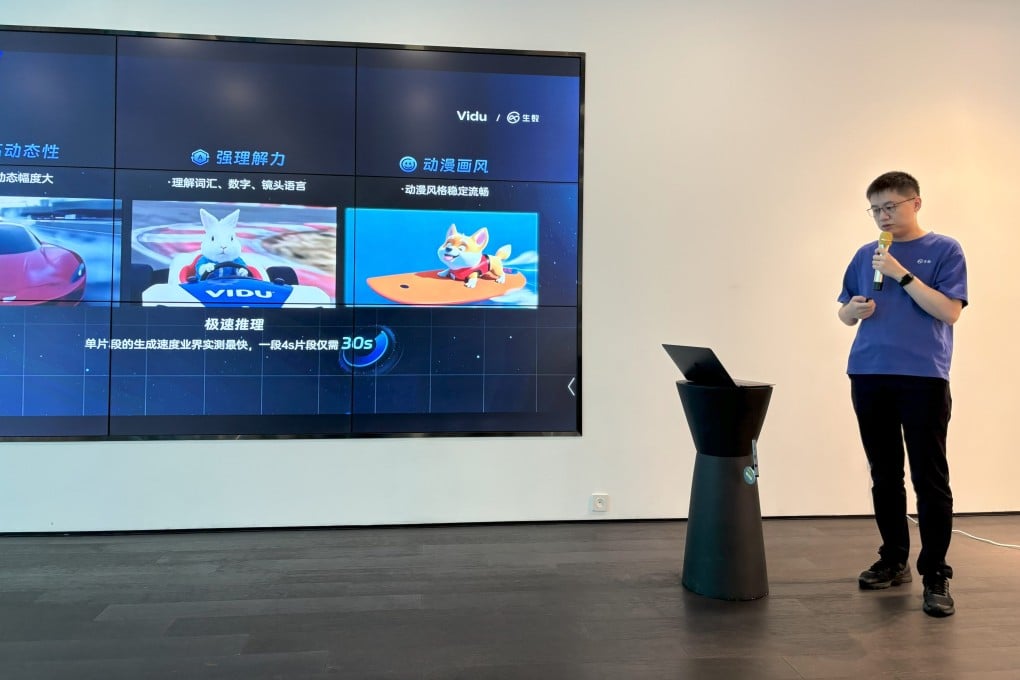
Beijing-based Shengshu Technology on Wednesday said that its artificial intelligence-powered text-to-video tool Vidu will now be able to generate videos from multiple images. When prompted with text and images, Vidu’s new AI feature can combine three pictures — such as a shirt, person and moped — into a video of the person wearing the shirt and driving the moped through a scene, Shengshu said. The AI video generator is already making money from advertisers, animators and other businesses, Shengshu co-founder and CEO Jiayu Tang said in Mandarin, according to a CNBC translation.
BEIJING – Het in Peking gevestigde Shengshu Technology zei woensdag dat zijn door kunstmatige intelligentie aangedreven tekst-naar-video-tool Vidu nu video’s kan genereren door meerdere afbeeldingen te combineren.
Met Vidu kunnen gebruikers clips van 8 seconden maken op basis van schriftelijke aanwijzingen. Terwijl OpenAI – de maker van ChatGPT – in februari onthulde dat zijn AI-model Sora video’s van één minuut uit tekst kon genereren, heeft het dat nog niet publiekelijk vrijgegeven.
De nieuwe AI-functie van Vidu kan drie afbeeldingen – zoals een shirt, een persoon en een bromfiets – combineren tot een video van de persoon die het shirt draagt en de bromfiets door een scène rijdt, zei Shengshu.
Andere platforms beweren dat ze met behulp van AI tekst of afbeeldingen in video's kunnen omzetten, maar de kwaliteit van de uitvoer varieert. De doorbraak die Shengshu claimt, is de mogelijkheid om drie unieke beelden te maken en deze met visuele consistentie te integreren in een door AI gegenereerde video.
“Al heel vroeg hebben we [visuele consistentie] als het probleem aangewezen en wilden we het goed oplossen”, zei Fan Bao, hoofd technologie bij Shengshu, in het Mandarijn, vertaald door CNBC.
Vidu werd in april 2023 gelanceerd en de mogelijkheid om twee profielfoto's om te zetten in levensechte video's van knuffelende mensen ging viraal op TikTok.
De AI-videogenerator verdient al geld aan adverteerders, animators en andere bedrijven, zei Jiayu Tang, medeoprichter en CEO van Shengshu, in het Mandarijn, volgens een vertaling van CNBC. Hij zei dat de maandelijkse gebruikstarieven per klant kunnen variëren van 100.000 yuan tot 1 miljoen yuan ($13.871 tot $138.711).
Om auteursrechtproblemen aan te pakken, zei Tang dat het bedrijf mogelijk een deal zou sluiten met een kunstenaar waardoor de AI de schilderstijl van de kunstenaar voor een advertentie kan nabootsen. Hij zei dat hij geen significante rechtszaken rond consumenten had gezien bij het gebruik van afbeeldingen.
Volgens PitchBook werd Shengshu vorig jaar opgericht met onder meer Baidu Ventures, Alibaba-gelieerde Ant Group, de Chinese startup Zhipu AI, Qiming Venture Partners en de stad Beijing als investeerders. De startup heeft $13.96 miljoen dollar opgehaald in 5 investeringsronden. Tang zei dat de AI van Vidu draait op gehuurde cloudservers in China en daarbuiten.
Bron: https://www.cnbc.com/2024(...)l-rivaling-sora.html

[ Bericht 0% gewijzigd door Peppert op 01-12-2024 00:37:28 ]
quote:
We zullen dit maar de vierde week noemen. Ik ben toch thuis uit mijn neus aan het vreten: geen sport en werk op zaterdag. Iets eerder dan 1 oktober voor de geïnteresseerden. Als dit soort spam niet gewenst is dan hoor ik het graag. Een of twee reacties en ik houd natuurlijk mee op. Zo niet dan een nieuwe update rond 15 oktober.We zullen dit maar de zevende week noemen. De volgende update ergens in de tweede helft van maart. Ik houd het puur bij civiliele of dual use industrie. Anders facetten van het land zoals sociaal/militaire en andere factoren hetzij zeer belangrijk laat ik zeer bewust achterwege. Er is veel meer te melden maar selectie van 10 binnen een beperkte gebied van het land wat we industriële bedrijvigheid noemen is voldoende voor een keer in de 3 maanden. Een land bestaat uit natuurlijk veel meer dan alleen industrie.SPOILEROm spoilers te kunnen lezen moet je zijn ingelogd. Je moet je daarvoor eerst gratis Registreren. Ook kun je spoilers niet lezen als je een ban hebt.SPOILEROm spoilers te kunnen lezen moet je zijn ingelogd. Je moet je daarvoor eerst gratis Registreren. Ook kun je spoilers niet lezen als je een ban hebt.2. Een stuk van een artikel van de Duitse (staats)denktank Merics. Het Ministerie van Industrie en Informatietechnologie (MIIT) (minister: Jin Zhuanglong), het Ministerie van Financiën (MOF) (minister: Lan Fo'an) en het Nationaal Databureau (directeur: Liu Liehong) hebben in december 24 een gezamenlijke plan gepubliceerd om een groot datacentersysteem voor nieuwe materialen te ontwikkelen. Het big data-systeem heeft tot doel zoveel mogelijk industriële gegevens te bundelen en te delen met onderzoeksinstituten en bedrijven, met als doel om het onderzoek en vooruitgang op het gebied van ontdekking van nieuwe materialen en verbetering van bestaande materialen in de toekomst te verbeteren.3. Het ministerie van Industrie en Informatietechnologie (MIIT) heeft een actieplan uitgebracht om de ontwikkeling van China’s nieuwe productie-industrie voor energieopslag te stimuleren.quote:New materials big data system
The Ministry of Industry and Information Technology (MIIT), the Ministry of Finance (MOF) and the National Data Bureau released a plan to develop a big data center system for new materials. The big data system aims to pool industrial data and share it with research institutes and enterprises, strengthening research and development (R&D) and the application of new materials research outputs. Key goals include:
• By 2027, data aggregation and circulation will be enhanced, a “1+N” new materials big data system will be established, creating one main platform and 30+ data nodes, 30+ tools, and 20+ data-driven applications
• By 2035, the new materials big data center system will be fully operational, enabling comprehensive aggregation, processing and development of materials data, placing it among global leaders
• Develop key technologies and software across the materials R&D chain, with a focus on applications like aerospace, marine engineering and ICT, while integrating advances in frontier technologies such as superconductors and biomimetic materials
MERICS comment: The aim is to enhance the productivity, innovation, and competitiveness of China’s manufacturing sector. Leveraging big data analytics allows companies to explore new manufacturing methods, analyze materials’ properties, and optimize production processes. This approach can transform material science and redefine cutting-edge technologies, with stronger, lighter, and more sustainable composites. Responsibility for data-gathering is divided between universities, research institutes, and companies, so that computing power and software (such as AI and blockchain) can convert the data into applicable and tangible results.
International competitors and similar scientific initiatives already exist in the EU and United States. Beijing is monitoring international developments closely and has expressed openness to cooperation and exchange through joint R&D programs. For China, there are potential benefits as it hosts one third of the global manufacturing industry and hence can access a much greater quantity of data than is available in other markets, provided Chinese companies are willing to share their IPs and data.
Meanwhile, if local companies obtain preferential access to the big data center system for new materials the program could become a long-term competitiveness risk for foreign firms.
Bron: https://merics.org/en/mer(...)stry-smart-factories4. Ze zijn op 16 december 2024 begonnen met de lancering van hun tweede internetsatellietconstellatie genaamd Guowang nadat ze in augustus 2024 waren begonnen met het lanceren van satellieten voor de eerste Chinese internetsatellietconstellatie genaamd Qianfan (Thousands Sail constellatie). Het betrof de lancering van 10 Guowang internetsatellieten. Het wordt heel heel heel druk boven onze hoofden de komende jaren. Extreem druk zelfs.quote:China aims to further crank up its new energy storage industry
The Ministry of Industry and Information Technology (MIIT) released an action plan to boost the development of China’s new energy storage manufacturing industry. The specific products and technologies involved are lithium batteries, sodium batteries, flow batteries, supercapacitors, lead carbon batteries, flywheel energy storage, and compressed air energy storage. Important goals for 2027 include:
Cultivate between three to five companies worth CNY 100 billion
Increase new energy storage manufacturing capacity to match downstream demand in various sectors, for instance transportation, construction, communications, and agriculture Promote international cooperation in the new energy storage industry through mechanisms such as the Belt and Road Initiative (BRI)
MERICS comment: New energy storage – which differs from traditional energy storage by excluding pumped hydro systems – is already a booming industry. China added 20 gigawatts (GW) in battery energy storage in 2023, helping it to reach its 2025 goal of installing 30 GW in new energy storage capacity two years early. China hosted almost half of the 42 GW of new energy storage added globally in 2023.
However, there are signs that the sector has begun to suffer from overcapacity. For example, in 2023 energy storage system prices fell by half within only two months. In energy storage battery production, capacity utilization plunged from 87 percent in 2022 to less than 50 percent.
The action plan addresses this challenge by promoting international expansion for China’s new energy storage industry through the BRI. China has rebranded the BRI to focus more on digital and green technologies since the Third Belt and Road Forum in October 2023.
Beijing might have to resort to additional measures, such as encouraging joint ventures or mergers and acquisitions, in order to achieve the plan’s goal of cultivating at least three CNY 100 billion companies by 2027. China’s leading battery makers in terms of revenue in 2023 were BYD (CNY 604 billion, including all business segments), CATL (CNY 404 billion), Zhejiang Changxing Tianneng Power Supply Co. (CNY 64 billion), and Ningde New Energy Technology Co. (CNY 48 billion).
Bron: https://merics.org/en/mer(...)stry-smart-factories
https://fr.wikipedia.org/wiki/Guowang5. De derde lancering voor de internetsatellietconstellatie Qianfan op 5 december 2024. Dit keer ook een cache van 18 internetsatellieten voor een totaal van 54 Qianfan internetsatellieten anno 25 december 2024.quote:China kicks off Guowang megaconstellation with Long March 5B launch
China began the construction of its Guowang megaconstellation early Monday with a launch from Hainan island. A Long March 5B with a Yuanzheng-2 upper stage lifted off from Wenchang Satellite Launch Center at 5:00 a.m. Eastern (1000 UTC) Dec. 16, carrying the first group of satellites for China’s national Guowang (“national net”) megaconstellation. Despite no official coverage of the launch, amateur live streams provided footage from Wenchang, showing a large number of spectators on beaches close in viewing distance of the launch pad.
The Shanghai Academy of Spaceflight Technology (SAST) confirmed the success of the launch two hours after liftoff. Aboard were the satellite Internet low-orbit 01 satellite group, according to SAST, revealing no information about the number of satellites, nor basic details such as their orbits, satellite mass and manufacturer. Xinhua likewise referred to the satellites only as a first group of low Earth orbit satellites for a satellite internet constellation. U.S. space domain awareness will likely catalog the satellites in orbit in the coming hours.
Guowang aims to provide global communications coverage from low Earth orbit and is seen as a response to Starlink and other constellations. Despite the ostensibly civilian focus of the Guowang constellation, the availability of details regarding the project is limited. Unlike previous missions, the first stage of the Long March 5B is not expected to reach orbit, avoiding an uncontrolled reentry. This is due to the rocket using the YZ-2 upper stage to insert the satellites into their intended orbits.
The launch marks the start of the construction of the Guowang constellation. The existence of the Guowang plans first became known in 2020 through filings for just under 13,000 satellites with the International Telecommunication Union. The constellation is managed by the China Satellite Network Group Co., Ltd., or China Satnet, established in April 2021. The company, with a new headquarters in Xiong’an New Area in Hebei Province, oversees the design, deployment, and operation of the constellation. China Satnet will need, according to ITU regulations, to launch half of the 13,000 satellites by 2032. This will require a steep rise in China’s launch rate while continuing with other programs.
One country, two megaconstellations
It is not the first Chinese megaconstellation to begin being constructed this year. The Qianfan/Thousand Sails project, a Shanghai-based megaconstellation, started later but has already sent its first 54 satellites into orbit across three launches this year.
A fourth launch could take place on a Long March 8 rocket from the new Hainan commercial space launch center as soon as Dec. 22 Eastern. Spacesail aims to construct a 14,000-satellite constellation, with the aim of having around 600 satellites in orbit by the end of 2025. SSST has garnered substantial support, securing approximately $943 million in funding in early 2024.
The Chinese government approval of two low Earth orbit communications suggests a high strategic value is placed on such systems. The megaconstellations have been as enablers for China’s digital economy, providing broadband services in remote and underserved areas, and part of a satellite internet project for China’s “new infrastructures” policy unveiled in 2020.
By offering satellite internet services internationally, Guowang and Qianfan could strengthen China’s soft power and economic influence, particularly in developing countries. Qianfan has already signed an agreement with Brazil to provide services from 2026.
A domestically controlled satellite network ensures China’s strategic independence from foreign providers like Starlink. The Chinese military also noted the value of that system from the early days of Ukraine’s response to the Russian invasion of the country in 2022. Both constellations could also provide contracts for China’s commercial satellite makers and its fleet of commercial launch service providers, which are developing a range of reusable medium-lift launchers.
Launch rate inflection point
The launch of the first satellites is a long-awaited milestone which had been expected to come earlier. The event, however—alongside Qianfan—marks an inflection point in China’s already-growing launch rate. China is leveraging the Long March 5B, originally designed to launch the country’s space station modules and a crew spacecraft for lunar missions, to launch its megaconstellations, along with an enhanced Long March 8 rocket expected to debut next year. Commercial actors will also play a role.
The country is also expanding its spaceports to facilitate a much greater launch rate with more diverse launch vehicles in order to make the satellite deployment plans feasible. The launch was China’s 64th orbital launch attempt of 2024. While this indicates China is someway short of the targeted 100 launches this year, progress on megaconstellations, spaceports and new rockets suggests that leap could take place in 2025.
The construction of Guowang and Qianfan and growing launch rate will likely have ramifications for space traffic management, space debris and astronomy, as well as having a geopolitical impact.
Bron: https://spacenews.com/chi(...)ong-march-5b-launch/
https://en.wikipedia.org/wiki/Qianfan6. Het MIIT (Ministerie van Industrie en Informatietechnologie) heeft op 30 oktober 2024 een beleidsdocument uitgegeven om typische voorbeelden te verzamelen van slimme technologieën – zoals AI – die worden geïmplementeerd in bioproductiefaciliteiten. De modelcases moeten elke fase van de productontwikkeling bestrijken, van R&D via opschaling tot massaproductie. Het document schetst acht prioriteitsgebieden.quote:Long March 6A launches third batch of Thousand Sails constellation satellites
Bekijk deze YouTube-video
China launched the third batch of 18 satellites for the Thousand Sails constellation late Tuesday as the firm behind the project aims for global services in 2025.
A Long March 6A rocket lifted off at 11:41 p.m. Eastern, Dec. 4 (0441 UTC, Dec. 5) from Taiyuan Satellite Launch Center, north China. The state-owned Shanghai Academy of Spaceflight Technology (SAST) announced launch success hours later, once all payloads were deployed into their predetermined polar orbits.
Aboard were 18 flat panel satellites for the Thousand Sails megaconstellation to provide low Earth orbit communications services. The project is led by Shanghai Spacecom Satellite Technology (SSST). The project is sometimes also referred to as Qianfan and G60 Starlink. The launch followed earlier Thousand Sails/Qianfan constellation satellite launches in August and October this year.
The satellites were developed by the Shanghai Microsatellite Engineering Center and are the first generation of Thousand Sails satellites.
Spacesail aims to construct a 14,000-satellite constellation, with the aim of having around 600 satellites in orbit by the end of 2025. SSST has garnered substantial support, securing approximately $943 million in funding in early 2024.
The company recently reached an agreement with Brazil, which will see Spacesail begin providing services to the county in 2026. The move follows a dispute between Brazil and the X social media platform owned by Elon Musk. The issue saw Brazil’s Supreme Court temporarily freeze the bank accounts of Starlink in the country.
The Long March 6A, developed by SAST, is the first and so far only Chinese launcher to bundle a liquid propellant core stage with solid propellant side boosters. It is capable of launching 4,500 kilograms of payload to a 700-kilometer sun-synchronous orbit
The rocket has, despite successful launches, suffered issues with its upper stage fragmenting. The launch which carried the first 18 Qianfan satellites broke up into a cloud suspected to number more than 700 pieces of orbital debris. SAST has so far not responded to requests for comment. The 36 previously launched satellites have all been cataloged in polar orbits by U.S. Space Force space domain awareness.
There are also concerns over the apparent brightness of the Qianfan satellites and their potential impact on astronomy.
The launch was China’s 62nd orbital launch attempt of 2024. It is China’s fifth launch since November 27, when the first enhanced Zhuque-2 rocket lifted off from Jiuquan, northwest China. This was followed by two experimental satellites on the first Long March 12, the launch of likely early warning satellite TJS-13 on the 100th Long March 3B, and the launch of the first enhanced Kuaizhou-1A solid rocket from Xichang.
China’s national record for launch attempts in a calendar year is 67, set in 2023. The country had stated plans to launch around 100 times across 2024.
Bron: https://spacenews.com/lon(...)ellation-satellites/7. Een beleidsdocument uitgebracht op 11 november 2024 door het MIIT om traditionele productie up te graden. Bedrijven kunnen zich aanmelden voor deelname.quote:Biomanufacturing best practice: MIIT collects model cases
At a glance: The MIIT issued instructions to collect typical examples of smart technologies – such as AI – being implemented in biomanufacturing facilities. The model cases should cover each stage of product development, from R&D through scaling up to mass production. The document outlines eight priority areas, including:
• Discover and design high-performance protein sequences and spatial structures with the help of machine learning, big language models and other artificial intelligence. Explore the gene expression and enzyme reaction level regulation mechanism of engineered bacterial strains and cell lines, to improve yield, conversion rate, and stress resistance
• Enhance bioreactor mass production methods through smart sensors, online analysis, digital twins, etc., allowing for monitoring and adjustments in real time.
MERICS comment: The government’s efforts to compile and promote best practice cases for high-tech biomanufacturing reflect the high value placed on the biotech industry as a strategic sector. In 2022, the National Development and Reform Commission (NDRC) released a dedicated development plan for the bioeconomy, highlighting potential applications for biotech advances in fields like agriculture, medicine and environmental protection. The smart manufacturing typical cases seek to leverage digital technologies to fast track the development and commercialization processes. Yet the actual impact of this “best practice promotion” approach is likely to be limited. Companies that can afford to pursue smart production methods would be driven to explore them anyway because of competitive pressures.
Local firms could gain from participating in the typical case program by winning political favor and enhancing their reputation as a high-tech enterprise. The provincial MIIT departments are empowered to provide additional financial and taxation support to companies that feature in typical cases.
Bron: https://merics.org/en/mer(...)stry-smart-factories8. De eerste Chinese productielijn voor banden voor passagiersvliegtuigen is eind november 24 in gebruik genomen in de stad Guilin. De faciliteit kan 100.000 banden per jaar voor de passagiersluchtvaart produceren wat goed is voor 40% van de binnenlandse vraag. De faciliteit is van het staatsbedrijf Sinochem.quote:MIIT (Ministerie van Industrie en Informatietechnologie) streeft ernaar de traditionele productie te upgraden door middel van modeltechnologieën
In één oogopslag: het MIIT nodigde bedrijven uit om zich aan te melden voor haar selectie van geavanceerde en toepasbare technologieën om vijf traditionele productie-industrieën te upgraden: non-ferrometalen, chemicaliën, algemene machines, lichte industrie en elektronica. Door te eisen dat in aanmerking komende technologieën een lage adoptiedrempel hebben, is de regeling bedoeld om ook kleine en middelgrote bedrijven ten goede te komen. In de mededeling worden vier technologiegebieden uiteengezet waaruit aanvragers kunnen kiezen:
• High-end technology: improve the technical content and added value of industrial products such as basic components or industrial software
• Smart technology: optimize algorithms, improve data processing capabilities, and achieve independent decision-making
• Green technology: promote energy conservation and carbon reduction and improve environmental protection and resource utilization
• Industrial base technology: enhance the industrial base, including measurement, standards, quality, management, digital information technologies
MERICS-commentaar: De mededeling weerspiegelt de voortdurende inspanningen van China om zijn gehele industriële sector en productie-industrieën te digitaliseren en te upgraden. Recent beleid met een vergelijkbare focus omvat onder meer een MIIT-mededeling uit 2024 over het verzamelen van typische gevallen van diepe integratie tussen de reële economie en de digitale economie, en MIIT-richtlijnen die in 2023 zijn uitgebracht over het transformeren en upgraden van de traditionele productie. De reële economie werd ook als prioriteit benadrukt tijdens het derde plenum van het Centraal Comité van de CCP in 2024. Toch heeft de focus van het Chinese leiderschap op productie een langere traditie en is ook duidelijk zichtbaar in haar Made in China 2025-strategie.
Het is nog steeds onduidelijk hoe verleidelijk het is voor bedrijven om aan deze regeling deel te nemen. Het vereist dat technologieën een lage drempel hebben voor brede adoptie en geeft het MIIT de opdracht om het gebruik van deze technologieën actief te promoten bij andere bedrijven. Dit kan bestaan uit het bouwen van platforms om vraag en aanbod met elkaar te verbinden of het organiseren van technische trainingen.
Bron: https://merics.org/en/mer(...)stry-smart-factories9. Een schip dat gebouwd en in gebruik is genomen aan het eind van 2024/begin 2025 speciaal om de bodem van de oceaan tot 11 km diepte te verkennen en onderzoeken. Geen fan van. Ik vrees voor het leven op de bodem van de oceaan zodra de mens daar zijn tentakels naar toe spreidt. Bah. Aan het eind van de dag zijn we extreem destructieve apen.quote:China lanceert de eerste grootschalige productielijn voor banden voor de burgerluchtvaart
China's eerste grootschalige productielijn voor banden voor de burgerluchtvaart is voltooid en in gebruik genomen in Guilin, de Zuid-Chinese autonome regio Guangxi Zhuang, zo meldde het Xinhua News Agency maandag.
Volgens fabrikant Sinochem Holdings heeft de productiefaciliteit een jaarlijkse productiecapaciteit van 100.000 luchtvaartbanden, wat in 40 procent van de jaarlijkse vraag naar burgerluchtvaartbanden in China kan voorzien.
De productielijn beslaat bijna 50.000 vierkante meter en is uitgerust met meer dan 80 hoogwaardige machines voor de productie van luchtvaartbanden, van grondstoffen tot eindproducten.
Bron: https://www.globaltimes.cn/page/202411/1323769.shtml10. Het Chinese eiland Hainan is in de afrondende fase van de bouw van een satellietproductiecentrum belandt. Deze satellietproductiecentrum zal in juni 2025 in gebruik worden genomen en kan 1000 satellieten per jaar produceren zodra het op volle toeren draait. Ik kwam dit tegen op de website van de Amerikaanse denktank CSET. Ze nemen de moeite om Chinese bronnen te vertalen als ze het interessant lijkt en gratis te publiceren. Het is een unicum aangezien meestal een journalist het verhaal aan ons brengt volgestopt met eigen ideologische interpretaties. Zij laten die handel met hun tool SCOUT achterwege en doen cold turkey vertalen zonder ideologie van hun eigen kant in te stoppen. Ze hebben de ruimtevaartindustrie ook geopend voor een aantal private bedrijven in de laatste jaren. Het werd tot een paar jaar puur door een staatsbureaucratie gerund maar ze hebben enkele entrepreneurs druppelsgewijs toegang gegeven tot satellietproductie en ontwikkeling.quote:China’s ‘dreamy’ new ship aims for Earth’s mantle—and assumes ocean-drilling leadership
Berthed in China’s port city of Guangzhou is the future of scientific ocean drilling: the $470 million Meng Xiang, a brand-new, 180-meter-long ship.
Starting next year Meng Xiang—Chinese for “Dream”—will begin drilling into seafloor rock and sediment at sites throughout the world’s oceans to investigate plate tectonics, ancient marine climates, and deep-buried microbial life. It will also embark on a daring mission to pierce Earth’s crust and reach the mantle below. At a workshop last month in Guangzhou, researchers discussed the research agenda and toured the ship, which has nine dedicated science laboratories and a drilling rig that promises to delve deeper than any previous research ship. “I’m green with jealousy,” says Henry Dick, a geologist at the Woods Hole Oceanographic Institution. “This ship has the capacity to answer fundamental climate, oceanographic, microbiological, and earth science questions … for the next 50 years,” says paleoceanographer Peter Bijl of Utrecht University.
China’s new ship—and an accompanying research program expected to be open to foreign scientists—marks a handoff in ocean drilling from the United States. Japan has a formidable research ship, the Chikyu, but for decades the U.S. led the International Ocean Discovery Program (IODP) with its drilling ship the JOIDES Resolution, which retired in September. “I’m very happy that China has stepped up in providing a ship,” says James Austin, a seismic stratigrapher at the University of Texas at Austin. But, “It’s a sad day for the United States.”
Meng Xiang’s most notable feature is its capability to drill to a depth of 11,000 meters below the sea surface, compared with the JOIDES Resolution’s 8385 meters and the 10,000 meters of Chikyu. This means Meng Xiang could make history by boring into the mantle, past a boundary known as the Mohorovičić discontinuity, or the Moho. Scientists have yearned to pierce the Moho since 1961 when the first scientific oceanic drilling program was dubbed “Project Mohole.”
Croatian seismologist Andrija Mohorovičić—the boundary’s namesake—observed that seismic waves travel through Earth faster below the Moho than above it, suggesting an abrupt change in the composition of the rocks. The textbook explanation is that the Moho separates denser mantle peridotites, magnesium-rich rocks, from lighter crustal gabbros, which crystallize from magmas. Rocks brought to the surface in volcanic eruptions or recovered at midocean ridges, where the crust is thinnest, support that picture. But seawater and other geochemical processes can alter those rocks; fresh rock samples from the Moho and the mantle could confirm their compositions and shed light on the formation and evolution of Earth’s crust.
“This is a foundational step in the plate tectonic cycle; we should understand it better than we do,” says Damon Teagle, a geologist at the University of Southampton. But the original Project Mohole was terminated after several test holes. And a 2016 effort in the Indian Ocean, the SloMo Project, didn’t make it beyond a shallow phase 1 hole.
Scientists believe the Moho is shallowest near fast-spreading ridges in the Pacific Ocean, where the water is about 4000 meters deep and the Moho another 6000 meters below that. To keep such a deep hole from collapsing under high subterranean pressures, drillers will have to pump a dense slurry called drilling mud from the ship through the borehole and back. Steering the mud through 4000 meters of water requires a new circulation system that Meng Xiang engineers hope to have ready by 2030 if not earlier, says Zhen Sun, Meng Xiang’s chief scientist and a structural geologist at the Guangzhou Marine Geological Survey.
China took up the Moho challenge because the country’s scientists played little role in the discovery of plate tectonics and decided it was time “for China to make big contributions to the international community,” Yaoling Niu, a petrologist with the Laoshan Laboratory, said during his workshop presentation.
But the ship “will do more than Moho drilling,” Sun adds. China is planning a Deep Ocean Drilling Program to manage up to 30 drilling expeditions from 2025 to 2035, according to Shouting Tuo, a sedimentologist at Tongji University. International proposals will be welcomed, and all cores and data will be openly accessible to scientists worldwide, Tuo told workshop attendees.
Some investigators hope to revive projects left orphaned by the end of IODP. These include drilling into the Sunda Shelf, a vast geological formation beneath the shallow seas of Southeast Asia, to reconstruct sea level changes from 5 million years ago; looking for evidence of a 130-million-year-old ocean basin east of Taiwan that has since been swallowed by tectonic movements in the region; and probing the Mariana Trench, created by an oceanic crustal plate plunging into the mantle southeast of Japan, for tectonic, geochemical, and biological activity.
Bijl plans to submit an especially ambitious IODP proposal. He wants to drill sediment and rock cores at four sites spaced between Australia and Antarctica for clues to the origin and evolution of the Antarctic Circumpolar Current. The current, Earth’s strongest, has a large influence on Southern Hemisphere weather and also the future of Antarctic ice sheets, because it affects how warm waters reach the underside of vulnerable ice shelves that jut into the ocean. Bijl’s proposal calls for drilling in water depths up to 5000 meters in one of the harshest ocean environments on Earth. But he says the Meng Xiang, designed to withstand winds and seas during all but the fiercest typhoons, “is the ideal vessel to execute this drilling plan.”
Bron: https://www.science.org/c(...)-drilling-leadershipquote:De zuidelijke provincie Hainan is van plan om in juni 2025 een satellietproductiecentrum te openen
A super satellite manufacturing factory is expected to commence operation at the Wenchang International Aerospace City in South China's Hainan Province in June 2025, the aerospace city said in a statement on Thursday, noting that the factory will have the capacity to enable satellites to be launched immediately upon delivery.
The super satellite factory covers an area of 60,000 square meters, making it the largest satellite factory in Asia, and it is estimated to complete roofing at the end of 2024.
Construction of the factory and its supporting projects is now underway. According to the aerospace city, the site has already attracted nearly 1,000 aerospace companies and is set to become the nation's major satellite-related manufacturing hub.
Notably, the factory is located in the vicinity of the Wenchang space launch site, which minimizes transportation costs and other risks, according to the aerospace city.
Hainan industry has been accelerating the development of local aerospace launch industry. The Long March-12 carrier rocket blasted off at 10:25 pm (Beijing Time) on Saturday from the site's No. 2 launch pad, and sent two experimental satellites into their planned orbits, the Xinhua News Agency reported.
The launch site will also accelerate the cultivation of the commercial space industry and talent in Hainan, with industrial chains covering spacecraft research and development, launch services, and satellite applications, according to the report.
Bron: https://www.ftpol.com/en/(...)20immediately%20upon
https://scout.eto.tech/?f(...)gs=rec6AQGf1xguWLBxs
[ Bericht 0% gewijzigd door Peppert op 02-01-2025 17:43:34 ]


communistisch en socialistisch bestaan niet, hebben nooit bestaan, het zijn allegaar dictaturen waar de gewone mensch niets te zeggen heeft
het befaamde rode boekje van MAO was niets dan een opgelegde leefregel net als in Noord Korea , MAO en Stalin verschilden niet veel van elkaar
de heen had de grote stap voorwaarts waarbij iedere persoon die meer opleidng had dan lager onderwijs naar het aardappel velden werden gestuurd , zodat ie geen rare ideen kreeg en Stalin deed exact hetzelfde,
die moesten allemaal dood of ver weg , Poetin doet nu hetzelfde, en dat wordt nog veel erger
uit angst voor een nieuwe leider
de waanzin en angst voor een nieuwe leider die de stem van het volk gaat krijgen
AI-overzicht Volgens onderzoeken behoren autonome, gezonde westerse ouderen met een goed pensioen tot meest tevreden mensen ter wereld.
Deze combinatie van factoren zorgt voor een hoog welzijn.
Deze combinatie van factoren zorgt voor een hoog welzijn.

Welnee, 300+ miljoen.quote:
[..]
Het beleid en het bewind van Mao Zedong hebben naar schatting geleid tot de dood van 40 tot 72 miljoen mensen (en sommige schattingen lopen zelfs op tot 80 miljoen).
 of laten we er 500 miljoen van maken.
Mao wordt door miljarden mensen geëerd voor al het goeds dat hij heeft kunnen bereiken met de hulp van de arbeider.

Zijn foto zal voor altijd bij de Verboden Stad hangen.
Zonder Mao was Tibet nooit bevrijd. Zonder Mao was China nooit verenigd.

🇨🇳🇻🇳🇱🇦🇨🇺🇰🇵🇷🇺☭


Een beetje context is ook wel fijn. China was straatarm en kwam uit decennia van oorlog, armoede en verzet. Ingrijpende landhervormingen waren nodig. Grootgrondbezitters werden als de vijand gezien, en terecht. De mensen die geen verzet leverden, kwamen vrijwel niet in de problemen.quote:Op zondag 18 oktober 2026 12:06 schreef MissButterflyy het volgende:
[..]
Ook hierdoor vielen vele miljoenen doden door het beleid van Mao.
• Politieke vervolging en zuiveringen: Executies van landeigenaren, politieke tegenstanders en 'klassevijanden' in de jaren 1950 en tijdens de Culturele Revolutie (1966–1969).
• Dwangarbeid: Miljoenen slachtoffers vielen in het kampensysteem (laogai).
Dwangarbeid is niet hetzelfde als een uitroeiingsprogramma zoals die van Hitler, en tuurlijk zijn daar doden gevallen in tijden van extreme instabiliteit. Het is makkelijk spreken vanuit de huidige stabiliteit en economische vooruitgang.
Het huidige China heeft betere tools, en het werkt. Geen land dat zo snel ontwikkeld.
🇨🇳🇻🇳🇱🇦🇨🇺🇰🇵🇷🇺☭
Nee, natuurlijk niet.quote:Op zondag 18 oktober 2026 12:24 schreef phpmystyle het volgende:
[..]
Het is een massamoordenaar, zelfs in China is dat al niet meer zo controversieel. Alleen wordt dat nog niet vanaf het Tiananmenplein geschreeuwd.
Echter zijn de vele doden onder zijn regime in aard en op zet minder intentioneel geweest vergeleken met een Pol Pot of Hitler. Die deden het erom. Bij Mao spelen mislukte oogsten, oorlogen, analfabetisme, etc etc een rol.
De officiële visie is dat hij de leider was die China verenigde als ware revolutionair.
Sterker nog, in Beijing zijn nog weleens demonstraties van jonge mensen die vinden dat de overheid het Maoïsme te veel heeft losgelaten.
🇨🇳🇻🇳🇱🇦🇨🇺🇰🇵🇷🇺☭

| Forum Opties | |
|---|---|
| Forumhop: | |
| Hop naar: | |