NWS Nieuws & Achtergronden
Discussieer hier diepgaander over de actualiteiten.



Zoals ik al paar posts geleden zei: westen gaat niet de belangrijkste data delen met turkije over de Koerden. Koerden komen altijd van pas om aan de Turken te laten weten wie de baas is.quote:
twitter:Kgthetweet twitterde op dinsdag 28-07-2015 om 17:09:23 #Turkey: ProAKP Journos completely derailed: "If Kurds keep on supporting HDP, they will face the consequences Armenians faced back in 1915" reageer retweet

twitter:moscow_ghost twitterde op dinsdag 28-07-2015 om 17:51:24 What Xi and Erdogan will talk about later:#Turkey supports #Uyghurs separatists in #China but bombs #Kurds in #Iraq? reageer retweet
 What Xi and Erdogan will talk about later:
Die Koerden verdienen sowieso geen plek in de democratie als ze niet voldoen aan de eisen die types als jij stellen, toch.quote:Op dinsdag 28 juli 2015 12:26 schreef Mathemaat het volgende:
[..]
En terecht. HDP deed nog niet eens de moeite om PKK te veroordelen, terwijl ze een voorbeeldfunctie hebben. Daarom verdienen ze geen plek in de democratie.
Leugenachtige wolven: Op vrijdag 15 januari 2016 01:20 schreef ClapClapYourHands het volgende:
Volgens berichten heeft het Turkse leger bombardementen uitgevoerd op Noord-Aleppo
12 jets vanuit Diyarbakir.
Volgens berichten heeft het Turkse leger bombardementen uitgevoerd op Noord-Aleppo
12 jets vanuit Diyarbakir.

jij weet!quote:
Er mag geen ruzie gezocht worden met Turkije, dat is duidelijk.
Ik heb Hem niet uit vrees voor de hel noch uit liefde voor het paradijs gediend, want dan zou ik als de slechte huurling zijn geweest; ik heb hem veeleer gediend in liefde tot Hem en in verlangen naar Hem.
-Rabia Al-Basri
-Rabia Al-Basri
De PKK zal niet worden genoemdquote:

Leugenachtige wolven: Op vrijdag 15 januari 2016 01:20 schreef ClapClapYourHands het volgende:
Volgens berichten heeft het Turkse leger bombardementen uitgevoerd op Noord-Aleppo
12 jets vanuit Diyarbakir.
Volgens berichten heeft het Turkse leger bombardementen uitgevoerd op Noord-Aleppo
12 jets vanuit Diyarbakir.
De Engelse versie van een artikel van Frederike Geerdink wat over 2 dagen zal verschijnen in de Groene Amsterdammer:
Who is Turkey really fighting?
Who is Turkey really fighting?
Leugenachtige wolven: Op vrijdag 15 januari 2016 01:20 schreef ClapClapYourHands het volgende:
Volgens berichten heeft het Turkse leger bombardementen uitgevoerd op Noord-Aleppo
12 jets vanuit Diyarbakir.
Volgens berichten heeft het Turkse leger bombardementen uitgevoerd op Noord-Aleppo
12 jets vanuit Diyarbakir.

Turkije creëert een extra front in de rug van de Koerden. Natuurlijk doet ze dit louter om IS in de kaart te spelen. Want het gaat IS niet goed genoeg en de Koerden zijn de pittigste tegenstanders gebleken. Dat betekent dat er iets op verzonnen moet worden van hogerhand, oftewel haar ontwerpers en financiers. Erdogan heeft dit met alle liefde uitgevoerd en u bent er getuige van.
Dat Erdogan zich hiervoor leent, mag geen verrassing zijn. Maar dat de NAVO lidstaten collectief wegkijken, is een extra bittere realiteit.
Interessant te zien hoe machtig de peetvaders van IS zijn. Het project zal slagen, tegen elke prijs.
Dat Erdogan zich hiervoor leent, mag geen verrassing zijn. Maar dat de NAVO lidstaten collectief wegkijken, is een extra bittere realiteit.
Interessant te zien hoe machtig de peetvaders van IS zijn. Het project zal slagen, tegen elke prijs.
Top court begins investigation into HDP after AK Party files complaint
http://www.todayszaman.co(...)omplaint_394891.htmlquote:The ruling Justice and Development Party has submitted a criminal complaint against members of the pro-Kurdish Peoples' Democratic Party (HDP), which is known to have close ties to the terrorist Kurdistan Worker's Party (PKK), upon which the Chief Prosecutor's Office at the Supreme Court of Appeals initiated an investigation.
Justice and Development Party (AK Party) Deputy Chairman Abdülhamit Gül tweeted on Monday that his party would file a criminal complaint about HDP deputies on the grounds that they are affiliated with the PKK.
“We [the AK Party] are submitting a criminal complaint against the HDP deputies who are singing the praises of the PKK to the public prosecutors. Those leaning on terrorist organizations, your backs are going to hurt a lot,” he tweeted.
Gül's tweets were seen as directed to HDP Co-chair Figen Yüsekdağ's recent statement in which she said that the HDP was leaning on the People's Protection Units (YPG), Women's People's Protection Units (YPJ) and the Democratic Union Party (PYD). “We [the HDP] see no problem in saying or defending this statement.”
Claiming that the PKK was shooting at ambulances that were serving the people in southeast Turkey and kidnapping hospital workers, Gül wrote on his Twitter account that “being a deputy of the people does not mean being a deputy for the terrorists.”
Supreme Court of Appeals investigating HDP
The Chief Prosecutor's Office at the Supreme Court of Appeals has begun investigating the HDP for violating Articles 68 and 69 of the Constitution pertaining to political parties.
The last sentence of Article 68 of the Constitution states: “They [political parties] shall not aim to promote or establish a class or group dictatorship or a dictatorship of any kind, nor shall they incite citizens to crime.”
The Supreme Court of Appeals will initiate a court case after the initial investigation into the actions and statements of HDP deputies, if it deems necessary and refer the case to the Constitutional Court, which deals with cases of possible party closures.
HDP Co-chair Selahattin Demirtaş's recent statement that “our people and our political institutions, civil society organizations, municipal administrations, trade bodies and all of our societal institutions must begin advancing their security precautions” is said to form the basis of the investigation into the HDP.
Demirtaş denies wrongdoing after Erdoğan urges prosecution
Demirtaş, whose party is being accused by President Recep Tayyip Erdoğan of links with "terrorist groups," denied any wrongdoing during his party's parliamentary group meeting held on Tuesday and said his group faced punishment simply for its electoral success.
"We have committed no unforgivable crimes. Our only crime was winning 13 percent of [the] vote," Demirtaş told his group in Parliament.
Demirtaş also said 80 deputies from his party will submit petitions to Parliament for their immunity from prosecution to be lifted on Wednesday.
Erdoğan earlier in the day called for the prosecution of party leaders and urged Parliament to strip lawmakers of immunity from prosecution for alleged links with the terrorist PKK. Demirtaş also accused Erdoğan of obstructing a plan by the PKK's jailed leader, Abdullah Öcalan, to call for his followers to disarm.
In a related incident, Ahmet Davutoğlu, the acting prime minister, recently said on live TV that there was both a judicial and a political aspect to the party closure investigation into the HDP deputies.
Replying to Nationalist Movement Party (MHP) leader Devlet Bahçeli's call to the Supreme Court of Appeals, Davutoğlu said: “When we look at it from a political perspective, I'm against closing down political parties. However, when we look at it from a judicial point of view, there are those supporting terrorism.”
Demirtaş and Yüksekdağ's statements came after the PKK began assaulting police and military targets in Turkey last week, in retaliation for the government failing to prevent a suicide bombing in Turkey's southeastern town of Suruç, where 32 people were killed and over 100 injured. It is believed an Islamic State in Iraq and the Levant (ISIL) militant perpetrated the attack.
Bahçeli, leader of the right-wing MHP, had said earlier that the Prosecutor's Office at the Supreme Court of Appeals should investigate the deputies of the HDP.
Bahçeli referred to them as “Kandil politicians,” in reference to the Kandil Mountains, where the PKK's headquarters are located.
“The Prosecutor's Office at the Supreme Court of Appeals must start the [workings] of the law against the Kandil politicians who cannot even bring themselves to condemn the rotten individuals [terrorists] who martyred [our soldiers], and cannot put any distance between themselves and the terrorists and praise the terrorists,” wrote Bahçeli in his statement.
HDP deputies to submit petitions calling for their immunity to be revoked
HDP Co-chair Demirtaş said on Tuesday that 80 HDP deputies would respond to Erdoğan's demands that their immunity be revoked by submitting petitions to Parliament requesting that their immunity be revoked.
Demirtaş called on AK Party deputies to also have their immunity revoked if they had nothing to fear. “We [the HDP] have nothing to hide. We did not steal, plunder, kill or betray [our country]. Come on, let us all, all 550 deputies, have our immunity revoked.”
Stating that only the people of Turkey can open and close political parties, Demirtaş said: “The people who gave us 13 percent in the election could very well give us 1 percent tomorrow. We will respect that and accept that our party has been closed down.”
Demirtaş claimed that Erdoğan was the one who stopped peace from coming to Turkey by ending the settlement process a week before PKK leader Öcalan was due to call for the organization to lay down its arms.
Niet alleen de Oeigoeren maar ook de Bosniërs en Kosovaren, bij beide waren ze er als de kippen bij om separatisme te steunen.quote:twitter:Kgthetweet twitterde op dinsdag 28-07-2015 om 17:09:23 #Turkey: ProAKP Journos completely derailed: "If Kurds keep on supporting HDP, they will face the consequences Armenians faced back in 1915" reageer retweettwitter:moscow_ghost twitterde op dinsdag 28-07-2015 om 17:51:24 What Xi and Erdogan will talk about later:#Turkey supports #Uyghurs separatists in #China but bombs #Kurds in #Iraq? reageer retweet
Toont weer aan wat voor bananenrepubliek Turkije is.quote:
Top court begins investigation into HDP after AK Party files complaint
[..]
http://www.todayszaman.co(...)omplaint_394891.html
twitter:CNNTURK_ENG twitterde op dinsdag 28-07-2015 om 19:19:58 #BREAKING Iraqi PM Abadi tweets:Council of Min considers TR airstrikes on Iraqi territory a dangerous escalation&violation of Iraq's sovgty. reageer retweet

Zoals ik al met #Post 194 al zei: met een beetje geluk is HDP afgeschaft voor de vervroegde verkiezingen.quote:
Top court begins investigation into HDP after AK Party files complaint
[..]
http://www.todayszaman.co(...)omplaint_394891.html
Zie ik niet gebeuren.quote:
[..]
Zoals ik al met #Post 194 al zei: met een beetje geluk is HDP afgeschaft voor de vervroegde verkiezingen.
En wat vind jij hiervan?quote:
Top court begins investigation into HDP after AK Party files complaint
[..]
http://www.todayszaman.co(...)omplaint_394891.html
Leugenachtige wolven: Op vrijdag 15 januari 2016 01:20 schreef ClapClapYourHands het volgende:
Volgens berichten heeft het Turkse leger bombardementen uitgevoerd op Noord-Aleppo
12 jets vanuit Diyarbakir.
Volgens berichten heeft het Turkse leger bombardementen uitgevoerd op Noord-Aleppo
12 jets vanuit Diyarbakir.
Inderdaad.quote:
[..]
Niet alleen de Oeigoeren maar ook de Bosniërs en Kosovaren, bij beide waren ze er als de kippen bij om separatisme te steunen.

En dan de vervolgvraag: keur jij de acties en strategie van Erdogan goed?quote:
[..]
Geniaal. Strategisch magnifiek, vanuit Erdogan's kant.
Leugenachtige wolven: Op vrijdag 15 januari 2016 01:20 schreef ClapClapYourHands het volgende:
Volgens berichten heeft het Turkse leger bombardementen uitgevoerd op Noord-Aleppo
12 jets vanuit Diyarbakir.
Volgens berichten heeft het Turkse leger bombardementen uitgevoerd op Noord-Aleppo
12 jets vanuit Diyarbakir.
Neuh, Erdogan moet zijn bek houden en een president zijn zoals de Turkse wetten dat voorschrijven, zonder zelf een player te zijn op het niveau van partijpolitiek (als hij dat deed zou hij de eerste President zijn die zich symbolisch gedraagt, maar goed) maar zoals ik al zei, wel veel kudows.quote:
[..]
En dan de vervolgvraag: keur jij de acties en strategie van Erdogan goed?
[ Bericht 6% gewijzigd door #ANONIEM op 28-07-2015 21:26:17 ]
De vraag mbt zijn strategie op het vlak van de Koerden heb je nog niet beantwoord. Je bent hier iemand die het goed volgt, maar je mening omtrent de kant waar het nu naar toe gaat heb je nog niet echt kenbaar gemaakt, vandaar dat ik het vraag.
Leugenachtige wolven: Op vrijdag 15 januari 2016 01:20 schreef ClapClapYourHands het volgende:
Volgens berichten heeft het Turkse leger bombardementen uitgevoerd op Noord-Aleppo
12 jets vanuit Diyarbakir.
Volgens berichten heeft het Turkse leger bombardementen uitgevoerd op Noord-Aleppo
12 jets vanuit Diyarbakir.

Je hebt het over een vraag dat gesteld is in de vorige 2 reacties?quote:
De vraag mbt zijn strategie op het vlak van de Koerden heb je nog niet beantwoord. Je bent hier iemand die het goed volgt, maar je mening omtrent de kant waar het nu naar toe gaat heb je nog niet echt kenbaar gemaakt, vandaar dat ik het vraag.
Ja, met strategie van Erdogan doelde ik eigenlijk daarop.quote:Op dinsdag 28 juli 2015 21:28 schreef Triggershot het volgende:
[..]
Je hebt het over een vraag dat gesteld is in de vorige 2 reacties?
Leugenachtige wolven: Op vrijdag 15 januari 2016 01:20 schreef ClapClapYourHands het volgende:
Volgens berichten heeft het Turkse leger bombardementen uitgevoerd op Noord-Aleppo
12 jets vanuit Diyarbakir.
Volgens berichten heeft het Turkse leger bombardementen uitgevoerd op Noord-Aleppo
12 jets vanuit Diyarbakir.
Dus meer op waar ik denk dat het op gaat uitlopen dan een (moreel) oordeel te geven over de strategie zelf, begrijp ik je zo goed?quote:
[..]
Ja, met strategie van Erdogan doelde ik eigenlijk daarop.
Het liefst beide.quote:
[..]
Dus meer op waar ik denk dat het op gaat uitlopen dan een (moreel) oordeel te geven over de strategie zelf, begrijp ik je zo goed?
Leugenachtige wolven: Op vrijdag 15 januari 2016 01:20 schreef ClapClapYourHands het volgende:
Volgens berichten heeft het Turkse leger bombardementen uitgevoerd op Noord-Aleppo
12 jets vanuit Diyarbakir.
Volgens berichten heeft het Turkse leger bombardementen uitgevoerd op Noord-Aleppo
12 jets vanuit Diyarbakir.
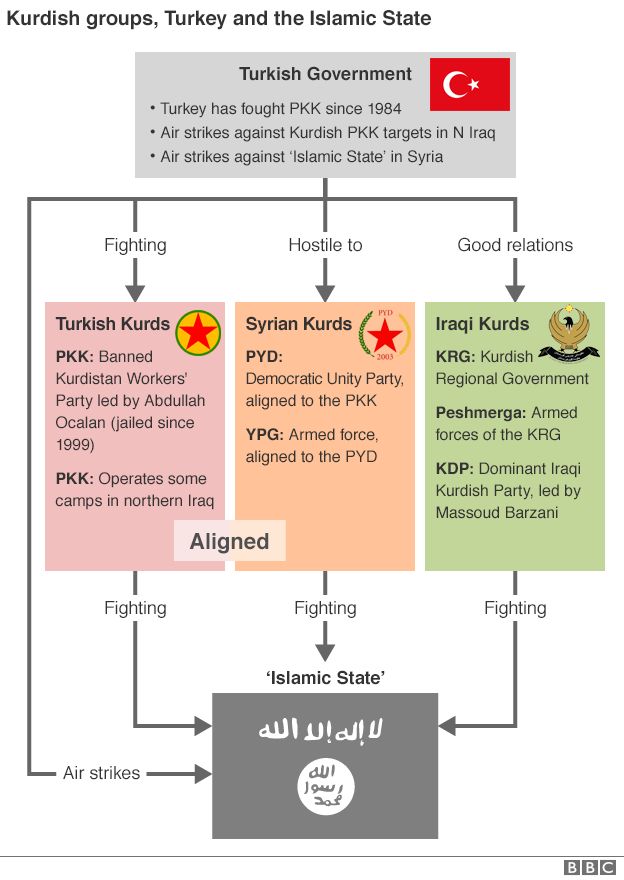
quote:Turkey v Islamic State v the Kurds: What's going on?
Turkey has opened up a new front in the fight against Islamic State (IS) militants, by bombing their positions in Syria and permitting US jets to do the same from its territory.
But Turkey has also bombed a Kurdish rebel group that is leading the fight against IS in Syria and Iraq.
Turkey's government says its intervention in the conflict will prove decisive.
Critics say Turkey's strategy, which is complicated by long-standing problems with its large Kurdish minority, is short-sighted and likely to backfire.
How did Turkey get here?
The superficial story behind the Turkish intervention is clear enough. It starts on 20 July with a suicide attack in Suruc, a Kurdish-dominated town in south-eastern Turkey, near the Syrian border.
A bomber blew himself up at a gathering of left-wing activists, killing 32 people. The attack was apparently ordered by IS. However, Kurdish protesters also blamed the Turkish government for colluding with IS - a charge it denies.
Two days later, Kurdish rebels from the PKK - a banned political party and guerrilla movement - killed two Turkish policemen, accusing them of facilitating the Suruc bombing.
Meanwhile, IS fighters clashed with Turkish troops along the Syrian border, killing one of them.
Turkey responded last Friday by arresting hundreds of suspected supporters of IS and the PKK, while its aircraft bombed the groups' positions in Syria and Iraq respectively.
Turkey also revealed that it had struck a deal that would grant the US use of the Incirlik base - potentially speeding up air strikes against IS.
Two Turkish troops were killed in an apparent retaliation by the PKK. The group also indicated it may revive a decades-old armed struggle against Ankara.
The Turkish government says it is ready to fight all the enemies of its national interest. But many observers believe it is particularly interested in one enemy.
The question is: Which one?
Some say Turkey will help the Americans hammer IS, while striking the PKK as a warning - no more. Others say it will go after the Kurds hardest, while doing the bare minimum against IS.
Turkish policy is "to pretend that it is waging a war against IS, while at the same time following up on another goal, which is to destroy the PKK," says Kerem Oktem, a professor at the Centre for Southeast European Studies at the University of Graz in Austria.
What has Turkey been doing until now?
For the underlying narrative behind Turkey's intervention, look to its troubled history with the Kurds.
United by ethnicity and divided by modern borders, the Kurds are a sizeable minority within Turkey, as well as within the neighbouring states of Syria, Iraq and Iran.
In each of these countries, the Kurds have agitated against governments, sometimes for greater rights, sometimes for outright independence.
An armed struggle in Turkey was led for many years by the PKK, until it signed up to a ceasefire in 2013.
That truce has been strained by the civil war in Syria, which has strengthened the PKK's armed offshoot there, known as the YPG.
Like its allies in the Gulf, Turkey wants the overthrow of Syrian President Bashar al-Assad. It too has been accused of supporting many of the rebel groups fighting him - though not the YPG.
Turkey has looked on, worried, as the YPG has carved out a proto-state across its southern border - an unwanted beneficiary, in its view, of the fragmentation of Syria.
The other big beneficiary has been IS, whose Syrian territory roughly encircles the areas held by the YPG. Turkey denies the accusation, levelled by many Kurds, that it is using IS to check Kurdish influence.
Turkey has nonetheless served as a highway for foreign fighters eager to join the jihad in Syria. Weapons and funds have also allegedly flowed down the same route.
Until now, Turkey has been reluctant to take a leading role in the US-led campaign against IS. Instead, it has labelled the PKK and IS as terrorists alike, and demanded the creation of a buffer zone - controlled by neither group - deep inside Syrian territory along the Turkish border.
Meanwhile, the YPG has taken the lead in the fight against IS in Syria.
Backed by US bombardment, it defended the border town of Kobane against the militants last year. This year, it has driven the militants from more Syrian towns along the Turkish border, expanding the area under its control - and further upsetting the Turkish government.
So what changed for Turkey?
The Washington Post reports that the US and Turkey finally reached agreement on a buffer zone in late July, just as they announced a deal on the use of the Incirlik base. Many analysts believe Turkey was spurred into action by the need to check the YPG's westward advance in Syria.
According to this theory, the Ankara government realised that its approach to IS has been counter-productive. By staying on the sidelines, Turkey had inadvertently allowed the YPG to prosper under the shield of American air strikes.
The buffer zone plan reportedly gives Turkey a starring role in the conflict alongside the US.
Details are still unclear, but the plan is said to envisage driving IS out of northern Syria, through US air strikes. Syrian opposition groups - vetted and supported by Turkey and the US - will fill the vacuum, putting a brake on Kurdish territorial gains.
The deal between Turkey and the US suggests a preference for the old alliances between Nato member states, over the shotgun weddings with armed groups on the Syrian battlefield.
"The American and Turkish position from the beginning of the conflict has not been that different," says Aaron Stein, an expert on Turkey at the Royal United Services Institute, a London-based think tank.
"The US is not going to choose the PKK over Ankara - ever."
There are other explanations for Turkey's intervention, besides events in Syria.
Sinan Ulgen, an expert in Turkish foreign policy with Carnegie Europe, a Brussels-based think tank, says Ankara has revised its view of IS as "a useful enemy".
Turkey's policy towards IS has exposed it to criticism from Nato allies, he says. Meanwhile, the Suruc attack has increased public appetite for a crackdown on IS, while highlighting the hazards of tolerating the group.
What happens to the Kurds?
It is not clear what will happen to the territory acquired recently by the YPG. But if the buffer zone is enforced, they may withdraw from some areas.
"The Kurds are over-extended - they're not welcome in the areas they're extending into," says Mr Stein.
He compares the YPG's position to that of the Iraqi Kurdish militia, the Peshmerga, which is also fighting IS - but has backed away from holding territory where Kurds are not a major ethnic group.
Moreover, says Mr Stein, the YPG may be reassured by the "de facto US security guarantee" that it has enjoyed since the bombing of Kobane.
Turkey may also try to drive a wedge between the YPG and PKK by adopting a softer approach to the Syrian Kurdish group.
"Turkey is making a differentiation" between the two groups, says Mr Ulgen, on account of the YPG's role in the fight against IS. Turkish air strikes, he says, will mainly target the PKK at its bases in the mountains of northern Iraq.
However, there is no guarantee such a tactic will work. The tightly-knit ranks of the PKK and YPG have little regard for national borders and could well reject any attempt to divide them.
What else might go wrong?
As the saying goes, no plan survives first contact with the enemy. It is unclear how IS - or the Syrian government - will respond to an uptick in US air strikes. Nor is it clear if the rebel groups that are meant to stabilise the buffer zone will play ball.
Those groups are dominated by Islamists and jihadists, including the al-Qaeda-allied Jabhat al-Nusra - not exactly the "moderates" the US would like to be bombing on behalf of.
Moreover, if Turkey miscalculates against the Kurds and domestic supporters of IS, it could face a dual uprising.
The country's security forces could end up trying to tamp down a domestic insurgency in order to defend the national interests that they are intervening for abroad.
For now, the Turkish and Kurdish forces that are fighting against Islamic State militants are also poised to fight each other.
The outcome of this multi-faceted contest is uncertain. But the Turkish action underscores what has become an unofficial axiom of the campaign against Islamic State: the US goal of defeating the militants cannot be untangled from the conflicting aims of its allies in the fight.
Say what?
