WGR Werk, Geldzaken, Recht en de Beurs
Hier kun je alles kwijt over sollicitaties, werksituaties, belastingen, (handelen op) de beurs, hypotheken, beleggingen en salarissen, arbeidscontracten of geschillen met je (huis)baas. Alles over werk, geldzaken en recht dus.



Zeker niets gelezen over vele gesloten rafinaderijen door Ike?quote:Op maandag 15 september 2008 12:06 schreef Bulletdodger het volgende:
nu de benzineprijs nog
Olie <> benzine.
For great justice!


Wij krijgen geen benzine van die kant, dat ze daar tekorten hebben zegt al dat wij er geen last van hoeven te hebben.quote:Op maandag 15 september 2008 12:14 schreef Q. het volgende:
[..]
Zeker niets gelezen over vele gesloten rafinaderijen door Ike?
Olie <> benzine.
censuur :O
Tenzij Europa benzine gaat leveren aan de VS, wat in 2005 ook gebeurde.quote:Op maandag 15 september 2008 12:24 schreef RemcoDelft het volgende:
[..]
Wij krijgen geen benzine van die kant, dat ze daar tekorten hebben zegt al dat wij er geen last van hoeven te hebben.
En voor iedereen die maar wat lult dat de benzineprijs niet aan de olieprijs gekoppeld is: Bron?
The problem is not the occupation, but how people deal with it.

En sowieso heeft men in de VS al langer een probleem met de rafinage capaciteit. Aangezien de olie die op dit moment het meest leverbaar is geen texas sweet crude kwaliteit meer is en men veel meer moet ontzwavelen maar daarop de rafinaderijen nog steeds niet aangepast heeft.

3 jaar geleden tankte je aan de pomp voor 1.19 een liter benzine, met een olieprijs van 75 dollar.quote:Op maandag 15 september 2008 12:31 schreef waht het volgende:
[..]
Tenzij Europa benzine gaat leveren aan de VS, wat in 2005 ook gebeurde.
En voor iedereen die maar wat lult dat de benzineprijs niet aan de olieprijs gekoppeld is: Bron?
Nu betaal je 1.62 aan de pomp, met een olieprijs van 98 dollar....
De olieprijs is met een kwart gestegen, de benzineprijs met 40%.
[ Bericht 3% gewijzigd door #ANONIEM op 15-09-2008 12:54:59 ]
Oke, daar gaan we.quote:Op maandag 15 september 2008 12:49 schreef Scorpie het volgende:
[..]
3 jaar geleden tankte je aan de pomp voor 1.19 een liter benzine, met een olieprijs van 75 dollar.
Nu betaal je 1.62 aan de pomp, met een olieprijs van 98 dollar....
De olieprijs is met een kwart gestegen, de benzineprijs met 40%.
3 jaar geleden? 15 september 2005?
Eerder dus $57 per vat.quote:2005-Sep 09/02 60.75 09/09 59.18 09/16 56.93 09/23 58.20
http://tonto.eia.doe.gov/dnav/pet/hist/wtotworldw.htm
http://asp.unitedconsumers.com/graph_landadvies.asp (doet het alleen met Internet Explorer)
Eén ding is duidelijk, de benzineprijs lag niet op 1.19, een stuk hoger en minstens op 1.35.
Afgezien van dit duurt het, zoals ik al eerder zei, ongeveer een maand voordat het doorberekent wordt. Prijzen van nu horen bij de olieprijzen van een maand geleden die veel hoger lagen. En zoals ook al eerder gezegd, het loopt niet 1 op 1.
The problem is not the occupation, but how people deal with it.
http://www.upstreamonline.com/market_data/?id=markets_oil
Urals, Oman 1M en Forties onder de $90.
Lijst van verschillende olie-types
Urals, Oman 1M en Forties onder de $90.
Lijst van verschillende olie-types
The problem is not the occupation, but how people deal with it.

De Brent olie staat al onder de 90 dollar.quote:Op maandag 15 september 2008 12:24 schreef RemcoDelft het volgende:
[..]
Wij krijgen geen benzine van die kant, dat ze daar tekorten hebben zegt al dat wij er geen last van hoeven te hebben.
Olie rond $92. Had ik persoonlijk nooit kunnen voorspellen. Anders was ik namelijk rijk geweest en zat ik niet op FOK!. 
Former oil exec: Gas rationing needed
The Oil Drum: Damage Caused by Hurricane Ike
All-electric vehicles no magic bullet: scientist
Nigerian militants launch new attacks on oil sector
Weak oil and debt markets may bedevil oil sands plans
The price of oil has nowhere to go but up
Leestip:
The net energy cliff
Former oil exec: Gas rationing needed
Tsja, verkiezingen hè?quote:John Hofmeister, the former president of Shell Oil Co. and one of the most influential voices in the oil industry, called for short-term gasoline rationing by introducing odd-even purchases based on an automobile's license plate and by limiting the amount of gasoline drivers can purchase.
The United States will be in "a world of hurt" for the next four to six weeks as the oil industry recovers from the damage from Hurricanes Gustav and Ike, said Mr. Hofmeister, who recently founded a new company, Citizens for Affordable Energy. The areas where rationing will be needed include the Southeast and extend northward toward Denver, the upper Midwest and Washington, D.C., Mr. Hofmeister said in a newsmaker interview Monday morning with editors and reporters of The Washington Times.
[..]
"America is suffering a lot more than is being reported," said Mr. Hofmeister, who is also chairman of the National Urban League. The economic slowdown may not be affecting the well-to-do, but it is "really nailing middle- and low-income people."
The Oil Drum: Damage Caused by Hurricane Ike
Misschien horen deze niet in dit topic, maar toch, Crystal Beach;quote:
According to today's DOE report, 3.6 million barrels of refinery capacity is shut in, and 2.5 million barrels is operating with reduced runs. In my refinery article, I used an estimate of one-third of production from reduced runs being off line. With this approach, 4.4 million barrels of refinery production is off-line, which is about 22% of oil products use. The corresponding calculation from yesterday's report would indicate that 4.5 million barrels were offline then, so we are making slight progress. It would be difficult to get along without 22% of oil products for long, however.
[..]
The report indicates that 1.3 million barrels of crude oil production is off-line. The US produced a total of about 5.1 million barrels of crude oil a day, including all of the United States. The amount currently off-line amounts to about 25% of US production.


All-electric vehicles no magic bullet: scientist
Credit crisis hurting clean energy sector: bankersquote:ARGONNE, Illinois (Reuters) - A future of all-electric cars coasting along streets and highways may be illusory, given that their range may be cut in half by aggressive drivers speeding along with the air conditioning blasting, U.S. scientists said on Monday.
That may not be a bad thing, as it will persuade consumers to choose the best blend of electric- and gas-powered hybrid vehicle to suit the type of driving they do.
House to vote on offshore drilling Tuesdayquote:LONDON (Reuters) - The renewable energy sector will see a 21 billion euro ($29.43 billion) shortfall in debt finance by 2020, following the credit crisis and a brake on lending, a senior banker said on Monday.
Investors at a renewable energy finance conference in London tried to digest the implications of a banking hiatus following Lehman Brothers' filing for bankruptcy and Bank of America's acquisition of Merrill Lynch.
[..]
"The credit crunch will have a major impact on the renewable energy sector," Cuppen said. "I think we haven't had the worst yet."
[..]
However, energy infrastructure projects are hurting because the banks, faced with the threat of more loan defaults, are limiting lending.
Nigerian militants launch new attacks on oil sector
Weak oil and debt markets may bedevil oil sands plans
The price of oil has nowhere to go but up
Leestip:
The net energy cliff
quote:Charles Hall, the father of the energy return on investment (EROI) concept, once told me that our current society would probably not be able to function if the EROI for the entire society slipped below five.
What does that mean?
The problem is not the occupation, but how people deal with it.
Ik had het wel gedacht en loop hier al langer te roepen dat commoties een bubble zijnquote:Op dinsdag 16 september 2008 10:08 schreef waht het volgende:
Olie rond $92. Had ik persoonlijk nooit kunnen voorspellen. Anders was ik namelijk rijk geweest en zat ik niet op FOK!.

Maar heb ik er geld op gezet? Natuurlijk niet. Markten voorspellen is casinowerk. Met de aandelenmarkten riep ik ook in 1998 al dat het een bubble was. Maar die bubble liep nog 2 jaar door en ging nog veel hoger dan ik ooit had gedacht. Gelukkig niet short gegaan in 1998 (wel het meeste verkocht).
"If you want to make God laugh, tell him about your plans"
Mijn reisverslagen
Mijn reisverslagen


Straks wordt energie gewoon weer bereikbaar voor het plebs

Ik vond het wel mooi eigenlijk, benzine van € 1,65

Op donderdag 28 augustus 2008 14:34 schreef Breathtaking het volgende:
:9~
:9~

Brent Noordzee-olie zit daar al een tijdjequote:Op dinsdag 16 september 2008 21:18 schreef Q. het volgende:
Bizar! Zou het nog onder de 90 dollar komen? Vast wel.


"Alternatieven? Die hebben we toch heul niet nodig met zulke goedkope olie?"quote:Op dinsdag 16 september 2008 22:27 schreef sungaMsunitraM het volgende:
Straks wordt energie gewoon weer bereikbaar voor het plebs
Ik vond het wel mooi eigenlijk, benzine van € 1,65
Ach, met al die failliete financials is er toch niemand meer die leningen af geeft voor duurzame energie. Arme wij.
For great justice!
Vanmiddag de brandstofvoorraden van de VS.
Drivers and Gas Stations On Empty
Google News: Gas Shortage
Hurricane Ike Damages Several US Offshore Platforms
Opnieuw olie-installatie verwoest in Nigeria
UK government responds to oil depletion e-petition
Were We Wrong To Fret About Peak Oil?
En het gevolg van buiten werking zijnde raffinaderijen en pijpleidingen;quote:On average, industry analysts surveyed by Platts expect the Wednesday report to show that crude supplies fell by 3.7 million barrels for the week ended Sept. 12, distillates fell by 1.7 million and motor gasoline inventories fell by 3.6 million barrels.
"A combination of lower imports as the Louisiana Offshore Oil Platform and the Houston Ship Channel closed ahead of the arrival of Hurricane Ike, as well as oil production in the Gulf of Mexico that remained shut-in after Hurricane Gustav, will result in another week of sharp stock declines," said Linda Rafield, Platts senior oil analyst, in a note to clients.
Drivers and Gas Stations On Empty
Google News: Gas Shortage
Oil price dives againquote:The reason that GA, SC, NC, TN are seeing more shortages than other parts of the country is that they are total dependant on the pipelines to supply them. They have no other source of supply than the Gulf refineries. This makes those area particularly susceptible to Gulf outages.
According to the EIA the US has about 20 days of finished product inventory. About one-half of that inventory is stuck in a pipe somewhere between the source (refinery, import point) and the storage tanks at the end of the pipelines. The US has at most about 10 days of useable stock at any point in time.
Hurricane Ike Damages Several US Offshore Platforms
Opnieuw olie-installatie verwoest in Nigeria
UK government responds to oil depletion e-petition
Het is (al lang) geen discussie meer óf er een piek in olieproductie is/komt. Het is nu wanneer.quote:The Government’s assessment is that the world’s oil resources are sufficient to prevent global total oil production peaking in the foreseeable future. This is consistent with the assessment made by the International Energy Agency (IEA) in its recent 2007 World Energy Outlook (WEO), which concludes that proven reserves are already larger than the cumulative production needed to meet rising demand until at least 2030.
Were We Wrong To Fret About Peak Oil?
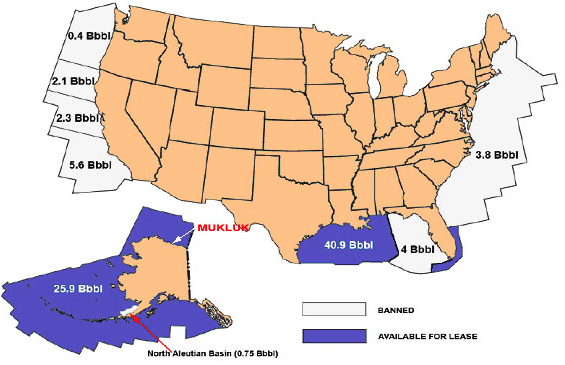
Offshore drilling, waar?quote:Remember when $200-per-barrel oil looked inevitable? Or, at the very least, a $100-per-barrel plateau looked certain? Plenty of oil analysts thought that was just over the horizon (yes, I was also guilty of this). But now crude futures are hovering down around $90, despite the succession of brutal hurricanes in the Gulf of Mexico—mainly due to fears that the crisis on Wall Street will knock more wind out of the U.S. economy and further dampen demand. So does that mean all the frantic concern about "peak oil" and all the apocalyptic blather about the end of mass air travel and so on and so forth was all totally baseless and wrong?
Well, I'm not sure about that. Production figures and forecasts still suggest that oil production really may peak in the next few years. But it's worth trying to clarify what peak oil would actually entail. Here's Richard Heinberg of the Post Carbon Institute: "Sometime around 2010 (give or take two or three years), growing decline rates in oil production from existing oilfields will overwhelm new production streams coming online. The price of oil will rise dramatically. However, when it does it will cripple the trucking industry, the airline industry, tourism, agriculture—essentially, the whole economy. A serious recession will ensue, which will reduce demand for oil (among other things). Oil’s price will temporarily drop in response. Then, as declines in oil production worsen, the price will resume its upward march—but again in a sawtooth or whipsaw fashion."
In other words, if global production is in fact peaking, we may be in not so much for an inexorable march upward in the price of oil and a permanent $150-per-barrel plateau, but rather lots and lots of volatility—which would prove just as damaging in the long run. (What good is cheap oil if we have to suffer through a recession to get it?) Now, if Heinberg's right, then it's a good time to start reducing our vulnerability to oil shocks, which in the long term means getting off the black gooey stuff for good. In the short term, that means—among other things—upping the energy intensity of the economy (especially in the transport sector), which would minimize the damage inflicted by rapid price fluctuations. The fact that prices have rocketed back down rather quickly is no reason to get complacent. On the other hand, if we're in a world of wildly volatile—rather than permanently high—oil prices, that also makes it much harder for alternative energy sources to get a foothold in the market without smarter policies from on high.
The problem is not the occupation, but how people deal with it.
Brandstofvoorraden
In miljoenen
Ruwe Olie: 291,7 (-6,3 tov vorige week)
Benzine: 184,6 (-3,3 tov vorige week)
Olie import: 9,199 (-10,5 % tov vorig jaar)
Productie: 4,519 (-7,8 % tov vorig jaar)
Totaal aanbod: 19,880 (-4,4% tov vorig jaar)
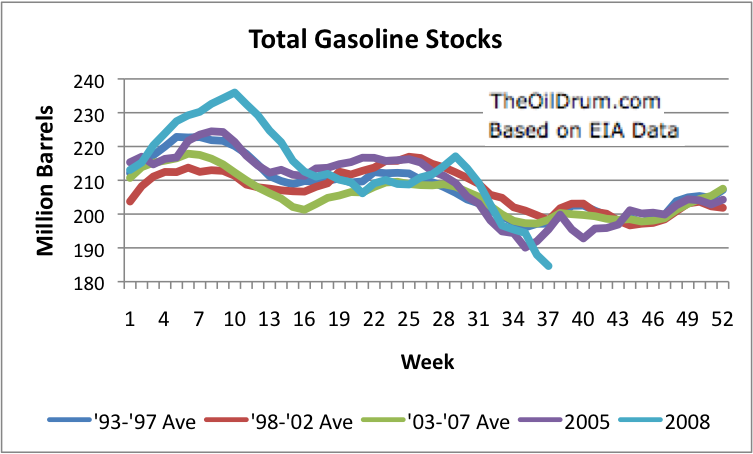
Naar het blijkt is de benzinevoorraad het laagste sinds 1990 toen de EIA begon dit vast te leggen.
In miljoenen
Ruwe Olie: 291,7 (-6,3 tov vorige week)
Benzine: 184,6 (-3,3 tov vorige week)
Olie import: 9,199 (-10,5 % tov vorig jaar)
Productie: 4,519 (-7,8 % tov vorig jaar)
Totaal aanbod: 19,880 (-4,4% tov vorig jaar)
Naar het blijkt is de benzinevoorraad het laagste sinds 1990 toen de EIA begon dit vast te leggen.
The problem is not the occupation, but how people deal with it.
Speculaties? Voorraad nu verkopen en aanvullen als de olie nog goedkoper is?quote:Op woensdag 17 september 2008 17:42 schreef waht het volgende:
Naar het blijkt is de benzinevoorraad het laagste sinds 1990 toen de EIA begon dit vast te leggen.
censuur :O
Heeft te maken met de seizoensgebonden hogere vraag naar benzine, 'driving season'. Maar die is eigenlijk op labor day (1 sept) al afgelopen. Daarna hadden we Gustav en nu Ike. Die hebben voor een groot gedeelte de raffinage-capaciteit rond de Golf stilgelegd. Verder heeft de VS geen strategische opslag van benzine (wel van ruwe olie) dus moeten ze het doen met de commerciële voorraden.quote:Op woensdag 17 september 2008 19:51 schreef RemcoDelft het volgende:
[..]
Speculaties? Voorraad nu verkopen en aanvullen als de olie nog goedkoper is?

Benzineprijzen zitten tot nu toe ongeveer 10-30 cent onder de records van juni/juli.
http://www.eia.doe.gov/oi(...)p/mogas_history.html
En de prijs van RBOB gasoline futures blijft verder vallen.
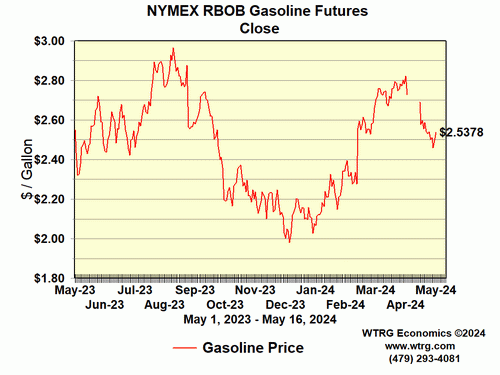
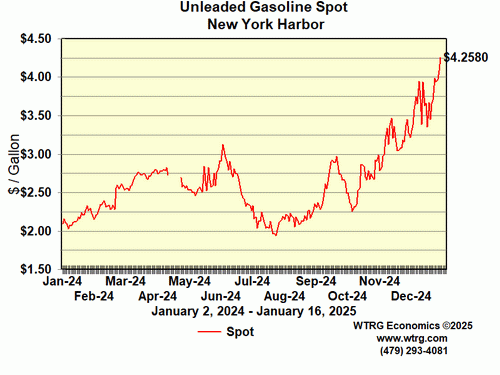
Hier de spot price van benzine.
The problem is not the occupation, but how people deal with it.

Dat klopt niet hoorquote:Op vrijdag 19 september 2008 20:24 schreef waht het volgende:
[ afbeelding ]
Lekker stabiele prijs tegenwoordig.
Ik had al zo'n vermoeden. Maar dan nog, een stijging van $10 in twee dagen...quote:
The problem is not the occupation, but how people deal with it.
De dollar daalt weer...quote:Op zaterdag 20 september 2008 12:12 schreef waht het volgende:
[..]
Ik had al zo'n vermoeden. Maar dan nog, een stijging van $10 in twee dagen...
censuur :O
Olie afgelopen vrijdag gesloten op $104.
Crude climbs despite financial worries
Benzine-tekorten blijven nog steeds een probleem in de VS.
Benzineprijzen in de VS
Nashville pumps dry after panic about rumor of no gas
Gas prices remain higher in Middle Tennessee
Beaufort: Low Country gas stations out of gas
Cherokee: Gas spikes as drivers rush stations
Gasoline Supply May Fall `Substantially,' Energy Official Says
EIA Report on Hurricane Impact
'PADD' staat voor Petroleum Administration for Defense Districts, regio's waarin het land is ingedeeld voor de olie/benzine-distributie. De benzinetekorten zijn natuurlijk niet overal in het land. Bepaalde delen zitten echter aan het einde van de distributie-keten en zullen dus eerder problemen krijgen dan andere delen van het land. In Seattle, Washington, krijgen ze bijvoorbeeld genoeg olie uit Sarah Palin's staat, Alaska, en kunnen de boel zelf raffineren.
The Oil Drum; How Much Will Gustav and Ike Affect Gas Supplies?
Oil shale is a problematic fuel option
Crude climbs despite financial worries
Benzine-tekorten blijven nog steeds een probleem in de VS.
Benzineprijzen in de VS
Nashville pumps dry after panic about rumor of no gas
Gas prices remain higher in Middle Tennessee
Beaufort: Low Country gas stations out of gas
Cherokee: Gas spikes as drivers rush stations
Gasoline Supply May Fall `Substantially,' Energy Official Says
Gaat nog spannend worden.quote:``Probably the max is an 8.5 million draw in gasoline because demand is down, and it could be as low as 6.5 million'' barrels, John Duff, survey manager for the Energy Department's weekly petroleum status report, said in an interview. The report will show ``the real impact of the hurricane on the refining sector,'' he said. Supplies will fall ``substantially.''
EIA Report on Hurricane Impact
quote:So far, since refineries first shut down before Hurricane Gustav, over 36 million barrels of products have not been produced, including nearly 17 million barrels of gasoline and nearly 12 million barrels of distillate fuel. This does not include reduced production from refineries that have reduced runs at various times during Hurricanes Gustav or Ike. As of September 19, 7 refineries were running at a reduced rate. As of September 19, the Colonial and Plantation product pipelines continue to operate at reduced rates. Both of these are major product pipelines going from the Gulf Coast to the East Coast.

'PADD' staat voor Petroleum Administration for Defense Districts, regio's waarin het land is ingedeeld voor de olie/benzine-distributie. De benzinetekorten zijn natuurlijk niet overal in het land. Bepaalde delen zitten echter aan het einde van de distributie-keten en zullen dus eerder problemen krijgen dan andere delen van het land. In Seattle, Washington, krijgen ze bijvoorbeeld genoeg olie uit Sarah Palin's staat, Alaska, en kunnen de boel zelf raffineren.

The Oil Drum; How Much Will Gustav and Ike Affect Gas Supplies?
quote:There are a lot of issues that I might have mentioned, but didn't. One of the more important is the possibility that the pipeline system may be near minimum operating level, and that some sections will no longer function if the level gets too low. The areas that would seem to be most at risk are the ones at the ends or lines, or on small spur pipelines. If this should happen, residents in the areas affected areas might find themselves out of all types of refined products (including diesel and jet fuel), unless they had extra supply stored in local supply tanks. Additional supply could theoretically be trucked in, but we have a limited number of trucks for transporting fuel.
Colonial pipeline is one of the pipelines that has had difficulty with adequate supply. The supply begins in Texas/Louisiana. The areas I would expect to be most at risk are on the spur pipelines and farthest north.

Oil shale is a problematic fuel option
Saudi needs oil above $49 to avoid deficitquote:The good news is that it is plentiful. Around the world, there are thought to be roughly 3 trillion barrels of oil locked in oil shale deposits. And more than half of that is in the United States. Most of the U.S. oil shale is located in an area known as the Green River Formation, which stretches across Colorado, Utah and Wyoming. It is possible that there is more oil in these U.S. deposits of oil shale than there is oil left in "normal" crude oil deposits worldwide. In other words, oil shale could provide the United States with oil for many decades.
The bad news is that the oil in oil shale is not so easy to extract. With a normal oil well, you are tapping into an underground lake of oil. An oil company drills down to the lake and then pumps the liquid oil to the surface. This liquid crude oil can flow through pipelines directly to a refinery.
With oil shale, you start with something that looks like a rock. You dig this rock out of the ground, usually using the same kind of techniques used to mine coal. This rock obviously contains energy, because the rock burns if you light it. In some countries, oil shale rock is a fuel for power plants.
But, if you want to convert oil shale into something like gasoline or diesel fuel, you need a few more steps. The most common technique is to heat the rock to a high temperature to turn all of the oil contained in the rock into a gas. The heating is done in a container that does not contain any oxygen, so the oil won't burn. Once you cool the gas back down, much of it liquefies. This liquid is processed and refined to form different liquid fuels.
An obvious problem here is the heat. You have to do something to heat up the rock. One solution is to burn some of the oil coming out of the rock. This is easy and obvious, but it lowers the yield and creates more pollution. Another more ambitious idea uses heat from a nuclear power plant to release the oil.
In any case, after all of this processing, you end up with something like 10 to 60 gallons of shale oil from each ton of rock that you mine from the ground. The mining and processing means that the oil coming from oil shale can be relatively expensive compared to crude oil that is pumped from the ground. When oil costs $10 a barrel, oil shale does not make economic sense. But when oil is at $100 a barrel or more, oil shale has a lot of economic justification.
Even with economic viability, however, oil shale has another problem: It has a relatively large effect on the environment. Mining is not great for the environment to begin with. Then the process of heating the rock and extracting the oil creates pollution and greenhouse gas emissions. In addition, processing the oil shale can consume a lot of water. And then there is all the shale left over once the oil is extracted. Millions and millions of tons of it, and it all has to go somewhere. Often it goes right back where it came from, where there are more environmental costs involved. New techniques, like heating and extracting the oil while the shale is still in the ground, lower some of these environmental costs.
quote:Saudi Arabia, the world’s largest oil exporter, will need crude prices to remain above $49 a barrel to avoid a fiscal deficit, a senior International Monetary Fund official has said.
“If it goes below that level we would start seeing a fiscal account deficit,” Mohsin Khan, director of Middle East and central Asia at the IMF, told Dow Jones Newswires.
Oil prices have fallen drastically in the past two month, shedding over $50 in value since they hit $147 a barrel in July, raising concerns over the continued strength of Persian Gulf Arab economies.
Saudi Arabia, the Middle East largest economy, depends on oil and gas sales for 90% of its export income. “Saudi Arabia’s break-even price is the highest among the Gulf Co-operation Council Countries because they are spending on a lot of projects right now, and oil money is used to fund these projects,” he said. Further declines in oil prices could tip the region’s economies over the edge as they continue to spend heavily on infrastructure projects.
According to Middle East Economic Digest, Gulf states are spending about $2.3tn on projects.
The problem is not the occupation, but how people deal with it.
En ondertussen zo goed als $120quote:Op zondag 21 september 2008 18:01 schreef waht het volgende:
Olie afgelopen vrijdag gesloten op $104.
 De WTI op Nymex that is...
Buenos dias Tristeza
