NWS Nieuws & Achtergronden
Discussieer hier diepgaander over de actualiteiten.



Bij het lezen van deze berichten kreeg ik voor het eerst echt een bezorgd gevoel... kippevel.quote:Op zaterdag 18 februari 2006 15:28 schreef indahnesia.com het volgende:
Zo, het gaat gewoon verder in het weekeinde natuurlijk.
Tientallen nieuwe gevallen van vogelgriep in Duitsland
Vogelgriep duikt ook op in India


ben je al opgehokt?quote:Op zaterdag 18 februari 2006 15:50 schreef -Wolf- het volgende:
[..]
Bij het lezen van deze berichten kreeg ik voor het eerst echt een bezorgd gevoel... kippevel.

Wolven hoeven niet opgehokt te worden.quote:

Nu zijn mensen wel bang dat het virus kan muteren in een menselijk virus.... maar hoe zit dat met dieren eigenlijk? Dalijk gaan alle koeien dood ofzo.
katten kunnen het schijnbaar krijgen.. tja.. verder is het afwachten he..quote:Op zaterdag 18 februari 2006 15:54 schreef -Wolf- het volgende:
[..]
Wolven hoeven niet opgehokt te worden.
Nu zijn mensen wel bang dat het virus kan muteren in een menselijk virus.... maar hoe zit dat met dieren eigenlijk? Dalijk gaan alle koeien dood ofzo.
Op CNN zonet ook het bericht dat er een besmette eend gevonden is in een dicht bevolkte wijk in Hong Kong.

In India worden de vogels op grote schaal ziek:
Tienduizenden vogels
In Duitsland gaat het ook lekker:
www.ophokken.nlquote:Vogelgriep nu ook in India; negentiende vogelgriepdode in Indonesië
NEW DELHI - De vogelgriep lijkt nu ook te zijn opgedoken in India. In het district Nandurbar in de westelijke deelstaat Maharashtra zijn in de afgelopen dagen tienduizenden vogels gestorven. Aanvankelijk werd gedacht aan de ziekte van Newcastle, maar nader onderzoek heeft uitgewezen dat de sterfte is veroorzaakt door vogelgriep.
Tienduizenden vogels
In Duitsland gaat het ook lekker:
telegraaf.nlquote:28 nieuwe gevallen van vogelgriep in Duitsland
SCHWERIN - In de Duitse deelstaat Mecklenburg-Vorpommern zijn zaterdag 28 nieuwe gevallen ontdekt van besmetting met het vogelgriepvirus H5N1. Dat hebben de plaatselijke autoriteiten bekendgemaakt.
Eerder deze week waren al dertien dode vogels gevonden.
In Oostenrijk, waar het virus H5N1 vorige week al werd ontdekt, verspreidt de vogelgriep zich verder uit over het land. In onder meer Wenen werd een dode zwaan gevonden die besmet was met het virus.
"Nee, dat is geen vogelgriep hoor!" En dan tot de ontdekking komen dat 50,000 beesten wél de vogelgriep hebben. Ben je mooi mee.
Ook is er besmetting op minder dan 500 kilometer van Mumbai. Wat als er daar in de stad een grote uitbraak komt?
Ook is er besmetting op minder dan 500 kilometer van Mumbai. Wat als er daar in de stad een grote uitbraak komt?
quote:India confirmed its first bird flu infections in poultry on Saturday after 50,000 birds died in western Maharashtra state, the state's animal husbandry minister said on Saturday.
A federal health ministry official said there were no reports of human infections.
State husbandry minister Anees Ahmed said tests had confirmed the presence of the H5N1 avian flu virus in some of the dead chickens in Nandurbar district, about 450 km (280 miles) north of Mumbai, the country's bustling commercial capital.
Samples sent to a government laboratory in central Bhopal town had confirmed bird flu.
"Yes, it is confirmed. The disease is H5N1. It has come to Maharashtra," Ahmed said by telephone.
"We are treating it as an emergency. We are carrying out the operations of culling birds in Nandurbar. We have sent 200 veterinary doctors there," Ahmed said.
In New Delhi, an emergency meeting of the cabinet secretariat was called, a TV report said.
Maharashtra animal husbandry commissioner Bijay Kumar told Reuters culling operations would start from Sunday and farmers would be adequately compensated.
Maharashtra, India's richest and most industrialized state, has hundreds of poultry farms.
"We have banned trade in poultry in a 10-km radius of Nandurbar with immediate effect," he said.
"We are fully prepared. We have airlifted adequate stocks of vaccinations for the healthy birds and Tamiflu for workers. There are 60 teams working in the area," Kumar added.
"There are 900,000 birds in that area and birds within a 3-km (two miles) radius will have to be culled. There is no report of an outbreak in any other areas," he said.
India is the fifth largest producer of eggs in the world. Livestock and poultry is one of the fastest-growing sectors in the country.
The highly pathogenic H5N1 avian influenza virus has spread from Asia to Europe and Africa, infecting 171 people since 2003 and killing 93 of them.
Scientists fear that if the virus mutates and acquires the ability to pass easily from person to person, it could cause a pandemic in which millions might die because they would have no immunity.
Uttam Khobragade, principal secretary at Maharashtra's animal husbandry department, said the birds were initially thought to have died from Raniketh disease, but laboratory tests later confirmed avian flu. Raniketh is a local disease that has been affecting poultry in the state for decades.
"It is possible that the bird flu came from migratory birds," Mumbai-based analyst G. Chandrashekhar told Reuters. India receives hundreds of thousands of migratory birds each year, from as far away as Siberia to the far East.
At least 60 percent of India's one-billion plus people live in rural areas close to their livestock, just like in many other parts of Asia, raising the risks of the bird flu virus infecting people.
Poultry farming is particularly popular in Maharashtra. There are 52 poultry farms in Nandurbar area, officials said.
Though a majority of Indians follow Hinduism, which bans meat-eating, its consumption is common in rural and urban areas.

quote:Op zaterdag 18 februari 2006 15:41 schreef ..-._---_-.- het volgende:
Jonge mensen komen meer buiten. Oude mensen worden vaker opgehokt.
Dus puur op basis van besmettingsrisico.quote:Op zaterdag 18 februari 2006 15:49 schreef indahnesia.com het volgende:
[..]
die jonge mensen werken met die dieren, en worden dus ziek. Maar er zijn vast ook wel weer andere redenen
Als je het eenmaal hebt zullen de ouderen en zwakkeren desondanks toch eerder dood gaan?
Godfather Bodybuilding topic reeks
Dat zou ik ook wel eens willen wetenquote:Op zaterdag 18 februari 2006 17:35 schreef Gebleekte het volgende:
Hoe gevaarlijk is dit voor gezonde mensen?

Experience is what you get when you don't get what you wanted
Take my advice ... I don't use it anyway...
Een goede Fok! Search
Een goede Fok! Search
Take my advice ... I don't use it anyway...
Een goede Fok! Search
Een goede Fok! Search
Ja idd. Want 2 jaar geleden in de zomer, toen kwamen ze ook met het bericht dat er in Frankrijk door de hitte 5000 mensen waren gestorven Maar dat waren stuk voor stuk bejaardenquote:Op zaterdag 18 februari 2006 17:53 schreef Martijn_77 het volgende:
[..]
Dat zou ik ook wel eens willen weten
In Nederland is toch ook een vogelpestdode gevallen? Ik meen dat in 2003 een veearts overleden is aan longontstekingachtige verschijnselen ten gevolge van vogelpest. Dat was dan geen H5N1 variant maar een andere variant.
klopt inderdaad, maar toen heette het nog vogelpest, en nu vogelgriep.quote:Op zondag 19 februari 2006 10:53 schreef ..-._---_-.- het volgende:
In Nederland is toch ook een vogelpestdode gevallen? Ik meen dat in 2003 een veearts overleden is aan longontstekingachtige verschijnselen ten gevolge van vogelpest. Dat was dan geen H5N1 variant maar een andere variant.
heb je een linkje/bron?quote:Op zondag 19 februari 2006 13:38 schreef nummer_zoveel het volgende:
Er wordt al geadviseerd huiskatten binnen te laten.
http://www.nu.nl/news/678(...)iep_%28video%29.html
Vogelhouders adviseren het, minister van Landbouw vindt het (nog) niet nodig.
Over een maandje gaan we verhuizen en dan is het de bedoeling dat Poes weer naar buiten kan, maar als dat vogelgriepgedoe bezig blijft moet ie binnen blijven.
Vogelhouders adviseren het, minister van Landbouw vindt het (nog) niet nodig.
Over een maandje gaan we verhuizen en dan is het de bedoeling dat Poes weer naar buiten kan, maar als dat vogelgriepgedoe bezig blijft moet ie binnen blijven.
Ik had in een programma op tv gehoord dat het juist voor gezonde mensen het gevaarlijkst was.quote:Op zaterdag 18 februari 2006 17:35 schreef Gebleekte het volgende:
Hoe gevaarlijk is dit voor gezonde mensen?
Heb helaas geen bron...
Aan de andere kant....
'Maar het virus springt moeilijk van dieren over op mensen. Bovendien worden gezonde mensen niet zomaar ziek van het virus. Angst voor een epidemie is daarom niet nodig. Pas als het virus verandert, kan er een risico voor mensen omstaan. Maar wanneer en of dat gebeurt is giswerk (lees Vogelgriep: Wat u moet weten)'.
Bron
[ Bericht 23% gewijzigd door Noax op 19-02-2006 15:17:53 ]
Learn From Your Parents Mistakes...Use Birth Control.
︻╦╤─--
︻┳═一 ︻┳═一
︻╦╤─--
︻┳═一 ︻┳═一
In Duitsland en Italië breidt de vogelgriep zich uit. Het gaat in alle gevallen om de H5N1 variant. In Duitsland staat de teller nu al op 28.
Ik heb begrepen dat in België de ophokplicht ook wordt ingevoerd, maar dan alleen voor hobbydieren:
[ Bericht 0% gewijzigd door #ANONIEM op 19-02-2006 17:02:46 ]
www.ophokken.nlquote:19-02-2006 - Toename vogelgriep in Europa
De vogelgriep is dit weekeinde verder opgerukt in Europa. In Frankrijk is het voor mensen gevaarlijke vogelgriepvirus H5N1 voor het eerst opgedoken, zo maakte het Franse ministerie van Landbouw bekend. In Duitsland werden 28 nieuwe besmettingen ontdekt en Italië constateerde een tiende geval van H5N1.
Ik heb begrepen dat in België de ophokplicht ook wordt ingevoerd, maar dan alleen voor hobbydieren:
www.hln.bequote:Ophokregeling
Momenteel is vastgelegd dat er vanaf 1 maart in gevoelige natuurgebieden een ophokregeling komt voor pluimvee van particulieren. Dat betekent dat particulieren in die gebieden vanaf dan hun pluimvee moeten afschermen.
[ Bericht 0% gewijzigd door #ANONIEM op 19-02-2006 17:02:46 ]
Ik dacht juist,quote:Op zondag 19 februari 2006 14:57 schreef Noax het volgende:
[..]
Ik had in een programma op tv gehoord dat het juist voor gezonde mensen het gevaarlijkst was.
Heb helaas geen bron...
Aan de andere kant....
'Maar het virus springt moeilijk van dieren over op mensen. Bovendien worden gezonde mensen niet zomaar ziek van het virus. Angst voor een epidemie is daarom niet nodig. Pas als het virus verandert, kan er een risico voor mensen omstaan. Maar wanneer en of dat gebeurt is giswerk (lees Vogelgriep: Wat u moet weten)'.
Bron
oudere mensen, jonge kindjes en mensen met slechte weerstand

Ik geef het geen week meer, dus vanaf maandag 20-2-2006 tot 27-2-2006.
Net voor carnaval :/
Two things are infinite: the universe and human stupidity; and I'm not sure about the the universe
Don’t take my kindness for weakness and then expect me to treat you the same
Don’t take my kindness for weakness and then expect me to treat you the same
Nou, het spreid nu zo hard uit, dat het eiland Rügen tot rampgebied is verklaard, er liggen nog veel dode vogels. Ook is op het vaste land nu dood pluimvee gevonden.
Kwestie van 'uren' dat het hier bevestigd word. Het is toch al hier.
Kwestie van 'uren' dat het hier bevestigd word. Het is toch al hier.
Jonge mensen hebben minder met griep en andere virussen te maken gehad dan ouderen en hebben dus minder antistoffen in hun lichaam.quote:Op zaterdag 18 februari 2006 15:34 schreef Mr.J het volgende:
Wat ik dus even niet vat is dat naw jonge en gezonde mensen hier eerder aan zullen overlijden dan ouderen.
Kan iemand mij dit uitleggen svp?

Verder is het zo dat de weerstand bij kinderen en laten we zeggen volwassenen van 60+ lager ligt dan bij volwassenen -60 en zullen deze dus eerder bezwijken aan het virus.

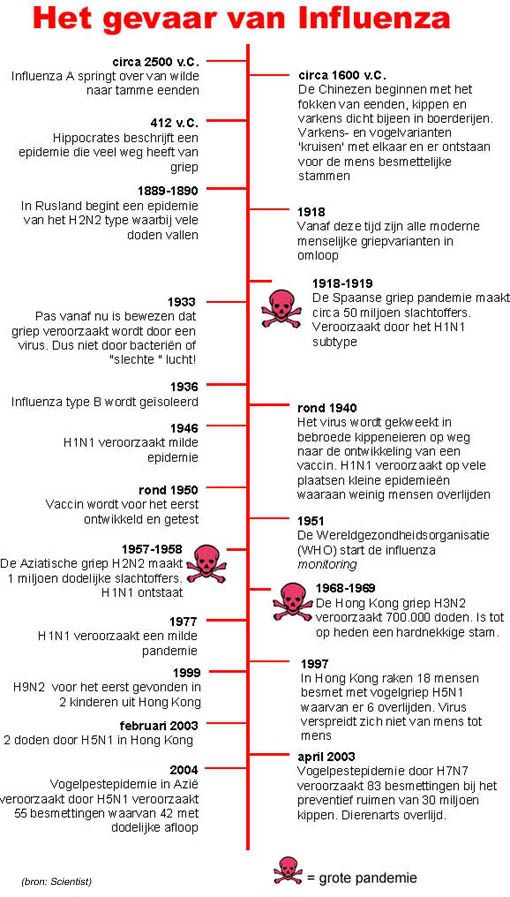

Wanneer kan het tot een hoogtepunt komen?
In het voorjaar, als alle vogels uit verre oorden hier neergestreken zijn?
In het voorjaar, als alle vogels uit verre oorden hier neergestreken zijn?
besmetting op mensen komt door "contact met vogels", ik vermoed dat vogels onderling ook wel eens dicht bij elkaar zijn.quote:Op maandag 20 februari 2006 09:16 schreef feessie het volgende:
Kan het virus ook via wind verspreid worden ? Ik vraag me af , hoe die vogels elkaar besmetten.

Virus verspreid via de wind? Gelukkig niet zeg!
Mensen die veelvuldig met vogels in contact komen lopen het meeste risico. Pluimeeveehouders en mensen die kippen als hobby houden enz. Maar poezebeesten die met een dode vogel thuis aan komen zetten zou ik ook mee oppassen nu. Je weet maar nooit!

Mensen die veelvuldig met vogels in contact komen lopen het meeste risico. Pluimeeveehouders en mensen die kippen als hobby houden enz. Maar poezebeesten die met een dode vogel thuis aan komen zetten zou ik ook mee oppassen nu. Je weet maar nooit!
Na de 2 zwanen bij Kampen en in Flevoland hoor je de laatste dagen geen verdachte gevallen meer, maar lijkt me een stilte voor de storm
Brakmanschap is Meesterschap
Ja,wij zijn ons er eentje!
Ja,wij zijn ons er eentje!
Volgens minister Veerman duurt het nog enkele etmalen (of eerder ) voordat er hier vogelgriep geconstateerd gaat worden .quote:Op maandag 20 februari 2006 11:25 schreef Dr.Aart het volgende:
Na de 2 zwanen bij Kampen en in Flevoland hoor je de laatste dagen geen verdachte gevallen meer, maar lijkt me een stilte voor de storm
Bangmakerij. Mijn moeder slaat op hol als ze dit hoort, maar het slaat nog niet van mens tot mens over...quote:Op maandag 20 februari 2006 11:34 schreef feessie het volgende:
[..]
Volgens minister Veerman duurt het nog enkele etmalen (of eerder ) voordat er hier vogelgriep geconstateerd gaat worden .
Ich bin der Führer.
Nah, is geen bangmakerij maar een feit. Het is hier allang, alleen de bevestiging moet nog komen.
Mens op mens is inderdaad heel wat anders, maar dat heeft verder niets te maken met het feit of de vogelgriep hier nu wel of niet is. Dat komt mogelijk in een ander stadium nog.
Mens op mens is inderdaad heel wat anders, maar dat heeft verder niets te maken met het feit of de vogelgriep hier nu wel of niet is. Dat komt mogelijk in een ander stadium nog.
Ja uhh , mijn vriendin is biomedisch wetenschapper in opleiding, (wel ver al 3/4e jaar) , en die zegt dat het best gevaarlijk is dit virus, maar ook dat men al 1 jaar voor deze hype begon, af wist van h5n1, iig dat hebben de verschillende professoren gezegd. - Ik vind dat de regering te weinig doet, en vooral te laat. Als het zover komt dat er in Nederland een vogel naar mens besmetting komt, kun je op 40.000 doden rekenen, voornamelijk kleine kinderen en ouderen. Maar dit betekent niet dat gezonde mensen het niet krijgen, die zullen er ook ziek van worden, maar die hebben genoeg weerstand, om waarschijnlijk,het virus te overleven. We moeten maar zien. Misschien wel een strom in glas water en gehyped door media, net zoals Sars, of een human-killer.
Een virus is moeilijker aan te pakken dan bacterie, omdat virus zich ''voortplant'' in gezonde cellen, en bacterien niet. Bij bacterien kunnen medicijnen de verschillende ''aanhechtingsplaatsen' blokkeren, waardoor ze niet meer tot uiting komen uiteindelijk. Een virus is gemener, die kun je soms niet goed zien.
Een virus is moeilijker aan te pakken dan bacterie, omdat virus zich ''voortplant'' in gezonde cellen, en bacterien niet. Bij bacterien kunnen medicijnen de verschillende ''aanhechtingsplaatsen' blokkeren, waardoor ze niet meer tot uiting komen uiteindelijk. Een virus is gemener, die kun je soms niet goed zien.
Squelch - a circuit that cuts off the audio-frequency amplifier of a radio receiver in the absence of an input signal, in order to suppress background noise.
Een bacterie kan net zo gemeen zijn als een virus, de bekende medicijnen blokkeren ook de aanhechtingsplaatsen bij bacterien, net als bij virussen. Probleem bij virussen is echter dat ze zo vaak en veel muteren, dat de medicijnen niet meer werken.
Wetenschappers schatten in welke (griep)virussen elk seizoen voor problemen zullen zorgen, aan de hand daarvan wordt de griepprik samengesteld. Probleem met H5N1 is dat het zoveel muteert dat een gewone griepprik niet helpt.
Is het overhyped? Ja, tuurlijk.. maar daar is het de tijd ook naar. Dit soort virussen hebben zich vroeger ook in grote mate verspreid, maar vroeger lag bv Japan op enkele maanden reizen met de boot, en bestond er niet zoeits als radio of tv. Men had simpelweg geen weet van wat er aan de andere kant van de wereld gebeurde, en de media die erover berichten werden (krant) werd alleen gelezen door de elite. De gewone burgerman had er geen weet van.
Tegenwoordig echter kan iedereen snel en makkelijk aan nieuws komen, is Azie binnen een dag bereikbaar en is er in het algemeen veel meer media dan pakweg 100 jaar terug. Dus ja, een hype is snel geboren.
Wetenschappers schatten in welke (griep)virussen elk seizoen voor problemen zullen zorgen, aan de hand daarvan wordt de griepprik samengesteld. Probleem met H5N1 is dat het zoveel muteert dat een gewone griepprik niet helpt.
Is het overhyped? Ja, tuurlijk.. maar daar is het de tijd ook naar. Dit soort virussen hebben zich vroeger ook in grote mate verspreid, maar vroeger lag bv Japan op enkele maanden reizen met de boot, en bestond er niet zoeits als radio of tv. Men had simpelweg geen weet van wat er aan de andere kant van de wereld gebeurde, en de media die erover berichten werden (krant) werd alleen gelezen door de elite. De gewone burgerman had er geen weet van.
Tegenwoordig echter kan iedereen snel en makkelijk aan nieuws komen, is Azie binnen een dag bereikbaar en is er in het algemeen veel meer media dan pakweg 100 jaar terug. Dus ja, een hype is snel geboren.
Bij tijd en wijle aanwezig...
En weer een geval :
Het eerst geval van vogelgriep in Bosnië is een feit. Vandaag werd bevestigd dat een aantal zwanen is besmet. Verdere testen moeten uitwijzen of het om de voor mensen gevaarlijke H5N1 variant gaat.
bron nieuwnieuws.nl
Het eerst geval van vogelgriep in Bosnië is een feit. Vandaag werd bevestigd dat een aantal zwanen is besmet. Verdere testen moeten uitwijzen of het om de voor mensen gevaarlijke H5N1 variant gaat.
bron nieuwnieuws.nl
het WHO heeft een tekst uitgegeven
Dus het virus is niet gevaarlijker voor mensen geworden, maar wel voor pluimvee. Als er echter meer pluimvee ziek wordt, zullen er ook meer mensen besmet raken. Maar goed, dat is logisch natuurlijk.quote:Several recent media reports have included speculations about the significance of mutations in H5N1 avian influenza viruses. Some reports have suggested that the likelihood of another pandemic may have increased as a result of changes in the virus.
Since 1997, when the first human infections with the H5N1 avian influenza virus were documented, the virus has undergone a number of changes.
These changes have affected patterns of virus transmission and spread among domestic and wild birds. They have not, however, had any discernible impact on the disease in humans, including its modes of transmission. Human infections remain a rare event. The virus does not spread easily from birds to humans or readily from person to person.
Influenza viruses are inherently unstable. As these viruses lack a genetic proof-reading mechanism, small errors that occur when the virus copies itself go undetected and uncorrected. Specific mutations and evolution in influenza viruses cannot be predicted, making it difficult if not impossible to know if or when a virus such as H5N1 might acquire the properties needed to spread easily and sustainably among humans. This difficulty is increased by the present lack of understanding concerning which specific mutations would lead to increased transmissibility of the virus among humans.
Animal viruses
Virtually all the known subtypes of influenza A viruses circulate in some wild birds, most notably wild waterfowl. In these birds, different viruses constantly mingle with each other and frequently exchange genetic material, resulting in a huge pool of constantly changing viruses. Mutations and reassortment events are commonly observed in the affected bird populations.
In animals, some recent evolutionary changes in the H5N1 virus appear to have made control efforts more difficult and further international spread of the virus in birds more likely. Such changes are fully understandable, particularly in view of the exceptionally large number of birds that have been infected with the H5N1 virus and the frequent interactions between infected free-ranging poultry and wild waterfowl.
Studies have shown that H5N1 viruses from the current outbreaks, when compared with viruses from 1997 and 2003, have become progressively more lethal in experimentally infected chickens and mice, and are also hardier, surviving several days longer in the environment. Other studies have shown that the virus is not yet fully adapted to poultry and is continuing to evolve.
Domestic ducks have acquired an ability to resist the disease caused by some strains, and are now capable of excreting large quantities of highly pathogenic virus without showing the warning signs of illness. In endemic countries, this altered role of domestic ducks is now thought to contribute to perpetuation of the transmission cycle. Research conducted in South-east Asia has recently shown that multiple distinct lineages of H5N1 virus have become established in poultry in different geographical regions, indicating the long-term endemicity of the virus in parts of Asia. That research also detected highly pathogenic H5N1 virus in apparently healthy migratory birds.
In birds, one important recent finding has been the remarkable similarity of viruses from recent outbreaks to those isolated from migratory birds that began dying at the Qinghai Lake nature reserve in central China in late April 2005. Evidence is mounting that this event, which resulted in the deaths of more than 6,000 wild birds, signalled an important change in the way the virus interacts with its natural reservoir host.
Unlike the case with mutations of human viruses (some of which have been transient), it appears that some changes have become fixed in viruses circulating in at least some species of wild birds.
Prior to the Qinghai Lake event, the highly pathogenic H5N1 virus was known to cause occasional sporadic deaths in migratory waterfowl, but not to kill them in large numbers or be carried by them over long distances.
Viruses from Qinghai Lake showed a distinctive mutation at one site experimentally associated with greater lethality in birds and mice. Viruses from the most recent outbreaks, in Nigeria, Iraq, and Turkey, as well as from earlier outbreaks in Russia, Kazakhstan, and Mongolia, are virtually identical to Qinghai Lake viruses.
It is considered unusual for an avian influenza virus causing outbreaks in birds to remain this genetically stable over so many months. This finding raises the possibility that the virus – in its highly pathogenic form – has now adapted to at least some species of migratory waterfowl and is co-existing with these birds in evolutionary equilibrium, causing no apparent harm, and travelling with these birds along their migratory routes.
If further research verifies this hypothesis, re-introduction of the virus or spread to new geographical areas can be anticipated when migratory birds begin returning to their breeding areas.
The recent appearance of the virus in birds in a rapidly growing number of countries is of public health concern, as it expands opportunities for human exposures and infections to occur. These opportunities increase when the virus spreads from wild to domestic birds, especially when these birds are kept as backyard flocks in close proximity to humans..
To date, no human cases have been linked to exposure to wild birds. Close contact with infected poultry and other domestic birds remains the most important source of human infections.
Human viruses
Some mutations have been detected in human viruses isolated in 2005 and, most recently, in one virus isolated from a fatal case in the January 2006 outbreak in Turkey. Although these mutations were found at the receptor-binding site and involved the substitution of more mammalian-like amino acids, the effect of these changes on transmissibility of the virus, either from birds to humans or from one person to another, is not fully understood. Moreover, recent studies show that these mutations were transient and did not become fixed in the circulating viruses.
Scientists do not presently know which specific mutations are needed to make the H5N1 virus easily and sustainably transmissible among humans. For example, it is not known whether the absence of a specific receptor in humans for this purely avian virus is responsible for the present lack of efficient human-to-human transmission. For this reason, virological evidence of mutational changes must be assessed together with epidemiological information about transmission patterns actually occurring in human populations. This necessity further underscores the importance of close surveillance and thorough investigation during every outbreak involving human cases.
Assessments of the outbreak in Turkey, conducted by WHO investigative teams, have produced no convincing evidence that mutations have altered the epidemiology of the disease in humans, which was similar to the pattern consistently seen in affected parts of Asia. There is no evidence, at present, from any outbreak site that the virus has increased its ability to spread easily from one person to another.
Wanneer je besmet bent moet je binnen 48 uur Tamiflu gebruiken.
Het virus zou dan geremd worden en zich niet verder verspreiden in het lichaam.
Betekent dit dat je bij een volgende besmetting weer Tamiflu moet gebruiken?
Het virus zou dan geremd worden en zich niet verder verspreiden in het lichaam.
Betekent dit dat je bij een volgende besmetting weer Tamiflu moet gebruiken?
Learn From Your Parents Mistakes...Use Birth Control.
︻╦╤─--
︻┳═一 ︻┳═一
︻╦╤─--
︻┳═一 ︻┳═一

Het virus wordt vooral verspreid via veetransporten. Via banden en voetzolen. Van verspreiding via vogels is nog nooit een officiele bevestiging gekomen. Gek he dat die transporten dan gewoon doorgaan.
yeps...quote:Op maandag 20 februari 2006 17:37 schreef Noax het volgende:
Wanneer je besmet bent moet je binnen 48 uur Tamiflu gebruiken.
Het virus zou dan geremd worden en zich niet verder verspreiden in het lichaam.
Betekent dit dat je bij een volgende besmetting weer Tamiflu moet gebruiken?
tamiflu blokkeerd bepaalde receptoren van de cel, zodat het virus niet de cel in kan dringen.
tamiflu is echter geen vaccin, een vaccin zorgt er namelijk voor dat je immuunsysteem het virus de volgende keer sneller herkent en sneller aanpakt. Dat doet tamiflu niet
Bij tijd en wijle aanwezig...
Vogelpest kan wel de einde betekenen
Voor vrede en rechtvaardigheid - Tegen alle soorten vormen van geweld.
de einde nog wel...quote:Op maandag 20 februari 2006 18:11 schreef Meki het volgende:
Vogelpest kan wel de einde betekenen
Bij tijd en wijle aanwezig...
Het zal me niets verbazen dat terroristen er iets mee gaan doen wanneer het virus eenmaal gemuteerd is....
Learn From Your Parents Mistakes...Use Birth Control.
︻╦╤─--
︻┳═一 ︻┳═一
︻╦╤─--
︻┳═一 ︻┳═一
lijkt me niet zo zinvol.. er zijn veel dodelijkere virussen/bacterien/gifstoffen, diequote:Op maandag 20 februari 2006 18:21 schreef Noax het volgende:
Het zal me niets verbazen dat terroristen er iets mee gaan doen wanneer het virus eenmaal gemuteerd is....
- meer slachtoffers maken
- minder bewerkelijk zijn
- constanter zijn (virus maakt waarschijnlijk maar een paar maanden slachtoffers in de westerse wereld, daarna is er ofwel een vaccin, of is het weer gemuteerd dat het minder gevaarlijk is)
Bij tijd en wijle aanwezig...
Oke fantasie even de vrije loop...
Je gaat als met een paar 'vrienden' die dezelfde gedachte gang als b.v. Samir A hebben in een drukke winkelstraat staan.
Van mij met een paar folders die je aan het winkelend publiek geeft.
Na het afgeven van de folder geef je vervolgens iedereen een hand....
Uiteraard ben jezelf dan besmet.
Een hele goedekope manier om veel slachtoffers te maken...
Je gaat als met een paar 'vrienden' die dezelfde gedachte gang als b.v. Samir A hebben in een drukke winkelstraat staan.
Van mij met een paar folders die je aan het winkelend publiek geeft.
Na het afgeven van de folder geef je vervolgens iedereen een hand....
Uiteraard ben jezelf dan besmet.
Een hele goedekope manier om veel slachtoffers te maken...
Learn From Your Parents Mistakes...Use Birth Control.
︻╦╤─--
︻┳═一 ︻┳═一
︻╦╤─--
︻┳═一 ︻┳═一
quote:20-02-2006 - Ook ophokplicht voor pluimvee in Zwitserland
BERN - In Zwitserland geldt sinds maandag ophokplicht voor pluimvee hoewel in het land het gevreesde virus H5N1 nog niet is aangetroffen. De overheid heeft laten weten dat zij daar streng de hand aan zal houden en dat er maar weinig uitzonderingen op gemaakt zullen worden.
www.ophokken.nlquote:20-02-2006 - Ophokplicht alle pluimvee in België vanaf 1 maart
BRUSSEL - België voert per 1 maart een ophokplicht in voor alle pluimvee uit voorzorg voor de vogelgriep. Ook buiten natuurgebieden moeten vogels en pluimvee binnen blijven. Dat heeft de Belgische minister van Volksgezondheid Demotte maandag besloten na overleg met wetenschappelijke experts.
Voor alle duidelijkheid: In beide landen is geen vogelgriep aangetroffen (H5N1) maar voor België en Zwitserland in een aantal buurlanden (Nederland, Frankrijk, Duitsland, Oostenrijk, Italië)wel. Opmerkelijk is wel dat de Zwitsers sinds vandaag een ophokplicht kennen maar dat de Belgen nog meer dan een week wachten!
mits je gif gebruikt, met dit virus sta jij niet op straat folders uit te delen, maar lig jij met griep in bedquote:Op maandag 20 februari 2006 19:33 schreef Noax het volgende:
Oke fantasie even de vrije loop...
Je gaat als met een paar 'vrienden' die dezelfde gedachte gang als b.v. Samir A hebben in een drukke winkelstraat staan.
Van mij met een paar folders die je aan het winkelend publiek geeft.
Na het afgeven van de folder geef je vervolgens iedereen een hand....
Uiteraard ben jezelf dan besmet.
Een hele goedekope manier om veel slachtoffers te maken...
geloof me, dit virus is niet echt geschikt als massa vernietigingswapen, dat is sarin/antrax/ebola in het drinkwatersysteem veel meer
Bij tijd en wijle aanwezig...
Maar na hoelang ga je je pas zo ziek voelen na aanraking/besmetting van... dat het niet meer draaglijk is om iets dergelijks te ondernemen?
Bedankt voor het reageren!
[ Bericht 18% gewijzigd door Noax op 20-02-2006 21:51:24 ]
Bedankt voor het reageren!
[ Bericht 18% gewijzigd door Noax op 20-02-2006 21:51:24 ]
Learn From Your Parents Mistakes...Use Birth Control.
︻╦╤─--
︻┳═一 ︻┳═一
︻╦╤─--
︻┳═一 ︻┳═一
