NWS Nieuws & Achtergronden
Discussieer hier diepgaander over de actualiteiten.



Wij importeren inderdaad vooral een deel van ons stikstofprobleem uit Oekraïn, in de vorm van mais en tarwe. Voor brood vinden we dat graan meestal niet goed genoeg.

quote:According to a report by The Atlantic, citing a Republican official in Congress, one of the primary holds-ups in the Trump Administration’s decision to license the production of air defense launchers and missiles to Ukraine, particularly the PATRIOT Surface-to-Air Missile System, has been the system’s designers Raytheon and Lockheed.
The official states that the two defense contractors “will officially frame their concerns around IP theft and tech transfer,” but “their real worry is that the Ukrainians will find a way to improve the PATRIOT and then produce them at scale faster and for much less money than what the existing production lines in the U.S. could do,” threatening manufacturers in the United States.
Klinkt wel aannemelijk. De Oekraïense wapenbouwers zitten in een veel grotere dynamiek en het zou mij ook niet verbazen wanneer ze de patriot snel door zouden ontwikkelen.quote:


Ze zouden natuurlijk in de deal kunnen verwerken dat de patenten uit de doorontwikkeling gedeelt worden, want dan proviteren ze allebei weer.quote:Op maandag 10 augustus 2026 08:49 schreef KareldeStoute het volgende:
[..]
Klinkt wel aannemelijk. De Oekraïense wapenbouwers zitten in een veel grotere dynamiek en het zou mij ook niet verbazen wanneer ze de patriot snel door zouden ontwikkelen.
🕰️₿🕰️₿🕰️₿🕰️₿🕰️₿🕰️ TikTok next Block
quote:Op maandag 10 augustus 2026 08:54 schreef raptorix het volgende:
[..]
Ze zouden natuurlijk in de deal kunnen verwerken dat de patenten uit de doorontwikkeling gedeelt worden, want dan proviteren ze allebei weer.
Het is hoe dan ook zaak dat Amerika meer landen of bedrijven patriotraketten moet laten bouwen. De huidige productie is gewoon veel en veel te laag als 1 maandje oorlog met iran bijna de wereldwijde patriotvoorraad opslokt.quote:
[..]
Klinkt wel aannemelijk. De Oekraïense wapenbouwers zitten in een veel grotere dynamiek en het zou mij ook niet verbazen wanneer ze de patriot snel door zouden ontwikkelen.
Laat het dan Oekraine maar doen waar je inderdaad vanwege hun noodzaak een mooie deal uit kan slepen. Maar sowieso moete je meer landen ze laten bouwen en anders mogen Lockheed en Raytheon uitleggen waarom zij het niet voor dat geld en productiecapaciteit kunnen
Volgens mij is Patriot ook ontwikkeld voor iets ander doel oorspronkelijk wellicht dat het vandaar zo duur is, overigens heeft nederland er ooit eens 1 afgeschoten in de Golfoorlog, was een foutjequote:
[..]
[..]
Het is hoe dan ook zaak dat Amerika meer landen of bedrijven patriotraketten moet laten bouwen. De huidige productie is gewoon veel en veel te laag als 1 maandje oorlog met iran bijna de wereldwijde patriotvoorraad opslokt.
Laat het dan Oekraine maar doen waar je inderdaad vanwege hun noodzaak een mooie deal uit kan slepen. Maar sowieso moete je meer landen ze laten bouwen en anders mogen Lockheed en Raytheon uitleggen waarom zij het niet voor dat geld en productiecapaciteit kunnen

🕰️₿🕰️₿🕰️₿🕰️₿🕰️₿🕰️ TikTok next Block

Klopt hoor. Maar dan komt ook de onwil van Trump weer langs…quote:
[..]
Ze zouden natuurlijk in de deal kunnen verwerken dat de patenten uit de doorontwikkeling gedeelt worden, want dan proviteren ze allebei weer.
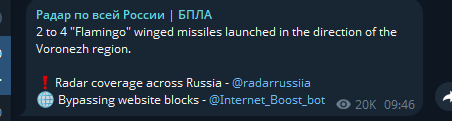
2 a 4 flamingo raketten zojuist gelanceerd. Opmerkelijke tijd.
bron:
https://telegram.dog/radarrussiia/86928
Wel enige russische radar tot dusver die flamingos meldt.
update:
lijkt er op dat ze of zijn neergehaald of foutieve informatie vanaf het begin.
[ Bericht 49% gewijzigd door skysherrif op 10-08-2026 10:12:02 ]
bron:
https://telegram.dog/radarrussiia/86928
Wel enige russische radar tot dusver die flamingos meldt.
update:
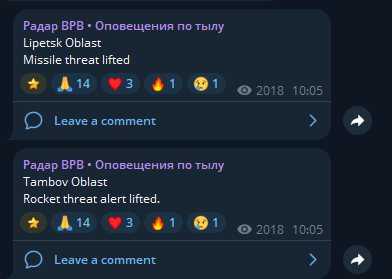
lijkt er op dat ze of zijn neergehaald of foutieve informatie vanaf het begin.
[ Bericht 49% gewijzigd door skysherrif op 10-08-2026 10:12:02 ]
Tevens een groep van ongeveer 10 drones richting Yekaterinenburg.
[ Bericht 53% gewijzigd door skysherrif op 10-08-2026 09:59:02 ]
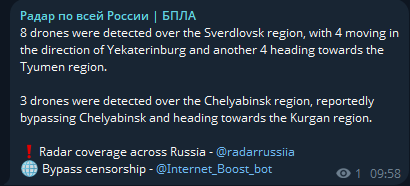
[ Bericht 53% gewijzigd door skysherrif op 10-08-2026 09:59:02 ]
Heeft niet zoveel met zijn onwil te maken. Ook een andere republikein, of zelfs een democraat zal er niet om staan te springen. De focus van Amerika is op China en ze zijn van mening dat wij Europeanen zelf onze boontjes moeten kunnen doppen.quote:
[..]
Klopt hoor. Maar dan komt ook de onwil van Trump weer langs…
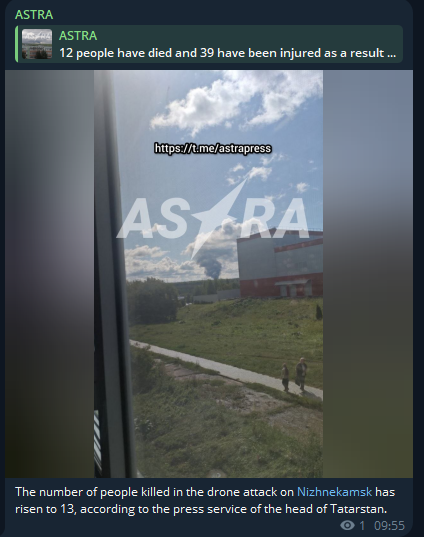
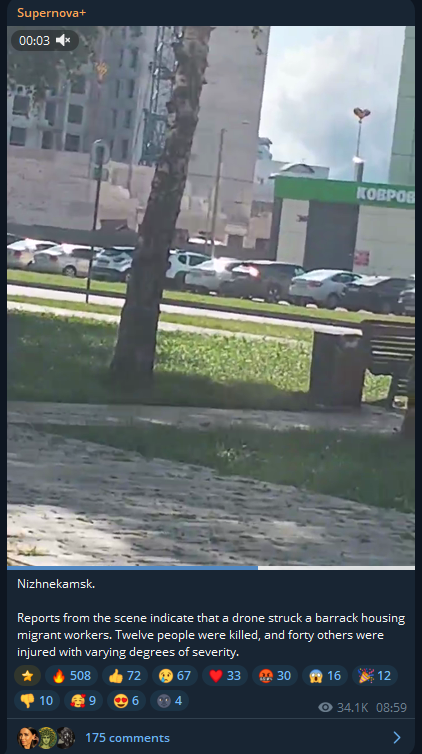
13 doden en 39 Russische gewonden bij de aanval op Nizhnekamsk. Blijkbaar een barak met werkimmigranten naast de raffinaderij geraakt.quote:
Gave compilatie van een drone team (Kurt and Company) in Kostyantynivka
https://www.instagram.com/p/Db0MjNioL1z/
https://www.instagram.com/p/Db0MjNioL1z/
https://t.me/kyriienko_press/3135quote:Deputy Head of the Ukrainian Defense Intelligence (GUR), Vadym Skibitskyi, in an interview (https://www.rbc.ua/rus/ne(...)ryad-1786309469.html) with RBC-Ukraine, discussed Russian production of missiles, drones, and the logic behind recent massive attacks.
Key points:
* Russia is increasing its use of ballistic missiles. In July, Russians launched 198 ballistic and hypersonic missiles – the highest number this year. For comparison: in April, there were 61, in May – 107, and in June – 134.
* Russia is meeting and exceeding its production plans. For the main types of missiles, the current monthly production rate is 110-120% of the plan. In July, the production of X-101 missiles reached 140% of the plan, "Kalibr" missiles reached 111%, and X-35 missiles reached 200%.
* Russia has fulfilled its annual plan for "Tsirkon" and modernized "Oniks" missiles in just 7 months. As of August 3, the Russians have produced 33 "Tsirkon" and 60 "Oniks" missiles.
* "Kinzhal" and X-32 missiles are essentially on hold since April. According to Skibitskyi, the resources, fuel, funds, and components for these missiles have been reallocated to other types of missiles that Russia considers more effective.
* Russia is also increasing production of "Iskander" missiles. As of August 5, the stockpile of 9M723 missiles for the military group is approximately 130 units. The planned production is 60 missiles per month, but 65 were produced in July.
* Russia is actively using RM-48U missiles launched from S-400 systems. According to Skibitskyi, these are not classic anti-aircraft missiles, but surface-to-surface missiles that fly along a ballistic trajectory. The estimated stockpile is approximately 400 units, with a plan of about 40 for August.
* A pause in shelling is unlikely. Skibitskyi believes that Russia may reduce the number of missiles used against a single target, but is unlikely to completely stop attacks to accumulate resources.
* In August, Russia plans to produce approximately 11,000 strike UAVs of various types. Production is being reconfigured for turbofan "Geran-4" and "Geran-5" drones.
* In one of the recent attacks, half of the UAVs were turbofan drones. Intercepting them requires different means – faster interceptors or short-range air defense systems.
* The main targets of Russian attacks are the Ukrainian defense industry, logistics, ports, and energy facilities.
* Russia is also targeting civilian infrastructure. Skibitskyi notes that attacks on facilities like Rozetka or "Nova Poshta" are often justified by Russia with claims of allegedly delivering components for drones, but in reality, it is terrorism against the civilian sector.
* Russia is deploying an analogue of Starlink – the "Rassvet" system. In March 2026, Russia launched 16 satellites into orbit. The plans include 292 satellites in 2027 and 924 in 2035.
* Currently, "Rassvet" operates fragmentarily – only when a satellite passes over Ukrainian territory. However, after the full deployment of the system, it is expected to operate according to the logic of Starlink.
Goed artikel over Russische "stille" mobilisatie
https://archive.is/202608(...)a6-9769-6971b4b69bcc
- Financial Times 4 uur geleden (auteur Max Seddon is goed ingevoerd)quote:Russian army recruiters are resorting to increasingly coercive tactics, including snatching men off the street and tricking students into signing up, as Moscow’s manpower advantage in Ukraine comes under strain.
The pressure stems from Vladimir Putin’s refusal to adapt his war strategy built on Russia’s willingness to sacrifice more soldiers than Ukraine, even as western estimates put Moscow’s losses at more than 30,000 men a month.
“Year by year and month by month, it’s harder for the Russian army to find people,” said Grigory Sverdlin, director of Get Lost, a non-profit that helps Russian soldiers desert. “Putin is evidently putting off a new wave of mobilization, so the defence ministry has to put more pressure on all sorts of people to sign contracts.”
Still, Putin insists Russia’s advance is inexorable and Ukraine’s collapse is only a matter of time. Another mobilisation is “nonsense”, according to his stand-in, former president Dmitry Medvedev.
Military analysts say Putin’s sweeping territorial ambitions have spread Russian forces thin, yielding only incremental gains at heavy cost. New units are sent straight to the front to sustain slow-moving offensives rather than build reserves.
“The more the Russian military grew in size, the less of it they were able to employ on the battlefield at any given time,” said Michael Kofman, a senior fellow at the Carnegie Endowment for International Peace. “The scale of Russian offensive action decreased as the size of the force deployed in Ukraine increased.”
Russia was also slow to adapt to Ukraine’s defensive tactics, sending its already high casualty rate even higher. Western governments estimate nearly 500,000 Russian soldiers have been killed in action during the war; Ukraine claims to have killed 131,000 this year alone.
“They became complacent and failed to adapt,” Kofman said. “If they’re not able to increase this recruitment rate, or conduct mobilisation, Russian units will start to deplete again and that will leave them vulnerable. Not only will the offensive effort stall, but they will face significant reversals on the battlefield over time.”
Although Medvedev claims the army recruited 200,000 more men in the first half of 2026, high attrition has forced Russia to send most of them to replenish frontline units rather than build reserves.
That has left Russia stretched thin outside its main axis of attack in Ukraine’s eastern Donbas region.
Russia’s defence ministry claimed in July that its forces seized 2,226 sq km in the first half of the year. The Institute for the Study of War puts its net gain at just 81.1 sq km, after Ukrainian counter-attacks.
Recruiting enough men to sustain even the current slow pace of attack has become increasingly difficult. Although new soldiers receive bonuses of up to Rbs4.5mn ($56,000) for signing up, officials are under increased pressure to find recruits, according to analysts.
Get Lost’s Sverdlin said: “They replenish the losses with people who sign new contracts, and there haven’t been enough people willing to sign up for quite some time — even for the huge sums offered in the contracts.”
The Kremlin and defence ministry have ordered local officials to meet quotas for new recruits as part of this year’s 409,000 target, said people familiar with the matter. Russians can also receive referral bonuses for persuading others to sign up, spawning a cottage industry of remote headhunters who cold-call potential recruits.
The pressure has increased in recent months. Activists describe the efforts as an attempt to help Putin avoid another politically unpopular mobilisation drive — the first since autumn 2022, when hundreds of thousands of men fled the country.
Instead, officials are “trying to squeeze as much as they can from every category of men”, said Artyom Klyga, a military law expert at Connection e.V., a Germany-based group supporting conscientious objectors and deserters. “There are traps for each group to trick them or pressure them into signing a contract.”
In Penza, a city in southern Russia, police have raided workplaces and taken people off the street to military recruitment offices, where they have been forced to sign contracts, according to activists.
Similar sweeps have taken place in other cities, including Ulyanovsk, where a man who had lost an eye said he was forced to sign a contract, and Rostov, where police detained 35 factory workers.
Russian police denied the raids were aimed at sending people to the front.
A report from a district in Russia’s Belgorod region suggests many recruits enlist only after pressure, with officials approaching “suitable candidates” for “conversations” at their homes and workplaces, including debtors, recently discharged draftees and men serving suspended sentences.
In the far-eastern region of Khabarovsk, police said they held 2,500 such “conversations” last year and persuaded 32 people to sign up — all but four of them suspects in criminal investigations.
“Local authorities are under enormous pressure to recruit enough soldiers each year,” said Janis Kluge, a Russia expert at the German Institute for International and Security Affairs, who compiled the reports. “They know who is in debt, who is under police investigation and who has recently lost their driving licence, and they home in on these men.”
Many others have been summoned to verify their military service records, including women with medical or other skills used by the armed forces. Starting in 2026, Russia gave local recruitment offices the power to issue such summonses year-round, a tool activists say is often used to pressure people into joining.
Indira, a real estate agent from Nalchik, told the FT that she and several former female classmates received draft notices in May because they have degrees in pharmacology. “The fact of receiving it is itself certainly very concerning, but there is no reason to worry just yet,” she said.
The notices have also been used to pressure political activists.
Roman Malozemov, 22, a lawyer from Novosibirsk who represents farmers suing the government over the culling of their cattle, said he received a draft notice on the same day a hearing was scheduled in the case. “I call it a jump-scare prank,” Malozemov told the FT.
The increase in coerced recruitment has coincided with a surge in desertions. At least 28,000 people have been convicted of fleeing their posts, according to rights organisation Peace Plea. Leaked internal documents indicate the real annual total is likely at least twice as high, according to Ukrainian analytical group Frontelligence Insight.
In private conversations and Telegram chats, Russians are increasingly voicing fears that a new mobilisation could follow September’s State Duma elections. Some are already checking flights abroad to avoid the last-minute price surge seen during the previous call-up, while others are considering leaving for several weeks before the vote as a precaution.
“I have no clue whether they will announce mobilisation or not. But everyone just has a feeling that something is about to happen after the elections,” said Yaroslav, a manager from Moscow.
But another mobilisation would carry at least as much risk for Russia as reward, said a person close to the defence ministry. “The political effect of major losses among mobilised men, combined with likely significant desertion, could be very negative domestically.”
https://archive.is/202608(...)a6-9769-6971b4b69bcc

Van gisteren, let even niet op de bron, maar kon de originele bron niet op twitter vinden ( https://t.me/exilenova_plus/28459 )
De drones zijn doorgevlogen naar Tyumen. 2200km van de Oekraiense grens.quote:
Tevens een groep van ongeveer 10 drones richting Yekaterinenburg.
[ afbeelding ]
Nog 40km van de stad.

Enig zicht op wat er met de eerste ronde van mobilisatie is gebeurd?quote:
1/10 Van de rappers dankt zijn bestaan in Amerika aan de Nederlanders die zijn voorouders met een cruiseschip uit hun hongerige landen ophaalde om te werken op prachtige plantages.
"Oorlog is de overtreffende trap van concurrentie."
"Oorlog is de overtreffende trap van concurrentie."
Precies, hier zou je toch afspraken over kunnen maken:quote:
[..]
Ze zouden natuurlijk in de deal kunnen verwerken dat de patenten uit de doorontwikkeling gedeelt worden, want dan proviteren ze allebei weer.
1) Patenten op doorontwikkelingen worden gedeeld
2) Oekraïne mag alleen voor binnenlands gebruik produceren, verkoop aan derde partijen is niet toegestaan om de concurrentiepositie van de Amerikaanse industrie te beschermen.
Met die 2 afspraken zie ik het probleem niet meer

quote:
[..]
Enig zicht op wat er met de eerste ronde van mobilisatie is gebeurd?
https://janiskluge.substa(...)itment-fell-by-20-inquote:Regional budget data suggests that Russia recruited 70,500 soldiers during the first quarter of the year. There was a lot of noise in the data at the end of 2025 and the beginning of 2026. One reason for this is the pace of budget execution, which typically accelerates in December and begins very slowly in January.
Another reason is that some regions temporarily lowered their bonuses in late 2025 and increased them again in early 2026, as a result of budgetary pressures and/or fulfilled recruitment quotas. Whenever the size of a region’s bonus changes, recruitment estimates become unreliable for a few weeks because it is unclear how much is spent on “old” bonuses and how much on “new” ones. That’s why I created a control group of regions that have not changed their bonuses in the last nine months, in order to confirm the downtrend.
Dus je wordt tegen je wil in van straat geplukt en naar het front gedwongen, waar je dan door zo'n drone te grazen wordt genomen, terwijl men op forums als deze staat te juichen na het zien van de beelden van je dood.quote:
Goed artikel over Russische "stille" mobilisatie
[..]
- Financial Times 4 uur geleden (auteur Max Seddon is goed ingevoerd)
https://archive.is/202608(...)a6-9769-6971b4b69bcc
