WKN Weer, Klimaat en Natuurrampen
Lees alles over het onstuimige weer op onze planeet, volg orkanen en tornado's, zie hoe vulkanen uitbarsten en hoe Moeder Aarde beeft bij een aardbeving. Alles over de verwoestende kracht van onze planeet en tal van andere natuurverschijnselen.



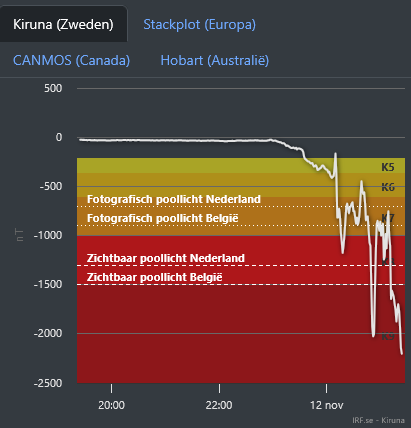


Ik had ff gespiekt rond 2.10 maar helaas toen nog niets..begreep een uur later wel  jammerrrr
jammerrrr
[b]Hobbelicious is back!
[/b]
[/b]


Bekijk deze YouTube-video
quote:Major X1.9 solar flare erupts from AR 4299, producing partial halo CME
A major solar flare registered as X1.9 erupted from Active Region 4299 at 02:49 UTC on December 1, 2025. The event started at 02:27 and ended at 03:05 UTC. This region is currently making its second run through the Earth-side of the Sun, after producing multiple X-class flares in early November.
A Type II Radio Emission with an estimated velocity of 988 km/s was registered at 02:43 UTC, indicating a coronal mass ejection (CME) was associated with the event.
Active Region 4299 is located on the Sun’s northeastern limb, limiting the possibility for Earth-directed CMEs. However, this will change as the week progresses, and the region moves toward a geoeffective position.
This is the old Region 4274, source of multiple X-class flares during its last rotation over the Earth-side in early November, including X5.1 on November 11, which produced the strongest Ground Level Enhancement event in 20 years.
Other notable flares from this region include X4.0 on November 14, X1.7 on November 9, and X1.2 on November 10.
Radio frequencies were forecast to be most degraded over Australia at the time of the flare event.
“This storm is not Earth-directed (it is directed towards Saturn), but I would not be surprised if we see a radiation storm rise at Earth over the next few hours,” Space Weather Physicist Dr. Tamitha Skov said.
“Preliminary analysis of the recent X1.95-flare shows radio bursts of over 1.2 GHz observed at the new Wairakei SIGN station in New Zealand,” Skov said.
“This means this region has the potential to temporarily disrupt GPS/GNSS, satellite phone, and ADS-B airline transponder communications when it flares! Stay vigilant if you use these services while on the dayside of Earth!”


Earth Shock Arrival Time = 2026-01-02T21:29Z
"I wear the mask to protect the city… but the city is what made the mask." – Batman
"The Living Nostradamus", Athos Salomé, voorspelde:
Ik ga vast vrije dagen opnemen en hamsteren denk ik
https://www.hola.com/us/l(...)us-2026-predictions/quote:But war isn’t the only threat he predicts. A massive solar storm could hit Earth between March 12 and 15, 2026, potentially causing widespread power outages. “The possibility of large-scale power outages is real, especially in more susceptible electrical systems, but nothing concrete,” he noted.
Ik ga vast vrije dagen opnemen en hamsteren denk ik
quote:Sun erupts with powerful X-Class flare
The sun sure has woken up this week, unleashing a powerful X-class solar flare along with a fast Earth-directed coronal mass ejection (CME), which is currently forecast to hit Earth within the next 24 hours.
If the CME arrives as expected and has the correct magnetic orientation to be "geoeffective," we could witness strong (G3) or even severe (G4) geomagnetic storm conditions tonight, according to the U.K. Met Office. If these conditions are reached, the northern lights might be visible as far south as Northern California and Alabama
Space weather forecasters are busy analysing data and running models to narrow down the CME's arrival window.
CME arrivals are notoriously difficult to forecast. Their speed, direction of travel and — most importantly — their magnetic orientation all determine how strongly (if at all) they will interact with Earth's magnetic field.
If the CME's magnetic field is oriented southward, a component known as the Bz, it can more easily link up with Earth's northward-pointing magnetic field, allowing energy to pour into our planet's magnetosphere and trigger geomagnetic storm conditions.
Some CMEs contain a mixture of southward and northward magnetic fields, which can lead to stop-start or fluctuating geomagnetic activity. These events keep space weather forecasters and aurora chasers very much on their toes.
quote:SOLAR PROTON STORM IN PROGRESS
Energetic protons from the sun are raining down on Earth. They were accelerated in our direction by yesterday's powerful X-class solar flare (described below). This is called a "solar proton storm," and currently it is category S2. Shortwave radios inside the Arctic Circle aren't working right now due to this storm, which is causing a polar cap absorption event.
SIGNIFICANT X-CLASS SOLAR FLARE: Sunspot 4341 erupted on Jan. 18th (1809 UTC), producing an X1.9-class solar flare. The explosion lasted for hours, which makes this flare even more powerful than than its "X1.9" rating would suggest. This video from NASA's Solar Dynamics Observatory says it all:
Radiation from the flare ionized Earth's atmosphere over the Americas, especially South America. This caused a shortwave radio blackout that may have lasted more than an hour at frequencies below 10 MHz.
Of greater interest is the CME. The explosion launched a full halo CME with a significant Earth-directed component. NASA models predict that it will reach Earth during the early hours of Jan. 20th. The impact could cause a strong G3-class geomagnetic storm with mid-latitude auroras. Stay tuned for updated forecast models
quote:Rare S3 – Strong solar radiation storm in progress after X1.9 flare on January 18
A strong solar radiation storm (S3) is in progress after ≥10 MeV proton flux exceeded 1 000 pfu at 10:20 UTC on January 19, 2026. The event follows an X1.9 solar flare and full-halo coronal mass ejection that erupted on January 18. S3 – Strong solar radiation storms are relatively rare, occurring just a few times in one 11-year solar cycle.
Solar radiation storm produced by a long-duration X1.9 solar flare from Active Region 4341 on January 18 reached S3 – Strong levels at 10:20 UTC on January 19 after the ≥10 MeV proton flux exceeded 1 000 pfu.
The flare peaked at 18:09 UTC on January 18 and was accompanied by Type II and Type IV radio emissions, a 3 200 sfu F10.7 radio burst with a Castelli-U signature, and a full-halo coronal mass ejection first observed in coronagraph imagery at approximately 18:30 UTC. The CME is expected to impact Earth on January 20.
Proton flux levels initially crossed the S1 – Minor threshold at 22:55 UTC on January 18, exceeded S2 – Moderate levels early on January 19, and continued rising steadily through the morning hours. At 10:20 UTC, ≥10 MeV protons surpassed 1 000 pfu, triggering an S3 alert issued at 10:29 UTC.
GOES-18 proton data show sustained increases across multiple energy channels, indicating an ongoing and well-developed solar energetic particle event. Elevated ≥50 MeV proton flux has also been observed, confirming the high-energy nature of the storm.
At S3 intensity, increased radiation exposure is possible for passengers and crew on high-latitude, high-altitude flights, while astronauts conducting extravehicular activities are exposed to significantly elevated radiation levels. Satellite systems may experience single-event upsets, noise in imaging sensors, and minor reductions in solar panel efficiency. Polar high-frequency radio propagation may become degraded or experience intermittent blackouts.
Solar radiation storms of S3 – Strong intensity are relatively rare space weather events. Based on long-term NOAA statistics, only a limited number of such storms usually occur during a full 11-year solar cycle, as they require efficient particle acceleration by strong solar eruptions and CME-driven shocks.
 Op
Op 


Op dit moment zie ik nog niets hier in Groningen. Maar er komt iets aan dus ik sta op wacht.quote:
 Op
Op
Maakt de lekkerste wraps :9


|
|
