NWS Nieuws & Achtergronden
Discussieer hier diepgaander over de actualiteiten.



quote:Neem een kijkje in de wiethoofdstad van de VS
Wij hebben in Nederland Tilburg als 'wiethoofdstad', in Amerika is dit Denver. In deze stad is er een overvloed aan coffeeshops en cannabisapotheken. VICE News bezocht de stad en zocht uit hoe de investeerders deze 'wiethype' omzetten in geld, heel veel geld.
In het zestien minuten durende item spreken ze met deze investeerders en bespreken ze de tegenstrijdige wetten die in Amerika gelden. Ik zou zeggen wacht niet langer en kijk de reportage van VICE.

....nachtrijder...Nachtzwelgje!


As the officer took her away, she recalled that she asked,
"Why do you push us around?"
And she remembered him saying,
"I don't know, but the law's the law, and you're under arrest."
"Why do you push us around?"
And she remembered him saying,
"I don't know, but the law's the law, and you're under arrest."


quote:Drug trafficking and corruption bankroll Guatemalan politics, says report | World news | The Guardian
Gangsters have infiltrated politics by financing campaigns, putting up candidates and creating construction companies to win government contracts
Drug money and corruption are now key sources of financing for political parties in Guatemala, a prominent anti-crime commission said on Thursday, ramping up pressure on the Central American country’s battered political establishment.
Just two months from a presidential ballot, the International Commission against Impunity in Guatemala (CICIG), a United Nations-backed independent group working with prosecutors to root out corruption, said that political contributor anonymity is facilitating links to organised crime.
“Corruption is the principal source of financing for political parties,” Ivan Velasquez, commissioner at the CICIG, told a news conference. The group’s investigations have rocked the government and led to the arrest of some high-ranking officials, including the central bank chief.
The report said that drug trafficking had infiltrated local politics by financing campaigns, putting its own members up as candidates and creating construction companies that later won government contracts.
Since Guatemala decided in April to renew the CICIG’s mandate, encouraged by the United States, corruption scandals have prompted several key politicians in the country to stand down, including vice-president Roxana Baldetti.
Guatemala’s president, Otto Perez, who has not been directly accused of any wrongdoing, is waiting to see whether US Congress decides to strip him of his immunity to be investigated over pending cases.
Bron: www.theguardian.com
Free Assange! Hack the Planet
[b]Op dinsdag 6 januari 2009 19:59 schreef Papierversnipperaar het volgende:[/b]
De gevolgen van de argumenten van de anti-rook maffia
[b]Op dinsdag 6 januari 2009 19:59 schreef Papierversnipperaar het volgende:[/b]
De gevolgen van de argumenten van de anti-rook maffia

Tengo todos estos federales en mi bolsillo de atrás, sin preocupaciones.quote:
[ Bericht 1% gewijzigd door JoaquinGuzman op 18-07-2015 15:51:17 ]
Mooie tunnel btw, mijn complimenten!quote:Op zaterdag 18 juli 2015 15:45 schreef JoaquinGuzman het volgende:
[..]
Tengo todos estos federales en mi bolsillo de atrás, sin preocupaciones.
As the officer took her away, she recalled that she asked,
"Why do you push us around?"
And she remembered him saying,
"I don't know, but the law's the law, and you're under arrest."
"Why do you push us around?"
And she remembered him saying,
"I don't know, but the law's the law, and you're under arrest."
Het Vereenigde Koninckrijck:
quote:Durham police stop targeting pot smokers and small-scale growers | Society | The Guardian
Durham PCC Ron Hogg says move is an effort to cut costs, keep users out of criminal justice system and focus resources on organised crime
A police force in the north-east of England will no longer actively pursue cannabis smokers and small-scale growers in order to prioritise its resources against more serious crime.
Durham’s police and crime commissioner, Ron Hogg, said the move was an effort to cut costs and keep users out of the criminal justice system, while focusing scarce resources on gangs and organised crime.
Indicating his support for the decriminalisation of drug use, Hogg also said he was prepared to meet the home secretary, Theresa May, to discuss the matter.
The move has been interpreted as a shift towards the effective decriminalisation of cannabis. However, Mike Penning, the policing minister, has already responded to the news by reaffirming that growing cannabis is illegal.
Hogg told the Guardian that his policy for Durham was about prioritisation. He insisted that his officers would still enforce the law if they got complaints from the public about cannabis users and growers.
“The focus of what we are trying to do is target those who produce drugs on a larger scale,” he said. “Our communities want us to focus on drug dealers in the streets. They don’t want dealers in the streets at the same time as their children are playing.
“It’s illegal to grow and use cannabis and we will still enforce the law. However, what we will try and do is engage with users and help them if that’s what they want.”
He said that continuing cuts to policing had made such prioritisation more important. “There’s a resource issue, we must also be clear about that, but we are doing it because it’s the right approach.”
The policy was first revealed in a meeting between Hogg and pro-cannabis activists from local chapters of the UK Cannabis Social Clubs in the first week of July. At the meeting Hogg confirmed rumours that Durham police were no longer actively working to detect small-scale cannabis growers and users, said John Holiday, a local activist.
Holiday – not his real name – said Hogg was clear that the policy was not intended as a free-for-all. He said: “It’s still illegal. If you were to light up in front of a policeman or go into a police station and tell them you’ve got a ten-bag you would still be arrested.
“The idea is discretion: don’t piss off your neighbours.”
The move follows a conference hosted by Hogg in Durham last November where police, drugs professionals and activists, including some from local cannabis clubs, debated the future of drugs policy. Following the summit, Hogg wrote a letter to the prime minister with a warning that current drug laws were failing.
“Policy on drug addiction should be moved to the Department of Health, in order for the focus to be on treating rather than punishing,” Hogg’s letter said.
Neil Woods, vice-chair of Law Enforcement Against Prohibition (Leap) UK, hailed Hogg’s move, saying that although police officials prioritised their officers’ work all the time, it was “quite bold to word it in the way that he is doing”.
Woods, a former undercover drugs detective, agreed with suggestions that drug crime could get less attention from police as they are forced to reassess priorities as budgets are pared back in the name of austerity.
“If you consider that a taxpayer pays £400 towards fighting the war on drugs in this country, the financial pressures are going to take us there,” he said.
Woods added: “It’s an important, small, incremental step in the right direction. I think it’s necessary and I’m pleased that they are brave enough to very publicly make this step.
“I applaud their move. No one should ever be criminalised for drug possession.”
Bron: www.theguardian.com
Free Assange! Hack the Planet
[b]Op dinsdag 6 januari 2009 19:59 schreef Papierversnipperaar het volgende:[/b]
De gevolgen van de argumenten van de anti-rook maffia
[b]Op dinsdag 6 januari 2009 19:59 schreef Papierversnipperaar het volgende:[/b]
De gevolgen van de argumenten van de anti-rook maffia
quote:US navy seizes submarine with seven tonnes of cocaine on board | World news | The Guardian
The vessel was intercepted off the coast of El Salvador and four suspected smugglers taken into custody
US authorities have seized a submarine-like vessel loaded with more than eight tonnes of cocaine off the coast of El Salvador.
US Navy, Customs and Border Protection and Coast Guard personnel took part in the operation last Saturday.
The semi-submersible vessel was tracked in international waters off the El Salvador coast by US aircraft. It was intercepted by the Coast Guard after a speedboat began to approach.
Inside the semi-submersible, authorities found 274 bales packed with 7,650kg (16,870 pounds) of cocaine worth hundreds of millions of dollars. Four suspected smugglers were taken into custody.
Traffickers use submarine-like vessels to move large amounts of cocaine because their low waterline profile makes them difficult to detect.
The interdiction is part of a 15-nation effort targeting international drug traffickers.
Bron: www.theguardian.com
Free Assange! Hack the Planet
[b]Op dinsdag 6 januari 2009 19:59 schreef Papierversnipperaar het volgende:[/b]
De gevolgen van de argumenten van de anti-rook maffia
[b]Op dinsdag 6 januari 2009 19:59 schreef Papierversnipperaar het volgende:[/b]
De gevolgen van de argumenten van de anti-rook maffia
quote:Ecstasy and LSD use reaches new high among young | UK news | The Guardian
Findings on drug use are serious blow to government’s hardline strategy
The use of ecstasy and LSD among young adults has spiked over the last two years, with survey results indicating the numbers taking the drugs in the past 12 months up 84% and 175% respectively.
An estimated 157,000 more people aged 16-24 took ecstasy over the past year compared to two years ago, according to figures released on Thursday. About 49,000 more used the hallucinogen LSD over the same period.
An estimated one in 20 young people have used ecstasy in the past 12 months, according to the latest data. Use of LSD is still much lower, with around 0.4% of young people – about one in 200 – using it.
Both drugs saw year-on-year increases in consumption by the young of around 40%.
The figures will be a serious blow to the government’s hardline strategy on drug use. In an effort to combat an increase in the numbers of new designer drugs a recent bill was introduced that would ban all new psychoactive substances.
But even as overall drug use remained flat, the statistics from the Crime Survey of England and Wales show a sharp rise in the use of two class-A drugs which are among the drug war’s major targets.
Among most of the population – those aged 16-59 – use of ecstasy in the past year has risen an estimated 37% since 2012/13, while use of LSD is up 117%. The reasons for the surge in the popularity of LSD are unclear, but one expert said the rise in ecstasy use could be explained by an increase in the availability of relatively pure MDMA – that drug’s active ingredient.
The figures also illustrate how young adults remain the most likely age group to take drugs: they indicated 19% of 16-19 year-olds and 20% of 20-24 year-olds took any drug within the past year. By contrast, only 2% of 55 to 59 year-olds did so.
The survey found that use of new psychoactive substances (NPSs), more commonly referred to as legal highs, was generally concentrated among young adults. Around 3% of 16-24 year-olds took an NPS within the past year, compared with 1% of 16-59 year-olds.
Those young adults who took NPSs were most likely to acquire them over the counter. An estimated 39% bought them from a shop, while 37% got them from a friend, neighbour or colleague. Only 1% of young people reported using the Internet to buy NPSs.
The survey results also appears to indicate a rise in the number of people mixing different drugs. Of those people who took drugs within the past year, 9% reported having used more than one drug at once, compared to a previous figure of 7%. The drugs most likely to be mixed with other drugs were mephedrone (68%), ecstasy (57%), amphetamines (50%) and tranquilisers (35%).
Professor Fiona Measham, who chairs a working group on polysubstance use for the Advisory Council on the Misuse of Drugs, said that the increase in the number of 16-24-year-olds using ecstasy from 3.9% to 5.4% represented an important development.
“My view is that increased purity from 2010 onwards across Europe is making ecstasy in pill, powder and crystal form increasingly attractive combined with easy availability and relatively low prices,” she said.
Separately, figures released by the Health and Social Care Information Centre show that the numbers of young people aged 11 to 15 who have ever tried smoking, drinking or drugs are at their lowest levels since 1982.
More than 6,000 pupils in 210 schools in England were asked a series of questions about smoking, drinking and drug use. Less than one in five (18%) said that they had ever smoked, the lowest figure since the survey began. The proportion of 11 – 15-year-olds who said they had tried e-cigarettes was slightly higher at 22%.
The results are consistent with a continuing decline in the number of children trying tobacco over the past decade. In 2003 as many as 42% said they had tried smoking. Meanwhile, 38% of 11-15 year-olds reported having tried alcohol, also the lowest level recorded since the survey began. In 2003 the figure was 61%.
The number of 11-15 year-olds who reported having ever tried drugs also hit a new low of 15%, down from 30% in 2003. Cannabis remains the drug most likely to be sampled by young people: of the 10% of pupils who said that they had tried drugs within the past year, 7% reported trying cannabis.
The survey also sheds light on young people’s attitudes towards why other young people their own age decided to smoke or drink. The most common reason, at 85% for smoking and 79% for drinking, was “to look cool in front of their friends”.
But there was a variety of other motivations: 72% of young people said they thought their peers smoked because “their friends pressure them into it”, while 70% thought it was because they were addicted to cigarettes. A smaller group, 67%, thought their friends drank in order to be more sociable, and 66% said they thought they drank for a rush or a buzz.
Measham, who is professor of criminology at Lancaster University, said the popularity of ecstasy, which has long been associated with rave culture, dipped when fashions changed in the 2000s and people moved onto alcohol and cocaine.
“I think now people have got back into raving,” she said. “Really there has been a resurgence in dance music, I’ve seen that in my undergraduates. My students all want to be part-time DJs and promoters.”
The rise in LSD use was more difficult to explain. “It was popular in the mid-90s when it got down to about 50p a tab,” Measham said. “So I think the risk to reward ratio for dealers was not there.” Although there were no sentencing guidelines, at the time dealers could expect to get about a month in jail for each tab of ecstasy in their possession, she said.
Again the increase in LSD use could simply be down to fashion, Measham speculated. “The 70s are back in fashion, for women’s fashions at least - you have these sort of revivals and cycles.”
Measham said relative scarcity of the drug could also be a factor, with some users shunning substances they feel have become too popular and too accessible because they are no longer cool. “Maybe there’s a whole load of stars aligning in relation to that,” she added.
Amanda Feilding, director of the Beckley Foundation, which researches psychedelic drugs, said she had heard anecdotal reports that more people were using LSD. “I think there’s more around now,” she said. “There was a kind of great shortage and now I think more people have got into it.
“Hopefully the terrible taboo on it will slowly pass away because actually it’s completely non-toxic and if it’s taken in the right conditions it can be a very useful substance.”
The policing minister, Mike Penning said: “There are positive signs our approach to drugs is working as there has been a long-term downward trend in drug use over the last decade.
“However, we continue to be concerned about the harms caused by drug misuse, including ecstasy and other class A drugs, new psychoactive substances and prescription only medicines.”
Bron: www.theguardian.com
Free Assange! Hack the Planet
[b]Op dinsdag 6 januari 2009 19:59 schreef Papierversnipperaar het volgende:[/b]
De gevolgen van de argumenten van de anti-rook maffia
[b]Op dinsdag 6 januari 2009 19:59 schreef Papierversnipperaar het volgende:[/b]
De gevolgen van de argumenten van de anti-rook maffia

quote:Coffeeshop Den Bosch beschoten | NOS
Vanmorgen rond 04.30 uur zijn zeker twintig schoten gelost op de Bossche coffeeshop Chip 'n Dale in de Hinthamerstraat.
Er zijn geen gewonden gevallen, zegt de politie. Op het moment van de schietpartij was er niemand in de coffeeshop.
Op een paar kilometer van de coffeeshop vond de politie zo'n tien minuten na de schietpartij een uitgebrande auto. Of het de vluchtauto van de dader(s) was, moet onderzoek uitwijzen.
In de Hinthamerstraat zitten meerdere coffeeshops. Deze week werden de eigenaressen van een van die andere coffeeshops aangehouden, omdat zij mogelijk iets te maken hadden met twee mannen die tientallen kilo's drugs bij zich hadden, vermoedelijk bestemd voor de shop.
Het is niet duidelijk of de schietpartij van vannacht en het incident van deze week iets met elkaar te maken hebben.
Bron: nos.nl
Free Assange! Hack the Planet
[b]Op dinsdag 6 januari 2009 19:59 schreef Papierversnipperaar het volgende:[/b]
De gevolgen van de argumenten van de anti-rook maffia
[b]Op dinsdag 6 januari 2009 19:59 schreef Papierversnipperaar het volgende:[/b]
De gevolgen van de argumenten van de anti-rook maffia
The Murders Don't Stop: How the War on Drugs Is Responsible For Mexico's Outrageous Death Toll
The war on drugs is a war on people, where the majority of casualties are black and brown bodies.
The war on drugs is a war on people, where the majority of casualties are black and brown bodies.
quote:Opium is Replacing Marijuana Plants in most Mexican States - The Yucatan Times
The plants growing along an increasing number of Mexican hillsides reflect trends in illegal drug use here in the United States. While marijuana fields easily outnumbered poppy plantations in prime Mexican growing regions, both government and international-agency statistics show those numbers have reversed as Mexican-origin heroin use in the US has exploded.
According to the Mexican daily Reforma, the leading marijuana production states in Mexico are Chihuahua, Guerrero, Jalisco, Durango, Sinaloa and Oaxaca. Between 2007-2010, the Mexican army discovered 432,561 marijuana fields in these areas. But that number plummeted by 56 percent between 2011-2014, as soldiers only found 187,056 marijuana plantations during that time frame. Mexico’s military department known as SEDENA indicated that opium poppies have been replacing marijuana plants in these states.
Shifts in illegal drug production by Mexican cartels tend to occur rather quickly in response to changes in demand from the US market. Unlike cocaine, which has to be brought into Mexico from other countries, heroin and marijuana can both be grown and processed internally. This allows cartels to dictate to their growers what kinds of plants they need to grow and in what quantities.
Guerrero, currently one of the most violent states in Mexico and home to the Guerreros Unidos Cartel and infiltrated by Jalisco Nueva Generación drug organization, remains first in poppy production. However, Chihuahua—across the border from southwest Texas—has seen the fastest increase in production, tripling its crop size in the past four years.
According to Substance Abuse and Mental Health Services Administration statistics released in May 2015 by the Drug Enforcement Administration, between 2007-2013 the number of heroin addicts in the US almost doubled from 161,000 to 289,000.
Besides, deaths involving heroin more than tripled between 2007 (2,402) and 2013 (8,260).
Bron: www.theyucatantimes.com
Free Assange! Hack the Planet
[b]Op dinsdag 6 januari 2009 19:59 schreef Papierversnipperaar het volgende:[/b]
De gevolgen van de argumenten van de anti-rook maffia
[b]Op dinsdag 6 januari 2009 19:59 schreef Papierversnipperaar het volgende:[/b]
De gevolgen van de argumenten van de anti-rook maffia
De Balie:
quote:Drugsdeal
Een driedelige reeks over de regulering van drugs
“Red het land, sta drugs toe!” Met die oproep schreven Frits Bolkestein, Els Borst, Hedy d’Ancona en anderen in 2010 een hartstochtelijk pleidooi voor de regulering van niet alleen wiet maar ook een flink aantal harddrugs. “Het verbod op drugs kost miljarden: het leidt tot misdaad en is slecht voor de volksgezondheid. Hef het op.”
Ooit was Nederland een toonbeeld van tolerantie met haar gedogen. Tegenwoordig lopen we met ons vreemde “voor- en achterdeurbeleid” achter, zelfs op verschillende staten in Amerika, toch de bakermat van de enorm averechtse en zelfs verslavende ‘war on drugs’. Door vooraanstaande politici, denkers, gebruikers en experts wordt al jaren geroepen om regulering.
De Balie en D66 nemen die uitdaging aan en onderzoeken in deze driedelige reeks wat nu eigenlijk de gevolgen zijn van de regulering van drugs. Eerst onderzoeken we de feiten wat betreft de kosten én opbrengsten en de gevolgen voor de volksgezondheid, daarna bespreken we, op basis van de verzamelde feiten, de grote vraag van het debat: kunnen we samen een nieuwe deal maken over drugs?
“Al ruim veertig jaar zijn drugs verboden. Maar het gebruik is groter dan ooit en niets wijst er op dat het verbod werkt. Wél is duidelijk dat het verbod schade veroorzaakt. De ongehoorde omvang daarvan dringt echter nauwelijks tot de publieke opinie door. Deze – ook letterlijk – ongehoorde feiten zijn de grote afwezige in het drugsdebat.” - Red het land, sta drugs toe! NRC Handelsblad, 18-10-2010
Free Assange! Hack the Planet
[b]Op dinsdag 6 januari 2009 19:59 schreef Papierversnipperaar het volgende:[/b]
De gevolgen van de argumenten van de anti-rook maffia
[b]Op dinsdag 6 januari 2009 19:59 schreef Papierversnipperaar het volgende:[/b]
De gevolgen van de argumenten van de anti-rook maffia
Ohio proposal seeks to drug test certain welfare applicants
COLUMBUS, Ohio — Ohio would screen and test welfare applicants for drugs under a bill expected to be introduced.
The proposal from Republican Reps. Tim Schaffer and Ron Maag would create a two-year pilot program in three counties that have yet to be determined.
Adults applying for cash assistance would have to complete a screening. If that shows they likely abuse drugs, they’d need to take a drug test.
If they test positive, then they couldn’t receive benefits. A third-party could accept the payment on behalf of the children and dependents of those who fail the tests.
The bill is to be introduced Wednesday. Its sponsors say it ensures taxpayer money isn’t supporting drug habits.
The American Civil Liberties Union of Ohio opposes the measure, saying it unfairly targets the poor.
http://fox8.com/2015/08/0(...)-welfare-applicants/
COLUMBUS, Ohio — Ohio would screen and test welfare applicants for drugs under a bill expected to be introduced.
The proposal from Republican Reps. Tim Schaffer and Ron Maag would create a two-year pilot program in three counties that have yet to be determined.
Adults applying for cash assistance would have to complete a screening. If that shows they likely abuse drugs, they’d need to take a drug test.
If they test positive, then they couldn’t receive benefits. A third-party could accept the payment on behalf of the children and dependents of those who fail the tests.
The bill is to be introduced Wednesday. Its sponsors say it ensures taxpayer money isn’t supporting drug habits.
The American Civil Liberties Union of Ohio opposes the measure, saying it unfairly targets the poor.
http://fox8.com/2015/08/0(...)-welfare-applicants/
There is only one religion
quote:Greater Manchester police step up patrols in wake of drug gang shootings | UK news | The Guardian
Detectives believe three separate turf wars are being played out, with most high-profile shooting that of Salford ‘Mr Big’ Paul Massey
Police have stepped up patrols on the streets of Manchester following a spate of shootings between rival drugs gangs.
Detectives believe three separate battles are being fought for “vacant turf” in north and south Manchester after four key drugs suspects were arrested earlier this year.
The turf wars are believed to be being played out in the Newton Heath area in north Manchester, in Wythenshawe in the south of the city and in Salford, Greater Manchester.
The most high-profile recent shooting came when Salford’s “Mr Big”, Paul Massey, was murdered outside his home 12 days ago.
Massey is believed to have been mediating between two warring gangs fighting for drugs rights in the city when he was shot four times.
Related: Salford's 'Mr Big' Paul Massey 'had been mediating between two warring gangs'
DCI Howard Millington, the senior investigating officer, issued an appeal for a man seen carrying a gun in nearby Clifton Country Park two days before Massey was killed.
He said: “It has been just over a week since the murder of Paul Massey and our investigation continues to catch whoever did this.
“We are keen to speak to a man who was seen at 7pm on Friday 24 July 2015, in Clifton Country Park. He was near to the entrance to Giants Seat Farm about 150 yards before the Giants Seat Garden Centre. He was in what was described as a white Renault Kangoo van.
“The man is described as white, in his late 30s to early 40s, about 5ft 10in tall, of average build, with a round face, and was wearing a black hat, black jacket, grey and black camouflage trousers, and was carrying a torch and a gun.”
Investigators believe a separate flare-up in the north of the city is linked to the arrests in March. Three houses in Ancoats and Newton Heath were the target of shootings on 27 March, followed a month later by gunshots in nearby Blackley and Chadderton.
A well-informed source said the turf war in north Manchester had been going on since jailed police killer Dale Cregan shot dead father and son David and Mark Short in 2012.
Two recent shootings in Wythenshaw are not considered to be connected to the north Manchester rivalries.
Bron: www.theguardian.com
Free Assange! Hack the Planet
[b]Op dinsdag 6 januari 2009 19:59 schreef Papierversnipperaar het volgende:[/b]
De gevolgen van de argumenten van de anti-rook maffia
[b]Op dinsdag 6 januari 2009 19:59 schreef Papierversnipperaar het volgende:[/b]
De gevolgen van de argumenten van de anti-rook maffia
Dat snap ik niet, hoe kan een positieve test nou het onderscheid maken tussen drugsgebruik en drugsmisbruik?quote:
Adults applying for cash assistance would have to complete a screening. If that shows they likely abuse drugs, they’d need to take a drug test.
If they test positive, then they couldn’t receive benefits.
Wees gehoorzaam. Alleen samen krijgen we de vrijheid eronder.
quote:165 miljoen euro aan cocaïne onderschept in onderzeeër
De Amerikaanse kustwacht heeft een zelfgemaakte onderzeeër met daarin een voorraad cocaïne ter waarde van ten minste 165 miljoen euro onderschept bij de kust van Mexico. Dat bericht NBC News. Nooit eerder in de geschiedenis van de kustwacht vond er zo'n grote onderschepping plaats.
De kustwacht arresteerde vier vermoedelijke smokkelaars. De onderzeeër is op 18 juli onderschept, maar het nieuws is nu pas naar buiten gekomen. Aan boord van het vaartuig lagen 275 balen samengeperste cocaïne. De onderzeeër werd gespot door een vliegtuig van de Amerikaanse marine, die vervolgens de kustwacht inschakelde.
'Elke onderschepping van zo'n half-afzinkbaar en zelfbesturend schip verstoort internationaal georganiseerde misdaadnetwerken en helpt het versterken van de veiligheid en stabiliteit op het westelijk halfrond', zei Charles W. Ray, viceadmiraal en commandant van het Pacifisch gebied in een verklaring.
De kustwacht probeerde het vaartuig naar de kust te slepen, maar het zonk met 1814 kilo cocaïne aan boord. Er kon 5443 kilo van de onderzeeër worden gehaald voordat het vaartuig zonk.
Onderzeeër geliefd bij smokkelaars
Colombiaanse smokkelaars maken al bijna tien jaar gebruik van onderzeeërs. 'Je ziet alleen de uitlaatpijp en de stuurhut vanuit de lucht', zei Allyson Conroy van de Amerikaanse kustwacht.
Ten minste 25 onderzeeërs zoals deze zijn sinds november 2006 onderschept door de Amerikaanse kustwacht. Op 16 juni onderschepte de kustwacht er nog een. Er bevond zich 2476 kilo cocaïne aan boord.
Bron: www.volkskrant.nl
Free Assange! Hack the Planet
[b]Op dinsdag 6 januari 2009 19:59 schreef Papierversnipperaar het volgende:[/b]
De gevolgen van de argumenten van de anti-rook maffia
[b]Op dinsdag 6 januari 2009 19:59 schreef Papierversnipperaar het volgende:[/b]
De gevolgen van de argumenten van de anti-rook maffia
quote:

As the officer took her away, she recalled that she asked,
"Why do you push us around?"
And she remembered him saying,
"I don't know, but the law's the law, and you're under arrest."
"Why do you push us around?"
And she remembered him saying,
"I don't know, but the law's the law, and you're under arrest."


quote:Murder and drug trafficking allegations cast pall over Argentina primary election | World news | The Guardian
Government says claim that cabinet chief Aníbal Fernández leads double life as drug kingpin ‘the Walrus’ is part of smear campaign by conservative media
Government says claim that cabinet chief Aníbal Fernández leads double life as drug kingpin ‘the Walrus’ is part of smear campaign by conservative media
Lurid allegations of murder and drug smuggling have overshadowed the build-up to this weekend’s primary elections in Argentina as outgoing president Cristina Fernández de Kirchner attempts to ensure a Peronist ally follows her to the Pink House.
The claims have been leveled against the president’s cabinet chief, Aníbal Fernández, who a convicted gangster recently claimed was living a double life as a trafficking kingpin known as “the Walrus”.
The ruling camp say the story has been fabricated by the opposition and the powerful Clarín media group – which has often clashed with President Fernández – in an attempt to dent the popularity of Peronist candidates ahead of Sunday’s open party primaries. The vote, in which Argentinians can vote for any candidate from any party, will offer a gauge of public opinion ahead of the presidential election on 25 October.
Opinion polls suggest Fernández’s preferred successor, Daniel Scioli – the current governor of Buenos Aires – is ahead of his rivals. He will run uncontested as the candidate of the ruling Frente Para la Victoria (Victory Front) this Sunday, while the conservative opposition alliance Cambiemos (Let’s Change) will see three candidates challenge for the nomination, including the frontrunner Mauricio Macri, the mayor of Buenos Aires.
But the campaign has been overshadowed by press reports claiming that the president’s righthand man Fernández masterminded the murder of three drug smugglers who triangulated the sale of vast amounts of the prescription drug ephedrine (used for the production of methamphetamine) between China and Mexico via Argentina in 2008.
Although press accusations of involvement with drug cartels have been raised before, these reached fever pitch this week after one of the criminals convicted for the triple murder alleged on the country’s most-watched television news programme Periodismo Para Todos that it was Fernández, then the justice minister, who had given the order.
Speaking from prison, convict Martín Lanatta claimed Fernández ordered the killings to elbow his way into the profitable business.
“The ephedrine-smuggling business ended up entirely in the hands of Aníbal Fernández with intelligence people,” said Lanatta.
He and another witness linked to the drug ring, José Luis Salerno, claimed Fernández was known under the code name “the Walrus” because of his abundant mustache.
The cabinet chief has denied the accusations. “I’m leading the polls,” said Fernández, who is running for governor of Buenos Aires province in the October elections. “They’re trying to keep me from becoming governor.”
The more sober side of the campaign has focused on the extent to which the next president will continue the Kirchnerist policies of the past 12 years, particularly with regard to workers’ rights, fighting inequality, controls on the economy and relations with international financial markets. Macri has promised a change of direction and more business-friendly policies.
Scioli is considered a relatively moderate figure inside the Peronist movement, but he has chosen a key ally of Fernández as his running mate and adopted a leftist stance in campaign speeches praising trade unions and pledging increased spending on public works and education.
Critics claim the outgoing president will maintain a strong influence if he wins. Scioli derided suggestions that Fernández will be a backseat driver.
“You know what, I’m going to do it my way,” he told supporters on Thursday, pledging to fight inflation and make Argentina more attractive to foreign investment.
Bron: www.theguardian.com
Free Assange! Hack the Planet
[b]Op dinsdag 6 januari 2009 19:59 schreef Papierversnipperaar het volgende:[/b]
De gevolgen van de argumenten van de anti-rook maffia
[b]Op dinsdag 6 januari 2009 19:59 schreef Papierversnipperaar het volgende:[/b]
De gevolgen van de argumenten van de anti-rook maffia
quote:Sydney man becomes oldest person charged with cocaine smuggling – at 91 | Australia news | The Guardian
Retired surgeon Victor Twartz ‘legitimately scammed’ by Indian gang over internet, one of 40 Australians arrested on home soil in such cases since 2013
A 91-year-old devout Christian with a penchant for tweed suits is believed to have become the oldest person to be charged with drug trafficking after he was duped into importing almost 5kg (11lbs) of cocaine from India to Australia.
Police say retired dental surgeon Victor Twartz was scammed by a drugs gang who groomed him via email and lured him into importing the class A drug last month, disguised in bars of coloured soap.
Twartz appeared briefly at court in Sydney on Tuesday, dressed in a three-piece tweed suit, after being charged with importing a commercial quantity of the drug. His case was adjourned until October.
Speaking to reporters afterwards, he said he had been tricked into importing the drugs. Citing the new testament book of Revelation, he said those responsible should be cast into a “lake of fire”.
Interviewed by the Sydney Morning Herald at his nursing home in a Sydney suburb, Twartz said: “I’m 1,000% against drugs. I don’t even drink alcohol.”
His son, Peter Twartz, told ABC News his father is a devout Seventh Day Adventist with no criminal background.
“His background is as a dentist, he is significantly religious,” Peter Twartz said. “There is no way that he would knowingly [have] anything to do with drugs — he sees it as a scourge.”
The Australian federal police’s organised crime commander, David Stewart, would not go into detail about what Twartz had been promised by the group, but said he had been in touch with them over many months.
Police were tipped off by Twartz’s family but were unable to stop him leaving Australia, Stewart said in Canberra. “There is certainly some evidence to suggest that this man was legitimately scammed by this group and exploited.
“There were warnings issued to him about his activities both here and overseas ... but you can only provide people with certain warnings. At the end of the day they’ll make their own choices.”
Twartz was returning to Australia from Delhi on 8 July when he was caught carrying 27 bars of soap, filled with about 4.5kg of cocaine.
He claims he was duped by people he met in Delhi after he was contacted online. He was handed a bag just before he boarded his flight and told it contained gifts for a person in Australia.
“I looked carefully at what was in the soap,” Twartz told the Herald. “I scraped it and it was certainly soap but there were these streaks of white stuff in between. I thought it was additional perfume or that was the style of Indian soap.”
Stewart said in the past two years 40 Australians have been arrested locally and more overseas in similar scams.
The internet is making it easier for organised crime syndicates to groom people using social media, Stewart added, with vulnerable Australians – particularly the elderly and mentally ill – targeted. But he warned ignorance was not a defence and urged the public to steer clear of any offer that sounds too good to be true.
Bron: www.theguardian.com
Free Assange! Hack the Planet
[b]Op dinsdag 6 januari 2009 19:59 schreef Papierversnipperaar het volgende:[/b]
De gevolgen van de argumenten van de anti-rook maffia
[b]Op dinsdag 6 januari 2009 19:59 schreef Papierversnipperaar het volgende:[/b]
De gevolgen van de argumenten van de anti-rook maffia

To smoke, or not to smoke, that is the question. 
http://www.nu.nl/cultuur-(...)iam-shakespeare.html
Wiet gevonden in pijpen uit tuin William Shakespeare
Foto: Thinkstock
Gepubliceerd: 10 augustus 2015 09:09
Laatste update: 10 augustus 2015 19:08
William Shakespeare rookte mogelijk meer dan tabaksbladeren. Wetenschappers uit Zuid-Afrika hebben cannabis gevonden in een aantal pijpen die werden gevonden in de tuin van de Britse schrijver.
De onderzoekers testten 24 pijpen en in 8 werd de drugs aangetroffen, waarvan in 4 pijpen gevonden in de tuin van de schrijver. De pijpen zijn meer dan vierhonderd jaar oud.
Dat schrijft de Britse krant The Independent.
Het is eerder gesuggereerd dat Shakespeare, die leefde tussen 1564 en 1616, wel eens wiet rookte. Hij zou wel op de hoogte zijn van de effecten van cannabis, aangezien hij in een aantal sonnetten schreef over 'weed' en 'vreemde drugs'.
In andere pijpen uit de omgeving van waar Shakespeare woonde, werd ook cocaïne aangetroffen.

http://www.nu.nl/cultuur-(...)iam-shakespeare.html
Wiet gevonden in pijpen uit tuin William Shakespeare
Foto: Thinkstock
Gepubliceerd: 10 augustus 2015 09:09
Laatste update: 10 augustus 2015 19:08
William Shakespeare rookte mogelijk meer dan tabaksbladeren. Wetenschappers uit Zuid-Afrika hebben cannabis gevonden in een aantal pijpen die werden gevonden in de tuin van de Britse schrijver.
De onderzoekers testten 24 pijpen en in 8 werd de drugs aangetroffen, waarvan in 4 pijpen gevonden in de tuin van de schrijver. De pijpen zijn meer dan vierhonderd jaar oud.
Dat schrijft de Britse krant The Independent.
Het is eerder gesuggereerd dat Shakespeare, die leefde tussen 1564 en 1616, wel eens wiet rookte. Hij zou wel op de hoogte zijn van de effecten van cannabis, aangezien hij in een aantal sonnetten schreef over 'weed' en 'vreemde drugs'.
In andere pijpen uit de omgeving van waar Shakespeare woonde, werd ook cocaïne aangetroffen.

quote:Kinderen zwaargewond door chemische stof in bos Zutendaal
In een bos in het Belgische Zutendaal, zo’n twaalf kilometer van Maastricht, zijn vier kinderen zwaargewond geraakt doordat ze door een plas fietsten waar vermoedelijk chemisch afval in was gedumpt.
Dat melden Belgische media. De kinderen zouden eerste- en tweedegraads brandwonden hebben opgelopen. Twee andere kinderen en de begeleider raakten niet gewond.
Momenteel wordt het water onderzocht, om vast te stellen om wat voor stof het gaat en het spul uit het bos te verwijderen. De politie wil ook achterhalen of op andere plaatsen in het bos afval is gedumpt.
Steeds meer drugsafval wordt gedumpt in de natuur. In Nederland wordt 90 procent van het gedumpte drugsafval gevonden in het zuiden van het land; Brabant spant de kroon. Zo’n 30 procent van alle drugsfabrieken staat in Brabant, Limburg of Zeeland. De oude traditionele Hollandse criminele netwerken verschuiven hun activiteiten steeds meer vanuit de Randstad naar het zuiden van Nederland.
Bron: NRC
Free Assange! Hack the Planet
[b]Op dinsdag 6 januari 2009 19:59 schreef Papierversnipperaar het volgende:[/b]
De gevolgen van de argumenten van de anti-rook maffia
[b]Op dinsdag 6 januari 2009 19:59 schreef Papierversnipperaar het volgende:[/b]
De gevolgen van de argumenten van de anti-rook maffia

So Much for the Munchies! Everything You Think You Knew About Pot And Weight Might Be Wrong
This latest study is not the first to link cannabis use with lower incidences of obesity and diabetes.
This latest study is not the first to link cannabis use with lower incidences of obesity and diabetes.
quote:België - Einde wietverbod komt in zicht - RollingStoned.nl
Hoewel de zomer niet eens voorbij is, durft de voorzitter van de Mambo Social Club ‘m al te benoemen tot ‘fraai’. Op wietgebied dan toch zeker, nu de publieke opinie in België snel switcht naar pro-cannabis, steeds meer mensen hun eigen medicijn verbouwen en dat ook nog eens eenvoudiger is dan ooit…
Nu de zomer stilletjes op zijn einde loopt, kunnen we zeggen dat het een mooie Belgische zomer is geweest voor onze geliefde plant. Het debat over cannabis lijkt eindelijk op gang te komen in België. Als er ergens peilingen worden gehouden over de regulering van cannabis dan wordt duidelijk dat er een maatschappelijk draagvlak is voor de regulering van cannabis en dat de meerderheid van de bevolking hier ondertussen achterstaat.
De voordelen van regulering beginnen ook bij het grote publiek bekend te raken, het is op dit moment enkel een kwestie van tijd voor onze plant bevrijd wordt.
In België hebben de cannabis social clubs ondertussen bewezen dat het mogelijk is een goed systeem op te zetten waar zowel de recreatieve als de medische gebruikers van cannabis mee geholpen zijn. Op die manier hoeven de leden van deze clubs zich niet meer via het illegale circuit te bevoorraden en zijn ze zeker van de kwaliteit. Dit is mogelijk binnen het huidige wettelijke kader dankzij de ministeriële richtlijn van 2005 die ervoor zorgt dat mensen die één cannabisplant kweken voor hun persoonlijke gebruik niet vervolgd hoeven te worden.
In de praktijk hangt dit echter van de willekeur af, sommige mensen worden vervolgd terwijl anderen voor gelijkaardige praktijken ongemoeid gelaten worden.
Gelukkig hebben heel wat mensen door dat het vrij simpel is om je eigen plantje te kweken en dat je hiervoor heus niet gestudeerd moet hebben of grote investeringen hoeft te doen. Met een zakje potgrond van het lokale tuincentrum, een goed zaadje en zon en water kom je al een heel eind. Alles wat je wil en moet weten is eenvoudig terug te vinden op internet tegenwoordig, je hoeft eigenlijk je huis nog niet meer uit om aan de slag te kunnen. Mochten er toch problemen zijn met je kweek dan zijn er heel wat forums of sites als RollingStoned waar je advies kan vinden en waar er zeker iemand is die je kan verder helpen. Het kweken van je eigen plantje was nog nooit zo eenvoudig als vandaag en steeds meer en meer blowers ontdekken wat een fijne hobby tuinieren is.
Steeds meer en meer mensen ontdekken ook de medicinale eigenschappen van de plant en komen er achter dat het simpel en eenvoudig is om je eigen medicijn zelf te kweken en zelf te maken. Dankzij internet en Youtube is het voor iedereen een koud kunstje om er achter te komen hoe je zelf olie, boter of zalf van cannabis maakt.
Gelukkig durven er ook steeds meer en meer mensen hun stem te laten horen in het debat en zijn er meer en meer mensen die zich uitspreken voor de regulering van cannabis omdat ze de zinloosheid en het perverse van het huidige systeem doorzien en begrijpen dat het ook heel anders kan. Dankzij de ontwikkelingen die er wereldwijd zijn is ondertussen in de praktijk bewezen dat regulering werkt.
Het momentum dat er is is nog nooit zo groot geweest als vandaag de dag. Je voelt aan alles dat het einde van de prohibitie nabij is en dat er betere tijden aankomen. We are winning, het is enkel nog een kwestie van tijd. Of waarom je tandpasta niet terug in de tube kan stoppen…
Free Assange! Hack the Planet
[b]Op dinsdag 6 januari 2009 19:59 schreef Papierversnipperaar het volgende:[/b]
De gevolgen van de argumenten van de anti-rook maffia
[b]Op dinsdag 6 januari 2009 19:59 schreef Papierversnipperaar het volgende:[/b]
De gevolgen van de argumenten van de anti-rook maffia
quote:Inwoners bepalen drugsbeleid gemeente Nijkerk - Omroep Gelderland
Uit analyses van rioolwater in de gemeente blijkt dat er bovengemiddeld veel drugs worden gebruikt. De gemeente nodigt zo veel mogelijk mensen uit om mee te denken over het beleid dat drugsgebruik moet verlagen.
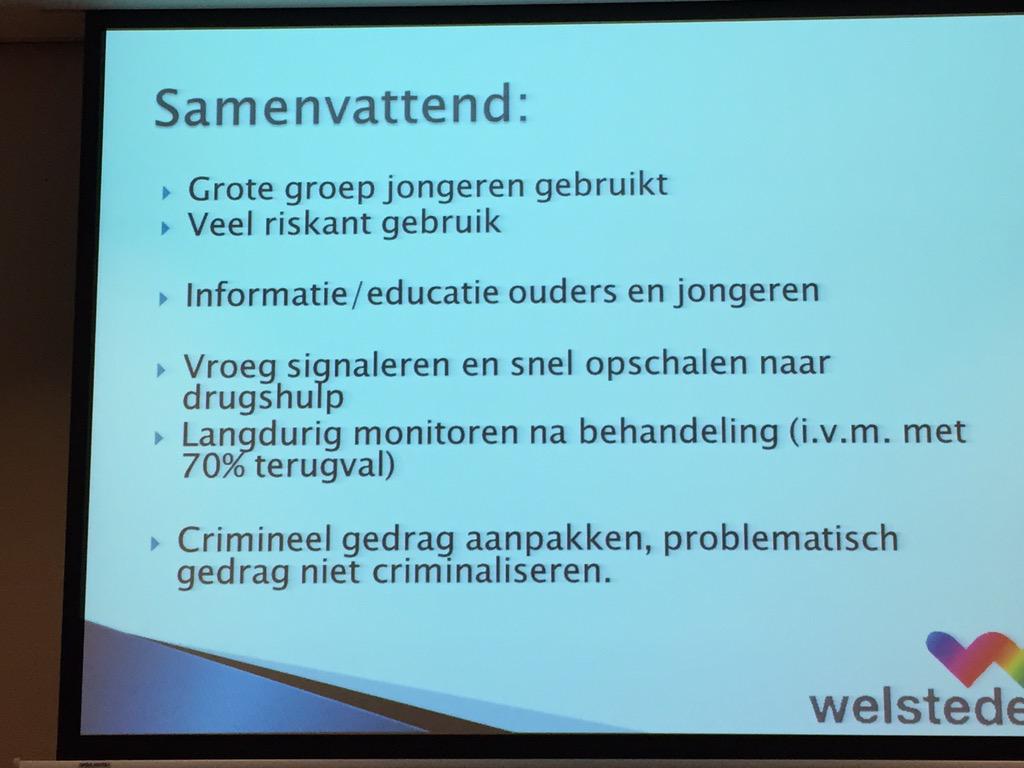
Maar hoe groot is het probleem? Volgens onderzoek is het Nijkerkse drugsgebruik vergelijkbaar met die van een gemiddelde grote stad. Wat betreft cocaïne scoort in het onderzoek alleen Amsterdam hoger. Het gebruik van XTC ligt op het niveau van Amsterdamse cijfers uit 2011. Uit onderzoek blijkt dat 70 procent van de jongeren wordt behandeld voor drugsgebruik raakt binnen een jaar weer in de problemen.
Welzijnsorganisatie Welstede onderzocht onlangs het drugsgebruik in Nijkerk. Wethouder Marly Klein is verantwoordelijk voor het drugsbeleid in de gemeente Nijkerk: 'Uit het onderzoek van Welstede bleek dat Nijkerk niet veel afwijkt van het landelijk gemiddelde, maar er is nog steeds sprake van een behoorlijk gebruik. De onderzoeken spreken elkaar misschien tegen, maar dat er gebruikt wordt is duidelijk. Het probleem is voldoende duidelijk, dat we er een vervolg op willen geven.'
Eerste beeld en aanzet voor drugsvraagstuk
De gemeente wil tot een praktische aanpak komen. Er komt niet een officieel beleid, maar wel een plan van aanpak. De gemeente nodigt zo veel mogelijk betrokkenen uit die met verslaving te maken hebben. Dat kunnen instanties zijn die met verslavingszorg te maken hebben, maar ook ouders. Alle partijen mogen meedenken over preventie, handhaving en alles wat met drugsgebruik te maken heeft.
'Dat soort input is heel belangrijk,' zegt wethouder Marly Klein, die verantwoordelijk is voor het drugsbeleid in de gemeente Nijkerk. 'Wij hebben de wijsheid ook niet in pacht. De huidige aanpak sluit niet aan bij de behoefte en ouders weten zelf ook heel goed wat er speelt. Ze hebben ook ideeën over hoe ze drugsgebruik kunnen voorkomen en willen daarover meepraten.'
Free Assange! Hack the Planet
[b]Op dinsdag 6 januari 2009 19:59 schreef Papierversnipperaar het volgende:[/b]
De gevolgen van de argumenten van de anti-rook maffia
[b]Op dinsdag 6 januari 2009 19:59 schreef Papierversnipperaar het volgende:[/b]
De gevolgen van de argumenten van de anti-rook maffia

As the officer took her away, she recalled that she asked,
"Why do you push us around?"
And she remembered him saying,
"I don't know, but the law's the law, and you're under arrest."
"Why do you push us around?"
And she remembered him saying,
"I don't know, but the law's the law, and you're under arrest."
As the officer took her away, she recalled that she asked,
"Why do you push us around?"
And she remembered him saying,
"I don't know, but the law's the law, and you're under arrest."
"Why do you push us around?"
And she remembered him saying,
"I don't know, but the law's the law, and you're under arrest."
Free Assange! Hack the Planet
[b]Op dinsdag 6 januari 2009 19:59 schreef Papierversnipperaar het volgende:[/b]
De gevolgen van de argumenten van de anti-rook maffia
[b]Op dinsdag 6 januari 2009 19:59 schreef Papierversnipperaar het volgende:[/b]
De gevolgen van de argumenten van de anti-rook maffia
VOC-mentaliteit! 
quote:Colombia overspoeld met Nederlandse xtc
Nederlandse drugsbendes hebben het Zuid-Amerikaanse continent kennelijk ontdekt als groeimarkt voor xtc. In het hippe uitgaansleven van grote Colombiaanse steden als Medellin, Bogota, Cali en Cartagena verdringt dure Nederlandse xtc het lokaal spotgoedkope witte feestpoeder. Met name in de dancescene kijken cokedealers jaloers toe hoe de in megapartijen aangevoerde partypilletjes gretig aftrek vinden.

quote:De tendens dat Europese en dan vooral Nederlandse drugsbendes Colombia hebben ontdekt als belangrijk afzetland, wordt ook gesignaleerd door de International Narcotics Control Board (INCB). In sommige gevallen vinden zelfs ruiltransacties plaats tussen criminele organisaties. Grote partijen coke worden dan geruild tegen xtc.
Bron: Telegraaf
Free Assange! Hack the Planet
[b]Op dinsdag 6 januari 2009 19:59 schreef Papierversnipperaar het volgende:[/b]
De gevolgen van de argumenten van de anti-rook maffia
[b]Op dinsdag 6 januari 2009 19:59 schreef Papierversnipperaar het volgende:[/b]
De gevolgen van de argumenten van de anti-rook maffia
quote:Instituto Manquehue - With no DEA in sight, Bolivia keeps reducing coca fields
Drug dealing now represents less than 1% of the Andean country's GDP, in a sustained reduction ever since the expulsion of the United States DEA agency.
According to data from the United Nations, Bolivia achieved a reduction in the amount of coca fields — the plant which is used as a raw material for the elaboration of cocaine — approximately in an 11% since the year 2014, and in over a 30% since 2010, which amounts to four consecutive years of decline, from over 30 thousand to some 20 thousand hectares.
Morales stressed that the progress against drug trafficking was possible after the 2008 expulsion of the United States Drug Enforcement Administration (DEA) — accused of conspiracy and espionage — together with a significant national effort.
The data, presented in the form of satellite images and imaging studies, were published last week in a report which was jointly presented by Antonio De Leo, representative of the UN Office Against Drug and Crime, and the Bolivian president, Evo Morales.
De Leo congratulated the Bolivian government over the good news, indicated that the area for the growing of coca is the lowest in twelve years, and asserted the participation of social movements, coca unions and different local authorities in the process.
During his speech, Morales stressed that the progress against drug trafficking was possible after the 2008 expulsion of the United States Drug Enforcement Administration (DEA) — accused of conspiracy and espionage — together with a significant national effort. The head of state also celebrated that drug trafficking no longer has a significant weight in the economy of the Andean country, now corresponding to less than 1% of its Gross Domestic Product (GDP).
Bolivia is the third world producer of coca, after Peru and Colombia, and approximately a 40% of the production ends up in the illegal market. The rest is consumed traditionally, chewed or in tea, as a natural analgesic.
Bron: en.institutomanquehue.org
Free Assange! Hack the Planet
[b]Op dinsdag 6 januari 2009 19:59 schreef Papierversnipperaar het volgende:[/b]
De gevolgen van de argumenten van de anti-rook maffia
[b]Op dinsdag 6 januari 2009 19:59 schreef Papierversnipperaar het volgende:[/b]
De gevolgen van de argumenten van de anti-rook maffia
quote:To Improve Police-Community Relations, End the War on Drugs | James Gierach
Protests and violence have captured the attention of world media following the first anniversary of the day police Officer Darren Wilson fatally shot unarmed teenager Michael Brown in Ferguson, Missouri. Yet President Obama's Task Force on 21st Century Policing, charged with improving police-community relations and reducing crime, has largely overlooked one of the elements most essential to accomplishing this goal: the need to reform drug policy. Ending drug prohibition is essential to restoring peace in the streets, reforming our criminal justice system, and healing our communities. Until those policies change, black communities will continue to fall victim to American policing gone awry.
Law Enforcement Against Prohibition (LEAP), a nonprofit of police, judges, prosecutors, and other criminal justice professionals dedicated to ending the War on Drugs, recently submitted the following statement to the Task Force:
"The drug war created [America's] crisis in policing and destroyed public support [for policing] in some quarters.... Both police and academic leaders have offered... their ideas [to the Task Force] regarding improved community policing, better training, more accountability, civilian review boards, grand jury reform, ending police impunity for misconduct, etc. These recommendations have merit and capacity for improved policing and better community relations. However, LEAP believes that without reforming U.S. and global drug policy, no reform or set of reforms can stop the unending perversion of American values, virtues [and]... policing [practices]."
It is the time-honored mission of police to "serve and protect" communities, but that mission has been corrupted by decades of failed drug enforcement policies. Federal grants and departmental promotion policies reward drug arrests, creating a monetary and personal incentive to focus on drug offenses instead of serious crimes. Violent crime has taken a back seat to drug enforcement for too long, and has changed the way police relate to marginalized communities, who no longer see police as protectors, but as aggressors.
Meanwhile, police are playing doctor, giving people addicted to drugs an arrest record rather than the treatment options and medical attention that would allow them to improve their lives.
LEAP called upon President Obama's Task Force on 21st Century Policing because we believe in introducing a new drug policy paradigm based upon human rights, harm reduction, education, accessible medications, economic development, racial equality, respect for the law, and respect for law enforcement. We now call on all Americans concerned with the state of our justice system to contact Congress and the President to end the War on Drugs. Call upon them to jointly push for an amendment of the three United Nations Drug-Control Treaties that serve as fountainhead for the global War on Drugs. Call upon them to replace the criminalization-and-incarceration model of drug policy with a system of legalized, controlled, and regulated drug markets, treating drug abuse as a health problem and not a law enforcement issue.
Bron: www.huffingtonpost.com
Free Assange! Hack the Planet
[b]Op dinsdag 6 januari 2009 19:59 schreef Papierversnipperaar het volgende:[/b]
De gevolgen van de argumenten van de anti-rook maffia
[b]Op dinsdag 6 januari 2009 19:59 schreef Papierversnipperaar het volgende:[/b]
De gevolgen van de argumenten van de anti-rook maffia
Ja ja, het was allemaal de schuld van de Amerikanen. Altijd lachen met die corrupte huichelaar Morales.quote:
Naturheilmittel
quote:UK sees huge rise in heroin and morphine-related deaths | Society | The Guardian
Increase contributes to total mortality rate from drug poisoning rising to the highest level since comparable records began in 1983
Heroin and morphine-related deaths have increased by almost two-thirds over the past two years, contributing to the mortality rate from drug poisoning rising to the highest level since comparable records began in 1983.
Official figures show there were 952 deaths involving the substances last year – their highest level since 2001 – compared with 579 in 2012, bucking a decline in previous years, according to Office for National Statistics (ONS) figures published on Thursday.
They contributed to the mortality rate from drug misuse rising to 39.9 deaths per million population.
Heroin-related fatalities – which are combined with those from morphine because heroin breaks down in the body into morphine, so either may be recorded on the death certificate – accounted for 42% of total drug misuse deaths.
Harry Shapiro, a drug information and policy analyst, described the figures as “pretty shocking”.
The former director of communications for now-defunct independent monitoring body DrugScope said: “There’s been such a focus on legal highs, new psychoactive substances, that to some extent maybe we’ve been taking our eye off the ball a bit [regarding illegal drugs]. We’ve certainly had declining drug use [in the recent past].
“From a policy point of view, we might have got a bit ‘we’ve ticked all the boxes on this, we’re doing well.’ There are figures here and from the Crime Survey of England and Wales, [which showed a spike in use of ecstasy and LSD among young adults] that suggest we are not ticking all the boxes.”
Public Health England calculated last year that around 60% of drug-related deaths between 2007 and 2012 were people who had not been in treatment at all, or in the previous five years.
Shapiro said the ONS figures raised questions about whether people were being let down by the commissioning process, leaving treatment too early, or being put off by an increasing reluctance to prescribe methadone.
He added that the 2013 abolition of the National Treatment Agency for Substance Misuse had put responsibility for treatment in the hands of local authorities but that they were under extreme financial pressures.
The ONS recorded an increase in the number of deaths involving heroin/morphine across all age groups bar people aged 70 or over between 2013 and 2014. Shapiro said ageing problems could be combining with complications from heroin use to increase the mortality rate.
The ONS highlighted an increase in supply of the drug, after a “heroin drought”, which it said had led to an increase in the purity of street heroin and declining prices, from £74.32 per gramme purity-adjusted in 2011 to £49.55 in 2013. However, Shapiro suggested this was probably the “least controversial version of events”.
He said: “The issue is really: is anyone going to do anything about it and come up with a national strategy to deal with drug-related deaths? It’s not just in relation to morphine.”
Deaths involving cocaine increased sharply last year to 247 from 169 in 2013, reaching an all-time high of 4.4 deaths per million population, according to the ONS. It was the third year in a row the mortality rate for cocaine-related deaths had increased.
Rosanna O’Connor, director of alcohol, drugs and tobacco at Public Health England, described the rise in heroin-related deaths as “a great concern”.
She said: “Fewer people are using heroin but the harms are increasingly concentrated among older, more vulnerable users and those not recently in touch with their local drug treatment services. Reassuringly, overall drug use has also declined and treatment services have helped many people to recover but these figures show the need for an enhanced effort.
“We need to ensure the most vulnerable users can access drug treatment services.”
Bron: www.theguardian.com
Free Assange! Hack the Planet
[b]Op dinsdag 6 januari 2009 19:59 schreef Papierversnipperaar het volgende:[/b]
De gevolgen van de argumenten van de anti-rook maffia
[b]Op dinsdag 6 januari 2009 19:59 schreef Papierversnipperaar het volgende:[/b]
De gevolgen van de argumenten van de anti-rook maffia
Heroine legaliseren. 
Gratis uitdelen tevens.
Iedereen verplicht bij geboorte heroine inspuiten.
Gratis uitdelen tevens.
Iedereen verplicht bij geboorte heroine inspuiten.
Naturheilmittel
quote:
quote:Na zes maanden onderzoek concludeert het team van onafhankelijke experts dat de studenten niet zijn verbrand op een vuilnisbelt, zoals de regering beweert. Wat er wel met ze is gebeurt, blijft onduidelijk. Een van de schokkendste bevindingen van het rapport betreft de rol van de federale politie en het leger. Zij wisten op het moment dat de studenten werden aangevallen precies wat er gebeurde. En ze deden niets.
Op 26 september vorig jaar gingen studenten van de lerarenopleiding in Ayotzinapa naar Iguala, een kleine stad in de zuidelijke deelstaat Guerrero. De studenten, jongens tussen de 17 en 26 jaar oud, kaapten daar een aantal bussen die ze wilden gebruiken voor transport naar een demonstratie in Mexico Stad. Politieagenten openden het vuur en hielden een urenlange klopjacht. Er vielen zes doden en sinds die nacht zijn 43 studenten spoorloos verdwenen.
Free Assange! Hack the Planet
[b]Op dinsdag 6 januari 2009 19:59 schreef Papierversnipperaar het volgende:[/b]
De gevolgen van de argumenten van de anti-rook maffia
[b]Op dinsdag 6 januari 2009 19:59 schreef Papierversnipperaar het volgende:[/b]
De gevolgen van de argumenten van de anti-rook maffia
quote:
quote:The outlawing of narcotic drugs at the start of the Twentieth Century, the turning of the matter from public health to social control, coincided with American’s imperial Open Door policy and the belief that the government had an obligation to American industrialists to create markets in every nation in the world, whether those nations liked it or not.
Civic institutions, like public education, were required to sanctify this policy, while “security” bureaucracies were established to ensure the citizenry conformed to the state ideology. Secret services, both public and private, were likewise established to promote the expansion of private American economic interests overseas.
It takes a book to explain the economic foundations of the war on drugs, and the reasons behind the regulation of the medical, pharmaceutical and drug manufacturers industries. Suffice it to say that by 1943, the nations of the “free world” were relying on America for their opium derivatives, under the guardianship of Harry Anslinger, the Commissioner of the Federal Bureau of Narcotics (FBN).
quote:The war on drugs is largely a projection of two things: the racism that has defined America since its inception, and the government policy of allowing political allies to traffic in narcotics. These unstated but official policies reinforce the belief among CIA and drug law enforcement officials that the Bill of Rights is an obstacle to national security.
Blanket immunity from prosecution for turning these policies into practice engenders a belief among bureaucrats that they are above the law, which fosters corruption in other forms. FBN agents, for example, routinely “created a crime” by breaking and entering, planting evidence, using illegal wiretaps, and falsifying reports. They tampered with heroin, transferred it to informants for sale, and even murdered other agents who threatened to expose them.
All of this was secretly known at the highest level of government, and in 1965 the Treasury Department launched a corruption investigation of the FBN. Headed by Andrew Tartaglino, the investigation ended in 1968 with the resignation of 32 agents and the indictment of five. That same year the FBN was reconstructed in the Department of Justice as the Bureau of Narcotics and Dangerous Drugs (BNDD).
But, as Tartaglino said dejectedly, “The job was only half done.”
quote:In its report, the Abzug Committee said: “It was ironic that the CIA should be given responsibility of narcotic intelligence, particularly since they are supporting the prime movers.”
quote:DCI William Webster formed the CIA’s Counter-Narcotics Center in 1988. Staffed by over 100 agents, it ostensibly became the springboard for the covert penetration of, and paramilitary operations against, top traffickers protected by high-tech security firms, lawyers and well-armed private armies.
The CNC brought together, under CIA control, every federal agency involved in the drug wars. Former CIA officer and erstwhile Twofold member, Terry Burke, then serving as the DEA’s Deputy for Operations, was allowed to send one liaison officer to the CNC.
The CNC quickly showed its true colors. In the late 1990, Customs agents in Miami seized a ton of pure cocaine from Venezuela. To their surprise, a Venezuelan undercover agent said the CIA had approved the delivery. DEA Administrator Robert Bonner ordered an investigation and discovered that the CIA had, in fact, shipped the load from its warehouse in Venezuela.
The “controlled deliveries” were managed by CIA officer Mark McFarlin, a veteran of Reagan’s terror campaign in El Salvador. Bonner wanted to indict McFarlin, but was prevented from doing so because Venezuela was in the process of fighting off a rebellion led by leftist Hugo Chavez. This same scenario has been playing out in Afghanistan for the last 15 years, largely through the DEA’s Special Operations Division (SOD), which provides cover for CIA operations worldwide.
Free Assange! Hack the Planet
[b]Op dinsdag 6 januari 2009 19:59 schreef Papierversnipperaar het volgende:[/b]
De gevolgen van de argumenten van de anti-rook maffia
[b]Op dinsdag 6 januari 2009 19:59 schreef Papierversnipperaar het volgende:[/b]
De gevolgen van de argumenten van de anti-rook maffia
quote:Belastingdienst verkoopt kweekspullen voor hennepteelt door
De Belastingdienst heeft in beslag genomen kweekbenodigdheden voor hennepteelt gisteren zelf verkocht op een veiling. Dat lijkt strijdig met de nieuwe Opiumwet, die “handelingen ter voorbereiding of vergemakkelijking van illegale hennepteelt” verbiedt.
Vloeibare meststoffen, koolstoffilters, ventilatorboxen en droogrekken, artikelen die growshops sinds 1 maart niet meer mogen verkopen, zijn via veilinghuis BVA Auctions verkocht. De artikelen zijn afkomstig van een growshop met een belastingschuld.
Het is niet voor het eerst dat de overheid artikelen van growshops in beslag neemt en ze daarna op de veiling brengt. Eind april was het de dienst Domeinen van het ministerie van Financiën dat in beslag genomen goederen aanbood, onder meer afzuigslangen, geurfilters en een kweektent - nuttig voor het verwijderen van geuren bij hennepteelt. Een “misverstand”, zei de woordvoerder toen. De spullen hadden moeten worden vernietigd. De kavel zou alsnog zijn ingetrokken.
Ditmaal is de kavel, ‘Tuinbouwmaterialen te Zwolle’, volgens de Belastingdienst “gewoon” executoriaal verkocht. De artikelen zijn volgens de fiscus “niet specifiek te koppelen aan hennepteelt omdat zij overal verkocht worden”, zegt een woordvoerder.
“Een goed voorbeeld zijn de plantenvoedingsstoffen. Die kun je bij ieder tuincentrum of op internet aanschaffen, een directe link met hennepteelt is er niet.”
Verbazingwekkend, vind de eigenaar van een Brabantse groothandel, waar een deel van de artikelen oorspronkelijk vandaan komt. Zijn advocaat, Frank Van Ardenne:
“Bij een politie-inval in april is juist zijn hele inboedel met identieke artikelen in beslag genomen omdat verkoop wél in strijd zou zijn met de nieuwe Opiumwet”.
De nieuwe wet verbiedt de verkoop van artikelen die vermoedelijk worden gebruikt bij grootschalige hennepteelt. Op grond daarvan heeft de politie inmiddels tientallen growshops ontruimd. Veel apparatuur is vernietigd. Over de rechtmatigheid van die inbeslagnames lopen vele procedures. Advocaat André Beckers heeft de kavel gisteren op een zitting waar hij een growshopeigenaar verdedigde, al genoemd als voorbeeld van het inconsistente beleid.
“Hoe kan de Belastingdienst dit nu in hemelsnaam doen?”
Dat de overheid opnieuw zelf growshop-artikelen verkoopt is “bizar”, zegt Jan Brouwer, hoogleraar algemene rechtswetenschap van de rijksuniversiteit Groningen.
“Met links wordt er afgepakt en met rechts verkocht. Helderheid in het wietbeleid ontbreekt al jaren. De overheid hoort met één mond te spreken, maar intussen spreken wetgever, rechters, Belastingdienst en burgemeesters elkaar voortdurend tegen. Gevolg: volstrekte willekeur.”
Bron: NRC

Free Assange! Hack the Planet
[b]Op dinsdag 6 januari 2009 19:59 schreef Papierversnipperaar het volgende:[/b]
De gevolgen van de argumenten van de anti-rook maffia
[b]Op dinsdag 6 januari 2009 19:59 schreef Papierversnipperaar het volgende:[/b]
De gevolgen van de argumenten van de anti-rook maffia
Weet niet of hij al door de versnipperaar is geweest.
http://worldnewsdailyrepo(...)-afghan-opium-trade/
http://worldnewsdailyrepo(...)-afghan-opium-trade/
We must guard against the aquisition of unwarranted influence, whether sought or unsought, by the military-industrial complex.
We must never let the weight of this combination endanger our liberties or democratic processes.
Eisenhower1961.
We must never let the weight of this combination endanger our liberties or democratic processes.
Eisenhower1961.

quote:Politie begonnen met grootschalig ruimen wietplantages
17 september 2015
ROERMOND - De politie is vandaag begonnen met het ruimen van meer dan honderd hennepplantages in open veld. Begin september ontdekte de politie in Limburg in totaal 112 wietplantages van verschillend formaat in onder meer de maisvelden, liet een woordvoerder vanochtend weten.
Een van de eerste plekken waar de politie vanochtend met ruimen begon was in een maisveld in het Noord-Limburgse Heijen. De velden werden begin september ontdekt door vluchten met een politiehelikopter. Om hoeveel planten het precies gaat kon de woordvoerder nog niet zeggen. ,,We zijn pas net met ruimen begonnen'', zei hij.
....nachtrijder...Nachtzwelgje!
quote:
quote:'Inderdaad. Wij gaan proberen beide begrotingen te wijzigen. In onze tegenbegroting zit meer geld voor veiligheid en justitie. Bijvoorbeeld door het legaliseren van wiet, dat levert een enorme bezuiniging op.'
Free Assange! Hack the Planet
[b]Op dinsdag 6 januari 2009 19:59 schreef Papierversnipperaar het volgende:[/b]
De gevolgen van de argumenten van de anti-rook maffia
[b]Op dinsdag 6 januari 2009 19:59 schreef Papierversnipperaar het volgende:[/b]
De gevolgen van de argumenten van de anti-rook maffia
Free Assange! Hack the Planet
[b]Op dinsdag 6 januari 2009 19:59 schreef Papierversnipperaar het volgende:[/b]
De gevolgen van de argumenten van de anti-rook maffia
[b]Op dinsdag 6 januari 2009 19:59 schreef Papierversnipperaar het volgende:[/b]
De gevolgen van de argumenten van de anti-rook maffia
Lang leve het korte termijn denken van onze moraal ridders aan de rechterzijde van het politieke spectrum

Drugsgebruik toegenomen na verhogen leeftijd alcoholgebruik'
Foto: ANP
Gepubliceerd: 22 september 2015 12:15
Laatste update: 22 september 2015 13:34
Het drugsgebruik onder tieners is toegenomen sinds het verhogen van de minimumleeftijd voor alcoholgebruik naar 18 jaar.
Dat blijkt uit een onderzoek onder vijfduizend jongeren tussen de 16 en 18 jaar dat is gedaan in opdracht van digitaal themakanaal NPO101 van BNN.
Van de ondervraagden jongeren zegt 1 op de 3 meer drugs te zijn gaan gebruiken sinds de nieuwe alcoholwet van kracht is. Voor 8 procent was het niet beschikbaar zijn van alcohol zelfs de reden om drugs voor de eerste maal te gaan proberen.
Bijna een derde van de jongeren gebruikt elke week drugs, en een derde doet maandelijks aan drugsgebruik. Het gaat om allerlei soorten drugs, zoals xtc, speed en pep.
Consumeren
D66 pleit naar aanleiding van deze peiling voor een uitgebreid en onafhankelijk onderzoek naar het gebruik van drugs onder minderjarigen, en wil met staatssecretaris Martin van Rijn van Volksgezondheid in gesprek.
De wet werd bijna twee jaar geleden van kracht. Sindsdien mogen jongeren onder de 18 jaar geen alcohol meer kopen of consumeren in horecagelegenheden en winkels. Alleen de PVV en D66 stemden tegen het wetsvoorstel.
Het onderzoek werd uitgevoerd door bureau Labyrinth in Utrecht en vond plaats via Facebook.
Vriendenkring
Regisseur Laïs van Niel maakte voor NPO101 een korte documentaire over het toenemende probleem. Zij kwam op het idee voor de film doordat zij in haar vriendenkring hoorde dat het drugsgebruik onder tieners toenam.
Het Trimbos-Instituut, dat onderzoek doet naar het gebruik van verdovende middelen, kan de normalisering van consumptie van drugs onder bepaalde groepen jongeren bevestigen. Maar cijfers over deze specifieke leeftijdscategorie zijn niet voorhanden, aldus een woordvoerster tegen NU.nl.
Bij-effecten
"We hebben wel bij de verhoging van de drankleeftijd gewaarschuwd dat alertheid geboden is voor dit soort bij-effecten", legt ze uit. "Maar uit de gegevens die we nu voorhanden hebben, blijkt geen schrikbarende stijging." Het gaat dan bijvoorbeeld om de incidenten-monitor en de meest recente cijfers van het CBS. "Drank is nog steeds relatief gemakkelijk verkrijgbaar voor deze leeftijdsgroep."
Het Trimbos doet in 2016 weer een groot onderzoek naar het gebruik van alcohol en drugs onder jongeren. "Als er effecten aantoonbaar zijn, verwachten we die in dat onderzoek te gaan zien. Maar de proef van BNN is niet representatief genoeg voor zulke harde conclusies."
Zorgwekkend
Vera Bergkamp van D66 noemde de cijfers dinsdag in De Nieuws BV "zorgwekkend". Bergkamp: "De nieuwe wet was bedoeld om de gezondheidsrisico's onder jongeren te beperken, maar het blijkt averechts te werken."
Zij stelt dat "de politieke werkelijkheid uitgaat van een zekere maakbaarheid: we verbieden iets en dat heeft het gewenste effect. Zo werkt dat dus niet. We moeten ons veel meer verplaatsen in jongeren."
Drugsgebruik toegenomen na verhogen leeftijd alcoholgebruik'
Foto: ANP
Gepubliceerd: 22 september 2015 12:15
Laatste update: 22 september 2015 13:34
Het drugsgebruik onder tieners is toegenomen sinds het verhogen van de minimumleeftijd voor alcoholgebruik naar 18 jaar.
Dat blijkt uit een onderzoek onder vijfduizend jongeren tussen de 16 en 18 jaar dat is gedaan in opdracht van digitaal themakanaal NPO101 van BNN.
Van de ondervraagden jongeren zegt 1 op de 3 meer drugs te zijn gaan gebruiken sinds de nieuwe alcoholwet van kracht is. Voor 8 procent was het niet beschikbaar zijn van alcohol zelfs de reden om drugs voor de eerste maal te gaan proberen.
Bijna een derde van de jongeren gebruikt elke week drugs, en een derde doet maandelijks aan drugsgebruik. Het gaat om allerlei soorten drugs, zoals xtc, speed en pep.
Consumeren
D66 pleit naar aanleiding van deze peiling voor een uitgebreid en onafhankelijk onderzoek naar het gebruik van drugs onder minderjarigen, en wil met staatssecretaris Martin van Rijn van Volksgezondheid in gesprek.
De wet werd bijna twee jaar geleden van kracht. Sindsdien mogen jongeren onder de 18 jaar geen alcohol meer kopen of consumeren in horecagelegenheden en winkels. Alleen de PVV en D66 stemden tegen het wetsvoorstel.
Het onderzoek werd uitgevoerd door bureau Labyrinth in Utrecht en vond plaats via Facebook.
Vriendenkring
Regisseur Laïs van Niel maakte voor NPO101 een korte documentaire over het toenemende probleem. Zij kwam op het idee voor de film doordat zij in haar vriendenkring hoorde dat het drugsgebruik onder tieners toenam.
Het Trimbos-Instituut, dat onderzoek doet naar het gebruik van verdovende middelen, kan de normalisering van consumptie van drugs onder bepaalde groepen jongeren bevestigen. Maar cijfers over deze specifieke leeftijdscategorie zijn niet voorhanden, aldus een woordvoerster tegen NU.nl.
Bij-effecten
"We hebben wel bij de verhoging van de drankleeftijd gewaarschuwd dat alertheid geboden is voor dit soort bij-effecten", legt ze uit. "Maar uit de gegevens die we nu voorhanden hebben, blijkt geen schrikbarende stijging." Het gaat dan bijvoorbeeld om de incidenten-monitor en de meest recente cijfers van het CBS. "Drank is nog steeds relatief gemakkelijk verkrijgbaar voor deze leeftijdsgroep."
Het Trimbos doet in 2016 weer een groot onderzoek naar het gebruik van alcohol en drugs onder jongeren. "Als er effecten aantoonbaar zijn, verwachten we die in dat onderzoek te gaan zien. Maar de proef van BNN is niet representatief genoeg voor zulke harde conclusies."
Zorgwekkend
Vera Bergkamp van D66 noemde de cijfers dinsdag in De Nieuws BV "zorgwekkend". Bergkamp: "De nieuwe wet was bedoeld om de gezondheidsrisico's onder jongeren te beperken, maar het blijkt averechts te werken."
Zij stelt dat "de politieke werkelijkheid uitgaat van een zekere maakbaarheid: we verbieden iets en dat heeft het gewenste effect. Zo werkt dat dus niet. We moeten ons veel meer verplaatsen in jongeren."
Free Assange! Hack the Planet
[b]Op dinsdag 6 januari 2009 19:59 schreef Papierversnipperaar het volgende:[/b]
De gevolgen van de argumenten van de anti-rook maffia
[b]Op dinsdag 6 januari 2009 19:59 schreef Papierversnipperaar het volgende:[/b]
De gevolgen van de argumenten van de anti-rook maffia
quote:Smugglers soak rice in cocaine in bid to beat Argentine customs | World news | The Guardian
Drug-sniffing dogs discovered about 30kg of cocaine absorbed into grains of rice at the port of Rosario, headed for Europe via Africa
Argentine customs agents found about 30kg (66lb) of cocaine hidden in a way they had never seen before – drug-sniffing dogs found it had been absorbed into grains of rice headed for Europe via Africa, an official said on Wednesday.
The bust underscores the role Argentina has come to play as a shipping point for cocaine produced in Bolivia, Peru and Colombia, destined for Africa, and then smuggled north to the lucrative markets of Europe.
Related: Murder, drug cartels and misery counter Argentina's claims of falling poverty | Patrick Greenfield
Imaginative drug runners soaked rice in water that had been mixed with cocaine, said Guillermo Gonzalez, chief of narcotic investigations for Argentina’s customs agency. When the water evaporated the rice was left invisibly “impregnated” with the addictive stimulant.
“It’s a new method,” Gonzalez said. “This is the first time we’ve seen technology this sophisticated.”
Rather than employing a chemical process to extract the cocaine from the rice once it reached its destination, Gonzales said the traffickers probably planned to grind the grains into fine powder and sell it as cocaine.
“Pure cocaine is too strong to be ingested without being cut with something. It may have been their plan to cut this shipment with the same rice that was used to carry it,” he said.
Twelve suspects, among them Argentines and Colombians, have been arrested in what people are calling “operation white rice”.
The scheme was discovered on 17 September when drug-sniffing dogs detected cocaine in a cargo of 50kg rice sacks at a warehouse in the port city of Rosario. It was kept secret for a week while security agents hunted for more suspects.
“The investigation indicates we have to keep looking. We know that these are international criminal organizations,” Gonzalez said.
The plan was to ship the cargo to Guinea-Bissau, a former Portuguese colony called by crime experts as Africa’s first “narco-state”. Each of the white sacks was stamped “country of origin: Argentina”.
The South American country is a major world food provider. On the banks of the Paraná river, Rosario, the birthplace of the iconic revolutionary Ernesto “Che” Guevara and soccer phenomenon Lionel Messi, is a departure point for millions of tonnes of soy, wheat and corn harvested from the Pampas grains belt.
But international drug enforcement officials have taken to calling Rosario “the Tijuana of Argentina” for what it has in common with the Mexican border city used to move cocaine into the US.
Experts say the drug enters Argentina by truck or plane from Andean cocaine-producing countries to the north. The smuggling routes narrow the closer shipments get to Rosario, increasing violent competition among gangs to control the final steps toward the Paraná river, leading south to Buenos Aires and shipping lanes of the Atlantic Ocean.
Drug-related killings spiked so high in Rosario last year that federal forces were called in to provide security.
Bron: www.theguardian.com
Free Assange! Hack the Planet
[b]Op dinsdag 6 januari 2009 19:59 schreef Papierversnipperaar het volgende:[/b]
De gevolgen van de argumenten van de anti-rook maffia
[b]Op dinsdag 6 januari 2009 19:59 schreef Papierversnipperaar het volgende:[/b]
De gevolgen van de argumenten van de anti-rook maffia
quote:Ex-police chief to head pro-legalisation National Cannabis Coalition | Society | The Guardian
Tom Lloyd, who will chair new cannabis law reform umbrella group, says he regrets arresting drug users during his career as a police officer
A former chief constable is to head a new umbrella organisation of cannabis law reform campaign groups that will seek to change views about the use of the drug.
Tom Lloyd, formerly of Cambridgeshire police, will chair the National Cannabis Coalition (NCC), an alliance of groups calling for legal access to the drug for recreational use for adults and for medicinal use for anybody who needs it.
Lloyd has said he now regrets investigating and arresting drug users during his career as a policeman in London and Cambridge. “When you think about arresting somebody who is in possession of drugs, are you really catching a criminal?” he asked. “When it came to law enforcement I think I caused more harm than good.”
The new organisation, which incorporates groups including Norml UK, the UK Cannabis Social Clubs and the United Patients Alliance, aims to move from grassroots protests to political campaigning, targeting decision makers in UK drug policy.
“A major problem in drug law reform, and the resistance to it, is that people look at people, whether they are heroin users or stoners, and they just think they are not serious people,” Lloyd told the Guardian.
He said that traditional tactics, including the annual 4/20 day picnic in Hyde Park, were doing little to transform this perception, but many people involved in the campaign to reform cannabis laws had brought strong evidence into the debate.
“There is a deeper message and that message gets clouded and subverted by the vested interests and it’s to some extend ridiculed,” he said. “I feel that we have got the opportunity to show that we are people who are very sincere and credible, with a lot of valid information.”
Related: I tried recipes from the Cannabis Kitchen Cookbook, then I needed a long nap
The NCC’s constituent groups will still campaign on their own terms, Lloyd said, with the aim of the coalition being to coordinate efforts across the country and to reach key policymakers, whose opinions can have a big impact on official decisions.
Although the new group is still in its early days – without its own website or social media pages – it comes along at a time when the campaign to reform cannabis laws is gathering pace. Two police commissioners have recently said they will not target small-scale cannabis users and growers. Next month MPs will debate cannabis legalisation in Westminster after more than 200,000 people signed a parliamentary petition calling for reform.
Lloyd said: “The world is changing: Uruguay has now legalised it; you have got legal production in states in America; in half the states you can get medicinal cannabis. America is a very powerful player.”
Nevertheless, the government seems dead set against changing the law. The biggest challenge the group faces is transforming the narrative surrounding cannabis use. Lloyd, like many others lobbying for reform, believes this will come through the work of groups campaigning for the right to use cannabis as a medicine.
But he added: “It’s difficult to draw a line between what might be medicinal use and what becomes what we call recreational use, because anybody who wants to consume cannabis to de-stress is doing something which is probably an improvement to their health. I don’t think there is a distinction between the two.”
Jonathan Liebling, of the United Patients Alliance, which campaigns specifically on medical cannabis use, said the hope was that bringing together a range of reform groups would eliminate wasted opportunities and overlapping efforts.
Most of the alliance’s work involves lobbying MPs by urging members to write letters and turn up to surgeries, and Liebling claims a number of successes. “It’s very easy for an MP, especially a Conservative MP, to respond to an email and give you the standard party line,” he said. “But it’s much harder for them to stand in front of an MS sufferer and tell them they can’t have their medicine.”
Liebling and Lloyd will share a platform, along with Lady Meacher, a crossbench peer who chairs the All-Party Parliamentary Group for Drug Policy Reform, in London on Monday for a pre-debate public meeting on medicinal cannabis. Medicinal users of the drug will tell their stories about how it helps them to deal with their conditions.
However, there is a big omission in the list of groups constituting and supporting the NCC. Clear, Britain’s largest membership-based cannabis reform group, is not a part of the coalition, with Liebling saying that their views and tactics are not compatible.
Related: Medicinal cannabis and the caregiving community giving it away for free
“They don’t like the epithet ‘stoners’, they will criticise people for looking a certain way,” Liebling said. “They have separated themselves in that regard and the rest of us said you are welcome to join the NCC but you have to stop shouting at us.”
Peter Reynolds, the president of Clear’s executive committee, disputed the claim that the organisation had turned down a chance to join, saying that they had never been invited. However, he was clear that they would not sign up at this stage and added that, with more than 500,000 followers on social media, Clear was one of the UK’s biggest pressure groups on any issue.
“We have some very difficult differences of opinion with the way that the campaign ought to be run,” Reynolds said, adding that although he had respect for the work of the United Patients Alliance, he felt that other groups who sought to take their cannabis use into the street were counterproductive.
“We would unashamedly criticise anybody who behaves in that way because we feel that the new approach that we have brought to the campaign in the past five years has been proven to work. In many ways UPA is the closest to that approach, but the whole stoner, go and smoke in a policeman’s face tactic has failed.”
He added: “There is not going to be a revolution. The government is not going to stand up and say we were wrong and you are right, but we are making slow progress. I’m confident that we will have some degree of medicinal access within this parliament.”
Bron: www.theguardian.com
Free Assange! Hack the Planet
[b]Op dinsdag 6 januari 2009 19:59 schreef Papierversnipperaar het volgende:[/b]
De gevolgen van de argumenten van de anti-rook maffia
[b]Op dinsdag 6 januari 2009 19:59 schreef Papierversnipperaar het volgende:[/b]
De gevolgen van de argumenten van de anti-rook maffia
quote:Xtc-team politie veel te zwaar belast | NOS
De specialisten van de politie die worden ingezet om illegale xtc-laboratoria op te rollen worden veel te zwaar belast. De Inspectie SZW heeft vastgesteld dat de agenten veel te lange dagen maken en onvoldoende rust krijgen. Politiebond ACP spreekt van een levensgevaarlijk situatie.
De werkbelasting komt terug in een nog niet gepubliceerde boeterapport van de Inspectie en is in handen van het ANP en ingezien door de NOS. In één geval is een dienst van 26,5 uur vastgesteld.
De zogeheten Landelijke Faciliteit Ontmantelen (LFO) - een team van vier specialisten - is opgezet om xtc-laboratoria te ontruimen. Dat gebeurt vele tientallen keren per jaar. Sinds een paar jaar zijn daar de dumpingen van chemicaliën in het bos bij gekomen. Daardoor is de werklast sterk toegenomen.
De Inspectie SZW onderzocht de werktijden en vond in vier weken tijd 48 overtredingen van de Arbeidstijdenwet. Behalve de uitzonderlijk lange dienst maakten medewerkers weken van meer dan 60 uur. Werkdagen langer dan 15 uur kwamen regelmatig voor. Eén medewerker moest 28 dagen achter elkaar werken zonder vrije dag. Sommigen hadden geen enkel weekend vrij, terwijl twee vrije weekenden per maand is voorgeschreven.
De Inspectie verwijt de Nationale Politie ook dat er geen inventarisatie is gemaakt van de risico’s die de medewerkers van het LFO lopen. Dat is noodzakelijk omdat zij in hun werk te maken krijgen met giftige of bedwelmende stoffen. Ook kan er iets ontploffen.
ACP-voorzitter Gerrit van der Kamp noemt de situatie bij het LFO levensgevaarlijk en onverantwoord. De medewerkers werken met gevaarlijke stoffen en moeten uitgerust en scherp zijn als ze een drugslab betreden. Ook omdat er boobytraps kunnen zijn aangebracht. Van der Kamp is bang dat de medewerkers gezondheidsrisico's lopen. Hij vraagt zich ook af waarom het rapport, dat al in maart is opgesteld, tot nu toe is achtergehouden.
De Landelijke Eenheid van de Nationale Politie, waaronder het LFO valt, geeft toe dat de werkdruk bij het xtc-team hoog was. Er wordt vaak een beroep op hen gedaan, om de locaties veilig te stellen voor nader onderzoek. Volgens een woordvoerder zijn er nu vier mensen extra aangenomen. Zij zijn begin volgend jaar volledig inzetbaar. Ook is er inmiddels een risico-inventarisatie gemaakt.
Bron: nos.nl
Free Assange! Hack the Planet
[b]Op dinsdag 6 januari 2009 19:59 schreef Papierversnipperaar het volgende:[/b]
De gevolgen van de argumenten van de anti-rook maffia
[b]Op dinsdag 6 januari 2009 19:59 schreef Papierversnipperaar het volgende:[/b]
De gevolgen van de argumenten van de anti-rook maffia
quote:Anti-Marijuana Politician Charged With Possession of Marijuana - Counter Current News
A New York State Republican assemblyman who opposed medical marijuana legislation at every turn was arrested and charged with unlawful possession of marijuana. The police found the marijuana after they pulled him over for speeding.
A statement released shortly after the March 2013 incident, law enforcement officials reported that state police discovered Steve Katz had a “small bag” of marijuana on him.
A New York State Trooper said that the 59-year-old assemblyman had been driving 80 miles per hour in 65 mph zone. He noticed the marijuana and took Katz into custody, charging him with possession before he was finally bailed out.
Katz had voted against the legalization of medical marijuana back in June.
The New York Times noted that the Republican assemblyman also sits on New York’s Alcoholism and Drug Abuse Committee.
Katz said that this was merely an “unfortunate incident” during a press conference.
“This should not overshadow the work I have done over the years for the public and my constituency,” Katz said to reporters. “I am confident that once the facts are presented that this will quickly be put to rest.”
Watch the local report that aired in March of 2013 (article continues below).
Now here’s where the story gets really interesting…
After the arrest, the Republican politician flipped his position on marijuana, even joining the investor network of San Francisco-based marijuana investment and research firm The ArcView Group.
ArcView CEO Troy Dayton said that Katz is “gung-ho” about marijuana.
He says that he hopes to help pool millions of dollars of investment capital and fund marijuana-related start-ups.
“For me, entering this industry at this time is a dream come true from a child of the Sixties all grown up,” Katz said, completely ignoring his history as an opponent of medical marijuana.
“I decided to vote what I believed to be the vote of my constituents. The day after that I told my wife, ‘Next year, I really don’t care. I’m voting for medical marijuana because that’s what I believe in and I’m not comfortable with what happened.’ … I knew how I was going to vote and I felt great about it. I knew how I was going to vote a year before the police incident.”
The marijuana bust was “an epiphany,” he explained. “‘You’re turning me into a criminal? You got to be kidding.’”
Katz says he knows doctors, lawyers, businessmen and pillars of their community who all use marijuana.
“We’re all criminals? This is ridiculous,” he emphasized.
The arrest he faced “didn’t change anything other than make me decide that I was going to not only be a champion for medical marijuana, and for its total legalization, I was going to become part of the wave that’s building in the industry itself. ;It’s a great feeling. It’s very liberating;.”
“Steve Katz is not an anomaly,” Dayton said. “In the last few months numerous very prominent and seemingly unlikely investors have joined our investor group. People from all walks of life are realizing that cannabis may be the next great American industry.”
(Article by M. David)
Share this:
Bron: countercurrentnews.com

Free Assange! Hack the Planet
[b]Op dinsdag 6 januari 2009 19:59 schreef Papierversnipperaar het volgende:[/b]
De gevolgen van de argumenten van de anti-rook maffia
[b]Op dinsdag 6 januari 2009 19:59 schreef Papierversnipperaar het volgende:[/b]
De gevolgen van de argumenten van de anti-rook maffia
Geen medelijden mee, teringboeven.quote:Op woensdag 30 september 2015 15:07 schreef Papierversnipperaar het volgende:
Politiebond ACP spreekt van een levensgevaarlijk situatie.
As the officer took her away, she recalled that she asked,
"Why do you push us around?"
And she remembered him saying,
"I don't know, but the law's the law, and you're under arrest."
"Why do you push us around?"
And she remembered him saying,
"I don't know, but the law's the law, and you're under arrest."
