NWS Nieuws & Achtergronden
Discussieer hier diepgaander over de actualiteiten.



Hierop aansluitend een zeer goed artikel wat de soennitische reacties analyseert op het aftreden van Maliki en wie welke houding aannemen naar de Iraakse centrale overheid toe (geleidt door sjitisch blok):quote:Op zaterdag 16 augustus 2014 18:31 schreef Aloulou het volgende:
Neem aan dat je gewoon met ze kan praten alleen dan wel in hun taal; macht en geld geven. Gewoon een soennitische Kadyrov zoeken die met zijn stam en bevriende stammen de soenni-provincies gaat regeren en schoonmaken van ISIS-tuig. Eventuele steun via de lucht van de Yanks of Iraakse airforce (als dat wat voorstelt).
quote:Intro and Analysis
The latest Naqshbandi Army (Jaysh Rijal al-Tariqa al-Naqshbandia/JRTN) statement is in short a reaffirmation of the group's revolutionary aims: that is, to overthrow the government and constitution. This statement reflects a wider insurgent trend calling on Sunnis not to attempt to reinvolve themselves in the political process with the stepping down of Nouri al-Maliki as prime minister designate in favor of Dawa party member Hayder al-Abadi, who must now form a new government. In a similar vein, for example, the Islamic Army of Iraq- associated with the demand for a Sunni federal region- has also come out against Abadi, with spokesman Ibrahim al-Shammary tweeting: "To those who rejoiced about Abadi, in what way does Abadi differ from Maliki? The knife by which the Ahl al-Sunna are slaughtered has been moved from one criminal to another! Do not be so rejoicing."
Further, a whole series of local JRTN-fronts in the form of "Military Council for the Revolutionaries of Tribes in X" (where X is a given locality) have issued statements rejecting the upcoming government formation process under Abadi, stressing that the goal is revolution. Some of these military councils claim a presence in localities where the Islamic State (IS) has emerged as the dominant power in military and administrative terms, including Rutba (in western Anbar), Fallujah, Tel Afar and Mosul. The point is, the JRTN's priorities are still very much focused on fighting government forces, not on confronting IS. Indeed, the JRTN's local military councils have either virtually accepted complete subordination to IS or a de facto alliance.
More generally, we can note the following:
a) To the extent that Sunni Arab politicians (e.g. Osama al-Nujaifi) have decided to come out in support of Hayder Abadi's nomination and work to form a new government, then the gap between them and the likes of the JRTN is only increased. Atheel al-Nujaifi's statement on the need for Abadi to work to build up a new Iraqi army and for the provinces to cooperate in that regard should also be noted. Any notions he was playing up last month of working with JRTN in Mosul have now died away. Indeed, the Nujaifi brothers' statements now focus wholly on countering IS, as they realize the extent of the crisis in Ninawa province in particular.
b) Presently, we can divide Sunni Arab sentiment into three camps:
1 Those who see the top priority as rolling back IS rather than pushing for political grievances, if they have any, to be addressed, under which camp we can identify figures such as Ahmed Abu Risha of Anbar and his nephew Muhammad Khamees, the former of whom recently announced a unified initiative of anti-IS tribal clans in Anbar province to push back against IS. It should be noted that there is nothing particularly groundbreaking about this announcement: anti-IS tribal sentiment has existed in Anbar province from the beginning of this year when IS first moved into Fallujah and Ramadi, most notably in Ramadi city and the wider area, Hīt and Haditha. Without it, these localities might have completely fallen out of government control long ago. Meanwhile, Muhammad Khamees has been ever keen to advertise social media material of anti-IS tribal fighters in the Ramadi area in particular:
However, nothing indicates that the main insurgent brands in Anbar and affiliated tribes- whether of JRTN, General Military Council (JRTN/Harith al-Dari), the Islamic Army of Iraq, Jaysh al-Mujahideen etc.- are willing to join Ahmed Abu Risha's supposed new initiative. Out towards the far west of the country, in localities like al-Qa'im, Rawa and Rutba, in all of which IS has asserted dominance, there is no hint of anti-IS tribal sentiment rallying to disrupt IS control of these areas. In short, the 'Abu Risha camp', so to speak, is still in the minority, though I would also draw attention to remnant Sahwa in areas like Daluiya (Salah ad-Din province) and north Baghdad province.
2 Those who push for the government to address demands first as a condition for turning against IS, which we can call the 'mainstream' camp. Arguably the most notable member of this camp is Ali Hatem Suleiman. We can also include at least some members of the Islamic Army of Iraq, who, as I have noted before, would likely be satisfied by an actual grant of a Sunni federal region. Fundamentally, these grievances revolve around the notion of granting Sunni-majority provinces greater autonomy and control over their own security forces with financial support from the central government but withdrawing the army, along with demands for reforms to de-Ba'athification and the idea of the supposed need for greater Sunni Arab representation in government. Here, I believe we have an impasse: though Maliki was often seen as unfairly uncompromising on these issues, he has hardly been alone in his sentiments. In fact, the entire Shi'a political spectrum (which includes Hayder Abadi) is generally reluctant to give any ground here. As far as the 'mainstream' demands go, I would deem the issue of reforms to de-Ba'athification as necessary but must question whether the Sunni Arab majority provinces, given the pervasiveness of nepotism and corruption, could effectively manage their own security forces without external ground support to roll back IS in the current circumstances.
3 Those who believe in 'revolution' and overthrowing the current government and constitution. In this camp fall most of the recognizable non-IS insurgent brands and their supporters: JRTN and its fronts, Jaysh al-Mujahideen, Jamaat Ansar al-Islam and the General Military Council for Iraq's Revolutionaries and affiliates. A strong factor behind this sentiment is the belief in Sunni Arabs as a plurality or majority who should be ruling from Baghdad, hence the centrality of Baghdad to the rhetoric.
In short, I must declare my pessimism in Hayder Abadi's ability to devise an effective strategy to roll back IS. While I believe in the addressing of grievances like reforming de-Ba'athification, foremost the adherents of the third camp I outlined above need to realize the futility of their struggle. I also think external powers will still need to put troops on the ground in large numbers, both in Iraq and Syria, to coordinate an effective anti-IS tribal and insurgent movement to roll back the group's power.
http://www.aymennjawad.or(...)t-13-august-analysis
Oorlog is de verderzetting van de politiek maar met andere middelen - Clausewitz


"Soldiers of the Islamic State of Iraq and Syria will pass from here soon," followed by a Koran verse that read, "and Allah is perfecting His Light even though the disbelievers hate (that)."


#Peshmerga forces with #US air support seize control of the eastern side of Mosul dam after intensive fighting with #ISIS.
Rudaw
Rudaw
http://www.nytimes.com/20(...)ast-chance.html?_r=0quote:Iraq’s Last Chance
By Ali Khedery
“The country is in your hands,” whispered Iraq’s president, Fuad Masum, on Aug. 11 as he charged the newly designated prime minister, Haider al-Abadi, with forming a cabinet. “May God help you,” another lawmaker added. Indeed, after last week’s sidelining of the country’s long-serving prime minister, Nuri Kamal al-Maliki, Mr. Abadi will need all the divine intervention he can get if Iraq is to be spared a descent into all-out civil war.
I was involved in the formation of all five of Iraq’s governments between 2003 and 2010, and I know that the coming weeks will be decisive, turbulent and violent, as leaders from all factions jockey for both power and money — to help represent their respective communities and to siphon away billions of government dollars through systemic patronage.
After spending more than $1 trillion and losing some 4,500 soldiers’ lives, American politicians cannot dare reveal a dirty little secret: Iraq has since 2003 devolved into a combination of Lebanon and Nigeria — a toxic brew of sectarian politics and oil-fueled kleptocracy. The combination of religious rivalry and endemic corruption has hollowed out the Iraqi government, as evidenced by the country’s ongoing electricity crisis and the collapse of entire Iraqi Army divisions in the face of an advance by the Islamic State in Iraq and Syria, or ISIS, into Iraq’s second-largest city, Mosul, even though the Iraqi troops vastly outnumbered the militants.
Over the past century, Iraq has suffered from regional wars, British colonialism, numerous coups, disastrous invasions of its neighbors Iran and Kuwait, international sanctions, an American military occupation and nearly four decades of misrule by Saddam Hussein and Mr. Maliki.
Once the capital of Arab culture, philosophy and commerce, Iraq is today an international pariah and incubator of transnational terrorism, where regional actors are engaged in a bloody proxy war that threatens to spill across borders and destabilize the entire region.
Mr. Abadi has inherited a country on the verge of collapse. Whether Iraq will shatter or be salvaged is not in his hands alone. It will depend on a dizzying number of other leaders, political parties, nonstate actors, and neighboring and global powers.
In accepting the post of prime minister, Mr. Abadi has essentially accepted the role of being the conductor of Iraq’s unruly political symphony. Whether he’ll be able to form a national unity government that equitably represents Iraqis of all creeds and political ideologies will be critical. As with a finely calibrated orchestra, his ministers will need to work hard as individuals and listen to and accommodate each other. Iraqi leaders will need to cooperate in a way that they never have since the 1958 revolution if they are to avert a lengthy civil war — one that would likely precipitate a regionwide Sunni-Shiite holy war.
As in 2006, when an obscure Iraqi parliamentarian, Mr. Maliki, became Iraq’s leader, the world is again asking: Who is Iraq’s new prime minister?
Like Mr. Maliki, Mr. Abadi is a Shiite Islamist Arab and a longtime leader in the Dawa Party, an entity that was founded to combat Iraq’s pre-2003 secular state and create a Shiite theocracy. Fueled by generous support from Iran’s intelligence services, Dawa was motivated to bring about change by any means necessary in the 1980s. Its members staged terrorist attacks across Iraq and elsewhere in the Middle East in a bid to weaken Hussein and his Western backers. The American and French embassies in Kuwait were bombed; a housing compound of the defense contractor Raytheon was overrun; and there were countless assassination attempts against Hussein and his senior deputies. Sensing an existential threat, the regime declared membership in Dawa to be a capital offense and thousands of suspected members were rounded up, tortured and executed.
Those events still resonate in every Iraqi leader’s mind — on both sides of the sectarian divide. The secular Sunnis and Shiites who were sympathetic to Hussein’s Baath Party rule view Dawa members and other Shiite Islamists as puppets of Iran. Likewise, they see Sunni Islamist parties like Speaker Salim al-Jubouri’s Iraqi Islamic Party as mere extensions of the fanatical Muslim Brotherhood. The Islamists see the secularists as drinking, smoking, whoring agents of Western intelligence services on an unholy crusade to separate mosque and state. Their visions of life, religion and politics are fundamentally incompatible, and that’s the heart of Iraqis’ violent struggle to define themselves and their future.
Increasing Iranian influence has only made matters worse. America sat back and watched in 2010 as Mr. Maliki’s cabinet was formed by Iranian generals in Tehran, thereby assuring its strategic defeat in Iraq. ISIS is a direct outgrowth of that defeat. Sensing an American vacuum, both Mr. Maliki and his Iranian patrons sought to consolidate their gains by economically, politically and physically crushing their Sunni and Kurdish rivals. Consequently, today’s “Iraqi security forces” are almost exclusively Shiite, reinforced by militias financed, trained, armed and directed by Iran. Given Mr. Maliki’s blatant sectarianism and his complicity in Bashar al-Assad’s campaign of genocide against Syria’s Sunnis, Sunni radicalization and the spread of ISIS across the region were predictable.
But if anyone has the potential to unite Iraq and hold it together in the face of ISIS terrorism and Iranian meddling, it is Mr. Abadi. In a society where name and upbringing count for a lot, he comes from a respected Baghdad family and was raised in an upscale neighborhood. He studied at one of the capital’s best high schools, earned a degree from one of its top universities and later received a doctorate in engineering in Britain.
While Mr. Maliki spent his years in exile in Iran and Syria and earned degrees in Islamic studies and Arabic literature, Mr. Abadi, a fluent English speaker, worked his own way through his long and costly studies abroad. In meetings over the past decade, Mr. Abadi always impressed me and other American diplomats with his self-effacing humor, humility, willingness to listen and ability to compromise — extremely rare traits among Iraq’s political elite, and precisely the characteristics that are needed to help heal the wounds Iraqis sustained under Hussein and Mr. Maliki.
“We’ll give Abadi a real chance if for no other reason than because he’s a Baghdadi — not a thug from a village like almost everyone else that’s ruled us since ’58,” a shadowy financier of the Sunni insurgency told me this week.
Indeed, for the first time since 2003, Iraq’s top three leaders, the Shiite Mr. Abadi, the Kurdish president, Mr. Masum, and the Parliament’s Sunni speaker, Mr. Jubouri, have all emerged from Iraq’s Parliament, where they cooperated over the past decade to pass legislation and defuse numerous crises.
Still, the challenges facing them today are daunting. Decades of misrule have entrenched sectarianism and corruption and accelerated a brain drain precisely when the country is in desperate need of talent; they have devastated moderate forces and polarized Iraq’s Sunni, Shiite and Kurdish communities; and they have empowered hard-liners from all factions, some of whom openly embrace Iranian-backed Shiite militias and neo-Baathist Sunni elements allied with ISIS or Al Qaeda. Even Iraq’s secular, moderate, pro-American Kurds have recently proved desperate enough to openly embrace a designated terrorist group, the Kurdistan Workers’ Party, with which they once fought a bitter war. Whether Mr. Abadi and his partners in the political process will be able to defuse and eventually marginalize these heavily armed hard-liners from all sides will be the key to Iraq’s viability as a unitary state.
ISIS will also have to be defeated. The root cause of its rise was Sunni disenfranchisement and disillusionment. If the Sunnis turn on ISIS now, which they’re ready to do, then they risk being obliterated by Shiite militants within a year or two. It won’t be easy to repeat the “Awakening” of roughly 2006-10, when Sunni tribes in western and central Iraq turned against the Al Qaeda fighters who were the forerunners of ISIS.
Baghdad and Washington betrayed their promises to these tribal members in 2010, after the secular Sunni-led Iraqiya coalition won more seats than Mr. Maliki’s coalition, only to be deprived of an opportunity to form a government due to Mr. Maliki’s coercion of the judiciary.Although Iraqiya would have inevitably failed to form a cabinet in the face of Iranian objections, simply allowing it the chance would have respected the intent of the Iraqi Constitution, which America helped draft.
Mr. Maliki’s unjust victory and overt purges of Sunnis only compounded the problem. It will be much harder now to convince them that the same thing won’t happen again given that Iran has displaced the United States as the most influential actor in Iraq.
Sunnis can gain real influence in Iraq’s government only if Iran and its Shiite Islamist proxies allow them back to the table in Baghdad. And that would require overcoming deep fears and hatred. To Shiites, it is akin to bringing Hutu génocidaires into the Rwandan cabinet or appointing apartheid apologists as ministers in the South African government. Sunnis, in light of their suffering since 2003, are now demanding the formation of an autonomous region like Kurdistan, but Iran will almost certainly view that as a strategic threat.
Iraq’s viability as a state will also be determined by whom Mr. Abadi chooses to surround himself with in the coming hours, days and weeks. Having traveled across three continents with all of Iraq’s presidents and prime ministers since 2003, I’ve learned that there are two highly revealing windows into the minds of Iraqi leaders: their advisers and bodyguards.
If he continues Mr. Maliki’s tradition of staffing the prime minister’s office with corrupt, proudly sectarian, conspiracy-prone Iran sympathizers who loathe Sunnis, Kurds and secular Shiites, Iraq is doomed. If, however, Mr. Abadi chooses to surround himself with moderate and savvy technocrats from all ethnic and religious groups, his odds of success will grow exponentially.
Mr. Abadi’s choices about who to entrust with his physical safety will also be critical. His security detail will almost certainly be led by tribe members and blood relatives, a universal practice in Iraq. How they behave in the coming months and years will tell us a lot about the prime minister’s mind-set, values, leadership and tolerance for corruption. Mr. Maliki’s abuses of power were legendary — and catastrophic. He bypassed the chain of command to ensure all generals reported to him, just as Hussein did. He ordered military units via cellphone to attack political rivals and installed his own son to lead forces in purging foreigners from their valuable Green Zone properties.
Even if Mr. Abadi manages to exorcise the inner sectarian demons fueled no doubt by Hussein’s execution of two of his brothers, even if he recruits competent advisers and respectful bodyguards, even if he delegates some powers to state institutions and embraces a campaign of national reconciliation, the odds will still be stacked against him.
That’s because all Iraqis and their leaders are psychologically scarred. Iraqis face a simple but defining question: Do they want to live with one another?
Can Shiite Islamists who suffered mightily under Hussein stomach the thought of sitting in a cabinet meeting with neo-Baathist Sunnis? Can those Sunnis stand the concept of sharing power with a currently serving Shiite cabinet minister who was a general in Iran’s Revolutionary Guards and is a death-squad commander behind an ongoing campaign to ethnically cleanse Baghdad of Sunnis by taking power drills to their skulls? Can the Kurds, who suffered decades of oppression at the hands of both Shiite and Sunni Arabs, stomach the idea of remaining part of a dysfunctional country that shares neither their language nor their traditions? This is not a hypothetical scenario but precisely what members of Mr. Maliki’s cabinet were forced to consider for the past eight years. Thus far, the results speak for themselves.
As I’ve told numerous American ambassadors and generals, I believe the answer to all these questions will ultimately be “no.” To date, I’ve seen no indication that there is enough tolerance or willingness among Iraq’s leaders to forgive, forget and move on.
I desperately hope I’m wrong. I’ve visited Walter Reed hospital and Arlington National Cemetery many times. I’ve buried countless Iraqi friends and colleagues since 2003, including two members of Iraq’s Governing Council. I pray daily that Americans’ and Iraqis’ extraordinary sacrifices will eventually pave the way for something magnificent.
Iraq should be one of the wealthiest countries on earth, with its human capital, strategic location, vast oil and gas reserves and two major rivers in an otherwise barren region. It even has tremendous potential for ecological and religious tourism showcasing Kurdistan’s scenic mountains, Samarra’s historic spiral minaret and the Shiite shrines of the south.
But as human history has repeatedly demonstrated, no commodity is as valuable as visionary leadership. Overcoming the legacies of Hussein and Mr. Maliki will not be easy. But it is vital. This really is Iraq’s last chance.
-
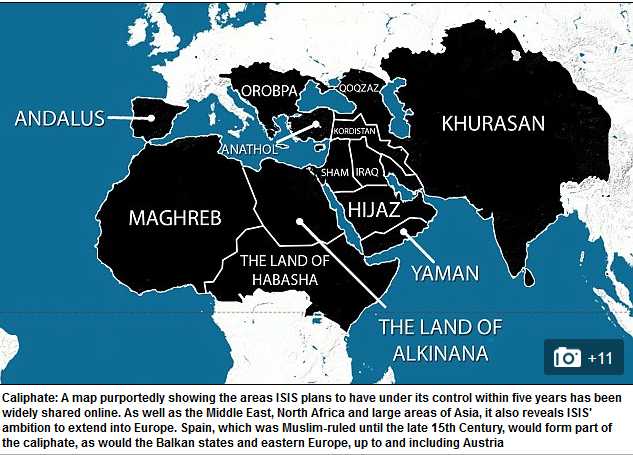
Fake.quote:
Het vijf-jarenplan van ISIS
‘Everywhere Around Is the Islamic State’: On the Road in Iraq with YPG Fighters
"Look at this," an English-speaking doctor said, as a Humvee drove past, YPG scrawled on its front and back in yellow paint. "ISIS took this from the Iraqi army, and we took this from ISIS. It would be better if you give us weapons directly next time. Give us artillery and rockets and tanks and we will destroy ISIS in three days. Three days!"
https://news.vice.com/art(...)urce=vicenewstwitter
-
Denken dat ze levend door de Balkan komen  .
.
.
"But the age of chivalry is gone; that of sophisters, economists, and calculators has succeeded, and the glory of Europe is extinguished forever."- Edmund Burke

Why Iraq Is So Desperate to Retake Mosul Dam from ISIS http://time.com/3126423/iraq-isis-mosul-dam-airstrikes/
Ik zou niet weten waarom niet.quote:
Denken dat ze levend door de Balkan komen
Mr Cameron also discloses that Britain is looking at leading talks with Iran to control the destabilising threat of Islamic State fighters in the region. He says Britain has to “work with countries like Saudi Arabia and Qatar, the UAE, Egypt and Turkey and perhaps even with Iran” against this “shared threat”. “I want Britain to play a leading role in this diplomatic effort,” he says.
http://www.telegraph.co.u(...)sonous-ideology.html
Ik vraag me af of hij verder komt met Iran en Turkije. Die hebben al lang geleden samen een verbond gesloten. Zowel Iran als Turkije reageren heel lauw op Isis. Erdogan faciliteert Isis-strijders en hij heeft een tijd geleden Afrika bezocht om zijn invloed daar te vergroten.
Cameron zal toezeggingen krijgen die niets waard zijn, vrees ik.
http://www.telegraph.co.u(...)sonous-ideology.html
Ik vraag me af of hij verder komt met Iran en Turkije. Die hebben al lang geleden samen een verbond gesloten. Zowel Iran als Turkije reageren heel lauw op Isis. Erdogan faciliteert Isis-strijders en hij heeft een tijd geleden Afrika bezocht om zijn invloed daar te vergroten.
Cameron zal toezeggingen krijgen die niets waard zijn, vrees ik.


twitter:carolmalouf twitterde op zondag 17-08-2014 om 11:46:28 #KDP spokesman tells us #Arab villages around #MosulDam dam joining #isis in their fight against #peshmerga @Telegraph @Rsherlock reageer retweet

twitter:RudawEnglish twitterde op zondag 17-08-2014 om 11:47:21 #Peshmerga forces regain control in two villages in outskirts of #Gwer (50 kilometers) west of #Erbil. http://t.co/ty3O8vexwg reageer retweet

Daar heeft het Iraakse leger dus ook last van, dorpen en steden die vol Baathisten zitten. Probeer zo'n dorp met gewapende bewoners maar eens onder controle te krijgen.quote:Op zondag 17 augustus 2014 14:18 schreef oksel12 het volgende:
twitter:carolmalouf twitterde op zondag 17-08-2014 om 11:46:28 #KDP spokesman tells us #Arab villages around #MosulDam dam joining #isis in their fight against #peshmerga @Telegraph @Rsherlock reageer retweet
Say what?
Daarom de Arabische soennitische steden bombarderen zoals de Russen deden in Grozny, veel minder onschuldige slachtoffers dan als dat niet gedaan wordt.quote:
[..]
Daar heeft het Iraakse leger dus ook last van, dorpen en steden die vol Baathisten zitten. Probeer zo'n dorp met gewapende bewoners maar eens onder controle te krijgen.
Omdat daar allemaal gekke volkeren wonen die moslimbloed drinken voor het ontbijt.quote:
[..]
Ik zou niet weten waarom niet.
"But the age of chivalry is gone; that of sophisters, economists, and calculators has succeeded, and the glory of Europe is extinguished forever."- Edmund Burke
Iranian Forces Fight Alongside Peshmerga In Jalawla
http://basnews.com/en/New(...)rga-In-Jalawla/30756quote:The Iranian Quds force has entered Khanaqen, a Kurdish city in Diyala Province in Northern Iraq, to fight Islamic State (IS) militants in the town of Jalawla.
IS militants captured Jalawla last week, and have since been fighting the Kurdish Peshmerga for control of the town. Iranian forces have now come in to fight alongside the Kurdish forces in the area.
A Peshmerga source in Khanaqen told BasNews Iranian forces entered Iraqi soil from the Parwezkhan border gate and they came in response to a request from Patriotic Union of Kurdistan officials to support Peshmerga in the affected areas.
The source also added that Iranian forces have helped Kurdish forces with weapons, although that only amounts to small quantities of ammunition.
Last week an Iranian Kurdish official told BasNews that Qassem Suleimani, the Iranian general commander of the Quds force of the Iranian Revolutionary Guard Corps (IRGC) is currently in Sulaimaniyah and trying to make the situation worse.
Since the recent attacks by IS militants in Northern Iraq, there have been reports of Iranian involvement helping the Iraqi army against the Jihadi group, especially in Kirkuk, Diyala and Baghdad.
quote:
[..]
Omdat daar allemaal gekke volkeren wonen die moslimbloed drinken voor het ontbijt.

Grapjas, zoals welke volkeren? Albanië is voor de meerderheid soennitisch.
Serviërsquote:
[..]
Grapjas, zoals welke volkeren? Albanië is voor de meerderheid soennitisch.
Say what?
Serviërs, Bulgaren, Grieken en Roemenen hebben allemaal een enorme hekel aan moslims en zijn niet bang om af te rekenen met ISIS kneusjes. En als de Albaniërs en Bosniërs door al dat Saoedisch geld ineens de kant van ISIS kiezen... Wel... Dan zal de NAVO ze ditmaal niet komen redden.quote:
[..]
Grapjas, zoals welke volkeren? Albanië is voor de meerderheid soennitisch.
"But the age of chivalry is gone; that of sophisters, economists, and calculators has succeeded, and the glory of Europe is extinguished forever."- Edmund Burke
1: Mladic zit vast.quote:
[..]
Serviërs, Bulgaren, Grieken en Roemenen hebben allemaal een enorme hekel aan moslims en zijn niet bang om af te rekenen met ISIS kneusjes. En als de Albaniërs en Bosniërs door al dat Saoedisch geld ineens de kant van ISIS kiezen... Wel... Dan zal de NAVO ze ditmaal niet komen redden.
2: Bulgaren.. ja oke.
3: Grieken...
4: Roemenen..
