W&T Wetenschap & Technologie
Een plek om te discussiëren over wetenschappelijke onderwerpen, wetenschappelijke problemen, technologische projecten en grootse uitvindingen.



Morgen is er een belangrijke announcement waarvan gedacht wordt dat het wel eens de bekendmaking kan zijn van de detectie van de echo van gravitatiegolven van de big bang.
Dit zou een enorme prestatie en ontdekking zijn!
Hier alvast een link naar de live stream:
Beetje lange zit, maar hij legt als eerste de bestaande/meest gangbare theorie heel goed uit.
Werkende stream:
http://www.ustream.tv/channel/aagie
[ Bericht 6% gewijzigd door nikao op 17-03-2014 17:03:50 ]
Dit zou een enorme prestatie en ontdekking zijn!
http://www.skyandtelescop(...)onday-250522521.htmlquote:There is intense speculation among cosmologists that a US team is on the verge of confirming they have detected "primordial gravitational waves" – an echo of the big bang in which the universe came into existence 14bn years ago... that would change the face of cosmology and particle physics.
"If they do announce primordial gravitational waves on Monday, I will take a huge amount of convincing," said Hiranya Peiris, a cosmologist from University College London. "But if they do have a robust detection … Jesus, wow! I'll be taking next week off."
The discovery of gravitational waves from the big bang would offer scientists their first glimpse of how the universe was born.
The signal is rumoured to have been found by a specialised telescope called Bicep (Background Imaging of Cosmic Extragalactic Polarization) at the south pole. It scans the sky at microwave frequencies, where it picks up the fossil energy from the big bang.
For decades, cosmologists have thought that the signature of primordial gravitational waves could be imprinted on this radiation. "It's been called the Holy Grail of cosmology," says Peiris, "It would be a real major, major, major discovery.... The primordial gravitational waves have long been thought to be the smoking gun of inflation. It's as close to a proof of that theory as you are going to get." This is because cosmologists believe only inflation can amplify the primordial gravitational waves into a detectable signal.
..."This is the real big tick-box that we have been waiting for. It will tell us something incredibly fundamental about what was happening when the universe was 10–34 seconds old," said Prof Andrew Jaffe, a cosmologist from Imperial College, London, who works on another telescope involved in the search called Polarbear....
Hier alvast een link naar de live stream:
Voor wat achtergrond informatie kan ik deze presentatie aanbevelen.quote:Video of the press conference will be streamed live beginning at 11:55 a.m. EDT from the link at http://www.cfa.harvard.edu/news/news_conferences.html

Beetje lange zit, maar hij legt als eerste de bestaande/meest gangbare theorie heel goed uit.
Werkende stream:
http://www.ustream.tv/channel/aagie
[ Bericht 6% gewijzigd door nikao op 17-03-2014 17:03:50 ]

Wat bedoel je hiermee te betogen?quote:Op zondag 16 maart 2014 20:06 schreef Hyaenidae het volgende:
Bewijs genoeg, kijk alleen al naar de benzineprijzen van de afgelopen 20 jaar.

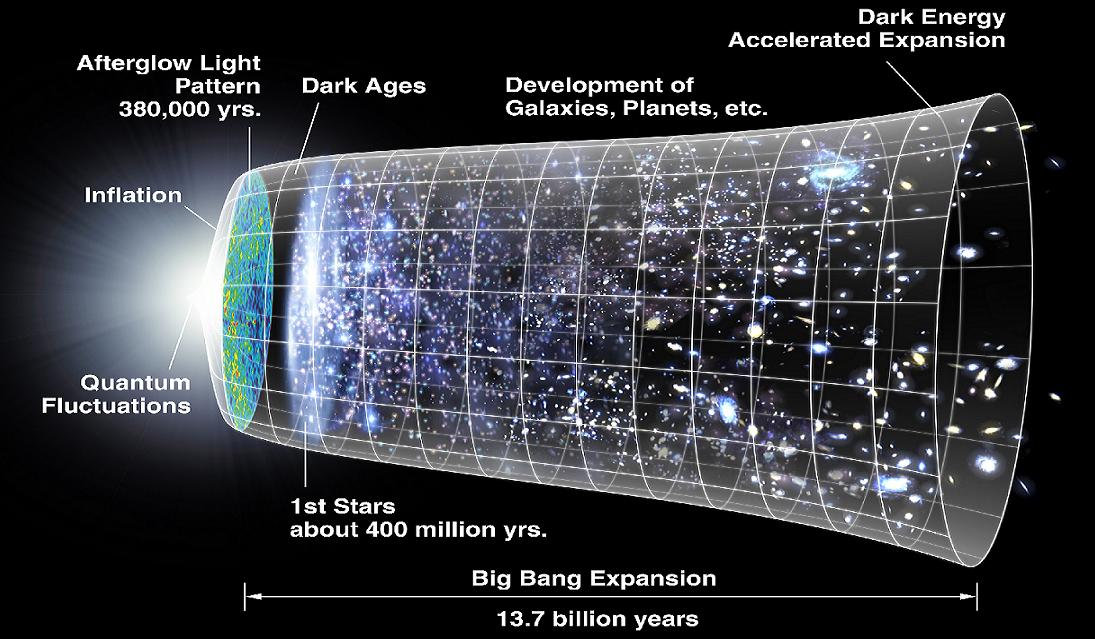
Voor de beeldvorming, inflatie gaat in dit verband over het allereerste stukje van de geschiedenis van het universum. Het eerste stukje in dit plaatje:
Niet meer aanwezig in dit forum.

GMTAquote:
[..]
Hij dacht aan prijsinflatie, net zoals ik in eerste instantie.
pindazakje
Dus de supersnelle expansie in het begin? Of vat ik het plaatje nou verkeerd op?quote:
Voor de beeldvorming, inflatie gaat in dit verband over het allereerste stukje van de geschiedenis van het universum. Het eerste stukje in dit plaatje:
[ afbeelding ]
Het gaat inderdaad over die supersnelle expansie in het begin, dat heb je goed gezien.quote:
[..]
Dus de supersnelle expansie in het begin? Of vat ik het plaatje nou verkeerd op?

Niet meer aanwezig in dit forum.
Ah, ik dacht altijd dat het universum zich gewoon even snel uitbreidde, wist niet dat het in het begin veel sneller ging. Interessant wel.quote:
[..]
Het gaat inderdaad over die supersnelle expansie in het begin, dat heb je goed gezien.

En laten we niet vergeten dat we dan ineens een flinke stap dichterbij het bewijs van de multiverse zijn. Eternal inflation voorspeld namelijk een oneindig aantal universa. Wat dus zou betekenen dat er ergens eentje is waarin wij ook bestaan zoals hier, alleen heb ik daar net een andere nickname.. Bizar!
Sterker nog, het ging ENORM veel sneller;quote:
[..]
Ah, ik dacht altijd dat het universum zich gewoon even snel uitbreidde, wist niet dat het in het begin veel sneller ging. Interessant wel.
Heel kort, maar een niet voor te stellen expansiequote:inflation is the extremely rapid exponential expansion of the early universe by a factor of at least 1078 in volume. It lasted from 10−36 seconds after the Big Bang to sometime between 10−33 and 10−32 seconds.
Damn.quote:
[..]
Sterker nog, het ging ENORM veel sneller;
[..]
Heel kort, maar een niet voor te stellen expansie
 Kan ik me gewoon niet voorstellen eigenlijk.
Dat kan niemandquote:
[..]
Damn.


Ik dacht dat de consensus was dat het universum 'plat' was?quote:
Voor de beeldvorming, inflatie gaat in dit verband over het allereerste stukje van de geschiedenis van het universum. Het eerste stukje in dit plaatje:
[ afbeelding ]
And if you listen very hard
The tune will come to you at last
When all are one and one is all
To be a rock and not to roll
The tune will come to you at last
When all are one and one is all
To be a rock and not to roll
Dat is niet strijdig met dit model. Wat je ziet in het plaatje is een 2D versie van wat in 3D het voor ons zichtbare deel van het universum is.quote:Op zondag 16 maart 2014 21:07 schreef Fir3fly het volgende:
[..]
Ik dacht dat de consensus was dat het universum 'plat' was?
Niet meer aanwezig in dit forum.
Ah, op die manier.quote:
[..]
Dat is niet strijdig met dit model. Wat je ziet in het plaatje is een 2D versie van wat in 3D het voor ons zichtbare deel van het universum is.
And if you listen very hard
The tune will come to you at last
When all are one and one is all
To be a rock and not to roll
The tune will come to you at last
When all are one and one is all
To be a rock and not to roll
Inderdaad heel spannend. De kosmologenwereld is momenteel in rep en roer.
Hier nog een mooie link met een goede uitleg:
http://motls.blogspot.nl/(...)ed-primordial-b.html
Als dit gerucht waar blijkt te zijn dan zijn er voor het eerst ook zwaartekrachtgolven waargenomen (in dit geval veroorzaakt door de inflatie zelf), dus rimpelingen in de ruimte-tijd metriek zoals voorspeld door de ART van Einstein.
Lichtelijk opgewonden gaat Agno nu slapen :-)
Hier nog een mooie link met een goede uitleg:
http://motls.blogspot.nl/(...)ed-primordial-b.html
Als dit gerucht waar blijkt te zijn dan zijn er voor het eerst ook zwaartekrachtgolven waargenomen (in dit geval veroorzaakt door de inflatie zelf), dus rimpelingen in de ruimte-tijd metriek zoals voorspeld door de ART van Einstein.
Lichtelijk opgewonden gaat Agno nu slapen :-)
quote:Brian Greene
Hi Everyone,
A quick heads up regarding some potentially exciting news:
There will be an announcement tomorrow of a "major discovery" and many think it will be the very first evidence pointing toward "primordial gravitational waves" -- loosely speaking, these would be ripples in the fabric of spacetime coming from the big bang.
As of now, this is unconfirmed speculation, but there's strong reason to believe that's what will be announced.
If true, it is a big deal.
Stay tuned.
-BG
Eindelijk iemand die denkt wat iedereen zegt
Kan iemand nog even mijn kennis van String theorie opfrissen? Zou dit betekenen dat string theorie niet klopt? Ik meen dat die geen inflatie voorspelt?
Het enige dat ik weet is dat stringtheorie tot dusver nog niet heeft geleid tot verifieerbare uitspraken over de waarneembare werkelijkheid.quote:
Kan iemand nog even mijn kennis van String theorie opfrissen? Zou dit betekenen dat string theorie niet klopt? Ik meen dat die geen inflatie voorspelt?
Dus als deze observatie stringtheorie ofwel weerlegt ofwel bevestigt dan zou dat ook groot nieuws zijn.

Niet meer aanwezig in dit forum.

Eigenlijk kunnen we dus steeds meer stellen dat de oerknal een feit is. Tenzij het een ander proces was dat zéér veel overeenkomt met een oerknal.
Laten we nog even de persconferentie afwachten en kijken of het inderdaad het nieuws is wat we denken/hopen.quote:
Eigenlijk kunnen we dus steeds meer stellen dat de oerknal een feit is. Tenzij het een ander proces was dat zéér veel overeenkomt met een oerknal.
Ik meen me eenzelfde soort hype te herinneren voor een eerste persconferentie van CERN over Higgs, toen maakten ze allen bekent 'sterke aanwijzingen' te hebben en moesten we alsnog flink lang wachten op echt definitief uitsluitsel. Kan nu natuurlijk zo maar weer gebeuren.

Klopt, dat heeft ook nog vele maanden geduurd toen dacht ik en toen het eenmaal officieel werd gemaakt was de lol er (voor mij) alweer van af.quote:
[..]
Laten we nog even de persconferentie afwachten en kijken of het inderdaad het nieuws is wat we denken/hopen.
Ik meen me eenzelfde soort hype te herinneren voor een eerste persconferentie van CERN over Higgs, toen maakten ze allen bekent 'sterke aanwijzingen' te hebben en moesten we alsnog flink lang wachten op echt definitief uitsluitsel. Kan nu natuurlijk zo maar weer gebeuren.
Hier een kleine uitleg over de inflatietheorie trouwens. Zeer interessant!!
Wat kan dit betekenen voor ons beeld van het heelal?quote:The inflationary theory of the Big Bang was worked out some 34 years ago to explain several paradoxes in today's universe.
- One was why very distant regions of space on opposite sides of the sky look similar even though they could have never have had any common causal relation to each other in the original, simple Big Bang.
- Another was why the matter-and-energy density in the universe is so exquisitely balanced between the amount that would cause a quick recollapse (a "Big Crunch") and a quick expansion away to practically nothing (the "Big Chill").
The inflation theory solved these problems, and then it succeeded even more spectacularly in a new way. It proved to explain the intractable mystery of the origin of cosmic structure, or the lumpiness of matter: how today's galaxies, galaxy clusters, and the overall cosmic web could have formed out of the extremely smooth Big Bang. Today's structures turned out to be explained almost perfectly by inflation rapidly expanding to cosmic size the microscopic, random quantum fluctuations that would be present in the dense matter before the first 10–34 second.
Bizar dat dit steeds meer werkelijkheid lijkt(!) te wordenquote:In its basic form it predicts that our spacetime is physically infinite, and is filled everywhere with stars and galaxies just about like those we see within our own cosmic horizon (out to just 13.8 billion light-years in terms of look-back distance).
On an even grander scale, "eternal inflation," which is now more or less the default model, predicts an infinite number of other Big Bang universes, separate from ours, continuing to erupt forever in an underlying matrix of the eternally inflating stuff that, at one particular point, gave birth to ours. (The concept of this "multiverse" was dramatically visualized in last week's Episode 1 of Cosmos.) Most other Big Bang universes might have very different physical properties from ours, expressing the vast number of different physical solutions to string theory as it's presently conceived.

(http://www.skyandtelescope.com)
[ Bericht 0% gewijzigd door RobbieRonald op 17-03-2014 15:52:14 ]
Onderwerp van de persconferentie is in elk geval nu officieel bevestigd:
"First Direct Evidence of Cosmic Inflation"
Nice!
"First Direct Evidence of Cosmic Inflation"
Nice!
Hier de paper:
http://bicepkeck.org/b2_respap_arxiv_v1.pdf
Nog wat meer (en duidelijke) uitleg uit een NASA press release:
Interessante Q&A van Nature
Ze hebben zelf ook een goeie FAQ:
Nog een visuele uitleg:
[ Bericht 27% gewijzigd door nikao op 17-03-2014 16:58:32 ]
http://bicepkeck.org/b2_respap_arxiv_v1.pdf

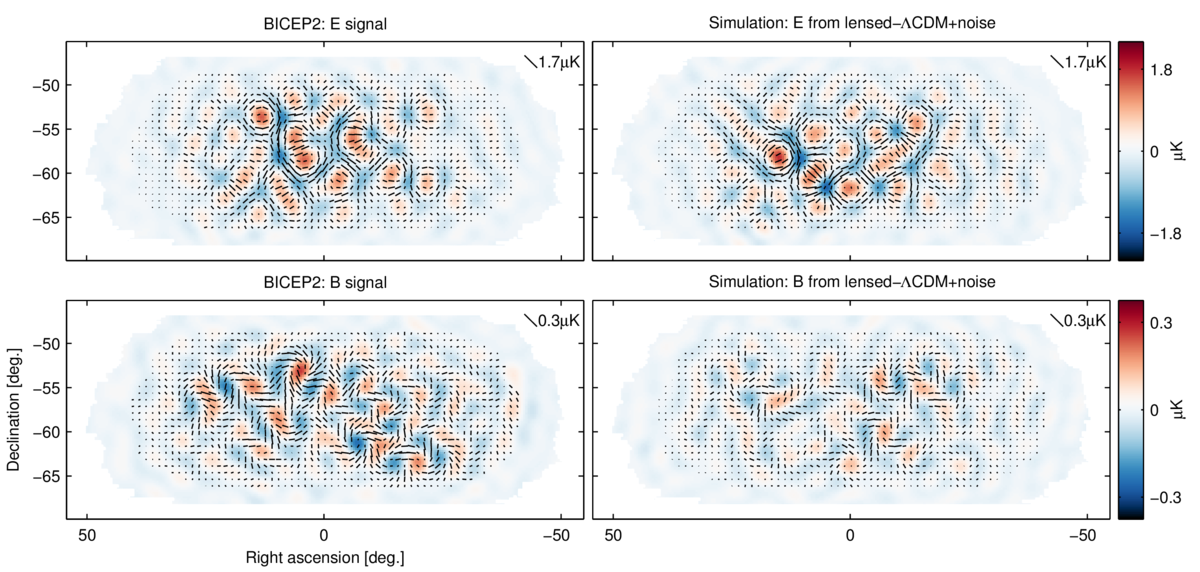
Nog wat meer (en duidelijke) uitleg uit een NASA press release:
http://www.jpl.nasa.gov/news/news.php?release=2014-082quote:Our universe burst into existence in an event known as the Big Bang 13.8 billion years ago. Moments later, space itself ripped apart, expanding exponentially in an episode known as inflation. Telltale signs of this early chapter in our universe's history are imprinted in the skies, in a relic glow called the cosmic microwave background. Recently, this basic theory of the universe was again confirmed by the Planck satellite, a European Space Agency mission for which NASA provided detector and cooler technology.
But researchers had long sought more direct evidence for inflation in the form of gravitational waves, which squeeze and stretch space.
"Small, quantum fluctuations were amplified to enormous sizes by the inflationary expansion of the universe. We know this produces another type of waves called density waves, but we wanted to test if gravitational waves are also produced," said project co-leader Jamie Bock of NASA's Jet Propulsion Laboratory, Pasadena, Calif., which developed the BICEP2 detector technology. Bock has a joint appointment with the California Institute of Technology, also in Pasadena.
The gravitational waves produced a characteristic swirly pattern in polarized light, called "B-mode" polarization. Light can become polarized by scattering off surfaces, such as a car or pond. Polarized sunglasses reject polarized light to reduce glare. In the case of the cosmic microwave background, light scattered off particles called electrons to become slightly polarized.
Interessante Q&A van Nature
http://www.nature.com/new(...)the-big-bang-1.14885quote:What are we seeing in BICEP2's snapshots of the CMB polarization?
The most important result were focused on is the implications of the signal we detected for models of inflation. We are seeing a direct image of a [primordial] gravitational wave, causing light to be polarized in a particular way. The CMB is a snapshot of the Universe 380,000 years after the Big Bang, when the radiation first streamed freely into space, but the gravitational-wave signal was imprinted on the CMB a tiny fraction of a second after the birth of the Universe.
What else is important about the finding?
Everyone in cosmology knows but it is not widely appreciated that the prediction about B modes from inflation relies not just on the phenomenon of gravitational waves but on the quantization of gravity itself. Inflation assumes that everything started out as quantum fluctuations that then got amplified by inflation. So at a very deep level, this finding relies on the connection between quantum mechanics and gravity being right.
Did it cause concern that BICEP2 had detected a B-mode polarization signal that was nearly twice as high as data from the Planck spacecraft suggested?
The Planck data [released so far] came from a temperature map of the CMB, not from a direct polarization measurement. We were always committed to doing an extra careful job on this analysis, but I will admit that the presence of a larger signal-to-noise ratio in our data [compared with the Planck data] sharpened our focus in thinking about every possible systematic explanation over the past three years that could have falsified the signal. Weve done the most extensive systematic analysis that Ive ever been involved in by far.
When did you first realize that you had detected the long-sought 'smoking gun for inflation'?
Last fall, when we first compared the BICEP2 signal with BICEP1. That was very powerful because BICEP1 had very different detectors and used much older technology. So the fact that we were able to see the same signal with this completely different kind of telescope laid a lot of lingering doubts to rest. The remaining sceptics on our team were convinced at that point.
In early December I was at the South Pole and we had a very intense meeting where I laid out all the tests the data had passed and the milestones still to be achieved, and that we would publish if those remaining tests were passed.
Ze hebben zelf ook een goeie FAQ:
Een discussie over de resultaten op Youtube:quote:About the detection
Have you detected B-modes from inflation?
We have detected B-mode polarization at precisely the angular scales where the inflationary signal is expected to peak with very high significance (> 5 sigma). We have extensively studied possible contamination from instrumental effects and feel confident we can limit them to much smaller than the observed signal. Inflationary gravitational waves appear to be by far the most likely explanation for the signal we see.
Couldnt it just be galactic emission or polarized dust?
The data disfavor this. The best current models of polarized galactic emission in our observing region show it to be much fainter than the signal we see. Also, there is little evidence for correlation between our B-mode maps and the predicted pattern from the galaxy. Finally, within our own data, the color of the B-modes found by comparing different frequencies is consistent with CMB but disfavors galactic contamination.
Have you detected a gravitational wave?
The frequency of the cosmic gravitational waves is very low, so we are not able to follow the temporal modulation. However, we are indeed directly observing a snapshot of gravitational waves through their imprints on matter and radiation over space. Ordinary density perturbations cannot create the pattern we observe. The presence of a water wave can be detected by feeling its up-and-down motion or by taking a picture of it. We are doing the latter.
About the science
What is B-mode polarization and how is it generated by inflation?
Measuring the polarization of the Cosmic Microwave Background at different points on the sky determines a direction and polarized intensity (the polarized intensity of the CMB is less than 1/1,000,000 its total brightness). This can be visualized as a map of little line segments at every spot on the sky, the patterns of which we analyze. B-mode polarization is essentially the swirly part of that pattern (known mathematically as the curl). For the density fluctuations that generate most of the polarization of the CMB this part of the primordial pattern is exactly zero.
[This is because density flows in the early universe go into or out of dense regions, and the polarization lines up with these flows in a way that doesn't swirl, producing only so-called E-mode polarization. To generate a B-mode pattern in the early universe you need gravitational waves.]
Inflation magnifies quantum fluctuations, which exist even in vacuum. The quantum fluctuations in the inflation field itself (inflaton) become the density fluctuations seen in the CMB and at much later times in galaxy distributions. During inflation, the quantum fluctuations in gravity (graviton) become long wavelength gravitational waves that produced the B-mode we see.
Wasnt B-mode polarization detected last year?
Yes - but a different kind. Last summer the 10-meter South Pole Telescope announced the first evidence for B-mode polarization in the CMB on arcminute scales which arises from the lensing, or bending of light, by gravitational attraction of structures formed in the relatively recent universe. Recently a second telescope, Polarbear, has also detected this effect. Our data sees this lensing effect too, but what is critical is that we see strong B-mode polarization at the much larger angular scales--2 to 4 degrees on the sky--where lensing is a tiny effect but where inflationary gravitational waves are expected to peak.
Didnt Planck find that r < 0.11? Do your experiments disagree?
Our measurements dont disagree. Constraints on the gravitational-wave background level r reported from Planck and previous experiments are not from measurements of B-mode polar

Nog een visuele uitleg:

[ Bericht 27% gewijzigd door nikao op 17-03-2014 16:58:32 ]
Linkje naar de live persconferentie voor de geïnteresseerden: http://www.ustream.tv/channel/aagie?#astronomy
Hi is nu ineens Off Airquote:
Linkje naar de live persconferentie voor de geïnteresseerden: http://www.ustream.tv/channel/aagie?#astronomy
Death Makes Angels of us all
And gives us wings where we had shoulders
Smooth as raven' s claws...
And gives us wings where we had shoulders
Smooth as raven' s claws...
ah is terug
Death Makes Angels of us all
And gives us wings where we had shoulders
Smooth as raven' s claws...
And gives us wings where we had shoulders
Smooth as raven' s claws...
Ik snap er nog niet al te veel van, maar ik ben enthousiast  .
.
.
And if you listen very hard
The tune will come to you at last
When all are one and one is all
To be a rock and not to roll
The tune will come to you at last
When all are one and one is all
To be a rock and not to roll
Ik wilde net hetzelfde zeggen: ik snap er geen kloot van maar het is wel interessantquote:Op maandag 17 maart 2014 17:40 schreef Fir3fly het volgende:
Ik snap er nog niet al te veel van, maar ik ben enthousiast

Belangrijkste is dat ze de gevolgen van zwaartekrachtgolven in de cosmic background radiation hebben gevonden. Ze zien als het ware de 'uitsmering van quantumfluctuaties' wat alleen door de inflatie gedaan kan zijn. (je blaast als het ware de quantumfluctuatie op).quote:
[..]
Ik wilde net hetzelfde zeggen: ik snap er geen kloot van maar het is wel interessant
Ik hoop dat ik het zo goed verwoord

EDIT: volgens mij zeg ik het niet helemaal correct. Wat ik beschrijf klopt wel, maar is niet wat ze meten. kan het (nog) niet simpel verwoorden nu..

[ Bericht 9% gewijzigd door nikao op 17-03-2014 17:55:03 ]

Nu snap ik het al iets beterquote:
[..]
Belangrijkste is dat ze de gevolgen van zwaartekrachtgolven in de cosmic background radiation hebben gevonden. Ze zien als het ware de 'uitsmering van quantumfluctuaties' wat alleen door de inflatie gedaan kan zijn. (je blaast als het ware de quantumfluctuatie op).
Ik hoop dat ik het zo goed verwoord

Ik ben wel van plan me er in het weekend een beetje in te verdiepenquote:
[..]
Ik wilde net hetzelfde zeggen: ik snap er geen kloot van maar het is wel interessant
.
And if you listen very hard
The tune will come to you at last
When all are one and one is all
To be a rock and not to roll
The tune will come to you at last
When all are one and one is all
To be a rock and not to roll
Direct na de persconferentie op scientias.nl
Direct bewijs gevonden voor oerknaltheorie: met dank aan zwaartekrachtsgolven
Astrofysici hebben een enorme ontdekking gedaan. Voor het eerst hebben ze direct bewijs gevonden voor kosmische inflatie, oftewel de theorie dat het heelal zich vrijwel direct na de oerknal exponentieel uitbreidde. In hun onderzoek presenteren ze direct de eerste beelden van zwaartekrachtsgolven: de naweeën van die oerknal.
Zo’n 13,8 miljard jaar geleden vond de oerknal plaats. Vrijwel direct erna begon het universum zich exponentieel uit te breiden. Tenminste: dat was de theorie. Een nieuw – baanbrekend onderzoek – onderschrijft die theorie nu. Wetenschappers hebben namelijk voor het eerst direct bewijs gevonden voor die exponentiële uitbreiding van het universum (ook wel kosmische inflatie genoemd). En daar blijft het niet bij. In hun data duiken ook direct de eerste beelden van zwaartekrachtsgolven op.
Zwaartekrachtsgolven
Opwindend nieuws
“Dit is echt opwindend,” vindt onderzoeker Chao-Lin Kuo. “We hebben voor het eerst zwaartekrachtsgolven – oftewel rimpels in de ruimtetijd – in beeld gebracht en een theorie over de totstandkoming van het gehele universum geverifieerd.” De onderzoekers deden hun ontdekking met de BICEP2-telescoop. Ze zetten de telescoop in om de kosmische achtergrondstraling – de gloed die de oerknal achterliet te bestuderen.
Zwaartekrachtsgolven ‘persen’ de ruime terwijl ze zich voortbewegen. Hierdoor ontstaat er een specifiek patroon in de kosmische achtergrondstraling. Dit patroon hebben wetenschappers nu daadwerkelijk gezien met de BICEP2-telescoop. Net als golven in de oceaan hebben zwaartekrachtsgolven een voorkeur voor een bepaalde richting, bijvoorbeeld links of rechts. De wetenschappers ontdekten een specifiek patroon, dat wijst op een snelle uitdijing. “Volgens alternatieve theorieën zouden we dit niet moeten zien”, vertelt de Russische fysicus Andrei Linde van de universiteit van Stanford.
Het begint met Einstein
Het bestaan van de zwaartekrachtsgolf wordt voorspeld door Einsteins zwaartekrachtstheorie. In deze theorie beschrijft Einstein de zwaartekracht als een vervorming van de ruimtetijd. Die vervorming ontstaat door materie. Om te begrijpen hoe dat zit, wordt vaak de metafoor van een laken gebruikt (let op: het is een tweedimensionale metafoor, die desalniettemin kan helpen begrijpen hoe materie ruimtetijd beïnvloedt). Stel: u houdt de punt van een laken vast en drie andere mensen houden de andere drie punten vast. U trekt het laken strak. Vervolgens legt iemand in het midden van het laken een bowlingbal. Wat gebeurt er? Er ontstaat een kromming in het laken die het grootst is nabij de bal. En het laken wordt in het gebied nabij de bal wat uitgerekt. Het komt min of meer overeen met wat er gebeurt met de ruimtetijd in de buurt van een grote hoeveelheid materie (bijvoorbeeld een planeet, zie hieronder). Tijd en ruimte worden nabij zo’n massa uitgerekt.
Afbeelding: Atamari (via Wikimedia Commons).
En dan de zwaartekrachtsgolf
Diezelfde theorie van Einstein voorspelt ook het bestaan van de zwaartekrachtsgolf. Deze golven worden door veel onderzoekers beschreven als ‘golfjes in ruimtetijd’. Zwaartekrachtsgolven ontstaan onder meer wanneer twee hele zware objecten (denk aan twee zwarte gaten of twee hele zware dubbelsterren) om elkaar heen cirkelen. De objecten verliezen door die zwaartekrachtsgolven energie en daardoor wordt de afstand tussen de twee objecten steeds kleiner. Uiteindelijk worden de twee objecten één.
Fysicus Andrei Linde – de ‘founding father’ van de inflatietheorie – krijgt te horen dat zijn theorie nu te bewijzen is!
Zwakker
Hoewel die zwaartekrachtsgolven dus in theorie al jaren bekend zijn en ook flinke invloed uitoefenen op het heelal, hebben we ze nog nooit waargenomen. Dat komt voornamelijk doordat die golven wanneer ze door de ruimte reizen in kracht afnemen. Vergelijk het met een boot die op zee vaart. Een luchtbed dicht bij de boot zal veel sterker op en neer deinen dan een luchtbed dat tientallen meters van de boot verwijderd is. Zo is het ook met zwaartekrachtsgolven: zodra ze bij de aarde arriveren, zijn ze zo verzwakt dat we ze eigenlijk niet meer kunnen waarnemen.
Implicaties
En dat vinden onderzoekers jammer. Want als we zwaartekrachtsgolven zouden kunnen waarnemen, zouden we die golven kunnen volgen om bijvoorbeeld zware dubbelstersystemen op te sporen. De golven zouden ons bovendien meer inzicht kunnen geven in het ontstaan van superzware zwarte gaten (wellicht het resultaat van samengesmolten zwarte gaten).
Gevonden!
Maar nu blijkt dus dat wetenschappers inderdaad in staat zijn om zwaartekrachtsgolven waar te nemen, en wel met de gevoelige BICEP2-telescoop. En deze zwaartekrachtsgolven wijzen er dus op dat het heelal kort na het ontstaan exponentieel uitbreidde.
http://www.scientias.nl/d(...)ekrachtsgolven/98920
Direct bewijs gevonden voor oerknaltheorie: met dank aan zwaartekrachtsgolven

Astrofysici hebben een enorme ontdekking gedaan. Voor het eerst hebben ze direct bewijs gevonden voor kosmische inflatie, oftewel de theorie dat het heelal zich vrijwel direct na de oerknal exponentieel uitbreidde. In hun onderzoek presenteren ze direct de eerste beelden van zwaartekrachtsgolven: de naweeën van die oerknal.
Zo’n 13,8 miljard jaar geleden vond de oerknal plaats. Vrijwel direct erna begon het universum zich exponentieel uit te breiden. Tenminste: dat was de theorie. Een nieuw – baanbrekend onderzoek – onderschrijft die theorie nu. Wetenschappers hebben namelijk voor het eerst direct bewijs gevonden voor die exponentiële uitbreiding van het universum (ook wel kosmische inflatie genoemd). En daar blijft het niet bij. In hun data duiken ook direct de eerste beelden van zwaartekrachtsgolven op.

Zwaartekrachtsgolven
Opwindend nieuws
“Dit is echt opwindend,” vindt onderzoeker Chao-Lin Kuo. “We hebben voor het eerst zwaartekrachtsgolven – oftewel rimpels in de ruimtetijd – in beeld gebracht en een theorie over de totstandkoming van het gehele universum geverifieerd.” De onderzoekers deden hun ontdekking met de BICEP2-telescoop. Ze zetten de telescoop in om de kosmische achtergrondstraling – de gloed die de oerknal achterliet te bestuderen.
Zwaartekrachtsgolven ‘persen’ de ruime terwijl ze zich voortbewegen. Hierdoor ontstaat er een specifiek patroon in de kosmische achtergrondstraling. Dit patroon hebben wetenschappers nu daadwerkelijk gezien met de BICEP2-telescoop. Net als golven in de oceaan hebben zwaartekrachtsgolven een voorkeur voor een bepaalde richting, bijvoorbeeld links of rechts. De wetenschappers ontdekten een specifiek patroon, dat wijst op een snelle uitdijing. “Volgens alternatieve theorieën zouden we dit niet moeten zien”, vertelt de Russische fysicus Andrei Linde van de universiteit van Stanford.
Het begint met Einstein
Het bestaan van de zwaartekrachtsgolf wordt voorspeld door Einsteins zwaartekrachtstheorie. In deze theorie beschrijft Einstein de zwaartekracht als een vervorming van de ruimtetijd. Die vervorming ontstaat door materie. Om te begrijpen hoe dat zit, wordt vaak de metafoor van een laken gebruikt (let op: het is een tweedimensionale metafoor, die desalniettemin kan helpen begrijpen hoe materie ruimtetijd beïnvloedt). Stel: u houdt de punt van een laken vast en drie andere mensen houden de andere drie punten vast. U trekt het laken strak. Vervolgens legt iemand in het midden van het laken een bowlingbal. Wat gebeurt er? Er ontstaat een kromming in het laken die het grootst is nabij de bal. En het laken wordt in het gebied nabij de bal wat uitgerekt. Het komt min of meer overeen met wat er gebeurt met de ruimtetijd in de buurt van een grote hoeveelheid materie (bijvoorbeeld een planeet, zie hieronder). Tijd en ruimte worden nabij zo’n massa uitgerekt.

Afbeelding: Atamari (via Wikimedia Commons).
En dan de zwaartekrachtsgolf
Diezelfde theorie van Einstein voorspelt ook het bestaan van de zwaartekrachtsgolf. Deze golven worden door veel onderzoekers beschreven als ‘golfjes in ruimtetijd’. Zwaartekrachtsgolven ontstaan onder meer wanneer twee hele zware objecten (denk aan twee zwarte gaten of twee hele zware dubbelsterren) om elkaar heen cirkelen. De objecten verliezen door die zwaartekrachtsgolven energie en daardoor wordt de afstand tussen de twee objecten steeds kleiner. Uiteindelijk worden de twee objecten één.
Fysicus Andrei Linde – de ‘founding father’ van de inflatietheorie – krijgt te horen dat zijn theorie nu te bewijzen is!

Zwakker
Hoewel die zwaartekrachtsgolven dus in theorie al jaren bekend zijn en ook flinke invloed uitoefenen op het heelal, hebben we ze nog nooit waargenomen. Dat komt voornamelijk doordat die golven wanneer ze door de ruimte reizen in kracht afnemen. Vergelijk het met een boot die op zee vaart. Een luchtbed dicht bij de boot zal veel sterker op en neer deinen dan een luchtbed dat tientallen meters van de boot verwijderd is. Zo is het ook met zwaartekrachtsgolven: zodra ze bij de aarde arriveren, zijn ze zo verzwakt dat we ze eigenlijk niet meer kunnen waarnemen.
Implicaties
En dat vinden onderzoekers jammer. Want als we zwaartekrachtsgolven zouden kunnen waarnemen, zouden we die golven kunnen volgen om bijvoorbeeld zware dubbelstersystemen op te sporen. De golven zouden ons bovendien meer inzicht kunnen geven in het ontstaan van superzware zwarte gaten (wellicht het resultaat van samengesmolten zwarte gaten).
Gevonden!
Maar nu blijkt dus dat wetenschappers inderdaad in staat zijn om zwaartekrachtsgolven waar te nemen, en wel met de gevoelige BICEP2-telescoop. En deze zwaartekrachtsgolven wijzen er dus op dat het heelal kort na het ontstaan exponentieel uitbreidde.
http://www.scientias.nl/d(...)ekrachtsgolven/98920

Beetje hetzelfde als Darwin en Wallace die naar dezelfde informatie keken en onafhankelijk van elkaar tot zo goed als dezelfde conclusie kwamenquote:
Ik meende dat Alan Guth inflatie had geintroduceerd.
Dat dacht ik eigenlijk ook en dit is wat Motl erover schrijft:quote:
Ik meende dat Alan Guth inflatie had geintroduceerd.
(...)Guth and Linde have already been jointly awarded several honours for their work on inflation theory including the Gruber Prize and Milner’s Fundamental Physics Prize, but the Swedish committee places a higher bar for empirical verification. The general idea of the inflationary universe may pass with the new evidence giving Guth his ticket, but Linde has worked on more specific models of inflation such as slow-roll and chaotic inflation. Brilliant and important though his work is, I am not convinced that he is destined for the Nobel yet. Argue with me if you disagree.(...)
Anyway, deze ontdekking doet het Haushofer-natuurkundehart toch wat sneller kloppen denk ik zo
Knap hoor allemaal. De bestaande theorie is dus bevestigd door dit onderzoek en nu weten we dat het heelal zich enorm snel uitbreidde na de oerknal.
Maar wat kunnen we nu werkelijk met deze wetenschap ? Is het alleen de conclusie dat we "alweer een stukje dichter bij de waarheid zijn" die het hart van kosmologen sneller doet kloppen ? Of kunnen we ECHT iets met deze informatie ?
Maar wat kunnen we nu werkelijk met deze wetenschap ? Is het alleen de conclusie dat we "alweer een stukje dichter bij de waarheid zijn" die het hart van kosmologen sneller doet kloppen ? Of kunnen we ECHT iets met deze informatie ?
ah daar is ie weerquote:
Knap hoor allemaal. De bestaande theorie is dus bevestigd door dit onderzoek en nu weten we dat het heelal zich enorm snel uitbreidde na de oerknal.
Maar wat kunnen we nu werkelijk met deze wetenschap ? Is het alleen de conclusie dat we "alweer een stukje dichter bij de waarheid zijn" die het hart van kosmologen sneller doet kloppen ? Of kunnen we ECHT iets met deze informatie ?
Eindelijk iemand die denkt wat iedereen zegt
Kan iemand in Jip & Janneke-taal uitleggen waarom dit een aanwijzing zou zijn voor een multiversum (een oneindig aantal zelfs?)?
[ Bericht 13% gewijzigd door Parafernalia op 17-03-2014 23:47:07 ]
[ Bericht 13% gewijzigd door Parafernalia op 17-03-2014 23:47:07 ]
Eindelijk iemand die denkt wat iedereen zegt
Dit is een aanwijzing voor inflatie theorie. En je moet wat capriolen uithalen om inflatietheorie te hebben zonder dat je met een oneindig aantal universa te maken krijgt. Er zijn flink wat goeie talks op youtube te vinden hierover, zal morgen wat linkjes posten.quote:
Kan iemand in Jip & Janneke-taal uitleggen waarom dit een aanwijzing zou zijn voor een multiversum (een oneindig aantal zelfs?)?
quote:
En je moet wat capriolen uithalen om inflatietheorie te hebben zonder dat je met een oneindig aantal universa te maken krijgt.
Ja maar waarom dan?quote:En je moet wat capriolen uithalen om inflatietheorie te hebben zonder dat je met een oneindig aantal universa te maken krijgt.
Eindelijk iemand die denkt wat iedereen zegt
Kort door de bocht; omdat inflatie niet overal tegelijk zal stoppen. Daarmee krijg je regionen die afgesloten zijn van andere (door de snelheid van het licht) waar inflatie langer of korter heeft geduurd.quote:
|
|
