NWS Nieuws & Achtergronden
Discussieer hier diepgaander over de actualiteiten.



Res. 487 (Jun. 19, 1981) – Expresses full awareness “of the fact that Iraq has been a party to the Treaty on the Non-Proliferation of Nuclear Weapons since it came into force in 1970, that in accordance with that Treaty Iraq has accepted IAEA safeguards on all its nuclear activities, and that the Agency has testified that these safeguards have been satisfactorily applied to date”, notes “furthermore that Israel has not adhered to the non-proliferation Treaty”, expresses deep concern “about the danger to international peace and security created by the premeditated Israeli air attack on Iraqi nuclear installations on 7 June 1981, which could at any time explode the situation in the area, with grave consequences for the vital interests of all States”, “Strongly condemns the military attack by Israel in clear violation of the Charter of the United Nations and the norms of international conduct”, “Further considers that the said attack constitutes a serious threat to the entire IAEA safeguards regime which is the foundation of the non-proliferation Treaty”, “Fully recognizes the inalienable sovereign right of Iraq, and all other States, especially the developing countries, to establish programmes of technological and nuclear development to develop their economy and industry for peaceful purposes in accordance with their present and future needs and consistent with the internationally accepted objectives of preventing nuclear-weapons proliferation”, and “Calls upon Israel urgently to place its nuclear facilities under IAEA safeguards”.
Res. 497 (Dec. 17, 1981) – Reaffirms “that the acquisition of territory by force is inadmissible, in accordance with the United Nations Charter, the principles of international law, and relevant Security Council resolutions”, “Decides that the Israeli decision to impose its laws, jurisdiction and administration in the occupied Syrian Golan Heights is null and void and without international legal effect”, “Demands that Israel, the occupying Power, should rescind forthwith its decision”, and “Determines that all the provisions of the” Fourth Geneva Convention “continue to apply to the Syrian territory occupied by Israel since June 1967”.
Res. 501 (Feb. 25, 1982) – Reaffirms resolution 425 calling upon Israel to cease its military action against Lebanon.
Res. 509 ( Jun. 6, 1982) – “Demands that Israel withdraw all its military forces forthwith and unconditionally to the internationally recognized boundaries of Lebanon”.
Res. 515 (Jul. 29, 1982) – “Demands that the Government of Israel lift immediately the blockade of the city of Beirut in order to permit the dispatch of supplies to meet the urgent needs of the civilian population and allow the distribution of aid provided by United Nations agencies and by non-governmental organizations, particularly the International Committee of the Red Cross (ICRC)”.
Res. 517 (Aug. 4, 1982) – Expresses deep shock and alarm “by the deplorable consequences of the Israeli invasion of Beirut on 3 August 1982”, “Confirms once again its demand for an immediate cease-fire and withdrawal of Israeli forces from Lebanon”, and “Censures Israel for its failure to comply with” resolutions 508, 509, 512, 513, 515, and 516.
Res. 518 (Aug. 12, 1982) – “Demands that Israel and all parties to the conflict observe strictly the terms of Security Council resolutions relevant to the immediate cessation of all military activities within Lebanon and, particularly, in and around Beirut”, “Demands the immediate lifting of all restrictions on the city of Beirut in order to permit the free entry of supplies to meet the urgent needs of the civilian population in Beirut”.
Res. 520 (Sep. 17, 1982) – “Condemns the recent Israeli incursions into Beirut in violation of the cease-fire agreements and of Security Council resolutions”, and “Demands an immediate return to the positions occupied by Israel before” September 15, 1982 “as a first step towards the full implementation of Security Council resolutions”.
Res. 521 (Sep. 19, 1982) – “Condemns the criminal massacre of Palestinian civilians in Beirut” in the Sabra and Shatila refugee camps.
Res. 573 (Oct. 4, 1985) – “Condemns vigorously the act of armed aggression perpetrated by Israel against Tunisian territory in flagrant violation of the Charter of the United Nations, international law and norms of conduct”.
Res. 592 (Dec. 8, 1986) – Reaffirms that the Fourth Geneva Convention “is applicable to the Palestinian and other Arab territories occupied by Israel since 1967, including Jerusalem”, and “Strongly deplores the opening of fire by the Israeli army resulting in the death and the wounding of defenceless students”.
Res. 605 (Dec. 22, 1987) – “Strongly deplores those policies and practices of Israel, the occupying Power, which violate the human rights of the Palestinian people in the occupied territories, and in particular the opening of fire by the Israeli army, resulting in the killing and wounding of defenceless Palestinian civilians”, and reaffirms the applicability of the Fourth Geneva Convention “to the Palestinian and other Arab territories occupied by Israel since 1967, including Jerusalem”.
Res. 607 (Jan. 5, 1988) – Expresses “grave concern over the situation in the occupied Palestinian territories”, notes “the decision of Israel, the occupying Power, to ‘continue the deportation’ of Palestinian civilians in the occupied territories”, “Reaffirms once again” the applicability of the Fourth Geneva Convention “to Palestinian and other Arab territories, occupied by Israel since 1967, including Jerusalem”, “Calls upon Israel to refrain from deporting any Palestinian civilians from the occupied territories”, and “Strongly requests Israel, the occupying Power, to abide by its obligations arising from the Convention”.
Res. 608 (Jan. 14, 1988) – Reaffirms resolution 607, expresses “deep regret that Israel, the occupying Power, has, in defiance of that resolution, deported Palestinian civilians”, and “Calls upon Israel to rescind the order to deport Palestinian civilians and to ensure the safe and immediate return to the occupied Palestinian territories of those already deported”.
Res. 611 (Apr. 25, 1988) – Notes “with concern that the aggression perpetrated” by Israelis on April 16, 1988 “in the locality of Sidi Bou Said”, Tunisia, “has caused loss of human life, particularly the assassination of Mr. Khalil El Wazir”, and “Condemns vigorously the aggression perpetrated … against the sovereignty and territorial integrity of Tunisia in flagrant violation of the Charter of the United Nations, international law and norms of conduct”.
Res. 636 (Jul. 6, 1989) – Reaffirms resolutions 607 and 608, notes “that Israel, the occupying Power, has once again, in defiance of those resolutions, deported eight Palestinian civilians on 29 June 1989”, Expresses deep regret “the continuing deportation by Israel, the occupying Power, of Palestinian civilians”, “Calls upon Israel to ensure the safe and immediate return to the occupied Palestinian territories of those deported and to desist forthwith from deporting any other Palestinian civilians”, and “Reaffirms that” the Fourth Geneva Convention “is applicable to the Palestinian territories, occupied by Israel since 1967, including Jerusalem, and to other occupied Arab territories”.
Res. 641 (Aug. 30, 1989) – Reaffirms resolutions 607, 608, and 636, notes that Israel “has once again, in defiance of those resolutions, deported five Palestinian civilians on 27 August 1989”, and “Deplores the continuing deportation by Israel, the occupying Power, of Palestinian civilians”.
Res. 672 (Oct. 12, 1990) – “Expresses alarm at the violence which took place” on October 8, 1990, “at the Al Haram al Shareef and other Holy Places of Jerusalem resulting in over twenty Palestinian deaths and to the injury of more than one hundred and fifty people, including Palestinian civilians and innocent worshippers”, “Condemns especially the acts of violence committed by the Israeli forces resulting in injuries and loss of human life”, and “Requests, in connection with the decision of the Secretary-General to send a mission to the region, which the Council welcomes, that he submit a report to it before the end of October 1990 containing his findings and conclusions and that he use as appropriate all the resources of the United Nations in the region in carrying out the mission.”
Res. 673 (Oct. 24, 1990) – “Deplores the refusal of the Israeli Government to receive the mission of the Secretary-General to the region”, and “Urges the Israeli Government to reconsider its decision and insists that it comply fully with resolution 672 (1990) and to permit the mission of the Secretary-General to proceed in keeping with its purpose”.
Res. 681 (Dec. 20, 1990) – Reaffirms “the obligations of Member States under the United Nations Charter”, reaffirms “also the principle of the inadmissibility of the acquisition of territory by war”, expresses alarm “by the decision of the Government of Israel to deport four Palestinians from the occupied territories in contravention of its obligations under the Fourth Geneva Convention” in contravention to resolutions 607, 608, 636, and 641, “Expresses its grave concern over the rejection by Israel of Security Council resolutions” 672 and 673, and “Deplores the decision by the Government of Israel, the occupying Power, to resume deportations of Palestinian civilians in the occupied territories”.
Res. 694 (May 24, 1991) – Reaffirms resolution 681 calling on Israel to respect the Fourth Geneva Convention, notes “with deep concern and consternation that Israel has, in violation of its obligations under the Fourth Geneva Convention of 1949, and acting in opposition to relevant Security Council resolutions, and to the detriment of efforts to achieve a comprehensive, just and lasting peace in the Middle East, deported four Palestinian civilians” on May 18, 1991, “Declares that the action of the Israeli authorities of deporting four Palestinians … is in violation of the Fourth Geneva Convention …, which is applicable to all the Palestinian territories occupied by Israel since 1967, including Jerusalem”, and “Deplores this action and reiterates that Israel, the occupying Power, refrain from deporting any Palestinian civilian from the occupied territories and ensure the safe and immediate return of all those deported”.
Res. 726 (Jan. 6, 1992) – Recalls resolutions 607, 608, 636, 641, and 694 calling on Israel to respect the Fourth Geneva Convention, “Strongly condemns the decision of Israel, the occupying Power, to resume deportations of Palestinian civilians”, “Reaffirms the applicability of the Fourth Geneva Convention … to all the Palestinian territories occupied by Israel since 1967, including Jerusalem”, and “requests Israel, the occupying Power, to ensure the safe and immediate return to the occupied territories of all those deported”.
Res. 799 (Dec. 18, 1992) – Reaffirms resolutions 607, 608, 636, 641, 681, 694, and 726 calling on Israel to respect the Fourth Geneva Convention, notes “with deep concern that Israel, the occupying Power, in contravention of its obligations under the Fourth Geneva Convention …, deported to Lebanon” on December 17, 1992 “hundreds of Palestinian civilians from the territories occupied by Israel since 1967, including Jersualem”, “Strongly condemns the action taken by Israel, the occupying Power, to deport hundreds of Palestinian civilians, and expresses its firm opposition to any such deportation by Israel”, “Reaffirms the applicability of the Fourth Geneva Convention … to all the Palestinian territories occupied by Israel since 1967, including Jerusalem, and affirms that deportation of civilians constitutes a contravention of its obligations under the Convention”, and “Demands that Israel, the occupying Power, ensure the safe and immediate return to the occupied territories of all those deported”.
Res. 904 (Mar. 18, 1994) – Expresses shock at “the appalling massacre committed against Palestinian worshippers in the Mosque of Ibrahim in Hebron” on February 25, 1994 by Jewish settler Baruch Goldstein “during the holy month of Ramadan”, expresses grave concern with “the consequent Palestinian casualties in the occupied Palestinian territory as a result of the massacre, which underlines the need to provide protection and security for the Palestinian people”, notes “the condemnation of this massacre by the entire international community”, “Strongly condemns the massacre in Hebron and its aftermath which took the lives of more than fifty Palestinian civilians and injured several hundred others”, and “Calls upon Israel, the occupying Power, to continue to take and implement measures, including, inter alia, confiscation of arms, with the aim of preventing illegal acts of violence by Israeli settlers”.
Res. 1073 (Sep. 28, 1996) – Expresses “deep concern about the tragic events in Jerusalem and the areas of Nablus, Ramallah, Bethlehem and the Gaza Strip, which resulted in a high number of deaths and injuries among the Palestinian civilians, and concerned also about the clashes between the Israeli army and the Palestinian police and the casualties on both sides”, and “Calls for the safety and protection for Palestinian civilians to be ensured”.
Res. 1322 (Oct. 7, 2000) – Expresses deep concern “by the tragic events that have taken place” since September 28, 2000 “that have led to numerous deaths and injuries, mostly among Palestinians”, “Deplores the provocation carried out at Al-Haram Al-Sharif in Jerusalem” on September 28, 2000 “and the subsequent violence there and at other Holy Places, as well as in other areas throughout the territories occupied by Israel since 1967, resulting in over 80 Palestinian deaths and many other casualties”, “Condemns acts of violence, especially the excessive use of force against Palestinians, resulting in injury and loss of human life”, and “Calls upon Israel, the occupying Power, to abide scrupulously by its legal obligations and its responsibilities under the Fourth Geneva Convention”.
Res. 1402 (Mar. 30, 2002) – Expresses grave concern “at the further deterioration of the situation, including the recent suicide bombings in Israel and the military attack against the headquarters of the president of the Palestinian Authority”, “Calls upon both parties to move immediately to a meaningful cease-fire” and “calls for the withdrawal of Israeli troops from Palestinian cities, including Ramallah”.
Res. 1403 (Apr. 4, 2002) – Expresses grave concern “at the further deterioration of the situation on the ground” and “Demands the implementation of its resolution 1402 (2002) without delay”.
Res. 1405 (Apr. 19, 2002) – Expresses concern for “the dire humanitarian situation of the Palestinian civilian population, in particular reports from the Jenin refugee camp of an unknown number of deaths and destruction”, calls for “the lifting of restrictions imposed, in particular in Jenin, on the operations of humanitarian organizations, including the International Committee of the Red Cross and United Nations Relief and Works Agency for Palestine Refugees in the Near East”, and “Emphasizes the urgency of access of medical and humanitarian organizations to the Palestinian civilian population”.
Res. 1435 (Sep. 24, 2002) – Expresses grave concern “at the reoccupation of the headquarters of the President of the Palestinian Authority in the City of Ramallah that took place” on September 19, 2002, demands “its immediate end”, expresses alarm “at the reoccupation of Palestinian cities as well as the severe restrictions imposed on the freedom of movement of persons and goods, and gravely concerned at the humanitarian crisis being faced by the Palestinian people”, reiterates “the need for respect in all circumstances of international humanitarian law, including the Fourth Geneva Convention relative to the Protection of Civilian Persons in Time of War”, “Demands that Israel immediately cease measures in and around Ramallah including the destruction of Palestinian civilian and security infrastructure”, and “Demands also the expeditious withdrawal of the Israeli occupying forces from Palestinian cities towards the return to the positions held prior to September 2000”.
Res. 1544 (May 19, 2004) – Reaffirms resolutions 242, 338, 446, 1322, 1397, 1402, 1405, 1435, and 1515, reiterates “the obligation of Israel, the occupying Power, to abide scrupulously by its legal obligations and responsibilities under the Fourth Geneva Convention relative to the Protection of Civilian Persons in Time of War”, calls “on Israel to address its security needs within the boundaries of international law”, expresses “grave concern at the continued deterioration of the situation on the ground in the territory occupied by Israel since 1967”, condemns “the killing of Palestinian civilians that took place in the Rafah area”, expresses grave concern “by the recent demolition of homes committed by Israel, the occupying Power, in the Rafah refugee camp”, reaffirms “its support for the Road Map, endorsed in resolution 1515”, “Calls on Israel to respect its obligations under international humanitarian law, and insists, in particular, on its obligation not to undertake demolition of homes contrary to that law”, and “Calls on both parties to immediately implement their obligations under the Road Map”.
Res. 1701 (Aug. 11, 2006) – Expresses “its utmost concern at the continuing escalation of hostilities in Lebanon and in Israel” that “has already caused hundreds of deaths and injuries” and “extensive damage to civilian infrastructure and hundreds of thousands of internally displaced persons”, and “Calls for a full cessation of hostilities” including “the immediate cessation by Israel of all offensive military operations”.
Res. 1860 (Jan. 8, 2009) – Expresses “grave concern at the escalation of violence and the deterioration of the situation, in particular the resulting heavy civilian casualties since the refusal to extend the period of calm”, expresses “grave concern also at the deepening humanitarian crisis in Gaza”, “calls for an immediate, durable and fully respected ceasefire, leading to the full withdrawal of Israeli forces from Gaza”, “Calls for the unimpeded provision and distribution throughout Gaza of humanitarian assistance, including of food, fuel and medical treatment”, and “Condemns all violence and hostilities directed against civilians and all acts of terrorism”.
Nu jij.
Res. 497 (Dec. 17, 1981) – Reaffirms “that the acquisition of territory by force is inadmissible, in accordance with the United Nations Charter, the principles of international law, and relevant Security Council resolutions”, “Decides that the Israeli decision to impose its laws, jurisdiction and administration in the occupied Syrian Golan Heights is null and void and without international legal effect”, “Demands that Israel, the occupying Power, should rescind forthwith its decision”, and “Determines that all the provisions of the” Fourth Geneva Convention “continue to apply to the Syrian territory occupied by Israel since June 1967”.
Res. 501 (Feb. 25, 1982) – Reaffirms resolution 425 calling upon Israel to cease its military action against Lebanon.
Res. 509 ( Jun. 6, 1982) – “Demands that Israel withdraw all its military forces forthwith and unconditionally to the internationally recognized boundaries of Lebanon”.
Res. 515 (Jul. 29, 1982) – “Demands that the Government of Israel lift immediately the blockade of the city of Beirut in order to permit the dispatch of supplies to meet the urgent needs of the civilian population and allow the distribution of aid provided by United Nations agencies and by non-governmental organizations, particularly the International Committee of the Red Cross (ICRC)”.
Res. 517 (Aug. 4, 1982) – Expresses deep shock and alarm “by the deplorable consequences of the Israeli invasion of Beirut on 3 August 1982”, “Confirms once again its demand for an immediate cease-fire and withdrawal of Israeli forces from Lebanon”, and “Censures Israel for its failure to comply with” resolutions 508, 509, 512, 513, 515, and 516.
Res. 518 (Aug. 12, 1982) – “Demands that Israel and all parties to the conflict observe strictly the terms of Security Council resolutions relevant to the immediate cessation of all military activities within Lebanon and, particularly, in and around Beirut”, “Demands the immediate lifting of all restrictions on the city of Beirut in order to permit the free entry of supplies to meet the urgent needs of the civilian population in Beirut”.
Res. 520 (Sep. 17, 1982) – “Condemns the recent Israeli incursions into Beirut in violation of the cease-fire agreements and of Security Council resolutions”, and “Demands an immediate return to the positions occupied by Israel before” September 15, 1982 “as a first step towards the full implementation of Security Council resolutions”.
Res. 521 (Sep. 19, 1982) – “Condemns the criminal massacre of Palestinian civilians in Beirut” in the Sabra and Shatila refugee camps.
Res. 573 (Oct. 4, 1985) – “Condemns vigorously the act of armed aggression perpetrated by Israel against Tunisian territory in flagrant violation of the Charter of the United Nations, international law and norms of conduct”.
Res. 592 (Dec. 8, 1986) – Reaffirms that the Fourth Geneva Convention “is applicable to the Palestinian and other Arab territories occupied by Israel since 1967, including Jerusalem”, and “Strongly deplores the opening of fire by the Israeli army resulting in the death and the wounding of defenceless students”.
Res. 605 (Dec. 22, 1987) – “Strongly deplores those policies and practices of Israel, the occupying Power, which violate the human rights of the Palestinian people in the occupied territories, and in particular the opening of fire by the Israeli army, resulting in the killing and wounding of defenceless Palestinian civilians”, and reaffirms the applicability of the Fourth Geneva Convention “to the Palestinian and other Arab territories occupied by Israel since 1967, including Jerusalem”.
Res. 607 (Jan. 5, 1988) – Expresses “grave concern over the situation in the occupied Palestinian territories”, notes “the decision of Israel, the occupying Power, to ‘continue the deportation’ of Palestinian civilians in the occupied territories”, “Reaffirms once again” the applicability of the Fourth Geneva Convention “to Palestinian and other Arab territories, occupied by Israel since 1967, including Jerusalem”, “Calls upon Israel to refrain from deporting any Palestinian civilians from the occupied territories”, and “Strongly requests Israel, the occupying Power, to abide by its obligations arising from the Convention”.
Res. 608 (Jan. 14, 1988) – Reaffirms resolution 607, expresses “deep regret that Israel, the occupying Power, has, in defiance of that resolution, deported Palestinian civilians”, and “Calls upon Israel to rescind the order to deport Palestinian civilians and to ensure the safe and immediate return to the occupied Palestinian territories of those already deported”.
Res. 611 (Apr. 25, 1988) – Notes “with concern that the aggression perpetrated” by Israelis on April 16, 1988 “in the locality of Sidi Bou Said”, Tunisia, “has caused loss of human life, particularly the assassination of Mr. Khalil El Wazir”, and “Condemns vigorously the aggression perpetrated … against the sovereignty and territorial integrity of Tunisia in flagrant violation of the Charter of the United Nations, international law and norms of conduct”.
Res. 636 (Jul. 6, 1989) – Reaffirms resolutions 607 and 608, notes “that Israel, the occupying Power, has once again, in defiance of those resolutions, deported eight Palestinian civilians on 29 June 1989”, Expresses deep regret “the continuing deportation by Israel, the occupying Power, of Palestinian civilians”, “Calls upon Israel to ensure the safe and immediate return to the occupied Palestinian territories of those deported and to desist forthwith from deporting any other Palestinian civilians”, and “Reaffirms that” the Fourth Geneva Convention “is applicable to the Palestinian territories, occupied by Israel since 1967, including Jerusalem, and to other occupied Arab territories”.
Res. 641 (Aug. 30, 1989) – Reaffirms resolutions 607, 608, and 636, notes that Israel “has once again, in defiance of those resolutions, deported five Palestinian civilians on 27 August 1989”, and “Deplores the continuing deportation by Israel, the occupying Power, of Palestinian civilians”.
Res. 672 (Oct. 12, 1990) – “Expresses alarm at the violence which took place” on October 8, 1990, “at the Al Haram al Shareef and other Holy Places of Jerusalem resulting in over twenty Palestinian deaths and to the injury of more than one hundred and fifty people, including Palestinian civilians and innocent worshippers”, “Condemns especially the acts of violence committed by the Israeli forces resulting in injuries and loss of human life”, and “Requests, in connection with the decision of the Secretary-General to send a mission to the region, which the Council welcomes, that he submit a report to it before the end of October 1990 containing his findings and conclusions and that he use as appropriate all the resources of the United Nations in the region in carrying out the mission.”
Res. 673 (Oct. 24, 1990) – “Deplores the refusal of the Israeli Government to receive the mission of the Secretary-General to the region”, and “Urges the Israeli Government to reconsider its decision and insists that it comply fully with resolution 672 (1990) and to permit the mission of the Secretary-General to proceed in keeping with its purpose”.
Res. 681 (Dec. 20, 1990) – Reaffirms “the obligations of Member States under the United Nations Charter”, reaffirms “also the principle of the inadmissibility of the acquisition of territory by war”, expresses alarm “by the decision of the Government of Israel to deport four Palestinians from the occupied territories in contravention of its obligations under the Fourth Geneva Convention” in contravention to resolutions 607, 608, 636, and 641, “Expresses its grave concern over the rejection by Israel of Security Council resolutions” 672 and 673, and “Deplores the decision by the Government of Israel, the occupying Power, to resume deportations of Palestinian civilians in the occupied territories”.
Res. 694 (May 24, 1991) – Reaffirms resolution 681 calling on Israel to respect the Fourth Geneva Convention, notes “with deep concern and consternation that Israel has, in violation of its obligations under the Fourth Geneva Convention of 1949, and acting in opposition to relevant Security Council resolutions, and to the detriment of efforts to achieve a comprehensive, just and lasting peace in the Middle East, deported four Palestinian civilians” on May 18, 1991, “Declares that the action of the Israeli authorities of deporting four Palestinians … is in violation of the Fourth Geneva Convention …, which is applicable to all the Palestinian territories occupied by Israel since 1967, including Jerusalem”, and “Deplores this action and reiterates that Israel, the occupying Power, refrain from deporting any Palestinian civilian from the occupied territories and ensure the safe and immediate return of all those deported”.
Res. 726 (Jan. 6, 1992) – Recalls resolutions 607, 608, 636, 641, and 694 calling on Israel to respect the Fourth Geneva Convention, “Strongly condemns the decision of Israel, the occupying Power, to resume deportations of Palestinian civilians”, “Reaffirms the applicability of the Fourth Geneva Convention … to all the Palestinian territories occupied by Israel since 1967, including Jerusalem”, and “requests Israel, the occupying Power, to ensure the safe and immediate return to the occupied territories of all those deported”.
Res. 799 (Dec. 18, 1992) – Reaffirms resolutions 607, 608, 636, 641, 681, 694, and 726 calling on Israel to respect the Fourth Geneva Convention, notes “with deep concern that Israel, the occupying Power, in contravention of its obligations under the Fourth Geneva Convention …, deported to Lebanon” on December 17, 1992 “hundreds of Palestinian civilians from the territories occupied by Israel since 1967, including Jersualem”, “Strongly condemns the action taken by Israel, the occupying Power, to deport hundreds of Palestinian civilians, and expresses its firm opposition to any such deportation by Israel”, “Reaffirms the applicability of the Fourth Geneva Convention … to all the Palestinian territories occupied by Israel since 1967, including Jerusalem, and affirms that deportation of civilians constitutes a contravention of its obligations under the Convention”, and “Demands that Israel, the occupying Power, ensure the safe and immediate return to the occupied territories of all those deported”.
Res. 904 (Mar. 18, 1994) – Expresses shock at “the appalling massacre committed against Palestinian worshippers in the Mosque of Ibrahim in Hebron” on February 25, 1994 by Jewish settler Baruch Goldstein “during the holy month of Ramadan”, expresses grave concern with “the consequent Palestinian casualties in the occupied Palestinian territory as a result of the massacre, which underlines the need to provide protection and security for the Palestinian people”, notes “the condemnation of this massacre by the entire international community”, “Strongly condemns the massacre in Hebron and its aftermath which took the lives of more than fifty Palestinian civilians and injured several hundred others”, and “Calls upon Israel, the occupying Power, to continue to take and implement measures, including, inter alia, confiscation of arms, with the aim of preventing illegal acts of violence by Israeli settlers”.
Res. 1073 (Sep. 28, 1996) – Expresses “deep concern about the tragic events in Jerusalem and the areas of Nablus, Ramallah, Bethlehem and the Gaza Strip, which resulted in a high number of deaths and injuries among the Palestinian civilians, and concerned also about the clashes between the Israeli army and the Palestinian police and the casualties on both sides”, and “Calls for the safety and protection for Palestinian civilians to be ensured”.
Res. 1322 (Oct. 7, 2000) – Expresses deep concern “by the tragic events that have taken place” since September 28, 2000 “that have led to numerous deaths and injuries, mostly among Palestinians”, “Deplores the provocation carried out at Al-Haram Al-Sharif in Jerusalem” on September 28, 2000 “and the subsequent violence there and at other Holy Places, as well as in other areas throughout the territories occupied by Israel since 1967, resulting in over 80 Palestinian deaths and many other casualties”, “Condemns acts of violence, especially the excessive use of force against Palestinians, resulting in injury and loss of human life”, and “Calls upon Israel, the occupying Power, to abide scrupulously by its legal obligations and its responsibilities under the Fourth Geneva Convention”.
Res. 1402 (Mar. 30, 2002) – Expresses grave concern “at the further deterioration of the situation, including the recent suicide bombings in Israel and the military attack against the headquarters of the president of the Palestinian Authority”, “Calls upon both parties to move immediately to a meaningful cease-fire” and “calls for the withdrawal of Israeli troops from Palestinian cities, including Ramallah”.
Res. 1403 (Apr. 4, 2002) – Expresses grave concern “at the further deterioration of the situation on the ground” and “Demands the implementation of its resolution 1402 (2002) without delay”.
Res. 1405 (Apr. 19, 2002) – Expresses concern for “the dire humanitarian situation of the Palestinian civilian population, in particular reports from the Jenin refugee camp of an unknown number of deaths and destruction”, calls for “the lifting of restrictions imposed, in particular in Jenin, on the operations of humanitarian organizations, including the International Committee of the Red Cross and United Nations Relief and Works Agency for Palestine Refugees in the Near East”, and “Emphasizes the urgency of access of medical and humanitarian organizations to the Palestinian civilian population”.
Res. 1435 (Sep. 24, 2002) – Expresses grave concern “at the reoccupation of the headquarters of the President of the Palestinian Authority in the City of Ramallah that took place” on September 19, 2002, demands “its immediate end”, expresses alarm “at the reoccupation of Palestinian cities as well as the severe restrictions imposed on the freedom of movement of persons and goods, and gravely concerned at the humanitarian crisis being faced by the Palestinian people”, reiterates “the need for respect in all circumstances of international humanitarian law, including the Fourth Geneva Convention relative to the Protection of Civilian Persons in Time of War”, “Demands that Israel immediately cease measures in and around Ramallah including the destruction of Palestinian civilian and security infrastructure”, and “Demands also the expeditious withdrawal of the Israeli occupying forces from Palestinian cities towards the return to the positions held prior to September 2000”.
Res. 1544 (May 19, 2004) – Reaffirms resolutions 242, 338, 446, 1322, 1397, 1402, 1405, 1435, and 1515, reiterates “the obligation of Israel, the occupying Power, to abide scrupulously by its legal obligations and responsibilities under the Fourth Geneva Convention relative to the Protection of Civilian Persons in Time of War”, calls “on Israel to address its security needs within the boundaries of international law”, expresses “grave concern at the continued deterioration of the situation on the ground in the territory occupied by Israel since 1967”, condemns “the killing of Palestinian civilians that took place in the Rafah area”, expresses grave concern “by the recent demolition of homes committed by Israel, the occupying Power, in the Rafah refugee camp”, reaffirms “its support for the Road Map, endorsed in resolution 1515”, “Calls on Israel to respect its obligations under international humanitarian law, and insists, in particular, on its obligation not to undertake demolition of homes contrary to that law”, and “Calls on both parties to immediately implement their obligations under the Road Map”.
Res. 1701 (Aug. 11, 2006) – Expresses “its utmost concern at the continuing escalation of hostilities in Lebanon and in Israel” that “has already caused hundreds of deaths and injuries” and “extensive damage to civilian infrastructure and hundreds of thousands of internally displaced persons”, and “Calls for a full cessation of hostilities” including “the immediate cessation by Israel of all offensive military operations”.
Res. 1860 (Jan. 8, 2009) – Expresses “grave concern at the escalation of violence and the deterioration of the situation, in particular the resulting heavy civilian casualties since the refusal to extend the period of calm”, expresses “grave concern also at the deepening humanitarian crisis in Gaza”, “calls for an immediate, durable and fully respected ceasefire, leading to the full withdrawal of Israeli forces from Gaza”, “Calls for the unimpeded provision and distribution throughout Gaza of humanitarian assistance, including of food, fuel and medical treatment”, and “Condemns all violence and hostilities directed against civilians and all acts of terrorism”.
Nu jij.
Zolang er Arabische landen een machtige positie innemen binnen bepaalde platformen van internationale organisaties zoals de raad voor mensenrechten (  ) zal er zelden objectief worden gekeken naar Israel. Na de Camp David Akkoorden werd Egypte min of meer geboycot door de Arabische wereld en Zionisme binnen een VN-resolutie als racistisch verklaard (wat weer is teruggedraaid) en daar spreekt toch weinig objectiviteit van uit namelijk.
) zal er zelden objectief worden gekeken naar Israel. Na de Camp David Akkoorden werd Egypte min of meer geboycot door de Arabische wereld en Zionisme binnen een VN-resolutie als racistisch verklaard (wat weer is teruggedraaid) en daar spreekt toch weinig objectiviteit van uit namelijk.
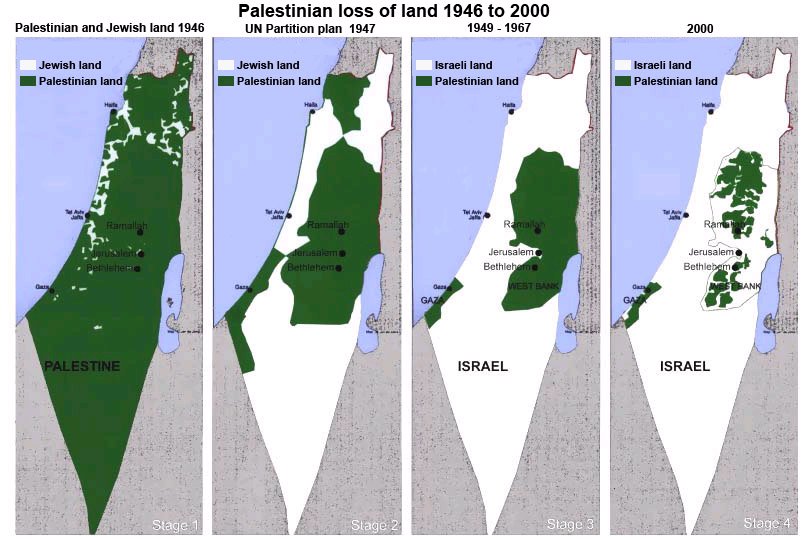
Toen Palestina in 1918 nog deel van het Britse mandaat was de officiele verdeling van inwoners ongeveer 90% Arabieren (Moslims en Christenen) en 10% Joden.
In 1948, 68% Arabieren en 32% Joden, rara waar zijn al die Arabieren toch en hoe zijn die extra Joden erbij gekomen?
De verenigde naties wilden meer dan 60% van het land aan de joden geven en daar waren de Arabieren het raar genoeg niet mee eens. Hebben ze toch gedaan.
En dat zijn landen die kritiek hebben op Israel? Noem die landen eens, gewoon voor de grap.quote:Op zaterdag 23 juni 2012 17:06 schreef DeParo het volgende:
Zolang er Arabische landen een machtige positie innemen binnen bepaalde platformen van internationale organisaties zoals de raad voor mensenrechten (
Dat ziet er heel indrukwekkend uit al dat groen, jammer dat een groot deel van wat je hier aanstipt van wat groen is woestijn betreft waar bijna niemand woonde dit plaatje zegt niets.quote:
[ afbeelding ]
Toen Palestina in 1918 nog deel van het Britse mandaat was de officiele verdeling van inwoners ongeveer 90% Arabieren (Moslims en Christenen) en 10% Joden.
In 1948, 68% Arabieren en 32% Joden, rara waar zijn al die Arabieren toch en hoe zijn die extra Joden erbij gekomen?
De verenigde naties wilden meer dan 60% van het land aan de joden geven en daar waren de Arabieren het raar genoeg niet mee eens. Hebben ze toch gedaan.

Wat maakt het nou uit of het woestijn of zee is? Voor mijn part is het allemaal prachtig groen vruchtbaar land en steken de Arabieren het allemaal in de fik, is hun land, wat hebben Europese Joden daarmee te maken?quote:
[..]
Dat ziet er heel indrukwekkend uit al dat groen, jammer dat een groot deel van wat je hier aanstipt van wat groen is woestijn betreft waar bijna niemand woonde dit plaatje zegt niets.
Saoedie Arabie, Indonesie, Libie en Mauritanie bijvoorbeeld.quote:
[..]
En dat zijn landen die kritiek hebben op Israel? Noem die landen eens, gewoon voor de grap.
Islamitisch dus.
Veel, omdat als er niemand woont je het dan toch ook niet kan aanwijzen als Palestijns land, dat lijkt me duidelijk.quote:Op zaterdag 23 juni 2012 17:11 schreef Peunage het volgende:
[..]
Wat maakt het nou uit of het woestijn of zee is? Voor mijn part is het allemaal prachtig groen vruchtbaar land en steken de Arabieren het allemaal in de fik, is hun land, wat hebben Europese Joden daarmee te maken?
En hoe is de relatie tussen Saoedie-Arabie en Israel? Heb jij ooit ook maar 1 keer kritiek gehoord van de Saudi's?quote:
[..]
Saoedie Arabie, Indonesie, Libie en Mauritanie bijvoorbeeld.
Islamitisch dus.
Ok, dus stukjes van Nederland waar niemand komt mogen de Duitsers best innemen? Of gelden hier weer speciale regels voor Europeanen die niet Arabieren gelden?quote:
[..]
Veel, omdat als er niemand woont je het dan toch ook niet kan aanwijzen als Palestijns land, dat lijkt me duidelijk.
Toen een tijd terug een Amerikaanse vliegmaatschappij en de regering van Soedie-Arabie overeenkwamen dat op de route tussen beide landen geen Joden mochten meevliegen was het wat mij betreft wel duidelijk. En dan heb ik het nog niet eens over de directe bewoordingen jegens Israel.quote:
[..]
En hoe is de relatie tussen Saoedie-Arabie en Israel? Heb jij ooit ook maar 1 keer kritiek gehoord van de Saudi's?
Nederland is een land, op dat moment was er helemaal geen Palestina maar eerst een Ottomaanse provincie of anders wel het Britse mandaat, dus dan dien je het ook als zodanig aan te stippen.quote:
[..]
Ok, dus stukjes van Nederland waar niemand komt mogen de Duitsers best innemen? Of gelden hier weer speciale regels voor Europeanen die niet Arabieren gelden?
Het betreft hoeveel mensen waar wonen, waar bijvoorbeeld 45% Joden woonden en 55% Palestijnen, dat wordt op zo'n kaart al aangestipt als Palestijns. Bovendien trokken veel Joden juist naar de steden terwijl Palestijnen wat meer verspreid over het land woonden ook dat geeft een vertekend beeld op die kaartjes.
quote:
[..]
Toen een tijd terug een Amerikaanse vliegmaatschappij en de regering van Soedie-Arabie overeenkwamen dat op de route tussen beide landen geen Joden mochten meevliegen was het wat mij betreft wel duidelijk. En dan heb ik het nog niet eens over de directe bewoordingen jegens Israel.

Dat heeft helemaal niks met Israel te maken, maar goed. Die bewoordingen? Wat dan? Als je Iran had genoemd, ok, maar Saudi-Arabie? Weetje hoe de Saudi's en Qatarezen(?) worden genoemd? De Joden onder de Arabieren, omdat ze politiek gezien vriendjes met de VS en Israel zijn.
Allemaal leuk en aardig, maar in 1918 waren er 700 000 Arabieren. 70 000 Arabische Christenen. 70 000 Joden. +- natuurlijk. Wat maakt het nou uit of die 700 000 Arabieren verspreid leven of niet? Waar kwamen al die extra Joden vandaan?quote:
[..]
Nederland is een land, op dat moment was er helemaal geen Palestina maar eerst een Ottomaanse provincie of anders wel het Britse mandaat, dus dan dien je het ook als zodanig aan te stippen.
Het betreft hoeveel mensen waar wonen, waar bijvoorbeeld 45% Joden woonden en 55% Palestijnen, dat wordt op zo'n kaart al aangestipt als Palestijns. Bovendien trokken veel Joden juist naar de steden terwijl Palestijnen wat meer verspreid over het land woonden ook dat geeft een vertekend beeld op die kaartjes.
Saudi Arabia does not have diplomatic relations with Israel.quote:
[..]
Dat heeft helemaal niks met Israel te maken, maar goed. Die bewoordingen? Wat dan? Als je Iran had genoemd, ok, maar Saudi-Arabie? Weetje hoe de Saudi's en Qatarezen(?) worden genoemd? De Joden onder de Arabieren, omdat ze politiek gezien vriendjes met de VS en Israel zijn.
http://en.wikipedia.org/w(...)udi_Arabia_relations
Kap maar met je onzin, om ook maar te denken dat er goede banden bestaan, tussen beide landen.

Ah, het is weer tijd voor nietszeggende afbeeldingen.quote:
Hulde!
The problem is not the occupation, but how people deal with it.
Veel Joden woonden er al, andere kwamen uit Europa, en weer andere Joden kwamen daarvandaan waar die Arabieren ook vandaan kwamen en waarvan genoeg ook daar niet zo lang woonden.quote:
[..]
Allemaal leuk en aardig, maar in 1918 waren er 700 000 Arabieren. 70 000 Arabische Christenen. 70 000 Joden. +- natuurlijk. Wat maakt het nou uit of die 700 000 Arabieren verspreid leven of niet? Waar kwamen al die extra Joden vandaan?
HOEveel? Ik heb je net al verteld dat het maar 10% was van het totaal. En de Arabieren kwamen niet net ergens vandaan.quote:
[..]
Veel Joden woonden er al, andere kwamen uit Europa, en weer andere Joden kwamen daarvandaan waar die Arabieren ook vandaan kwamen en waarvan genoeg ook daar niet zo lang woonden.
Ja, want wikipedia.quote:
[..]
Saudi Arabia does not have diplomatic relations with Israel.
http://en.wikipedia.org/w(...)udi_Arabia_relations
Kap maar met je onzin, om ook maar te denken dat er goede banden bestaan, tussen beide landen.

Deze discussie is er inderdaad al een tijdje niet meer geweest.quote:
[..]
Ah, het is weer tijd voor nietszeggende afbeeldingen.
Hulde!
