BNW Brave New World
Samenzwering, verborgen agenda's en geheime geschiedenis. De zoektocht naar de wereld die achter de façade van alledag ligt.



Hoe gaat het met de giftig vulkaan?
Ik in een aantal worden omschreven: Ondernemend | Moedig | Stout | Lief | Positief | Intuïtief | Communicatief | Humor | Creatief | Spontaan | Open | Sociaal | Vrolijk | Organisator | Pro-actief | Meedenkend | Levensgenieter | Spiritueel

Hij vroeg hoe het met de giftige vulkaan ging niet over de kap... Of is dit het zoveelste verzinseltje dat met de grond gelijk wordt gemaakt en waar we nooit meer iets van horen?quote:Op donderdag 5 augustus 2010 19:20 schreef mediacurator het volgende:
[..]
Der zit 'n z.g.n. "kap" op nu!

Er zijn theorien die de rondte doen dat de MG oil spill een soortemnt 9/11 false flag operatie is, alhoewel ik me kan voorstellen dat dit ietwat vergezocht over kan komen bij een niet-complottistquote:Op donderdag 5 augustus 2010 19:55 schreef DutchErrorist het volgende:
[..]
Hij vroeg hoe het met de giftige vulkaan ging niet over de kap... Of is dit het zoveelste verzinseltje dat met de grond gelijk wordt gemaakt en waar we nooit meer iets van horen?
Maar waarom mij nu al je eind conclusie willen opdringen? hou dat maar voor jezelf, dit verhaal is nog lang niet over hoor

NWO klootzakken gaan gewoon alle dystopische SciFi uitvoeren. Of beter gezegd die films zijn meer voorbodes dan dat het fantasie is.quote:'Zeestroom Golf van Mexico gestopt; ernstige gevolgen wereldwijd klimaat'
Volgens de Italiaanse natuurkundige en klimaatwetenschapper Gianluigi Zangari laten satellietgegevens zien dat de zeestroom in de Golf van Mexico als gevolg van de BP-olieramp is gestopt. Zangari zegt dat dit nu al zichtbare gevolgen heeft voor de extreem belangrijke Golfstroom in de Atlantische Oceaan, waar de Golf van Mexico de belangrijkste motor van is, en dat de temperatuur in de Golfstroom inmiddels 10 graden gedaald is. De gevolgen voor het wereldwijde klimaat zouden daarom op korte termijn desastreus kunnen zijn, waardoor we al in 2011 te maken kunnen krijgen met fors verminderde oogstopbrengsten en extreme weerstomstandigheden.
Als de natuur niet snel in staat zal zijn om de zeestroom in de Golf van Mexico uit zichzelf op te starten, dan zijn de gevolgen volgens Zangari, werkzaam als theoretisch natuurkundige en complexe-en-chaotische systeemanalist bij de Frascati National Laboratories in Italië, mogelijk niet te overzien. De zeestroom in de Golf van Mexico zorgt voor konstante toevoer van warm water naar de Golfstroom in de Atlantische Oceaan, wat de belangrijkste oorzaak is van het milde klimaat in Europa. Daarnaast is deze Golfstroom onlosmakelijk verbonden met het wereldwijde netwerk van zeestromen over de hele Aardbol.
Grootste boosdoener van het stoppen van de zeestroom is volgens Zangari het gebruik door BP van het omstreden oplosmiddel Corexit, dat vier keer giftiger is dan olie zélf. De zwaar onder vuur liggende oliemaatschappij gebruikte zeker 7 miljoen liter Corexit om de olielaag op het water van de Golf van Mexico op te lossen. Voor het publiek lijkt het nu alsof de olie aan het verdwijnen is, maar niets is minder waar. Het giftige olie/Corexit mengsel heeft zich in de diepere lagen van de Golf van Mexico verspreid, waardoor de zeestroom uiteindelijk tot stilstand is gekomen.
bron
Everything is backwards, everything is upside down. Doctors destroy health, lawyers destroy justice, psychiatrists destroy minds, scientists destroy truth, media destroys information, religions destroy spirituality and governments destroy freedom.
Yup, de corexit hebben ze bij de bron zelf in de olie gespoten, maandenlang miljarden liters.
Hierdoor zijn de miljarden liters olie en methaan in de diepzee gebleven, waardoor het water een stuk stroperiger is geworden. Dit heeft de golfstroom geblokkeerd.
Dit heeft ook effecten voor Nederland: De golfstroom drijft als het ware de atlantische golfstroom aan door het warme water wat deze erin pompt.
Hierdoor zijn de miljarden liters olie en methaan in de diepzee gebleven, waardoor het water een stuk stroperiger is geworden. Dit heeft de golfstroom geblokkeerd.
Dit heeft ook effecten voor Nederland: De golfstroom drijft als het ware de atlantische golfstroom aan door het warme water wat deze erin pompt.
Veni vidi foetsie

In een ander topic stond een link van de TU Delft. Met daarin beelden dat er 26 Juli gewoon nog een Golfstroom was. (kan het zo snel niet vinden)quote:Op vrijdag 6 augustus 2010 08:13 schreef Lambiekje het volgende:
[..]
NWO klootzakken gaan gewoon alle dystopische SciFi uitvoeren. Of beter gezegd die films zijn meer voorbodes dan dat het fantasie is.
Kortom, ik geloof er niet zo in dat de Golfstroom gestopt is door de olie.
Als het wel zo is dan gaan we het heeeeel koud krijgen in Europa

Klopt dat was in dit lopende topic in DEquote:Op vrijdag 6 augustus 2010 10:07 schreef Revolution-NL het volgende:
[..]
In een ander topic stond een link van de TU Delft. Met daarin beelden dat er 26 Juli gewoon nog een Golfstroom was. (kan het zo snel niet vinden)
Kortom, ik geloof er niet zo in dat de Golfstroom gestopt is door de olie.
Als het wel zo is dan gaan we het heeeeel koud krijgen in Europa
Kleine geheimen dienen beschermd te worden.
Grote geheimen worden beschermd door publiek ongeloof.
Grote geheimen worden beschermd door publiek ongeloof.
Thnx!
De golfstroom van 29 juli 2010
De golfstroom van 8 juli 2010
http://rads.tudelft.nl/gulfstream/
Kortom niks aan het handje
De golfstroom van 29 juli 2010

De golfstroom van 8 juli 2010

http://rads.tudelft.nl/gulfstream/
Kortom niks aan het handje

Waarom reageer je nu niet op de post van Revolution-NL? Die golfstroom is er nog wel.quote:Op vrijdag 6 augustus 2010 08:13 schreef Lambiekje het volgende:
[..]
NWO klootzakken gaan gewoon alle dystopische SciFi uitvoeren. Of beter gezegd die films zijn meer voorbodes dan dat het fantasie is.
Benjamin Fulford zegt het ook al jaren, de wereld wordt bestuurd door een harde kern mega rijken die niet het beste met de mensheid in het algemeen voor hebben.quote:Op vrijdag 6 augustus 2010 08:13 schreef Lambiekje het volgende:
[..]
NWO klootzakken gaan gewoon alle dystopische SciFi uitvoeren. Of beter gezegd die films zijn meer voorbodes dan dat het fantasie is.
Die harde kern zorgt er tenminste voor dat het nog geen al te grote puinhoop op deze aardbol is.quote:Op maandag 9 augustus 2010 13:25 schreef mediacurator het volgende:
[..]
Benjamin Fulford zegt het ook al jaren, de wereld wordt bestuurd door een harde kern mega rijken die niet het beste met de mensheid in het algemeen voor hebben.
Stel je voor zeg, dat zij hun macht verliezen, dan gaan de "gewone"mensen elkaar als beesten afmaken.
Nee, laat de Illuminati maar op de boel passen; er is nog geen goed alternatief.

Corrupte bronnen natuurlijkquote:
[..]
Waarom reageer je nu niet op de post van Revolution-NL? Die golfstroom is er nog wel.

quote:Breaking news: Matt Simmons, famous for his controversial criticisms of BP and the true undisclosed nature of the oil disaster in the Gulf, is dead.
From WLBZ:
The Knox County Sheriff's Department says Matthew Simmons, the founder of the Ocean Energy Institute, drowned at his house on North Haven late Sunday night.
Simmons was a leading investment banker for the energy industry and had recently retired to work full time on the new Ocean Energy Institute.
He was a leading proponent of offshore wind power and had started raising money to develop and build offshore turbines.
Dubieus.......quote:Biography from oceanenergy.org
Matthew R. Simmons -Founder, Ocean Energy Institute & OEI Board Member
Matthew Simmons is the founder and Chairman of the Board of the Ocean Energy Institute. He was past Chairman of the National Ocean Industries Association, and served as energy adviser to President George W. Bush, among others. Simmons is author of the book Twilight in the Desert: The Coming Saudi Oil Shock and the World Economy, which examines oil reserve decline rates to help raise awareness of the unreliability of Middle East oil reserves.
Background
The Ocean Energy Institute, founded in 2007 by Matthew R. Simmons, is a think-tank and venture capital fund addressing the challenges of U.S. offshore renewable energy. OEI approaches energy R&D and investment from a systems point of view; not just generation, but usage, storage and transmission all together as an interdependent set of opportunities and the next driving force of the international economy.
Mission
OEI is working to coordinate the diverse factors that will help make ocean energy a reality: energy system architecture, offshore wind technology, environmental interests, stakeholder concerns, industrial partners, academic research, financial firepower and political factors.
Biography from simmonsco-intl.com
Matthew R. Simmons graduated cum laude from the University of Utah and received a Masters degree with distinction in Business Administration from Harvard Business School. He then served on the faculty as a research associate for two years. In 1974, he founded Simmons & Company International. Simmons serves on the Board of Deans Advisors of Harvard Business School and is past President of the Harvard Business School Alumni Association. He also serves on the Board of Directors of Houston Technology Center and the Center for Houston’s Future. Simmons serves on The University of Texas’ M.D. Anderson Cancer Center Foundation Board of Visitors (Houston) and is a Trustee of the Bermuda Institute for Ocean Sciences. He is a member of the National Petroleum Council, Council on Foreign Relations and The Atlantic Council of the United States. In addition, he is past Chairman of the National Ocean Industry Association. Mr. Simmons is a Trustee of the National Trust for Historic Preservation and the Farnsworth Art Museum in Maine.
[ Bericht 63% gewijzigd door Revolution-NL op 09-08-2010 19:37:52 ]
Nog een theorie van Simmons. Ik denk dat de dood van simmons voor een aantal mensen zeer goed uitkomt. Dit zaakje stinkt.
quote:New reports on the BP oil spill disaster have confirmed that there is a leak on the sea floor several miles from the Macondo well’s blowout preventer, which was capped for well integrity pressure tests last Thursday. Some industry experts say this sub-sea breach has been leaking since the disaster began on April 20, 2010, and has been thus far ignored by a media blackout.
The undisclosed specific location of the sea floor leak is reported to be billowing oil and deadly methane gas.
In the early stages of the 90 day-old disaster, oil industry expert Matt Simmons told NBC News that a major area of seepage was coming from an area about 7 miles from the well. Simmons called it the “elephant behind the mouse.”
Simmons may have been referring to the third leak, confirmed by BP on May 5, 2010. That leak has been virtually ignored in what many have been calling an oil spill media blackout, intended to hide the true extent of the damage and potential catastrophic threats from the disaster.
If the sea floor leak announced today is confirmed to be in same location as the one Simmons and Senator Bill Nelson have reported, and BP previously acknowledged, then BP and the government have been aware of it all along and only now decided to address its existence publicly.
Until the exact location of the leak is revealed, it is unclear whether this is the same third leak, or a new one. Either way, the third leak was never declared sealed by BP or the government.
Controverse rondom de dood van de gerenommeerde Olie Industrie expert Matt Simmons en uitgesproken criticaster BP zou zijn overleden aan hartaanval volgens de reguliere pers terwijl volgens het lijkschouwing rapport dood door verdrinking als doodsoorzaak is vastgesteld.
BP Gulf Oil Spill Critic Matt Simmons Dead - Drowned
BP Gulf Oil Spill Critic Matt Simmons Dead - Drowned

quote:Below summarized from a WLBZ report
(http://www.wlbz2.com/news/local/story.aspx?storyid=123586&catid=3) The world is mourning the loss of the man who was a voice of truth in the BP Gulf Oil Spill Catastrophy. Matthew Simmons, a longtime summer resident of Rockport, Maine, died Sunday night at a summer house on North Haven island. He was 67 years old.
According to the Medical Examiner's office, Simmons drowned. A statement earlier in the day from the Ocean Energy institute in Rockland, which Simmons created, said Simmons suffered a heart attack while using his hot tub. The Medical Examiner's office says Simmons was suffering from heart disease, which may have been a contributing factor in the drowning.
In Louisiana is er weer spontaan een olie bron gesprongen 
quote:iReport — Oil well in the middle of a sugarcane field blew out last night. Oil and natural gas are shooting into the air. Oil is coming down like rain a mile away. This is in Assumption Parish Louisiana.
http://ireport.cnn.com/docs/DOC-481102?hpt=T2
Is deze op land? Kan nl. geen plaats o.i.d vinden.quote:Op donderdag 12 augustus 2010 22:10 schreef Revolution-NL het volgende:
In Louisiana is er weer spontaan een olie bron gesprongen
[..]
quote:Op dinsdag 10 augustus 2010 12:17 schreef mediacurator het volgende:
Controverse rondom de dood van de gerenommeerde Olie Industrie expert Matt Simmons en uitgesproken criticaster BP zou zijn overleden aan hartaanval volgens de reguliere pers terwijl volgens het lijkschouwing rapport dood door verdrinking als doodsoorzaak is vastgesteld.
BP Gulf Oil Spill Critic Matt Simmons Dead - Drowned
[..]

Contractor working on oil spill response struck and killed by vehicle
Published: Wednesday, August 11, 2010, 1:32 PM Updated: Wednesday, August 11, 2010, 1:46 PM
Kimberly Quillen, The Times-Picayune
Follow Share this story
Story tools
A contractor working on the oil spill response effort was killed in Plaquemines Parish this morning when he was hit by a vehicle while walking along a roadway, National Incident Commander Thad Allen said in a press briefing Wednesday afternoon.
The name of the individual is being withheld pending notification of family members. The incident occurred at 2 a.m. Wednesday morning, Allen said.
http://www.nola.com/news/(...)ing_on_oil_spil.html
BP Gulf Oil Spill Static Kill Has Failed And Created Mess That Will Make Well Harder To Seal
Drilling Experts Says BP Well Is Not Dead, Static Kill has Failed, and BP Needs To Answer Questions About Clouds Coming From Sea Floor.
Oil Industry Expert Bob Cavnar has posted a series of blog posts over the last few days that have escalated in charges that BP and the Federal Government BP and the Federal Government are deliberately providing the public with misinformation to cover up the fact that the static kill has backfired and made the BP Gulf Oil Spill well much harder to kill.
In a few of those posts Bob Cavnar says BP needs to explain the huge clouds coming from the sea floor that I have pointed out here, here, here, here, and here.
In his post BP: “Well is Static” US: “Oil is Gone” Nothing to See Here. Move Along he writes the following.
At 1 am today, we got the “everything is fine” press release from BP proclaiming that the well, after the “textbook” static kill, is static. They studiously avoided the words “dead” or “killed”. Per usual, they also provided no further information. I was watching the feeds of the worsening leak coming from the lower flex joint flange at the moment I got the press release. Odd. If the well is static, then why is the wellhead leaking? Also, the leaking fluid is rising, indicating hydrocarbons, and continues even at this moment. This whole operation has given me the willies.
…
BP has violated this principle in spades by doing what they are doing. Now that they’ve proclaimed the well is “static”, they’ve also gone radio silent with no press conferences or technical McBriefings scheduled for today. Admiral Allen is doing a victory lap at this moment during the White House briefing, also not giving any data, besides just saying that it’s static with seawater. Again, if that was true, why is the wellhead leaking? To be clear, dead means dead. If it’s leaking oil, that means it’s not dead.
…
I’m sitting here watching oil leaking from a well that is supposedly dead. I’m listening to Admiral Allen saying the well is dead and to Jane Lubchenco and Carol Browner seriously contending that almost 4 million barrels of oil have disappeared. Is it just me, or are we watching the Matrix in real life?
That post was followed up by Questions BP Needs to Answer in which he again alludes to the fact the BP and Government are not being transparent about the the success of the static kill and pointing out once again that oil is still leaking from the well and that there are the huge clouds coming from the sea floor.
Since announcing success (sort of) of the static kill, MSM attention has dropped to virtually zero, though the well is obviously far from static, judging from the huge clouds in the water around the wellhead and manifold, as well as numerous ROVs surrounding the wellhead, providing no feeds to the public. The media has payed virtually no attention to these feeds and has asked no questions of Adm Allen or BP. BP has stopped briefing the public daily.
The problem is that there are lots of questions that remain unanswered. Here’s what I want to know:
•Is the well dead?
•What is the pressure on the well? Now?
•If the well is open to the surface, what is that pressure?
•…
•How do you know all the cement went down the casing?
•…
•Why is the flex joint flange leaking?
•Why are the ROV feeds no longer provided in a decipherable resolution?
•Why are some ROV feeds not being provided?
•…
•Why are clouds of debris continuing to obscure the view several days after the well was supposedly “static”?
Until these questions are answered by BP, we have no real information to tell us that the well is dead, or even safe. As long as they continue to stonewall critical data, I’ll only continue to believe that the well is not “static” or safe.
Not only are the ROV feeds high pixelated to the point the screens can not be read BP has still not shown the BOP where a methane leak was discovered just inches from the well head
and BP is playing with the lighting to hide huge clouds shooting out of the sea floor and has even been caught applying filters in real time on the feeds to remove hydrates shooting out of the sea bed from the video feeds.
A comment on that post by fishgrease, an oil industry expert from over at the dailykos, responding to an attack on Cavnar’s post also agrees to the fact that the well is not dead.
They froze their chokes off this morning. The ones atop the Capping Stack. If you think that means this is a dead well,
1.You don’t know anything about oil, and/or gas wells.
2.You’re an idiot.
3.Both
Cavnar also posted the following response to the same person.
Mike,
A couple of questions for you:
1.If the “well is as dead as dead can be”, why does it have 4,200 psi on it, 2,000 psi more than seawater hydrostatic, and 600 psi more than 14 ppg mud hydrostatatic from the riser?
2.If the well is dead, why are they now “pressure testing” said dead well?
3.Both
That conversation was followed up with a new post from Bob Cavnar pointing out the fact that BP is conducting pressure tests indicates that the well is not dead and that BP and the Federal Government are deceiving the public about the real reasons the tests are being performed.
Adm Allen just finished his morning presser where he just casually mentioned that they are going to “test” the old BOP and capping stack and take pressure readings to determine if the hydrocarbons in the annulus are “dormant” or if they’re connected to the reservoir. Translation: “BP continues to have pressure on the wellhead from down below and have been letting me believe for a week that the well is static.” Of course, they’ve never disclosed not one bit of pressure data after the “well integrity test”, and even that “data” was sparse.
Yesterday, during his presser, the Admiral was asked about releasing the pressure readings and un-blurring the ROV feeds. The Admiral said he would check into the feeds and get BP to disclose the pressures. Of course, neither happened, and now he drops the bomb that they’re back to the ol’ BOP test again. That means they have no idea where the static kill and cement went.
Today Cavnar’s series of posts culminated to the conclusion that the Feds are deliberately putting out misinformation to hide the fact that the well is communicating with the reservoir, static kill has backfired miserably and the failure of static kill leaves BP and the Federal Government with no idea what to do next.
For the last several days, I’ve been trying to figure out what BP is doing and what is the actual condition of BP’s MC252 well after their “static kill” and cementing procedure last week apparently didn’t work.
…
On August 2nd and 3rd, BP ran the “static kill” pumping 2,300 barrels of mud. Early in the morning on the 4th, BP issued a press release saying the the well had reached a “static condition” with well pressure “controlled by the hydrostatic pressure of the drilling mud.” In his McBriefing later that day, Wells actually said that when they pumped the mud, they could actually see it go into the reservoir by pressures, and that they pumped up to 15 barrels per minute.
…
All was right with the world. Except, it wasn’t. Day before yesterday, Adm. Allen announced they were going to start a “pressure test”, babbling about the annulus and raising the ominous spectre that they are still actually communicated to the reservoir. Wells confirmed that fear in the afternoon, admitting that they indeed had 4,200 psi on the well when it’s supposed to be dead.
…
What’s going on here is that the “static kill” looks like it did the opposite of what BP and Allen had suggested at the beginning.
…
The mis-information and confusion is also taking its toll.
…
In actuality, this “static kill” did nothing that BP and Allen said it would do. Certainly the well is not dead or “static”.
BP and the government don’t really have a clue where the 2,300 barrels of mud and 500 barrels of cement went. They originally claimed it all went down the casing and out to the reservoir. I would set the probability of that actually having happened at zero… There is no way, unless that entire float assembly blew off, that they pumped down the casing and up the backside. On top of all that, there are HUGE lost circulation zones both below and above the reservoir.
…
So, where did all the mud and cement go? It likely went down the backside of the production casing and either out through some damage that was caused during the aborted top kill, or out the lost circulation zone right below the 9 7/8″ liner at 17,100. The fact that they’re getting pressure now tells me that they are indeed communicated to the reservoir below, probably obscured by the fact that they now have mud strung through the annulus. If they are indeed communicated, pressure will build on the wellhead, which is exactly what’s happening. Adm. Allen pledged to get BP to release the pressure data 3 days ago. The next day, when asked about it, he said it was released, but “nobody can find it.” The data is still AWOL.
As Washington’s blog points out:
BP has tried to cover up every aspect of the spill. See this, this and this.
The bottom kill – the procedure which all oil industry experts agree has the best chance of killing the leak – hasn’t yet been performed. The underwater cameras still show methane and oil leaking into the Gulf.
And yet the country’s attention is already drifting away from the Gulf and to celebrities, stocks, and other issues.
I’m beginning to wonder whether BP keeps on doing one confusing procedure after another, and keeps on saying that the well has been capped, hoping that everyone stops paying attention so that BP can just pack up its bags and slink away while people aren’t paying attention.
Relief wells are the best hope for permanently capping the well. But it is possible that BP has messed up the well so badly that the relief wells will fail.
As Cavnar notes, BP has already taken down or blurred most of its underwater camera feeds. BP might just declare “mission accomplished” and skip the relief wells, leaving a ticking time bomb which will pollute the Gulf for years to come.
Fishgrease, another oil industry expert that I mentioned earlier weighs in on the issue of the open communication that has caused a the choke line to freeze up and led to a new leak in the well.
I awoke early this morning to find they’ve got a hell of a pressure drop across those chokes on the capping stack…. those new ones they installed because the brand fucking new automated valves below them all failed and now require manual locks.
An ROV using a methanol hot-stab to try to thaw a choke out. Get this. It was poking the hot-stab INTO the end of the choke pipe! That’s right! They’re idiots! For that choke to freeze up like that (there were patches of external ice indicating it got pretty damned cold) there had to be a significant pressure drop across it. Pouring methanol into the low pressure end of that choke pipe is just… it’s fucking funny!
So now they got themselves a good old problem. We can’t see it, of course, and we’ll never get any pressure readings that will tell us exactly what sort of pressure drop caused those chokes to freeze. But let me tell you something that is true as death… it’s a LOT more hydrocarbon pressure then can be explained by anything residual in the BOP. The annulus is open to the reservoir and always has been.
Fishgrease’s comment was about the leak shown in this video.
The observation by fishgrease led to the following discussion from The Oil Drum community on the live chat about the issue.
[22:53] I should show a little respect. I mean, life isn’t just “one big cruise,” is it, TOB_ ?
[22:53] that was after they had to apply a fix to the valve underneath it, which had been probably damaged by clathrates
[22:53] I have 35-40 pics of bubbles coming from that choke pipe…
[22:53] okay.
[22:54] heh heh heh cigarette break
[22:54] when did they fix the valve? was that part of what i was staring at (mindlessly) last night?
[22:54] aviva: yeah, oi2 was holding onto a thing they stuck in the valve while oi1 had to adjust gauges and things
[22:55] What was the annulus question?
[22:55] anyway, after all that, apparently, according to dkos fishgrease, who got up to pee at 2 in the morning and glanced at the feeds
[22:55] yes….
[22:56] dkos, *eyes glaze over*
[22:56] one of the rovs was sticking a hot stab into that little chimney up there
[22:57] okay… you mean the curved one? the choke pipe?
[22:57] and releasing that stuff (i’m braindead) that melts ice into it
[22:57] aviva: yes
[22:57] methanol.
[22:57] TOB_ : I’d commented to CBLuc: “I’m not sure there’s been a lot of concern about cement in the annulus (from Halliburton/April), but more with the cement shoe.” (in reply to his concerns) and you wrote back: “That is the question, aviva.” Or something similar.
[22:58] TOB_: yes, thank you
[22:58] Okay, so they injected methanol in the choke pipe, which is outgassing methane (probably; it’s totally translucent emissions)
[22:58] and…
[22:59] what’s fishgrease thinking? or wondering?
[22:59] == SJFriedl [~Steve@ylnat.unixwiz.net] has quit [Quit: Leaving]
[22:59] Right, that is the big question.
[22:59] the question is why would the choke be releasing something that would indicated it’s icing up with clathrates on the inside?
[23:00] I think it’s the big question that they’ve shared with us, TOB_ . There may be others…
[23:00] Lot’s of other big questions remaining.
[23:01] fishgrease is proposing (and even tho he can get a little overpassionate, he knows this stuff) that the upper stack is under negative pressure
[23:01] There may be residual (trapped) hydrocarbons in the BOP and capping stack… hydrocarbons that are unlikely to be flowing up from the reservoir, but are still under some pressure and emerging from the capping stack…
[23:02] What does fishgrease say is causing the negative pressure in the upper stack?
[23:02] negative pressure?
[23:03] Does he think that the ambient pressure around the capping stack is squeezing it?
[23:03] negative pressure would cause those leaks that we’ve watched leak oil outward leak water inward instead
[23:03] Are asking why there would be hydrates in the choke line?
[23:03] TOB_: yes
[23:03] aviva: yes
[23:03] Oh. I see. And fishgrease is concerned that seawater oozing into the choke line is causing hydrates to grow…
[23:04] The pipe is full of water, when the little methane bubbles interact they form the hydrates.
[23:04] aviva: and wondering if they started the negative pressure test (which they said they would start after the storm) yesterday
[23:05] I can’t believe they’d start the negative pressure test — and then proclaim, in three briefings (2 for Allen, 1 for Wells) that they’re waiting until the storm’s over.
[23:05] It’s open to the seawater.
[23:07] Just a trickle of bubbles.
[23:07] or if they’re not already doing the negative pressure test, what else could cause the stack to go from being kept at positive pressure to being at negative pressure?
[23:08] TOB_: but the point has been to not let the stack go negative until they could do it under control, because it’s a pretty dangerous test to do
[23:10] == PhilMB [47f2a88d@gateway/web/freenode/ip.71.242.168.141] has joined #theoildrum
[23:10] I believe they are referring to pump pressure. Easing it off. Negative in relation to the reservoir pressure.
[23:11] the reason to do a negative pressure test is to see if, when they decrease the pressure, the force from the bottom will push back
[23:11] == oilyriser [18c1d9ec@gateway/web/freenode/ip.24.193.217.236] has quit [Ping timeout: 252 seconds]
[23:11] telling them whether or not they have successfully cemented it
[23:12] <== digging back thru the diary to his comments
[23:15] takes forever to find this stuff
[23:16] especially when i keep forgetting what day it is
[23:19] == WireWulf has changed nick to Wulf-is-not-here
[23:20] i can’t find it. i’ll bring it back tomorrow, for sure
[23:22] mostly, at this point, i was just wondering if anybody saw it
[23:22] Heard, didn’t see.
[23:25] OK here’s the link from this morning Fishgrease: I awoke early this morning to find they’ve got a
[23:25] hell of a pressure drop across those chokes on the capping stack…. those new ones they installed : http://www.dailykos.com/comments/2010/8/11/145651/819/8#c8
[23:27] it was five o clock, not two
[23:29] and i still don’t quite get what he’s saying
[23:32] oh, well, the more i try to understand this thing, the less i find i understand it
[23:33] nice waves and lights tho
[23:33] and down goes the hoss rov
[23:35] past my bedtime, adios por la noche! hasta manana!
[23:35] Didn’t take them long to re-launch.
[23:35] Nite.
[23:35] == TOB_ has changed nick to TOB_zzz
[23:35] he’s saying that there is a large pressure variation at the new choke valves, more than there should be if it was just pressure from residual oil in the top of the well after cementing
[23:35] Hasta mañana, evergreen.
[23:36] ahhhh yuriwho !
[23:36] yuriwho: i’m almost too brain dead to go further with this, but i would like to understand it and i don’t
[23:37] == derekivey [~Derek@c-98-235-202-26.hsd1.pa.comcast.net] has joined #theoildrum
[23:38] yuriwho: if things were the way they were supposed to be, after the positive pressure test, there would still be some positive pressure in the top of the stack, right?
[23:38] I don’t totally follow fishgrease’s entire reasoning here… but I won’t be surprised to discover that the annulus is open to the reservoir. I don’t expect it, exactly. But it’s still a possibility, as Allen stated in his briefing. Not probable, but possible.
[23:38] == overdub [~nomad@bas1-toronto05-1176310987.dsl.bell.ca] has quit [Ping timeout: 245 seconds]
[23:39] if the valve is frozen, thats because some gas is leaking through it causing the refrigeration effect (joule-thompson effect) which means that there is a increasing load of pressure building up inside the stack due to communication from the formation to the top
[23:39] Yep, possible. But they pumped a lot of cement in there.
[23:39] yuriwho: so it’s still positive pressure pushing from the inside to the outside?
[23:40] um… communication from the formation to the top? if it’s that obvious, why are allen and wells speaking of it as a highly remote possibility that must be checked, but isn’t likely?
[23:40] == Derek_ [~Derek@c-98-235-202-26.hsd1.pa.comcast.net] has quit [Ping timeout: 265 seconds]
[23:40] whether it is through the cememnt or from the annulus is a different question. It could be that the main casing string is plugged and it is slowly leaking up the annulus
[23:40] yes evergreen, that is what he is thinking
[23:41] yuriwho: i think what mixed me up was i was thinking it was negative pressure on the inside causing water to leak into the stack
[23:42] nope, has to be pressure leaking out. It would not get cold and freeze unless that pressure was building
[23:42] now i get it!!!
[23:42] If it was a leak, it was more like a trickle.
[23:42] it would only be a trickle prehaps up the choke
[23:42] == overdub [~nomad@bas1-toronto05-1176310987.dsl.bell.ca] has joined #theoildrum
[23:43] yuriwho, reading between the lines of allen’s briefing on august 10, do you think he believes that there’s a reasonable chance of communication from formation to capping stack? and up the annulus, most probably? Is he totally minimizing things?
[23:43] btw, his other comment about meeting the guys for coffee……thats his group of industry consultants who work for the service providers i the gulf
[23:44] personally I think there is a slow leak up the annulus, the pressure is only starting to build up now
[23:44] it’s when he said “pressure drop across it” that threw me, i translated that incorrectly inside my head
[23:46] imagine that the choke valve leaks gas slowly, if pressure is building on one side you get gas leaking and refridgeration occurs
[23:46] and he was actually more unnerved by their trying to stop it using methane than the fact that it’s there
[23:47] yuriwho: which is just a similar thing to what’s been happening all along, just a different version
[23:47] == rob___ [6de08ef6@gateway/web/freenode/ip.109.224.142.246] has joined #theoildrum
[23:48] slow leak up the annulus relates to what folks were talking about here about two hours ago
[23:48] that means there must be a place where the annulus under the wellhead is communicating with what’s above it
[23:49] could be where they never installed that locking ring
[23:49] yuriwho: right
[23:49] if it’s a slow leak it will be hard and slow to kill
[23:49] without opening up the well
[23:50] i had just gotten to that part of how they drill the well in that big document. i never understood how the well head was put together
[23:50] yea that pdf is excellent at explaing the fundamentals of well construction
[23:50] == overdub [~nomad@bas1-toronto05-1176310987.dsl.bell.ca] has quit [Ping timeout: 245 seconds]
[23:51] yuriwho: you showed up here just in time
[23:51] Speaking of the stack…where is it?
[23:51] heh, I just woke up……fell asleep after my sons soccer game tonight <–coach and ref…..got tired
[23:52] yuriwho: so if there’s a slow leak up the annulus it could help the relief well effort kinda sorta by providing a flow pressure upward
[23:52] perhaps too slow to get cement to move. Depends on how open it is
[23:53] but the problem is dealing with the wellhead could be quite problematic
[23:53] == overdub [~nomad@bas1-toronto05-1176310987.dsl.bell.ca] has joined #theoildrum
[23:54] they might have to pull both BOP’s and cement up past the leak point to the annulus.
[23:54] == bedrock [bedrock@c-66-229-142-240.hsd1.fl.comcast.net] has quit [Read error: Connection reset by peer]
[23:55] although I am just playing devil advocate here
[23:55] yuriwho: thank you so much. i was about to go to bed totally confused.
[23:55] not sure what their opions might be to deal with a slow leak from the annulus to above the cement
[23:56] well now i can go to bed trying to figure that one out. but at least i’ve got the pressure thing corrected.
[23:57] cheers! a margarita from me in burque to you!
[23:57] hasta manana y”all!
[23:58] youriwho, I have seen ice build up on the relief valve on a compresser when emptying it
http://blog.alexanderhigg(...)ed-mess-harder-seal/
Drilling Experts Says BP Well Is Not Dead, Static Kill has Failed, and BP Needs To Answer Questions About Clouds Coming From Sea Floor.
Oil Industry Expert Bob Cavnar has posted a series of blog posts over the last few days that have escalated in charges that BP and the Federal Government BP and the Federal Government are deliberately providing the public with misinformation to cover up the fact that the static kill has backfired and made the BP Gulf Oil Spill well much harder to kill.
In a few of those posts Bob Cavnar says BP needs to explain the huge clouds coming from the sea floor that I have pointed out here, here, here, here, and here.
In his post BP: “Well is Static” US: “Oil is Gone” Nothing to See Here. Move Along he writes the following.
At 1 am today, we got the “everything is fine” press release from BP proclaiming that the well, after the “textbook” static kill, is static. They studiously avoided the words “dead” or “killed”. Per usual, they also provided no further information. I was watching the feeds of the worsening leak coming from the lower flex joint flange at the moment I got the press release. Odd. If the well is static, then why is the wellhead leaking? Also, the leaking fluid is rising, indicating hydrocarbons, and continues even at this moment. This whole operation has given me the willies.
…
BP has violated this principle in spades by doing what they are doing. Now that they’ve proclaimed the well is “static”, they’ve also gone radio silent with no press conferences or technical McBriefings scheduled for today. Admiral Allen is doing a victory lap at this moment during the White House briefing, also not giving any data, besides just saying that it’s static with seawater. Again, if that was true, why is the wellhead leaking? To be clear, dead means dead. If it’s leaking oil, that means it’s not dead.
…
I’m sitting here watching oil leaking from a well that is supposedly dead. I’m listening to Admiral Allen saying the well is dead and to Jane Lubchenco and Carol Browner seriously contending that almost 4 million barrels of oil have disappeared. Is it just me, or are we watching the Matrix in real life?
That post was followed up by Questions BP Needs to Answer in which he again alludes to the fact the BP and Government are not being transparent about the the success of the static kill and pointing out once again that oil is still leaking from the well and that there are the huge clouds coming from the sea floor.
Since announcing success (sort of) of the static kill, MSM attention has dropped to virtually zero, though the well is obviously far from static, judging from the huge clouds in the water around the wellhead and manifold, as well as numerous ROVs surrounding the wellhead, providing no feeds to the public. The media has payed virtually no attention to these feeds and has asked no questions of Adm Allen or BP. BP has stopped briefing the public daily.
The problem is that there are lots of questions that remain unanswered. Here’s what I want to know:
•Is the well dead?
•What is the pressure on the well? Now?
•If the well is open to the surface, what is that pressure?
•…
•How do you know all the cement went down the casing?
•…
•Why is the flex joint flange leaking?
•Why are the ROV feeds no longer provided in a decipherable resolution?
•Why are some ROV feeds not being provided?
•…
•Why are clouds of debris continuing to obscure the view several days after the well was supposedly “static”?
Until these questions are answered by BP, we have no real information to tell us that the well is dead, or even safe. As long as they continue to stonewall critical data, I’ll only continue to believe that the well is not “static” or safe.
Not only are the ROV feeds high pixelated to the point the screens can not be read BP has still not shown the BOP where a methane leak was discovered just inches from the well head
and BP is playing with the lighting to hide huge clouds shooting out of the sea floor and has even been caught applying filters in real time on the feeds to remove hydrates shooting out of the sea bed from the video feeds.
A comment on that post by fishgrease, an oil industry expert from over at the dailykos, responding to an attack on Cavnar’s post also agrees to the fact that the well is not dead.
They froze their chokes off this morning. The ones atop the Capping Stack. If you think that means this is a dead well,
1.You don’t know anything about oil, and/or gas wells.
2.You’re an idiot.
3.Both
Cavnar also posted the following response to the same person.
Mike,
A couple of questions for you:
1.If the “well is as dead as dead can be”, why does it have 4,200 psi on it, 2,000 psi more than seawater hydrostatic, and 600 psi more than 14 ppg mud hydrostatatic from the riser?
2.If the well is dead, why are they now “pressure testing” said dead well?
3.Both
That conversation was followed up with a new post from Bob Cavnar pointing out the fact that BP is conducting pressure tests indicates that the well is not dead and that BP and the Federal Government are deceiving the public about the real reasons the tests are being performed.
Adm Allen just finished his morning presser where he just casually mentioned that they are going to “test” the old BOP and capping stack and take pressure readings to determine if the hydrocarbons in the annulus are “dormant” or if they’re connected to the reservoir. Translation: “BP continues to have pressure on the wellhead from down below and have been letting me believe for a week that the well is static.” Of course, they’ve never disclosed not one bit of pressure data after the “well integrity test”, and even that “data” was sparse.
Yesterday, during his presser, the Admiral was asked about releasing the pressure readings and un-blurring the ROV feeds. The Admiral said he would check into the feeds and get BP to disclose the pressures. Of course, neither happened, and now he drops the bomb that they’re back to the ol’ BOP test again. That means they have no idea where the static kill and cement went.
Today Cavnar’s series of posts culminated to the conclusion that the Feds are deliberately putting out misinformation to hide the fact that the well is communicating with the reservoir, static kill has backfired miserably and the failure of static kill leaves BP and the Federal Government with no idea what to do next.
For the last several days, I’ve been trying to figure out what BP is doing and what is the actual condition of BP’s MC252 well after their “static kill” and cementing procedure last week apparently didn’t work.
…
On August 2nd and 3rd, BP ran the “static kill” pumping 2,300 barrels of mud. Early in the morning on the 4th, BP issued a press release saying the the well had reached a “static condition” with well pressure “controlled by the hydrostatic pressure of the drilling mud.” In his McBriefing later that day, Wells actually said that when they pumped the mud, they could actually see it go into the reservoir by pressures, and that they pumped up to 15 barrels per minute.
…
All was right with the world. Except, it wasn’t. Day before yesterday, Adm. Allen announced they were going to start a “pressure test”, babbling about the annulus and raising the ominous spectre that they are still actually communicated to the reservoir. Wells confirmed that fear in the afternoon, admitting that they indeed had 4,200 psi on the well when it’s supposed to be dead.
…
What’s going on here is that the “static kill” looks like it did the opposite of what BP and Allen had suggested at the beginning.
…
The mis-information and confusion is also taking its toll.
…
In actuality, this “static kill” did nothing that BP and Allen said it would do. Certainly the well is not dead or “static”.
BP and the government don’t really have a clue where the 2,300 barrels of mud and 500 barrels of cement went. They originally claimed it all went down the casing and out to the reservoir. I would set the probability of that actually having happened at zero… There is no way, unless that entire float assembly blew off, that they pumped down the casing and up the backside. On top of all that, there are HUGE lost circulation zones both below and above the reservoir.
…
So, where did all the mud and cement go? It likely went down the backside of the production casing and either out through some damage that was caused during the aborted top kill, or out the lost circulation zone right below the 9 7/8″ liner at 17,100. The fact that they’re getting pressure now tells me that they are indeed communicated to the reservoir below, probably obscured by the fact that they now have mud strung through the annulus. If they are indeed communicated, pressure will build on the wellhead, which is exactly what’s happening. Adm. Allen pledged to get BP to release the pressure data 3 days ago. The next day, when asked about it, he said it was released, but “nobody can find it.” The data is still AWOL.
As Washington’s blog points out:
BP has tried to cover up every aspect of the spill. See this, this and this.
The bottom kill – the procedure which all oil industry experts agree has the best chance of killing the leak – hasn’t yet been performed. The underwater cameras still show methane and oil leaking into the Gulf.
And yet the country’s attention is already drifting away from the Gulf and to celebrities, stocks, and other issues.
I’m beginning to wonder whether BP keeps on doing one confusing procedure after another, and keeps on saying that the well has been capped, hoping that everyone stops paying attention so that BP can just pack up its bags and slink away while people aren’t paying attention.
Relief wells are the best hope for permanently capping the well. But it is possible that BP has messed up the well so badly that the relief wells will fail.
As Cavnar notes, BP has already taken down or blurred most of its underwater camera feeds. BP might just declare “mission accomplished” and skip the relief wells, leaving a ticking time bomb which will pollute the Gulf for years to come.
Fishgrease, another oil industry expert that I mentioned earlier weighs in on the issue of the open communication that has caused a the choke line to freeze up and led to a new leak in the well.
I awoke early this morning to find they’ve got a hell of a pressure drop across those chokes on the capping stack…. those new ones they installed because the brand fucking new automated valves below them all failed and now require manual locks.
An ROV using a methanol hot-stab to try to thaw a choke out. Get this. It was poking the hot-stab INTO the end of the choke pipe! That’s right! They’re idiots! For that choke to freeze up like that (there were patches of external ice indicating it got pretty damned cold) there had to be a significant pressure drop across it. Pouring methanol into the low pressure end of that choke pipe is just… it’s fucking funny!
So now they got themselves a good old problem. We can’t see it, of course, and we’ll never get any pressure readings that will tell us exactly what sort of pressure drop caused those chokes to freeze. But let me tell you something that is true as death… it’s a LOT more hydrocarbon pressure then can be explained by anything residual in the BOP. The annulus is open to the reservoir and always has been.
Fishgrease’s comment was about the leak shown in this video.
The observation by fishgrease led to the following discussion from The Oil Drum community on the live chat about the issue.

[22:53] I should show a little respect. I mean, life isn’t just “one big cruise,” is it, TOB_ ?
[22:53] that was after they had to apply a fix to the valve underneath it, which had been probably damaged by clathrates
[22:53] I have 35-40 pics of bubbles coming from that choke pipe…
[22:53] okay.
[22:54] heh heh heh cigarette break
[22:54] when did they fix the valve? was that part of what i was staring at (mindlessly) last night?
[22:54] aviva: yeah, oi2 was holding onto a thing they stuck in the valve while oi1 had to adjust gauges and things
[22:55] What was the annulus question?
[22:55] anyway, after all that, apparently, according to dkos fishgrease, who got up to pee at 2 in the morning and glanced at the feeds
[22:55] yes….
[22:56] dkos, *eyes glaze over*
[22:56] one of the rovs was sticking a hot stab into that little chimney up there
[22:57] okay… you mean the curved one? the choke pipe?
[22:57] and releasing that stuff (i’m braindead) that melts ice into it
[22:57] aviva: yes
[22:57] methanol.
[22:57] TOB_ : I’d commented to CBLuc: “I’m not sure there’s been a lot of concern about cement in the annulus (from Halliburton/April), but more with the cement shoe.” (in reply to his concerns) and you wrote back: “That is the question, aviva.” Or something similar.
[22:58] TOB_: yes, thank you
[22:58] Okay, so they injected methanol in the choke pipe, which is outgassing methane (probably; it’s totally translucent emissions)
[22:58] and…
[22:59] what’s fishgrease thinking? or wondering?
[22:59] == SJFriedl [~Steve@ylnat.unixwiz.net] has quit [Quit: Leaving]
[22:59] Right, that is the big question.
[22:59] the question is why would the choke be releasing something that would indicated it’s icing up with clathrates on the inside?
[23:00] I think it’s the big question that they’ve shared with us, TOB_ . There may be others…
[23:00] Lot’s of other big questions remaining.
[23:01] fishgrease is proposing (and even tho he can get a little overpassionate, he knows this stuff) that the upper stack is under negative pressure
[23:01] There may be residual (trapped) hydrocarbons in the BOP and capping stack… hydrocarbons that are unlikely to be flowing up from the reservoir, but are still under some pressure and emerging from the capping stack…
[23:02] What does fishgrease say is causing the negative pressure in the upper stack?
[23:02] negative pressure?
[23:03] Does he think that the ambient pressure around the capping stack is squeezing it?
[23:03] negative pressure would cause those leaks that we’ve watched leak oil outward leak water inward instead
[23:03] Are asking why there would be hydrates in the choke line?
[23:03] TOB_: yes
[23:03] aviva: yes
[23:03] Oh. I see. And fishgrease is concerned that seawater oozing into the choke line is causing hydrates to grow…
[23:04] The pipe is full of water, when the little methane bubbles interact they form the hydrates.
[23:04] aviva: and wondering if they started the negative pressure test (which they said they would start after the storm) yesterday
[23:05] I can’t believe they’d start the negative pressure test — and then proclaim, in three briefings (2 for Allen, 1 for Wells) that they’re waiting until the storm’s over.
[23:05] It’s open to the seawater.
[23:07] Just a trickle of bubbles.
[23:07] or if they’re not already doing the negative pressure test, what else could cause the stack to go from being kept at positive pressure to being at negative pressure?
[23:08] TOB_: but the point has been to not let the stack go negative until they could do it under control, because it’s a pretty dangerous test to do
[23:10] == PhilMB [47f2a88d@gateway/web/freenode/ip.71.242.168.141] has joined #theoildrum
[23:10] I believe they are referring to pump pressure. Easing it off. Negative in relation to the reservoir pressure.
[23:11] the reason to do a negative pressure test is to see if, when they decrease the pressure, the force from the bottom will push back
[23:11] == oilyriser [18c1d9ec@gateway/web/freenode/ip.24.193.217.236] has quit [Ping timeout: 252 seconds]
[23:11] telling them whether or not they have successfully cemented it
[23:12] <== digging back thru the diary to his comments
[23:15] takes forever to find this stuff
[23:16] especially when i keep forgetting what day it is
[23:19] == WireWulf has changed nick to Wulf-is-not-here
[23:20] i can’t find it. i’ll bring it back tomorrow, for sure
[23:22] mostly, at this point, i was just wondering if anybody saw it
[23:22] Heard, didn’t see.
[23:25] OK here’s the link from this morning Fishgrease: I awoke early this morning to find they’ve got a
[23:25] hell of a pressure drop across those chokes on the capping stack…. those new ones they installed : http://www.dailykos.com/comments/2010/8/11/145651/819/8#c8
[23:27] it was five o clock, not two
[23:29] and i still don’t quite get what he’s saying
[23:32] oh, well, the more i try to understand this thing, the less i find i understand it
[23:33] nice waves and lights tho
[23:33] and down goes the hoss rov
[23:35] past my bedtime, adios por la noche! hasta manana!
[23:35] Didn’t take them long to re-launch.
[23:35] Nite.
[23:35] == TOB_ has changed nick to TOB_zzz
[23:35] he’s saying that there is a large pressure variation at the new choke valves, more than there should be if it was just pressure from residual oil in the top of the well after cementing
[23:35] Hasta mañana, evergreen.
[23:36] ahhhh yuriwho !
[23:36] yuriwho: i’m almost too brain dead to go further with this, but i would like to understand it and i don’t
[23:37] == derekivey [~Derek@c-98-235-202-26.hsd1.pa.comcast.net] has joined #theoildrum
[23:38] yuriwho: if things were the way they were supposed to be, after the positive pressure test, there would still be some positive pressure in the top of the stack, right?
[23:38] I don’t totally follow fishgrease’s entire reasoning here… but I won’t be surprised to discover that the annulus is open to the reservoir. I don’t expect it, exactly. But it’s still a possibility, as Allen stated in his briefing. Not probable, but possible.
[23:38] == overdub [~nomad@bas1-toronto05-1176310987.dsl.bell.ca] has quit [Ping timeout: 245 seconds]
[23:39] if the valve is frozen, thats because some gas is leaking through it causing the refrigeration effect (joule-thompson effect) which means that there is a increasing load of pressure building up inside the stack due to communication from the formation to the top
[23:39] Yep, possible. But they pumped a lot of cement in there.
[23:39] yuriwho: so it’s still positive pressure pushing from the inside to the outside?
[23:40] um… communication from the formation to the top? if it’s that obvious, why are allen and wells speaking of it as a highly remote possibility that must be checked, but isn’t likely?
[23:40] == Derek_ [~Derek@c-98-235-202-26.hsd1.pa.comcast.net] has quit [Ping timeout: 265 seconds]
[23:40] whether it is through the cememnt or from the annulus is a different question. It could be that the main casing string is plugged and it is slowly leaking up the annulus
[23:40] yes evergreen, that is what he is thinking
[23:41] yuriwho: i think what mixed me up was i was thinking it was negative pressure on the inside causing water to leak into the stack
[23:42] nope, has to be pressure leaking out. It would not get cold and freeze unless that pressure was building
[23:42] now i get it!!!
[23:42] If it was a leak, it was more like a trickle.
[23:42] it would only be a trickle prehaps up the choke
[23:42] == overdub [~nomad@bas1-toronto05-1176310987.dsl.bell.ca] has joined #theoildrum
[23:43] yuriwho, reading between the lines of allen’s briefing on august 10, do you think he believes that there’s a reasonable chance of communication from formation to capping stack? and up the annulus, most probably? Is he totally minimizing things?
[23:43] btw, his other comment about meeting the guys for coffee……thats his group of industry consultants who work for the service providers i the gulf
[23:44] personally I think there is a slow leak up the annulus, the pressure is only starting to build up now
[23:44] it’s when he said “pressure drop across it” that threw me, i translated that incorrectly inside my head
[23:46] imagine that the choke valve leaks gas slowly, if pressure is building on one side you get gas leaking and refridgeration occurs
[23:46] and he was actually more unnerved by their trying to stop it using methane than the fact that it’s there
[23:47] yuriwho: which is just a similar thing to what’s been happening all along, just a different version
[23:47] == rob___ [6de08ef6@gateway/web/freenode/ip.109.224.142.246] has joined #theoildrum
[23:48] slow leak up the annulus relates to what folks were talking about here about two hours ago
[23:48] that means there must be a place where the annulus under the wellhead is communicating with what’s above it
[23:49] could be where they never installed that locking ring
[23:49] yuriwho: right
[23:49] if it’s a slow leak it will be hard and slow to kill
[23:49] without opening up the well
[23:50] i had just gotten to that part of how they drill the well in that big document. i never understood how the well head was put together
[23:50] yea that pdf is excellent at explaing the fundamentals of well construction
[23:50] == overdub [~nomad@bas1-toronto05-1176310987.dsl.bell.ca] has quit [Ping timeout: 245 seconds]
[23:51] yuriwho: you showed up here just in time
[23:51] Speaking of the stack…where is it?
[23:51] heh, I just woke up……fell asleep after my sons soccer game tonight <–coach and ref…..got tired
[23:52] yuriwho: so if there’s a slow leak up the annulus it could help the relief well effort kinda sorta by providing a flow pressure upward
[23:52] perhaps too slow to get cement to move. Depends on how open it is
[23:53] but the problem is dealing with the wellhead could be quite problematic
[23:53] == overdub [~nomad@bas1-toronto05-1176310987.dsl.bell.ca] has joined #theoildrum
[23:54] they might have to pull both BOP’s and cement up past the leak point to the annulus.
[23:54] == bedrock [bedrock@c-66-229-142-240.hsd1.fl.comcast.net] has quit [Read error: Connection reset by peer]
[23:55] although I am just playing devil advocate here
[23:55] yuriwho: thank you so much. i was about to go to bed totally confused.
[23:55] not sure what their opions might be to deal with a slow leak from the annulus to above the cement
[23:56] well now i can go to bed trying to figure that one out. but at least i’ve got the pressure thing corrected.
[23:57] cheers! a margarita from me in burque to you!
[23:57] hasta manana y”all!
[23:58] youriwho, I have seen ice build up on the relief valve on a compresser when emptying it
http://blog.alexanderhigg(...)ed-mess-harder-seal/
Change!!!
In an explosive first-hand account, ecosystem biologist Linda Hooper-Bui describes how Obama administration and BP lawyers are making independent scientific analysis of the Gulf region an impossibility. Hooper-Bui has found that only scientists who are part of the Natural Resource Damage Assessment (NRDA) process to determine BP’s civil liability get full access to contaminated sites and research data. Pete Tuttle, USFWS environmental contaminant specialist and Department of Interior NRDA coordinator, admitted to The Scientist that “researchers wishing to formally participate in NRDA must sign a contract that includes a confidentiality agreement” that “prevents signees from releasing information from studies and findings until authorized by the Department of Justice at some later and unspecified date.” Hooper-Bui writes:
.......
Hooper-Bui’s depictions of samples confiscated by US Fish and Wildlife officials and expeditions blocked by local law enforcement is consistent with the steady stream of reports about obstruction, censorship, and confusion under BP’s private army of contractors. A full and open scientific assessment of the effects of the BP disaster is crucial for the health of the ecosystem and the residents of this American jewel.
In an explosive first-hand account, ecosystem biologist Linda Hooper-Bui describes how Obama administration and BP lawyers are making independent scientific analysis of the Gulf region an impossibility. Hooper-Bui has found that only scientists who are part of the Natural Resource Damage Assessment (NRDA) process to determine BP’s civil liability get full access to contaminated sites and research data. Pete Tuttle, USFWS environmental contaminant specialist and Department of Interior NRDA coordinator, admitted to The Scientist that “researchers wishing to formally participate in NRDA must sign a contract that includes a confidentiality agreement” that “prevents signees from releasing information from studies and findings until authorized by the Department of Justice at some later and unspecified date.” Hooper-Bui writes:
.......
Hooper-Bui’s depictions of samples confiscated by US Fish and Wildlife officials and expeditions blocked by local law enforcement is consistent with the steady stream of reports about obstruction, censorship, and confusion under BP’s private army of contractors. A full and open scientific assessment of the effects of the BP disaster is crucial for the health of the ecosystem and the residents of this American jewel.
In deze docu wordt de dood van Matt Simmons vanuit een breder perspectief bekeken, namelijk als een voorbeeld van een vd velen in een lange reeks politieke moorden in de V.S.

British SIS Hit Team Kills Top US Oil Expert For Breaking Gulf Oil Spill News Blackout
A grim Russian Federal Security Service (FSB) report prepared for Prime Minister Putin states that a British Secret Intelligence Service (SIS, also known as MI6) ‘hit team’ was behind the assassination Matthew Simmons [photo top left] who was one of the United States top oil experts and the most outspoken critic of the US and BP’s handling of the Gulf of Mexico oil leak catastrophe.
According to this report, Simmons assassination was ordered by SIS Chief John Sawers after he met with Britain’s top business leaders who warned that the continued sinking of BP’s stock price because of the Gulf oil disaster posed a danger to their entire economy as the oil giants economic health was deemed “vital to the British Government’s plans to cut budget deficits and balance its books.”
What made Simmons particular dangerous to BP, this report continues, was the authority from which he warned that the United States and BP were covering up the true extent of this disaster and were keeping the American people’s attention diverted from the true site of the massive underwater oil leak which he said was located nearly 5-6 miles from the wellhead said responsible for this catastrophe.
Simmons authority to be heard as an expert on this disaster rested on his being one of the United States top oil insiders as a former adviser to President Bush and his being a member of the influential National Petroleum Council and the Council on Foreign Relations (CFR).
whatdoesitmean.com
A grim Russian Federal Security Service (FSB) report prepared for Prime Minister Putin states that a British Secret Intelligence Service (SIS, also known as MI6) ‘hit team’ was behind the assassination Matthew Simmons [photo top left] who was one of the United States top oil experts and the most outspoken critic of the US and BP’s handling of the Gulf of Mexico oil leak catastrophe.
According to this report, Simmons assassination was ordered by SIS Chief John Sawers after he met with Britain’s top business leaders who warned that the continued sinking of BP’s stock price because of the Gulf oil disaster posed a danger to their entire economy as the oil giants economic health was deemed “vital to the British Government’s plans to cut budget deficits and balance its books.”
What made Simmons particular dangerous to BP, this report continues, was the authority from which he warned that the United States and BP were covering up the true extent of this disaster and were keeping the American people’s attention diverted from the true site of the massive underwater oil leak which he said was located nearly 5-6 miles from the wellhead said responsible for this catastrophe.
Simmons authority to be heard as an expert on this disaster rested on his being one of the United States top oil insiders as a former adviser to President Bush and his being a member of the influential National Petroleum Council and the Council on Foreign Relations (CFR).
whatdoesitmean.com
Er komt nu roze vloeistof uit de blow-out preventer!
De mafkezen van BP zijn de boorpijp nu aan het verwijderen!

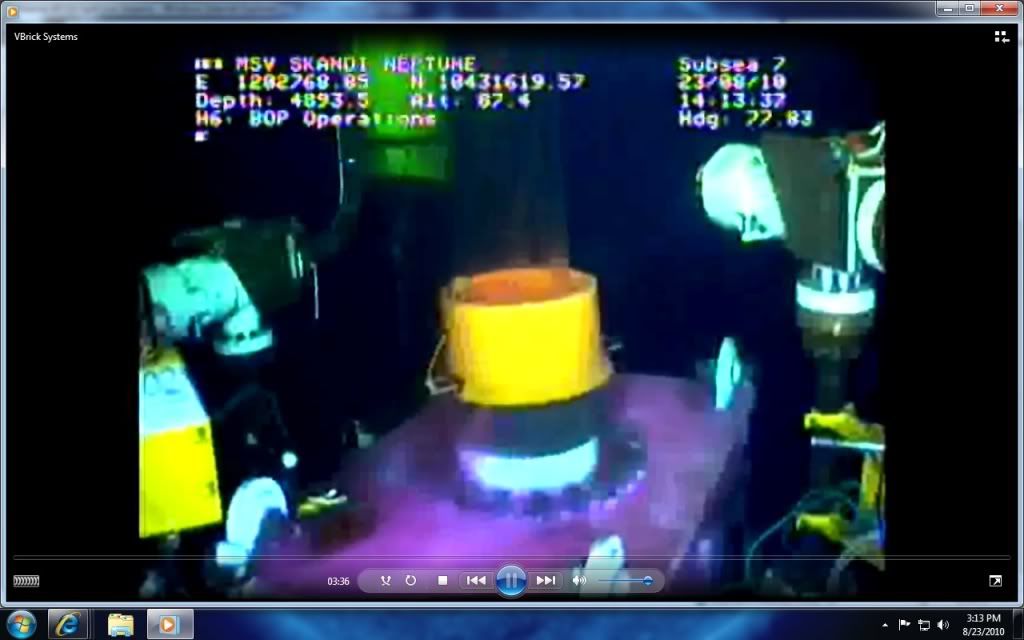
De mafkezen van BP zijn de boorpijp nu aan het verwijderen!
Veni vidi foetsie
|
|
