WKN Weer, Klimaat en Natuurrampen
Lees alles over het onstuimige weer op onze planeet, volg orkanen en tornado's, zie hoe vulkanen uitbarsten en hoe Moeder Aarde beeft bij een aardbeving. Alles over de verwoestende kracht van onze planeet en tal van andere natuurverschijnselen.



De Canarische Eilanden
Op de satellietoponame zijn alle grote eilanden van de Canarische archipel zichtbaar. De ouderdom van de eilanden neemt van oost naar west af. Lanzarote en Fuerteventura zijn het oudst. De basis van deze eilanden ontstond al in de Krijt-periode, meer dan 60 miljoen jaar geleden. De eilanden La Palma en El Hierro zijn geologisch gezien het jongst. Door de afname in ouderdom wordt de indruk gewekt dat de vorming van de Canarische eilanden het gevolg is van het opwellen van heet magma boven een hotspot.
Ontstaansgeschiedenis
De Canarische eilanden zijn alle van vulkanische oorsprong. Talloze vulkanen, waaronder de ruim 3700 meter hoge Pico de Teide, slakkenkegels, lavastromen en rotsformaties van basalt laten hierover weinig twijfel bestaan. De Canarische eilanden vormen samen met een aantal kleinere eilanden, w.o. de Ilhas Selvagens en een aantal seamounts (onderzeese vulkanen) een vulkanische gordel voor de Afrikaanse kust, die zich hoogstwaarschijnlijk ontwikkeld heeft langs een aantal breuken in de oceanische korst. De eilanden zelf vormen de toppen van grote onderzeese vulkaancomplexen die op de bodem van de Atlantische Oceaan rusten. Tussen de eilanden is de zee tot 3500 meter diep.
Zie ook -->
http://kijkeensomlaag.nl/(...)tstaansgeschiedenis#
Geology & Climate
Physically, the Canaries fall into two groups. The western group, made up of Tenerife, Gran Canaria, La Palma, La Gomera, and Ferro islands, consists of mountain peaks that rise directly from a deep ocean floor. The eastern group comprises Lanzarote, Fuerteventura Island, and six islets surmounting a single submarine plateau, the Canary Ridge, that rises about 4,500 feet (1,400 metres) from the ocean floor. The Canary Islands were formed by volcanic eruptions millions of years ago. All the western islands exceed 4,000 feet (1,200 metres) at their highest points, with Teide Peak on Tenerife rising to 12,198 feet (3,718 metres), the highest point on Spanish soil.
The Canary Islands have a subtropical climate. Temperatures are warm and show little seasonal variation. At Las Palmas city, for example, the average afternoon temperature in August is in the high 70s F (about 26 °C), while in January it drops to about 70 °F (21 °C). Annual precipitation, which is concentrated in November and December, is low, rarely exceeding 10 inches (250 mm) anywhere except on the windward northeastern sides of the islands, where it may reach 30 inches (750 mm).[/q]
Recentelijke ontwikkelingen
Eruptie gaande op eiland La Palma vanaf 19 september 2021
Nachtelijke beelden van eruptie La Palma op 19 september 2021
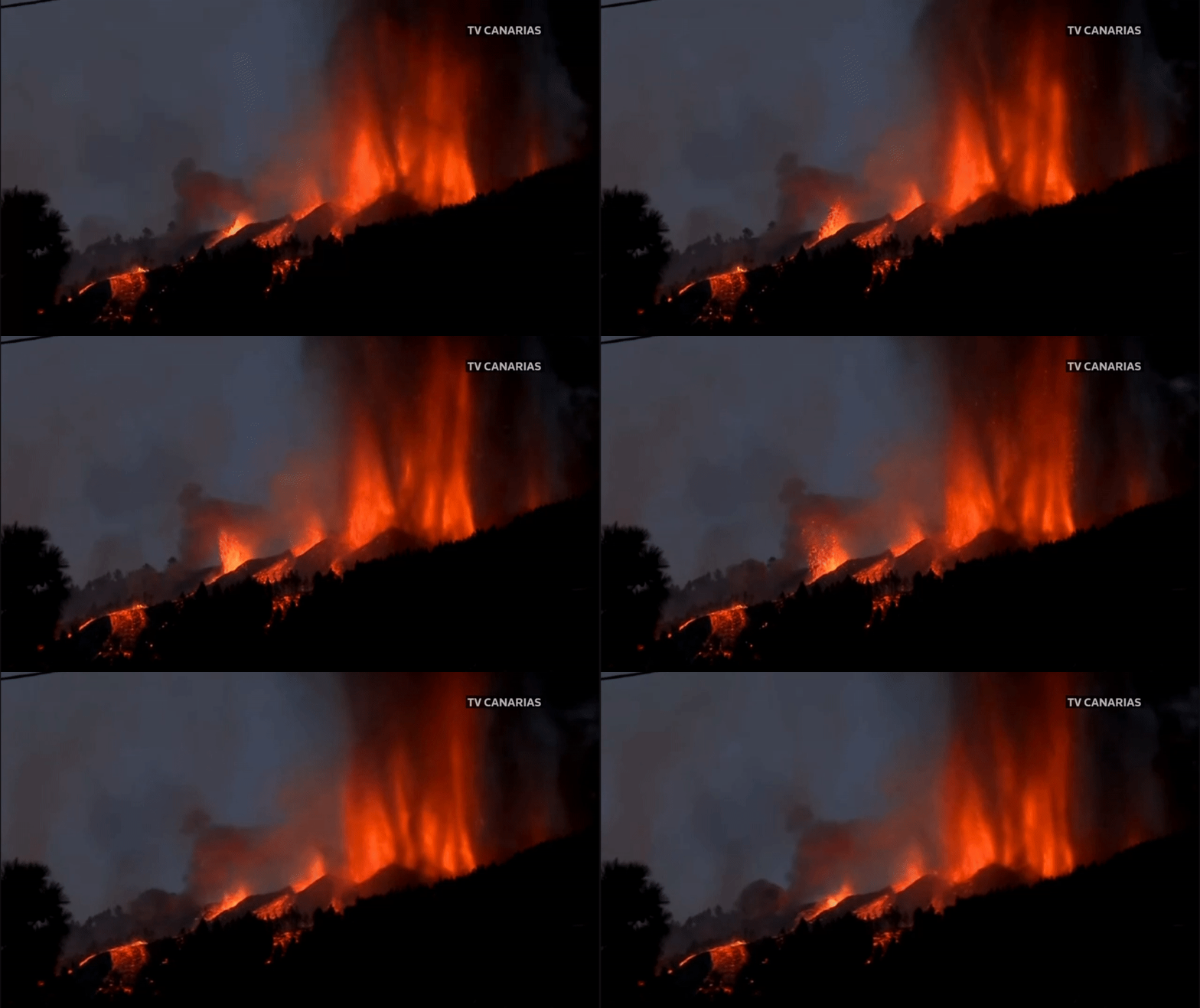
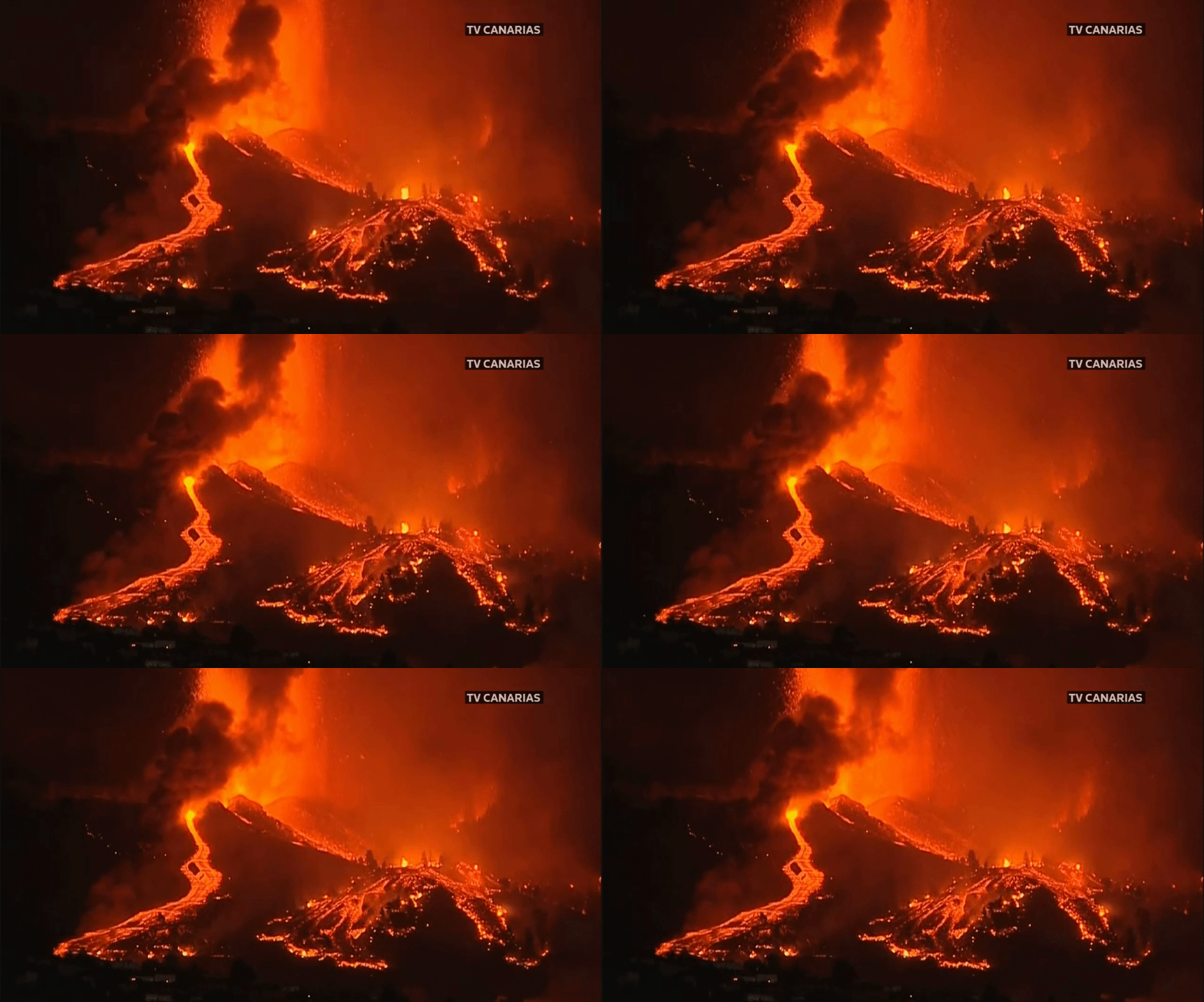
Lavastromen ontzien niets, natuur, huizen en zwembaden zijn kansloos
Overzicht eerdere uitbarstingen op La Palma

Livestream - tijdelijk zolang het duurt

Webcams
Webcams La Palma
Skyline Webcams Canarische Eilanden
Links
Canarian Weekly News
Canarian News Site
TV zender Canarische Eilanden
Volcano Discovery La Palma Status
INVOLCAN - Officieel Geologisch Instituut Canarische Eilanden
INVOLCAN - Faceboopagina
Twitteraccounts
@noticiacanaria
@canariesnews
@INVOLCAN
@Volcano Discovery
@eruptionsblog Erik Klemetti
@Jon Friman
@VolcanoHotspot
@Etna Boris
Gerelateerde topics en reeksen
Topicreeks: Vulkanen: the ring of fire
Topicreeks: Aardbevingen
WKN / Mega tsunami door in zee vallen van eiland La Palma?
Topicreeks: Vulkanen IJsland
WKN / [ACTUEEL] Vulkaan Etna voert weer een mooie show op
WKN / Vulkanische activiteit bij Mayotte (Indische Oceaan) neemt toe?
Eerdere delen van deze reeks
Topicreeks: [breaking] Vulkaanuitbarsting bij Canarische Eilanden
[ Bericht 1% gewijzigd door Frutsel op 16-12-2021 15:20:30 ]
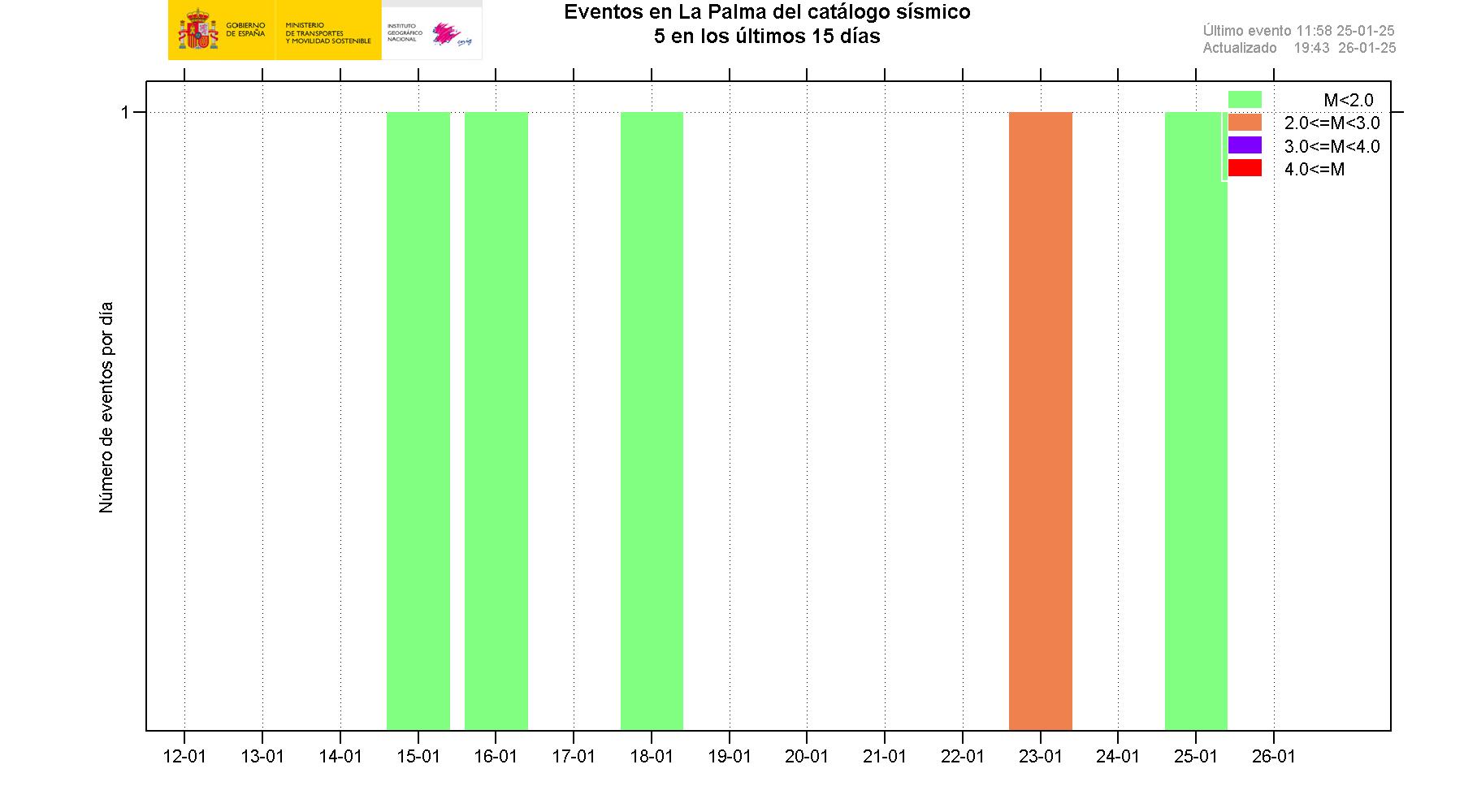
Toch weer aardig wat bevingen op LaPalma, benieuwd of de activiteit opnieuw gaat opstarten of dat het einde van de uitbarsting nu echt een feit is
https://www.emsc-csem.org(...)hp?key=53&typ=euro#2
https://www.emsc-csem.org(...)hp?key=53&typ=euro#2




Indrukwekkend aangezichtquote:
 Op
Op 
 Op
Op

Als de andere eilanden maar niet beginnen en zeker Gran Canaria niet waar ik binnenkort heen ga 
[b] Op zondag 14 november 2010 18:11 schreef liesje1979 het volgende:[/b]
Zo is daar Godshand, met zijn sarcastische toon,
Die regelmatig een topic voorziet van spot en hoon.
Zo is daar Godshand, met zijn sarcastische toon,
Die regelmatig een topic voorziet van spot en hoon.

Ben daar boven aan de grote vulkaan geweest ...quote:Op donderdag 3 februari 2022 22:40 schreef Godshand het volgende:
Als de andere eilanden maar niet beginnen en zeker Gran Canaria niet waar ik binnenkort heen ga


TOPICKICK

quote:Earthquake swarm detected in Tenerife’s Las Cañadas caldera, Spain
Between 23:42 UTC on May 27 and 04:08 UTC on May 28, 2024, the Canary Seismic Network detected a seismic swarm in Tenerife’s Las Cañadas caldera, consisting of dozens of small earthquakes, with 26 located.
The swarm consisted of dozens of small earthquakes, with 26 of these earthquakes having been precisely located. The earthquakes had magnitudes reaching up to 1.2 and occurred at depths between 5 and 10 km (3.1 to 6.2 miles).
Since June 2017, there has been a notable increase in micro-seismicity within Tenerife, characterized by 113 low-magnitude seismic swarms, including three hybrid seismic events.
This increase is attributed to a pressurization process of the volcanic-hydrothermal system, likely linked to the injection of magmatic gases, according to INVOLCAN.
The map provided by INVOLCAN shows the recent seismic swarm’s epicenters in red, with the seismic activity of the past year depicted in gray.
Despite this increase in seismic activity, INVOLCAN volcanologists emphasized that there is no immediate danger to the population, nor does this activity indicate an increased likelihood of a volcanic eruption in the short or medium term.
Tenerife, the largest of the Canary Islands, features a complex of overlapping Miocene-to-Quaternary stratovolcanoes.
The Las Cañadas caldera, a 10 x 17 km (6.2 x 10.5 miles) structure partially filled by the Teide stratovolcano, has been formed through collapse due to major explosive eruptions, massive landslides, or a combination of both. The most recent volcanic activity includes the construction of the Pico Viejo and Teide edifices, with historical eruptions possibly observed by Christopher Columbus.
The Teide volcano, located within the Teide National Park, a UNESCO World Heritage property, remains closely monitored.
quote:Increased volcanic activity detected at Mount Teide, no imminent eruption risk, Tenerife
The Scientific Committee for the Evaluation and Monitoring of Volcanic Phenomena (CCES) has confirmed that the Teide volcano in Tenerife, Spain is exhibiting anomalous geophysical activity, characterized by increased seismicity, geodetic deformation, and gas emissions. While there are no indications of an imminent eruption, experts acknowledge an elevated likelihood of volcanic activity in the medium to long term.
Since 2016, monitoring networks have recorded gradual yet persistent geophysical changes beneath Teide, with a marked intensification of activity since 2022. Key indicators, including seismic swarms, ground deformation, and variations in gas emissions, suggest increasing pressurization within the hydrothermal system underlying the stratovolcano.
Of particular note is the correlation between altered fumarolic emissions and seismic activity concentrated around Las Cañadas, Cumbres de Adeje, and Vilaflor. In addition, over the past week, a localized seismic cluster near Vilaflor has generated at least 14 earthquakes within a 24-hour period.
The Canary Islands Volcanology Institute (Involcan), the Spanish National Research Council (CSIC), and the Directorate General of Emergencies are actively analyzing these developments, refining hazard models, and enhancing surveillance strategies.
In June and July 2023, a significant cluster of deep-seated earthquakes was detected near Santiago del Teide at depths exceeding 30 km (18.6 miles), indicative of magmatic or hydrothermal system adjustments. Later in 2023, another seismic sequence occurred beneath Las Cañadas, with focal depths ranging from 17 to 23 km (10.5 to 14.3 miles). Smaller swarms have also been documented under Izaña and the peaks of Arico, highlighting the complexity of the volcanic system.
Geodetic measurements suggest subtle yet measurable ground deformation, reinforcing the hypothesis of increased pressurization. Although these indicators do not currently imply magma migration toward the surface, they warrant continued scrutiny to assess potential changes in the system’s behavior.
The Canary Islands government remains vigilant, maintaining operational readiness through the Special Civil Protection and Emergency Plan for Volcanic Risk (PEVOLCA). While there is no immediate hazard to the population, authorities stress the importance of continuous monitoring and public awareness.
Residents and visitors are advised to stay informed through official updates and adhere to any guidance provided by emergency management agencies, particularly in regions experiencing heightened seismic activity.
The government said it will make the scientific committee’s findings publicly accessible through the Territorial Policy Department’s website.
quote:New swarm of hybrid seismic events beneath Teide volcano, Tenerife
A new swarm of hybrid seismic events began beneath Teide volcano on Tenerife at 20:00 LT (21:00 UTC) on February 16, 2026, according to the Instituto Volcanológico de Canarias (INVOLCAN). More than 300 very low-magnitude earthquakes have been detected so far by the Canary Seismic Network, marking the eighth swarm of this type recorded on the island since 2016. INVOLCAN attributes the activity to magmatic-fluid injection into Tenerife’s hydrothermal system and states that the likelihood of an eruption remains unchanged.
A new swarm of hybrid seismic events is ongoing beneath Teide volcano, beginning at 20:00 local time (21:00 UTC) on February 16. Data from the Canary Seismic Network show more than 300 very low-magnitude events recorded since the start of the episode.
The earthquakes have depths of about 8–12 km (5–7 miles) below the volcano’s summit and display hybrid waveforms typical of the interaction between rock fracturing and fluid movement in a hydrothermal environment.
INVOLCAN states that the most likely mechanism is magmatic-fluid injection into Tenerife’s hydrothermal system. This process has been recurring since 2016 and is supported by independent geophysical and geochemical observations, including increased diffuse CO2 emissions from Teide’s crater and slight ground deformation on the volcano’s northeastern flank.
Authorities stated that the swarm does not alter the likelihood of eruption in the short or medium term and that no alert-level changes have been made under the Canary Islands Volcanic Risk Prevention Plan (PEVOLCA).
INVOLCAN describes the current sequence as part of the largest “volcanic noise” recorded in Tenerife since 2016 — a persistent background of low-level seismic and hydrothermal adjustments beneath Teide.
Instituto Geográfico Nacional (IGN) data confirm that the depth range and waveform characteristics of the current events are consistent with previous hydrothermal episodes. Low-frequency and hybrid signatures reflect interaction between gas and liquid phases at depth rather than brittle failure caused by magma migration.
Local civil-protection agencies report no felt earthquakes and no public concern requiring intervention as of February 17.
The new activity follows a similar hybrid swarm detected on February 7, 2026, and continues a decade-long pattern of episodic unrest.
Comparable swarms occurred on August 7, 2025, November 14, 2024, July 12, 2022, June 16, 2022, and June 14, 2019. Each involved hundreds of small earthquakes beneath Teide and Pico Viejo without surface manifestations or eruptive precursors.
Teide’s most recent eruption occurred in 1909 at the Chinyero vent on its north-western flank. Since then, the volcano has remained in a state of quiescent unrest punctuated by intermittent seismic and gas anomalies.
|
|
