WFL Wetenschap, Filosofie, Levensbeschouwing
Discussieer hier over alle aspecten van de wetenschap, filosofische problemen en zaken van levensbeschouwelijke aard.



Nou jongens, nog een paar dagen en dan gaat Huygens er vandoor.. Met hopelijk mooie foto's en lieve geluidjes van het oppervlak van Titan. Vind het serieus heel erg spannend

"End this war against drugs. Legalise the drug against wars."
-
[b]Op donderdag 28 september 2006 09:12 schreef Rio het volgende:[/b]
Uiteindelijk is dit een star_gazer-krijgt-een-keiharde-lul-van-zichzelf-omdat-hij-zichzelf-verheven-voelt topic.
-
[b]Op donderdag 28 september 2006 09:12 schreef Rio het volgende:[/b]
Uiteindelijk is dit een star_gazer-krijgt-een-keiharde-lul-van-zichzelf-omdat-hij-zichzelf-verheven-voelt topic.
Ik ook... helaas heeft de ontkoppeling zelf niet zoveel significantie, al is het natuurlijk altijd even afwachten of het goed gaat.
Ik kijk vooral uit naar 14 januari
Ik kijk vooral uit naar 14 januari
*SPOILER*
Zou je willen weten hoe Huygens fotos gaat uitzien? (als je het spannend wilt houden, niet lezen/kijken!! )
meer bij
htthttp://www.lpl.arizona.edu/~aeibl/disr_mission_plan.html *klikken op test images*
About 10 minutes later the large parachute will be released and be replaced by a much smaller parachute. The Probe and DISR will fall in this configuration for over two hours through the atmosphere until they reach the surface. Througout the fall the Probe will send radio transmissions to the Orbiter, for eventual relay to Earth.
The probe may survive the surface impact, although it is not specially designed to do so. The DISR will attempt to continue operating on the surface, sending back pictures and spectra.
Zou je willen weten hoe Huygens fotos gaat uitzien? (als je het spannend wilt houden, niet lezen/kijken!! )

meer bij
htthttp://www.lpl.arizona.edu/~aeibl/disr_mission_plan.html *klikken op test images*
About 10 minutes later the large parachute will be released and be replaced by a much smaller parachute. The Probe and DISR will fall in this configuration for over two hours through the atmosphere until they reach the surface. Througout the fall the Probe will send radio transmissions to the Orbiter, for eventual relay to Earth.
The probe may survive the surface impact, although it is not specially designed to do so. The DISR will attempt to continue operating on the surface, sending back pictures and spectra.
WOOK
Ruimtesonde Huygens op weg naar Titan (video)
bron: www.nu.nl
Uitgegeven: 24 december 2004 14:01
Laatst gewijzigd: 24 december 2004 16:27
AMSTERDAM - Op Eerste Kerstdag koppelt de ruimtesonde Huygens los van zijn moederschip Cassini en zet koers naar de bewolkte Saturnusmaan Titan. De twee hebben er al een aantal scheervluchten rond Titan en Saturnus opzitten, maar Huygens' reis na de ontkoppeling heeft niets weg van een scheervlucht. "Ramkoers" is een beter woord. Als alles goed gaat daalt de sonde op 14 januari via remschild en parachutes af in de dikke Titan-atmosfeer.
http://www.nu.nl/img.db?460012+s(350!x170!)
Tijdens twee eerdere passages bleek dat Titan heuse wolken en weerpatronen kent. Links de opname van 26 oktober, rechts die van 13 december. bron: NASA
Christiaan Huygens (1629 - 1695) ligt veilig begraven, maar op Eerste Kerstdag kan hem toch nog een ramp overkomen. Als de naar hem vernoemde ESA-sonde de Saturnusmaan Titan mist, kan hij voor eeuwig door de ruimte zwalken. Ook bij een landing in een van Titan's hypothetische ethaan-zeeën staat hem het lot van eeuwig varen te wachten.
Gegevens
De kleine sonde verzamelt tijdens zijn afdaling allerlei gegevens over de chemische samenstelling van Titan's atmosfeer, zoals bijvoorbeeld de temperatuur en lokale windsnelheid. Verder verzamelt de sonde minuscule zwevende deeltjes - aërosolen - uit Titan's ijskoude atmosfeer. Al die taken gebeuren bij temperaturen ver onder het vriespunt: -198 graden Celsius om precies te zijn. Huygens' radiozender is niet krachtig genoeg om zijn gegevensstroom vanaf het verre Saturnusstelsel in één keer naar de aarde te zenden. Daarom doet Cassini met zijn veel krachtiger zender dienst als tussenstation.
Rampspoed rond Kerstmis
ESA heeft geen goede ervaringen met reizen rond de kerst. Eerste Kerstdag, 2003: Isidis Planitia op Mars. Hoog boven de roestrode bodem trekt een zilveren stipje een baan langs de hemel. De sonde Beagle 2 heeft na een half jaar meeliften met ESA's Mars Express bijna zijn bestemming bereikt. In plaats van gracieus aan drie parachutes af te dalen, slaat de kleine robot als een ware vallende ster in op Mars. Een maand wanhopig zoeken levert niets op.
bron: www.nu.nl
Uitgegeven: 24 december 2004 14:01
Laatst gewijzigd: 24 december 2004 16:27
AMSTERDAM - Op Eerste Kerstdag koppelt de ruimtesonde Huygens los van zijn moederschip Cassini en zet koers naar de bewolkte Saturnusmaan Titan. De twee hebben er al een aantal scheervluchten rond Titan en Saturnus opzitten, maar Huygens' reis na de ontkoppeling heeft niets weg van een scheervlucht. "Ramkoers" is een beter woord. Als alles goed gaat daalt de sonde op 14 januari via remschild en parachutes af in de dikke Titan-atmosfeer.
http://www.nu.nl/img.db?460012+s(350!x170!)
Tijdens twee eerdere passages bleek dat Titan heuse wolken en weerpatronen kent. Links de opname van 26 oktober, rechts die van 13 december. bron: NASA
Christiaan Huygens (1629 - 1695) ligt veilig begraven, maar op Eerste Kerstdag kan hem toch nog een ramp overkomen. Als de naar hem vernoemde ESA-sonde de Saturnusmaan Titan mist, kan hij voor eeuwig door de ruimte zwalken. Ook bij een landing in een van Titan's hypothetische ethaan-zeeën staat hem het lot van eeuwig varen te wachten.
Gegevens
De kleine sonde verzamelt tijdens zijn afdaling allerlei gegevens over de chemische samenstelling van Titan's atmosfeer, zoals bijvoorbeeld de temperatuur en lokale windsnelheid. Verder verzamelt de sonde minuscule zwevende deeltjes - aërosolen - uit Titan's ijskoude atmosfeer. Al die taken gebeuren bij temperaturen ver onder het vriespunt: -198 graden Celsius om precies te zijn. Huygens' radiozender is niet krachtig genoeg om zijn gegevensstroom vanaf het verre Saturnusstelsel in één keer naar de aarde te zenden. Daarom doet Cassini met zijn veel krachtiger zender dienst als tussenstation.
Rampspoed rond Kerstmis
ESA heeft geen goede ervaringen met reizen rond de kerst. Eerste Kerstdag, 2003: Isidis Planitia op Mars. Hoog boven de roestrode bodem trekt een zilveren stipje een baan langs de hemel. De sonde Beagle 2 heeft na een half jaar meeliften met ESA's Mars Express bijna zijn bestemming bereikt. In plaats van gracieus aan drie parachutes af te dalen, slaat de kleine robot als een ware vallende ster in op Mars. Een maand wanhopig zoeken levert niets op.
En Huygens is losgekoppeld van Cassini.
BRON: Titan-Bound Huygens Probe Detaches From Cassini
December 24, 2004
(Source: Jet Propulsion Laboratory)
The European Space Agency's Huygens probe successfully detached from NASA's Cassini orbiter today to begin a three-week journey to Saturn¿s moon Titan. NASA's Deep Space Network tracking stations in Madrid, Spain, and Goldstone, Calif., received the signal at 7:24 p.m. (PST). All systems performed as expected and there were no problems reported with the Cassini spacecraft.
The Huygens probe, built and managed by the European Space Agency, was bolted to Cassini and has been riding along during the nearly seven-year journey to Saturn largely in a "sleep" mode. Huygens will be the first human-made object to explore on-site the unique environment of Titan, whose chemistry is assumed to be very similar to that of early Earth before life formed. Huygens will tell us whether this assumption is correct.
"We wish to congratulate our European partners as their journey begins and wish them well on their descent to Titan," said Robert T. Mitchell, Cassini program manager at NASA's Jet Propulsion Laboratory, Pasadena, Calif. "We are very excited to see the probe off and to have accomplished this part of our job. Now we're ready to finish our part -- receiving and relaying the Huygens data back to Earth."
"Today's release is another successful milestone in the Cassini- Huygens odyssey," said Dr. David Southwood, director of science program for the European Space Agency. "This was an amicable separation after seven years of living together. Our thanks to our partners at NASA for the lift. Each spacecraft will now continue on its own but we expect they'll keep in touch to complete this amazing mission. Now all our hopes and expectations are focused on getting the first in-situ data from a new world we've been dreaming of exploring for decades."
The Huygens probe will remain dormant until the onboard timer wakes it up just before the probe reaches Titan's upper atmosphere on Jan. 14, 2005. Then it will begin a dramatic plunge through Titan's murky atmosphere, tasting its chemical makeup and composition as it descends to touch down on its surface. The data gathered during this 2-1/2 hour descent will be transmitted from the probe to the Cassini orbiter. Afterward, Cassini will point its antenna to Earth and relay the data through NASA's Deep Space Network to JPL and on to the European Space Agency's Space Operations Center in Darmstadt, Germany, which serves as the operations center for the Huygens probe mission. From this control center, ESA engineers will be tracking the probe and scientists will be standing by to process the data from the probe's six instruments.
On Monday, Dec. 27, the Cassini orbiter will perform a deflection maneuver to keep it from following Huygens into Titan's atmosphere. This maneuver will also establish the required geometry between the probe and the orbiter for radio communications during the probe descent.
More information on the Cassini-Huygens mission is available at: http://saturn.jpl.nasa.gov and http://www.nasa.gov/cassini.
The Cassini-Huygens mission is a cooperative project of NASA, the European Space Agency and the Italian Space Agency. JPL, a division of the California Institute of Technology in Pasadena, manages the Cassini mission for NASA's Science Mission Directorate, Washington, D.C. JPL designed, developed and assembled the Cassini orbiter. The European Space Agency built and managed the development of the Huygens probe and is in charge of the probe operations. The Italian Space Agency provided the high-gain antenna, much of the radio system and elements of several of Cassini's science instruments.
BRON: Titan-Bound Huygens Probe Detaches From Cassini
December 24, 2004
(Source: Jet Propulsion Laboratory)
The European Space Agency's Huygens probe successfully detached from NASA's Cassini orbiter today to begin a three-week journey to Saturn¿s moon Titan. NASA's Deep Space Network tracking stations in Madrid, Spain, and Goldstone, Calif., received the signal at 7:24 p.m. (PST). All systems performed as expected and there were no problems reported with the Cassini spacecraft.
The Huygens probe, built and managed by the European Space Agency, was bolted to Cassini and has been riding along during the nearly seven-year journey to Saturn largely in a "sleep" mode. Huygens will be the first human-made object to explore on-site the unique environment of Titan, whose chemistry is assumed to be very similar to that of early Earth before life formed. Huygens will tell us whether this assumption is correct.
"We wish to congratulate our European partners as their journey begins and wish them well on their descent to Titan," said Robert T. Mitchell, Cassini program manager at NASA's Jet Propulsion Laboratory, Pasadena, Calif. "We are very excited to see the probe off and to have accomplished this part of our job. Now we're ready to finish our part -- receiving and relaying the Huygens data back to Earth."
"Today's release is another successful milestone in the Cassini- Huygens odyssey," said Dr. David Southwood, director of science program for the European Space Agency. "This was an amicable separation after seven years of living together. Our thanks to our partners at NASA for the lift. Each spacecraft will now continue on its own but we expect they'll keep in touch to complete this amazing mission. Now all our hopes and expectations are focused on getting the first in-situ data from a new world we've been dreaming of exploring for decades."
The Huygens probe will remain dormant until the onboard timer wakes it up just before the probe reaches Titan's upper atmosphere on Jan. 14, 2005. Then it will begin a dramatic plunge through Titan's murky atmosphere, tasting its chemical makeup and composition as it descends to touch down on its surface. The data gathered during this 2-1/2 hour descent will be transmitted from the probe to the Cassini orbiter. Afterward, Cassini will point its antenna to Earth and relay the data through NASA's Deep Space Network to JPL and on to the European Space Agency's Space Operations Center in Darmstadt, Germany, which serves as the operations center for the Huygens probe mission. From this control center, ESA engineers will be tracking the probe and scientists will be standing by to process the data from the probe's six instruments.
On Monday, Dec. 27, the Cassini orbiter will perform a deflection maneuver to keep it from following Huygens into Titan's atmosphere. This maneuver will also establish the required geometry between the probe and the orbiter for radio communications during the probe descent.
More information on the Cassini-Huygens mission is available at: http://saturn.jpl.nasa.gov and http://www.nasa.gov/cassini.
The Cassini-Huygens mission is a cooperative project of NASA, the European Space Agency and the Italian Space Agency. JPL, a division of the California Institute of Technology in Pasadena, manages the Cassini mission for NASA's Science Mission Directorate, Washington, D.C. JPL designed, developed and assembled the Cassini orbiter. The European Space Agency built and managed the development of the Huygens probe and is in charge of the probe operations. The Italian Space Agency provided the high-gain antenna, much of the radio system and elements of several of Cassini's science instruments.
<a href="http://www.vwkweb.nl/" rel="nofollow" target="_blank">[b]Vereniging voor weerkunde en klimatologie[/b]</a>
<a href="http://www.estofex.org/" rel="nofollow" target="_blank">[b]ESTOFEX[/b]</a>
<a href="http://www.estofex.org/" rel="nofollow" target="_blank">[b]ESTOFEX[/b]</a>
BRON: Huygens Probe Release Zoom
December 25, 2004
A closer view of the Cassini image of the Huygens Probe after its successful release.
The full image is available here
The image was taken about 12 hours after the probe's release from the orbiter. The probe successfully detached from Cassini on Dec. 24, 2004, and is on course for its January 14 encounter with Titan.
The Huygens probe will remain dormant until the onboard timer wakes it up just before the probe reaches Titan's upper atmosphere on Jan. 14, 2005. Then it will begin a dramatic plunge through Titan's murky atmosphere, tasting its chemical makeup and composition as it descends to touch down on its surface. The data gathered during this 2-1/2 hour descent will be transmitted from the probe to the Cassini orbiter.
Afterward, Cassini will point its antenna to Earth and relay the data through NASA's Deep Space Network to JPL and on to the European Space Agency's Space Operations Center in Darmstadt, Germany, which serves as the operations center for the Huygens probe mission. From this control center, ESA engineers will be tracking the probe and scientists will be standing by to process the data from the probe's six instruments.
December 25, 2004

A closer view of the Cassini image of the Huygens Probe after its successful release.
The full image is available here
The image was taken about 12 hours after the probe's release from the orbiter. The probe successfully detached from Cassini on Dec. 24, 2004, and is on course for its January 14 encounter with Titan.
The Huygens probe will remain dormant until the onboard timer wakes it up just before the probe reaches Titan's upper atmosphere on Jan. 14, 2005. Then it will begin a dramatic plunge through Titan's murky atmosphere, tasting its chemical makeup and composition as it descends to touch down on its surface. The data gathered during this 2-1/2 hour descent will be transmitted from the probe to the Cassini orbiter.
Afterward, Cassini will point its antenna to Earth and relay the data through NASA's Deep Space Network to JPL and on to the European Space Agency's Space Operations Center in Darmstadt, Germany, which serves as the operations center for the Huygens probe mission. From this control center, ESA engineers will be tracking the probe and scientists will be standing by to process the data from the probe's six instruments.
<a href="http://www.vwkweb.nl/" rel="nofollow" target="_blank">[b]Vereniging voor weerkunde en klimatologie[/b]</a>
<a href="http://www.estofex.org/" rel="nofollow" target="_blank">[b]ESTOFEX[/b]</a>
<a href="http://www.estofex.org/" rel="nofollow" target="_blank">[b]ESTOFEX[/b]</a>
whaa zwaar cool topic is dit! Geweldig, ik kijk echt uit naar 14 januari zeg .... vind het toch maar wat knap dat ze de baan van zo'n ding 7 jaar vooruit kunnen plannen met een afwijking van 1 seconde (tenminste ik meende dat ik dat las, heb wat vluchtig gelezen ... de plaatjes zijn geweldig!). En daarbij dat ze hem nog steeds kunnen controleren over een afstand van hier tot tokio en 10x terug.
Wat denken we eigelijk dat we daar moeten aantreffen op het oppervlak van titan? Wat zijn de temperaturen daar eigelijk aan de oppervlakte, zou het net zo'n dorre boel zijn net als op mars? Of krijgen we nou heel wat anders te zien (leven) ?
Overigens, het europese deel van de sonde gaat toch afdalen naar het oppervlak.... maare wat kan dat ding eigelijk allemaal? Toch niet alleen fotos maken hoop ik...
 .... vind het toch maar wat knap dat ze de baan van zo'n ding 7 jaar vooruit kunnen plannen met een afwijking van 1 seconde (tenminste ik meende dat ik dat las, heb wat vluchtig gelezen ... de plaatjes zijn geweldig!). En daarbij dat ze hem nog steeds kunnen controleren over een afstand van hier tot tokio en 10x terug.
Wat denken we eigelijk dat we daar moeten aantreffen op het oppervlak van titan? Wat zijn de temperaturen daar eigelijk aan de oppervlakte, zou het net zo'n dorre boel zijn net als op mars? Of krijgen we nou heel wat anders te zien (leven) ?

Overigens, het europese deel van de sonde gaat toch afdalen naar het oppervlak.... maare wat kan dat ding eigelijk allemaal? Toch niet alleen fotos maken hoop ik...

it wasn't me


Men verwacht vloeibare oceanen van methaan! Er is namelijk zoveel methaan in de atmosfeer aanwezig, dat dit vooralsnog alleen te verklaren is met een dergelijke veronderstelling. Er gaan zelfs stemmen op dat titan een soort proto-aarde in cryostasis is (oftewel, zo koud dat zich niets door heeft kunnen ontwikkelen). Organische stoffen ontstaan als zonlicht methaan afbreekt, maar op titan is zo weinig zonlicht, dat dit proces niet echt in gang gezet kan worden.quote:Op maandag 27 december 2004 11:20 schreef Djerikp het volgende:
Wat denken we eigelijk dat we daar moeten aantreffen op het oppervlak van titan? Wat zijn de temperaturen daar eigelijk aan de oppervlakte, zou het net zo'n dorre boel zijn net als op mars? Of krijgen we nou heel wat anders te zien (leven) ?
Leven zullen we niet vinden, maar interessant zal het zeker worden

"End this war against drugs. Legalise the drug against wars."
-
[b]Op donderdag 28 september 2006 09:12 schreef Rio het volgende:[/b]
Uiteindelijk is dit een star_gazer-krijgt-een-keiharde-lul-van-zichzelf-omdat-hij-zichzelf-verheven-voelt topic.
-
[b]Op donderdag 28 september 2006 09:12 schreef Rio het volgende:[/b]
Uiteindelijk is dit een star_gazer-krijgt-een-keiharde-lul-van-zichzelf-omdat-hij-zichzelf-verheven-voelt topic.
Wierd Mountain ridge
The most unique, and perhaps most remarkable feature discovered on Iapetus in Cassini images is a topographic ridge that coincides almost exactly with the geographic equator. The ridge is conspicuous in the picture as an approximately 20-kilometer wide (12 miles) band that extends from the western (left) side of the disc almost to the day/night boundary on the right. On the left horizon, the peak of the ridge reaches at least 13 kilometers (8 miles) above the surrounding terrain. Along the roughly 1,300 kilometer (800 mile) length over which it can be traced in this picture, it remains almost exactly parallel to the equator within a couple of degrees. The physical origin of the ridge has yet to be explained. It is not yet clear whether the ridge is a mountain belt that has folded upward, or an extensional crack in the surface through which material from inside Iapetus erupted onto the surface and accumulated locally, forming the ridge. The origin of Cassini Regio is a long-standing debate among scientists. One theory proposes that its dark material may have erupted onto Iapetus's icy surface from the interior. Another theory holds that the dark material represented accumulated debris ejected by impact events on dark, outer satellites of Saturn. Details of this Cassini image mosaic do not definitively rule out either of the theories. However, they do provide important new insights and constraints.
PIA06166.tif 1.031 MB
PIA06166.jpg 188.9 kB
[ Bericht 7% gewijzigd door -CRASH- op 08-01-2005 01:39:44 ]
The most unique, and perhaps most remarkable feature discovered on Iapetus in Cassini images is a topographic ridge that coincides almost exactly with the geographic equator. The ridge is conspicuous in the picture as an approximately 20-kilometer wide (12 miles) band that extends from the western (left) side of the disc almost to the day/night boundary on the right. On the left horizon, the peak of the ridge reaches at least 13 kilometers (8 miles) above the surrounding terrain. Along the roughly 1,300 kilometer (800 mile) length over which it can be traced in this picture, it remains almost exactly parallel to the equator within a couple of degrees. The physical origin of the ridge has yet to be explained. It is not yet clear whether the ridge is a mountain belt that has folded upward, or an extensional crack in the surface through which material from inside Iapetus erupted onto the surface and accumulated locally, forming the ridge. The origin of Cassini Regio is a long-standing debate among scientists. One theory proposes that its dark material may have erupted onto Iapetus's icy surface from the interior. Another theory holds that the dark material represented accumulated debris ejected by impact events on dark, outer satellites of Saturn. Details of this Cassini image mosaic do not definitively rule out either of the theories. However, they do provide important new insights and constraints.

PIA06166.tif 1.031 MB
PIA06166.jpg 188.9 kB
[ Bericht 7% gewijzigd door -CRASH- op 08-01-2005 01:39:44 ]
<a href="http://www.vwkweb.nl/" rel="nofollow" target="_blank">[b]Vereniging voor weerkunde en klimatologie[/b]</a>
<a href="http://www.estofex.org/" rel="nofollow" target="_blank">[b]ESTOFEX[/b]</a>
<a href="http://www.estofex.org/" rel="nofollow" target="_blank">[b]ESTOFEX[/b]</a>
Zoals ik al eens eerder heb gepost... Ik denk dat de licht/donker verschillen die we op het oppervlak van Titan hebben gezien wel eens dezelfde oorzaak kunnen hebben als die op Iapetus. Titan heeft ook een zeer licht gebied (Xanadu) en zeer donkere gebieden er vlakbij. Ik geloof niet zo in die methaan-oceanen theorie, dus ik denk dat het bestuderen van Iapetus misschien antwoorden verschaft over Titan.
Die gordel is inderdaad vreemd... Ik verwacht dat Iapetus in de niet al te verre toekomst nog wel eens het onderwerp zal worden van een missie, na de missie naar Europa.
Die gordel is inderdaad vreemd... Ik verwacht dat Iapetus in de niet al te verre toekomst nog wel eens het onderwerp zal worden van een missie, na de missie naar Europa.
That's no moon...!quote:
They told me all of my cages were mental, so I got wasted like all my potential.
bron / hele artikelquote:Scientists Prepare For Huygens Descent On Titan
Tucson AZ (SPX) Jan 06, 2005
Artistic depiction of Huygens' upcoming descent on Titan.
University of Arizona scientists, working on one of the most stunning robotic space missions ever attempted, head for Germany next week. Their experiments ride on the Huygens probe to Saturn's giant moon, Titan, part of the four-year NASA/European Space Agency/Italian Space Agency Cassini Huygens mission to the Saturn system.
The probe separated from the Cassini spacecraft early Saturday, Dec. 25, 2004, central European time (or about 8:30 p.m. Dec. 24, Arizona time). Huygens is now on its 14,000 mile-per-hour, 20-day cruise toward Titan. The probe will parachute onto Titan's surface on Jan. 14 - the most distant touchdown any human-made object will have ever made in the solar system.
The European Space Agency (ESA), which owns and manages the Huygens probe, controls probe operations at the European Space Operations Center (ESOC) in Darmstadt, Germany. About a dozen UA researchers will join their international colleagues in Darmstadt, which is near Frankfurt, for adrenalin-charged science operations on Jan. 14 and 15.
Titan - a world larger than Mercury and Pluto - is the only moon in the solar system with an atmosphere. Its mostly nitrogen atmosphere may resemble Earth's before life began. Scientists theorize that methane rains from Titan's sky, creating surface methane or ethane lakes, which may give rise to clouds, similar to the water cycle on Earth.
Scientists will study Titan's thick atmosphere, clouds and virtually unseen surface with six science experiments on Huygens during the probe's roughly 2.5-hour descent.[...]
The Descent Scenario
A system of alarm clocks will wake Huygens at a pre-programmed time a few hours before it slams into Titan's outermost atmosphere, more than 800 miles (1,270 kilometers) above Titan's surface.
During the first three minutes inside the atmosphere, Huygens must [...]
First Huygens Views and Results from Titan
The DISR team expects to receive its first dataset after 8 p.m. on Friday, Jan. 14, (Central European time). Bashar Rizk coordinates the DISR team that plans to produce a first panorama and perhaps even a simple movie during the early morning hours of Jan. 15.
At the same time, Martin Tomasko and others will be analyzing data on atmospheric particles for their preliminary report on Titan's atmosphere. The DISR team will release its first results at a Jan. 15 morning news conference at ESOC, where the European Space Agency is focusing media activities.[...]

bijna.... Vrijdag is het zover

"Mijn" fotoalbum...
-->creationisme _O- --> http://en.wikipedia.org/wiki/Panspermia *O* evolutie & Darwin O+
-->
BBC2 zendt in de nacht van vrijdag op zaterdag om 00.30 uur een rechtstreeks verslag uit van de landingspoging op Titan
En wie heeft er nog meer z'n Celestia geupdated met de Cassini_Huygens_Landed_CMOD.zip,
om toch enigzins de landing "live" mee te beleven.
I DID
[ Bericht 5% gewijzigd door -CRASH- op 12-01-2005 14:23:03 ]
om toch enigzins de landing "live" mee te beleven.
I DID


[ Bericht 5% gewijzigd door -CRASH- op 12-01-2005 14:23:03 ]
<a href="http://www.vwkweb.nl/" rel="nofollow" target="_blank">[b]Vereniging voor weerkunde en klimatologie[/b]</a>
<a href="http://www.estofex.org/" rel="nofollow" target="_blank">[b]ESTOFEX[/b]</a>
<a href="http://www.estofex.org/" rel="nofollow" target="_blank">[b]ESTOFEX[/b]</a>
Top, het staat dr op!
mare zegge, waar kenne ik updates van celestia kregge?
mare zegge, waar kenne ik updates van celestia kregge?
All I Need, is the air I breathe...
Op het moment is de site van Celestia down....quote:Op woensdag 12 januari 2005 16:28 schreef PeeJay het volgende:
Top, het staat dr op!
mare zegge, waar kenne ik updates van celestia kregge?
Maar als je op internet zoekt zal je wel wat vinden.
<a href="http://www.vwkweb.nl/" rel="nofollow" target="_blank">[b]Vereniging voor weerkunde en klimatologie[/b]</a>
<a href="http://www.estofex.org/" rel="nofollow" target="_blank">[b]ESTOFEX[/b]</a>
<a href="http://www.estofex.org/" rel="nofollow" target="_blank">[b]ESTOFEX[/b]</a>

Nog maar één dag!quote:Aliens 'could exist on Saturn moon'
By Roger Highfield, Science Editor
(Filed: 10/01/2005)
When the Huygens probe lands on Titan later this week, the pioneering space mission could encounter a bizarre form of life, a scientist claims.
The European probe will parachute down through the hazy atmosphere of Saturn's largest moon on Friday after a seven-year voyage.
Now an American team has challenged a basic assumption that has been used to guide the millions spent on the search for life elsewhere in the cosmos that life could only exist where there is unfrozen water and suggested that Huygens could encounter an alien on Titan.
Telegraph
Erg voorbarig vind ik...quote:The Florida team identified two absolute requirements for life to exist a suitable temperature range to allow chemical bonding and an energy source (for example, the sun or radioactive decay). Titan meets both requirements.
"This makes inescapable the conclusion that if life is an intrinsic property of chemical reactivity, life should exist on Titan," Dr Benner says.
"Indeed, for life not to exist on Titan, we would have to argue that life is not an intrinsic property of the reactivity of carbon-containing molecules under conditions where they are stable."
We weten niet precies onder welke omstandigheden leven ontstaat... Maar als ik me niet vergis heeft elke levensvorm die we op Aarde kennen water nodig om te kunnen voortbestaan. "Maar dat komt doordat het leven evolutionair is aangepast aan omstandigheden op Aarde," hoor ik ze al zeggen... Klopt, maar ook op Aarde zijn omstandigheden te vinden waar vrijwel geen vloeibaar water voorkomt, en die plekken zijn meestal erg levenloos. Voor zover ik weet kennen wij geen levensvormen die op louter een koud mengsel van methaan en stikstof kunnen teren. Als op Titan leven is, zou je verwachten dat op een veel dynamischer plaats als de Aarde ook dat soort levensvormen zouden zijn ontstaan.
Bovendien is het zonlicht dat Titan ontvangt erg zwak... Als de methaan-oceanen echt bestaan kan de aanwezigheid van Saturnus getijdekrachten veroorzaken die als energiebron dienen. Ik sta echter sceptich tegenover het bestaan van die oceanen.
Verder geldt hetzelfde als op Mars: als er leven is, is de kans groot dat het om micro organismen gaat, die gaat Huygens niet vinden.
Maar goed, we zullen wel zien... Ik ben zelf zoals gewoonlijk al blij met een kiekje van een kale, koude vlakte, het blijft iets bijzonders.
[ Bericht 2% gewijzigd door Speth op 13-01-2005 03:13:19 ]
Het was ook met een knipoog gepost.quote:

Zeker weten!quote:Maar goed, we zullen wel zien... Ik ben zelf zoals gewoonlijk al blij met een kiekje van een kale, koude vlakte, het blijft iets bijzonders.
Ik weet niet precies op wat voor soort beelden (als alles goed gaat) we zouden kunnen rekenen maar ik ben er wel erg benieuwd naar.
De sonde gaat naar alle waarschijnlijkheid landen in een gebied waar lichte en donkere gedeelten in elkaar overgaan (zoals we ze op de Cassini foto's al zagen), de foto's die Huygens vanaf grotere hoogten gaat nemen zullen waarschijnlijk beide gebieden laten zien. Als de donkere gebieden inderdaad oceanen zijn, zou het natuurlijk ideaal zijn als Huygens precies op het "strand" zou landen, helaas is die kans vrij klein... Het is echter wel te verwachten dat duidelijk wordt wat de beide soorten oppervlakken precies zijn.quote:Op donderdag 13 januari 2005 03:27 schreef NorthernStar het volgende:
[..]
Het was ook met een knipoog gepost.
[..]
Zeker weten!
Ik weet niet precies op wat voor soort beelden (als alles goed gaat) we zouden kunnen rekenen maar ik ben er wel erg benieuwd naar.
Hoe groot is Titan?
(aarde, titan en onze maan)
Dit is ook een leuke vergelijkingskaart van de grootste manen en kleinste planeten:
Moons
en nog een

(aarde, titan en onze maan)
Dit is ook een leuke vergelijkingskaart van de grootste manen en kleinste planeten:
Moons
en nog een
Is er trouwens voldoende luchtdruk in Titan's atmosfeer?
Anders heeft een parachute niet zoveel zin en leidt een vrije val het einde in van deze missie.
Anders heeft een parachute niet zoveel zin en leidt een vrije val het einde in van deze missie.
http://www.infoster.be/negepl/titan.htmlquote:Op donderdag 13 januari 2005 05:25 schreef Yosomite het volgende:
Is er trouwens voldoende luchtdruk in Titan's atmosfeer?
Anders heeft een parachute niet zoveel zin en leidt een vrije val het einde in van deze missie.
Als enige satelliet in het zonnestelsel heeft Titan een belangrijke atmosfeer. Aan het oppervlak is de druk meer dan 1,5 bar (50% meer dan bij Aarde). De atmosfeer bestaat hoofdzakelijk uit stikstof (net zoals op aarde) met ongeveer 15% argon en een paar procent methaan. Tot verwondering van velen zijn er sporen van ongeveer een dozijn andere organische componenten (zoals ethaan, hydrogen cyanide, koolstofdioxide). De organische stoffen zoals methaan, die de bovenste atmosfeer van Titan domineren, worden vernietigd door het zonlicht. Met als resultaat dat er een smog gevormd wordt die een heel stuk dikker is dan de smog die zich vormt boven de steden op aarde. In verschillende opzichten is dit hetzelfde proces dat plaatsvond op de aarde in de periode dat het eerste leven ontstaan is.
<a href="http://www.vwkweb.nl/" rel="nofollow" target="_blank">[b]Vereniging voor weerkunde en klimatologie[/b]</a>
<a href="http://www.estofex.org/" rel="nofollow" target="_blank">[b]ESTOFEX[/b]</a>
<a href="http://www.estofex.org/" rel="nofollow" target="_blank">[b]ESTOFEX[/b]</a>

kan echt niet w88, hoelaat kunnen we morgen de eerste kiekjes verw88
edit: er vanuitgaan dat alles goed gaat natuurlijk


edit: er vanuitgaan dat alles goed gaat natuurlijk
Not that we needed all that for the trip, but once you get into a serious drug collection, the tendency is to push it as far as you can.

Ik denk dat ik wel ga kijken, best leuk om te zien. Hopen dat het een paar mooie plaatjes oplevert
~ Grolsch flesjes bewegen onevenredig niet significant met de treinrichting
Volgens ESA morgen (14 jan) 6 uur 's ochtends
[ alle babes op 1 pagina via fok!wiki -bijgewerkt tot 20/10/2015 ]
Leve Kim , Leve Maduro , Leve Castro
#freeTarik #freeDemon_from_heaven
Leve Kim , Leve Maduro , Leve Castro
#freeTarik #freeDemon_from_heaven
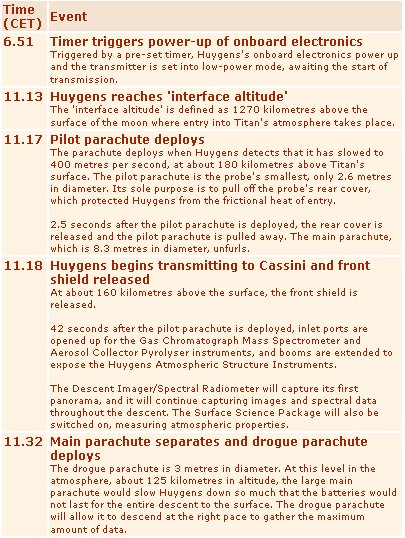
Huygens descent timeline
Timeline of expected events during
the Huygens descent to the surface
of Titan on 14 January 2005.
Time (CET)
6.51
Timer triggers power-up of onboard electronics
Triggered by a pre-set timer, Huygens's onboard electronics power up and the transmitter is set into low-power mode, awaiting the start of transmission.
11.13
Huygens reaches 'interface altitude'
The 'interface altitude' is defined as 1270 kilometres above the surface of the moon where entry into Titan's atmosphere takes place.
11.17
Pilot parachute deploys
The parachute deploys when Huygens detects that it has slowed to 400 metres per second, at about 180 kilometres above Titan's surface. The pilot parachute is the probe's smallest, only 2.6 metres in diameter. Its sole purpose is to pull off the probe's rear cover, which protected Huygens from the frictional heat of entry.
2.5 seconds after the pilot parachute is deployed, the rear cover is released and the pilot parachute is pulled away. The main parachute, which is 8.3 metres in diameter, unfurls.
11.18
Huygens begins transmitting to Cassini and front shield released
At about 160 kilometres above the surface, the front shield is released.
42 seconds after the pilot parachute is deployed, inlet ports are opened up for the Gas Chromatograph Mass Spectrometer and Aerosol Collector Pyrolyser instruments, and booms are extended to expose the Huygens Atmospheric Structure Instruments.
The Descent Imager/Spectral Radiometer will capture its first panorama, and it will continue capturing images and spectral data throughout the descent. The Surface Science Package will also be switched on, measuring atmospheric properties.
11.32
Main parachute separates and drogue parachute deploys
The drogue parachute is 3 metres in diameter. At this level in the atmosphere, about 125 kilometres in altitude, the large main parachute would slow Huygens down so much that the batteries would not last for the entire descent to the surface. The drogue parachute will allow it to descend at the right pace to gather the maximum amount of data.
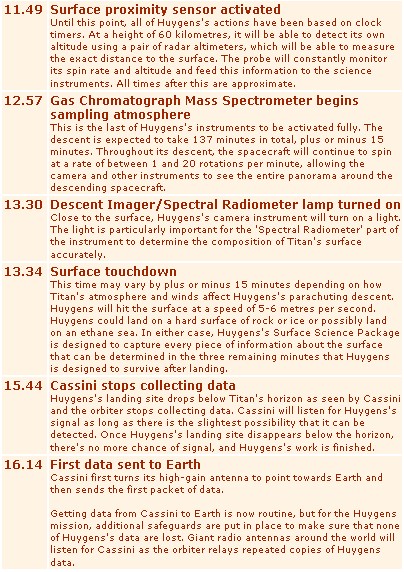
11.49
Surface proximity sensor activated
Until this point, all of Huygens's actions have been based on clock timers. At a height of 60 kilometres, it will be able to detect its own altitude using a pair of radar altimeters, which will be able to measure the exact distance to the surface. The probe will constantly monitor its spin rate and altitude and feed this information to the science instruments. All times after this are approximate.
12.57
Gas Chromatograph Mass Spectrometer begins sampling atmosphere
This is the last of Huygens's instruments to be activated fully. The descent is expected to take 137 minutes in total, plus or minus 15 minutes. Throughout its descent, the spacecraft will continue to spin at a rate of between 1 and 20 rotations per minute, allowing the camera and other instruments to see the entire panorama around the descending spacecraft.
13.30
Descent Imager/Spectral Radiometer lamp turned on
Close to the surface, Huygens's camera instrument will turn on a light. The light is particularly important for the 'Spectral Radiometer' part of the instrument to determine the composition of Titan's surface accurately.
13.34
Surface touchdown
This time may vary by plus or minus 15 minutes depending on how Titan's atmosphere and winds affect Huygens's parachuting descent. Huygens will hit the surface at a speed of 5-6 metres per second. Huygens could land on a hard surface of rock or ice or possibly land on an ethane sea. In either case, Huygens's Surface Science Package is designed to capture every piece of information about the surface that can be determined in the three remaining minutes that Huygens is designed to survive after landing.
15.44
Cassini stops collecting data
Huygens's landing site drops below Titan's horizon as seen by Cassini and the orbiter stops collecting data. Cassini will listen for Huygens's signal as long as there is the slightest possibility that it can be detected. Once Huygens's landing site disappears below the horizon, there's no more chance of signal, and Huygens's work is finished.
16.00
First data sent to Earth
Cassini first turns its high-gain antenna to point towards Earth and then sends the first packet of data.
Getting data from Cassini to Earth is now routine, but for the Huygens mission, additional safeguards are put in place to make sure that none of Huygens's data are lost. Giant radio antennas around the world will listen for Cassini as the orbiter relays repeated copies of Huygens data.
[ Bericht 0% gewijzigd door -CRASH- op 14-01-2005 05:25:47 ]
Timeline of expected events during
the Huygens descent to the surface
of Titan on 14 January 2005.
Time (CET)
6.51
Timer triggers power-up of onboard electronics
Triggered by a pre-set timer, Huygens's onboard electronics power up and the transmitter is set into low-power mode, awaiting the start of transmission.
11.13
Huygens reaches 'interface altitude'
The 'interface altitude' is defined as 1270 kilometres above the surface of the moon where entry into Titan's atmosphere takes place.
11.17
Pilot parachute deploys
The parachute deploys when Huygens detects that it has slowed to 400 metres per second, at about 180 kilometres above Titan's surface. The pilot parachute is the probe's smallest, only 2.6 metres in diameter. Its sole purpose is to pull off the probe's rear cover, which protected Huygens from the frictional heat of entry.
2.5 seconds after the pilot parachute is deployed, the rear cover is released and the pilot parachute is pulled away. The main parachute, which is 8.3 metres in diameter, unfurls.
11.18
Huygens begins transmitting to Cassini and front shield released
At about 160 kilometres above the surface, the front shield is released.
42 seconds after the pilot parachute is deployed, inlet ports are opened up for the Gas Chromatograph Mass Spectrometer and Aerosol Collector Pyrolyser instruments, and booms are extended to expose the Huygens Atmospheric Structure Instruments.
The Descent Imager/Spectral Radiometer will capture its first panorama, and it will continue capturing images and spectral data throughout the descent. The Surface Science Package will also be switched on, measuring atmospheric properties.
11.32
Main parachute separates and drogue parachute deploys
The drogue parachute is 3 metres in diameter. At this level in the atmosphere, about 125 kilometres in altitude, the large main parachute would slow Huygens down so much that the batteries would not last for the entire descent to the surface. The drogue parachute will allow it to descend at the right pace to gather the maximum amount of data.
11.49
Surface proximity sensor activated
Until this point, all of Huygens's actions have been based on clock timers. At a height of 60 kilometres, it will be able to detect its own altitude using a pair of radar altimeters, which will be able to measure the exact distance to the surface. The probe will constantly monitor its spin rate and altitude and feed this information to the science instruments. All times after this are approximate.
12.57
Gas Chromatograph Mass Spectrometer begins sampling atmosphere
This is the last of Huygens's instruments to be activated fully. The descent is expected to take 137 minutes in total, plus or minus 15 minutes. Throughout its descent, the spacecraft will continue to spin at a rate of between 1 and 20 rotations per minute, allowing the camera and other instruments to see the entire panorama around the descending spacecraft.
13.30
Descent Imager/Spectral Radiometer lamp turned on
Close to the surface, Huygens's camera instrument will turn on a light. The light is particularly important for the 'Spectral Radiometer' part of the instrument to determine the composition of Titan's surface accurately.
13.34
Surface touchdown
This time may vary by plus or minus 15 minutes depending on how Titan's atmosphere and winds affect Huygens's parachuting descent. Huygens will hit the surface at a speed of 5-6 metres per second. Huygens could land on a hard surface of rock or ice or possibly land on an ethane sea. In either case, Huygens's Surface Science Package is designed to capture every piece of information about the surface that can be determined in the three remaining minutes that Huygens is designed to survive after landing.
15.44
Cassini stops collecting data
Huygens's landing site drops below Titan's horizon as seen by Cassini and the orbiter stops collecting data. Cassini will listen for Huygens's signal as long as there is the slightest possibility that it can be detected. Once Huygens's landing site disappears below the horizon, there's no more chance of signal, and Huygens's work is finished.
16.00
First data sent to Earth
Cassini first turns its high-gain antenna to point towards Earth and then sends the first packet of data.
Getting data from Cassini to Earth is now routine, but for the Huygens mission, additional safeguards are put in place to make sure that none of Huygens's data are lost. Giant radio antennas around the world will listen for Cassini as the orbiter relays repeated copies of Huygens data.
[ Bericht 0% gewijzigd door -CRASH- op 14-01-2005 05:25:47 ]
<a href="http://www.vwkweb.nl/" rel="nofollow" target="_blank">[b]Vereniging voor weerkunde en klimatologie[/b]</a>
<a href="http://www.estofex.org/" rel="nofollow" target="_blank">[b]ESTOFEX[/b]</a>
<a href="http://www.estofex.org/" rel="nofollow" target="_blank">[b]ESTOFEX[/b]</a>
16:00 - 16:30
Cassini returns the first data from Huygens
17:15
onwards Media briefing on mission outcome
20:45
onwards First science data from Huygens
23:00 - 23:20
Review of the day - more science data from Huygens
Cassini returns the first data from Huygens
17:15
onwards Media briefing on mission outcome
20:45
onwards First science data from Huygens
23:00 - 23:20
Review of the day - more science data from Huygens
<a href="http://www.vwkweb.nl/" rel="nofollow" target="_blank">[b]Vereniging voor weerkunde en klimatologie[/b]</a>
<a href="http://www.estofex.org/" rel="nofollow" target="_blank">[b]ESTOFEX[/b]</a>
<a href="http://www.estofex.org/" rel="nofollow" target="_blank">[b]ESTOFEX[/b]</a>


quote:Op vrijdag 14 januari 2005 05:55 schreef Yosomite het volgende:
We wachten de OP van bv een NorthernStar af, of zijn inspiratie (of een leuke foto van Titan).
Even wat linkjes verzamelen.

Na een reis van acht jaar is de ruimtesonde Huygens klaar om geschiedenis te schrijven, op weg naar zijn ontmoeting met de met smog omgeven maan van Saturnus, Titan.
Vandaag, 14 januari, zal Huygens door Titans atmosfeer duiken terwijl het ondertussen data zal verzamelen, waaronder de eerste foto's en geluiden van deze buitenaardse wereld.
Animatie
De kleine robot zal Titans atmosfeer rond kwart over elf vanmorgen bereiken. Als alles goed gaat zal korte tijd later de tot nu toe verste landing ooit in de geschiedenis van de ruimtevaart een feit zijn.
De eerste data zal in de namiddag de aarde bereiken.
Tijdlijn
Links
ESA - Cassini-Huygens
Jet Propulsion Laboratory
ESA
BBC - Mission to Saturn
Informatie over Titan
De Negen Planeten
Volkssterrenwacht
Wikipedia - Titan
Televisie
BBC2 - Stardate: Mission to Titan (0.30 Nl. tijd)
Web-tv
Extra uitzendingen NASA-TV 14 January 2005
9.00 - 9:30 - Live Coverage and Commentary "Cassini Turns Towards Titan"
11.00 - 12.30 - "The Huygens Probe Enters the Atmosphere of Titan"
14.30 - 15:15 - ESA Commentary on Huygens Probe Mission
16.00 - 16:30 - ESA Commentary "Cassini Turns Back to Earth - Data Transmission Begins"
17:15 - 18.00 - Huygens Probe News Briefing - JPL/ESA (Mission Coverage)
18.45 - 19.15 - ESA Commentary "Presentation of First 18 Images from Titan"
23.00 - 23.30 - ESA Commentary and "Additional Images from Tital & B-Roll"
23:30 - 0.00 - JPL Commentary - JPL (Mission Coverage)
Voor meer info zie ook het centrale topic Cassini-Huygens missie // Saturnus in de picture
[ Bericht 5% gewijzigd door NorthernStar op 14-01-2005 07:53:26 ]
Vandaag, 14 januari, zal Huygens door Titans atmosfeer duiken terwijl het ondertussen data zal verzamelen, waaronder de eerste foto's en geluiden van deze buitenaardse wereld.
Animatie
De kleine robot zal Titans atmosfeer rond kwart over elf vanmorgen bereiken. Als alles goed gaat zal korte tijd later de tot nu toe verste landing ooit in de geschiedenis van de ruimtevaart een feit zijn.
De eerste data zal in de namiddag de aarde bereiken.

Tijdlijn
Links
Informatie over Titan
Televisie
Web-tv
Extra uitzendingen NASA-TV 14 January 2005
9.00 - 9:30 - Live Coverage and Commentary "Cassini Turns Towards Titan"
11.00 - 12.30 - "The Huygens Probe Enters the Atmosphere of Titan"
14.30 - 15:15 - ESA Commentary on Huygens Probe Mission
16.00 - 16:30 - ESA Commentary "Cassini Turns Back to Earth - Data Transmission Begins"
17:15 - 18.00 - Huygens Probe News Briefing - JPL/ESA (Mission Coverage)
18.45 - 19.15 - ESA Commentary "Presentation of First 18 Images from Titan"
23.00 - 23.30 - ESA Commentary and "Additional Images from Tital & B-Roll"
23:30 - 0.00 - JPL Commentary - JPL (Mission Coverage)
Voor meer info zie ook het centrale topic Cassini-Huygens missie // Saturnus in de picture
[ Bericht 5% gewijzigd door NorthernStar op 14-01-2005 07:53:26 ]
Over een paar minuten begint er een persconferrentie op NASA TV
<a href="http://www.vwkweb.nl/" rel="nofollow" target="_blank">[b]Vereniging voor weerkunde en klimatologie[/b]</a>
<a href="http://www.estofex.org/" rel="nofollow" target="_blank">[b]ESTOFEX[/b]</a>
<a href="http://www.estofex.org/" rel="nofollow" target="_blank">[b]ESTOFEX[/b]</a>
Zeker weten? Ze announcen niets op de stream...quote:Op vrijdag 14 januari 2005 06:51 schreef -CRASH- het volgende:
Over een paar minuten begint er een persconferrentie op NASA TV
Er is nu alleen een herhaling van de return to flight press conference.
Er begint nu een uitzending over de Space Shuttlequote:Op vrijdag 14 januari 2005 07:02 schreef Speth het volgende:
[..]
Zeker weten? Ze announcen niets op de stream...
All times are Eastern U.S. time - iemand die even snel kan omrekenen?
[ Bericht 61% gewijzigd door NorthernStar op 14-01-2005 07:50:28 ]
Heb al uren de stream aan..quote:Op vrijdag 14 januari 2005 07:02 schreef Speth het volgende:
[..]
Zeker weten? Ze announcen niets op de stream...
Er is nu alleen een herhaling van de return to flight press conference.
Eerst zitten ze te roepen... over een uur een speciale persconf.
en nu is er nog niks

<a href="http://www.vwkweb.nl/" rel="nofollow" target="_blank">[b]Vereniging voor weerkunde en klimatologie[/b]</a>
<a href="http://www.estofex.org/" rel="nofollow" target="_blank">[b]ESTOFEX[/b]</a>
<a href="http://www.estofex.org/" rel="nofollow" target="_blank">[b]ESTOFEX[/b]</a>
wow zo'n verbinding wil ik ook 8 K per seconde maarliefst

WHY NOT?????????????????????????????????????
Dan zijn dit de (extra) uitzendingen van vandaagquote:Op vrijdag 14 januari 2005 07:21 schreef Speth het volgende:
EST loopt trouwens 6 uur achter, in New York is het nu 1:20
NASA -TVquote:zie OP
[ Bericht 14% gewijzigd door NorthernStar op 14-01-2005 07:53:56 ]
oww, ja dat was vandaag, was een maand geleden ofzo een erg boeiende docu over op BBC 2, ik geloof in Horizon.
Klonk is alleen Klonk als er Klonk op staat
