WKN Weer, Klimaat en Natuurrampen
Lees alles over het onstuimige weer op onze planeet, volg orkanen en tornado's, zie hoe vulkanen uitbarsten en hoe Moeder Aarde beeft bij een aardbeving. Alles over de verwoestende kracht van onze planeet en tal van andere natuurverschijnselen.



quote:Very strong M6.9 earthquake, series of aftershocks hit Mindanao, Philippines
A strong and shallow earthquake registered by PHIVOLCS as M6.9 hit Mindanao, Philippines at 06:11 UTC (14:11 LT) on December 15, 2019. The agency is reporting a depth of 3 km (1.8 miles). The USGS is reporting M6.8 at a depth of 22.4 km (13.9 miles); EMSC M6.8 at a depth of 30 km (18.6 miles). More than 25 moderate to strong aftershocks were registered by 09:00 UTC. At least 4 people have been killed.
The epicenter was located 6.6 km (4.1 miles) S of Magsaysay (population 16 592), 9.1 km (5.7 miles) SSW of Bansalan (population 21 391), 18.3 km (11.4 miles) W of Guihing (population 12 466), 18.8 km (11.7 miles) WNW of Padada (population 11 439) and 44.1 km (27.4 miles) ENE of Korondal (population 125 502).
There are 7 779 000 people living within 100 km (62 miles).
365 000 are estimated to have felt very strong shaking, 4 087 000 strong, 4 882 000 moderate, and 10 309 000 light.
Based on all available data, there is no tsunami threat from this earthquake, PTWC said.
The USGS issued a green alert for shaking-related fatalities and economic losses.
Overall, the population in this region resides in structures that are a mix of vulnerable and earthquake-resistant construction. The predominant vulnerable building types are reinforced concrete and unknown/miscellaneous types of construction.
Recent earthquakes in this area have caused secondary hazards such as landslides that might have contributed to losses.
Liquefaction triggered by this earthquake is estimated to be significant in severity and (or) spatial extent. The number of people living near areas that could have produced liquefaction in this earthquake is extensive.
Little or no landsliding is expected, but some landslides could have occurred in highly susceptible areas. The number of people living near areas that could have produced landslides in this earthquake is low, but landslide damage or fatalities are still possible in highly susceptible areas.
According to Anthony Allada, public information officer of Magsaysay Town, Davao del Sur, 14 people were injured but none seriously.
Roads and buildings, including the local government office, were damaged and power was out in the town.
At least 3 people have been killed after a three-story supermarket collapsed in Padada town, Davao Del Sur. An unknown number of people were believed to be trapped under the rubble.
A six-year-old girl was killed in nearby Matanao town after she was hit by a falling concrete wall.
This region was shaken by four powerful quakes in October and November, which together killed at least 20 people.

twitter:EMSC twitterde op maandag 23-12-2019 om 21:06:14 Update: M6.0 #earthquake (#séisme #TremblementDeTerre) strikes 333 km W of Campbell River (#Canada) 16 min ago. https://t.co/6C1UjGbahB reageer retweet
 Update: M6.0
Da's al de derde vandaag. Eerder al 2 keer een 5+quote:Op maandag 23 december 2019 21:27 schreef Houtenbeen het volgende:
twitter:EMSC twitterde op maandag 23-12-2019 om 21:06:14 Update: M6.0 #earthquake (#séisme #TremblementDeTerre) strikes 333 km W of Campbell River (#Canada) 16 min ago. https://t.co/6C1UjGbahB reageer retweet
En weer een 6.0quote:Op maandag 23 december 2019 21:35 schreef Frutsel het volgende:
[..]
Da's al de derde vandaag. Eerder al 2 keer een 5+
twitter:USGSBigQuakes twitterde op maandag 23-12-2019 om 22:08:18 Prelim M6.0 Earthquake Vancouver Island, Canada region Dec-23 20:56 UTC, updates https://t.co/MoODY19AoW reageer retweet
 Prelim M6.0 Earthquake Vancouver Island, Canada region Dec-23 20:56 UTC, updates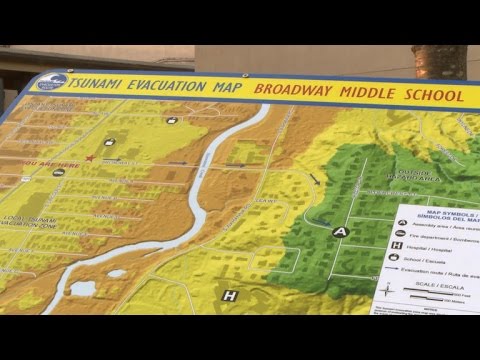

ja bekend verhaal ... en het is lange gevaren zone .. Aan de ene kant zegt mn geologen hart ... ...zien, maar aan de andere is elke ramp er 1 te veel ..
En weer eentwitter:EMSC twitterde op woensdag 25-12-2019 om 04:46:34 Update: M6.1 #earthquake (#séisme #TremblementDeTerre) strikes 338 km W of Campbell River (#Canada) 11 min ago. https://t.co/dIX8s7DH7I reageer retweet

Magnitude Mw 5.7quote:5.8 tremor strikes Puerto Rico
An early-morning earthquake struck Puerto Rico on Monday, the US Geological Survey said.
The magnitude 5.8 tremor was centered about 8 miles south-southeast of Indios, Puerto Rico, the USGS said.
The depth of the earthquake was about 3.7 miles below ground.
It was not immediately clear whether the quake caused any significant damage or injuries.
Region PUERTO RICO REGION
Date time 2020-01-06 10:32:20.0 UTC
Location 17.87 N ; 66.83 W
Depth 2 km
Distances 101 km SW of San Juan, Puerto Rico / pop: 419,000 / local time: 06:32:20.0 2020-01-06
68 km SE of Aguada, Puerto Rico / pop: 4,100 / local time: 06:32:20.0 2020-01-06
14 km SE of Maria Antonia, Puerto Rico / pop: 1,500 / local time: 06:32:20.0 2020-01-06

twitter:LastQuake twitterde op zaterdag 11-01-2020 om 14:01:57 Felt #earthquake (#sismo) M6.1 strikes 82 km SW of San Juan (Puerto Rico) 7 min ago. Please report to: https://t.co/LSeg7Mwrre https://t.co/omkVPraA2k reageer retweet
 Felt
Felt 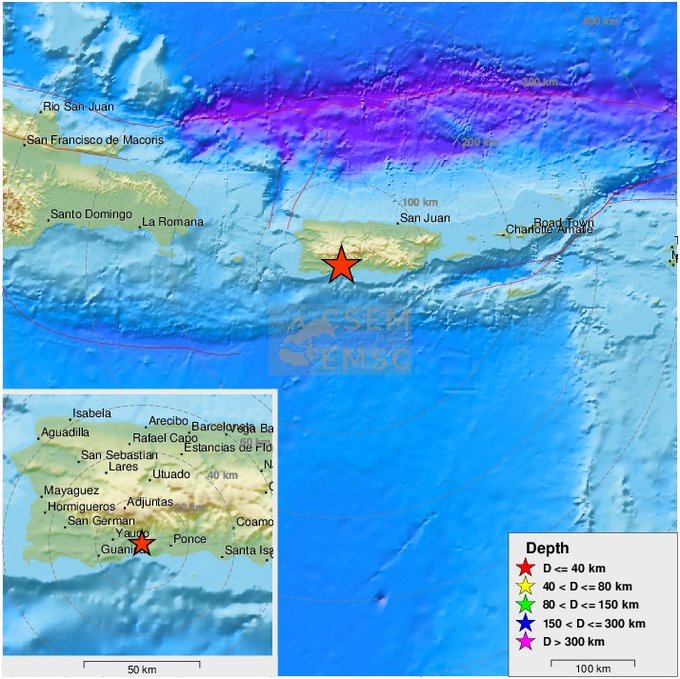

twitter:EMSC twitterde op dinsdag 28-01-2020 om 16:48:11 Update: M6.2 #earthquake (#deprem) strikes 194 km SW of #Fethiye (#Turkey) 10 min ago. https://t.co/0X2yvDnzvC reageer retweet


twitter:USGSBigQuakes twitterde op donderdag 13-02-2020 om 11:50:40 Prelim M6.9 Earthquake Kuril Islands Feb-13 10:33 UTC, updates https://t.co/dZOMradJMd reageer retweet
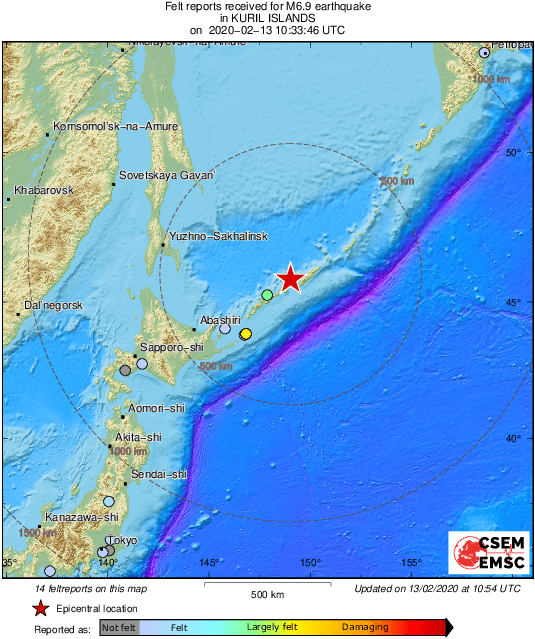
[ Bericht 6% gewijzigd door Houtenbeen op 13-02-2020 11:56:19 ]
quote:Earthquake experts lay out latest outlook for the ‘Really Big One’ that’ll hit Seattle
Earthquake experts say current building codes don’t reflect the riskiest features of the Seattle area’s geology — but the outlook for survivability looks a lot better if the Really Big One can just hold off for a few more years.
That’s the bottom line from a session focusing on Seattle’s seismic hazards, presented at ground zero today during the American Association for the Advancement of Science’s annual meeting. The session — titled “Is the Coast Toast?” — followed up on a 2015 New Yorker article that painted a grim picture of the possibilities, based on studies of the Pacific Northwest’s Cascadia subduction zone.
The Cascadia subduction zone, centered along a submarine fault just off the West Coast, is known to be capable of generating magnitude-9 quakes, based on the geological and historical evidence for a massive tsunami that reached Japan in 1700.
Seismologists estimate that such quakes and tsunami waves occur roughly every 500 years on average. “We say that there’s approximately a 14% chance of another approximately magnitude-9 earthquake occurring in the next 50 years,” said Erin Wirth, a geophysicist at the University of Washington and the U.S. Geological Survey.
To assess the potential effects of a Cascadia mega-quake, Wirth and other researchers are conducting a six-year, $3 million study known as the M9 Project.
One of the project’s experiments involved running 50 simulations of Cascadia quakes under a variety of conditions. The researchers found wide variation in the effects, depending on whether the undersea fault ruptured in a direction pointing away from Seattle (which would be good) or toward the city (which would be bad).
Another issue has to do with the fact that Seattle is built atop a sedimentary basin with relatively soft soil, which would amplify the strength of a seismic shock.
“A good analogy is, this is like a bowl of Jell-O,” Wirth said. “If you have a bowl of Jell-O, or a Jell-O mold on top of a plate, and you shake that plate, the Jell-O is so weak it’s going to move much more than the plate that you’re shaking. That’s kind of what’s happening here.”
And as if that weren’t bad enough, the Cascadia fault is so extended that the resulting quake is expected to last for about 100 seconds. That’s significantly longer than the duration of a typical California earthquake, and that adds to the bad news, said UW engineering professor Jeffrey Berman.
“Our building code is all built on the California experience, because that’s where we’ve had a lot of earthquakes and a lot of building and infrastructure damage,” Berman said. “So we haven’t really incorporated long-duration effects in building codes that are in use in the U.S., because we haven’t really had long-duration earthquakes. … We’re hoping that our work will actually go to change that.”
Earlier analyses of earthquake effects pegged the risk of collapse for buildings up to 20 stories tall at less than 10%. The M9 Project’s updated analysis, which takes account of longer-duration quakes as well as the Seattle area’s sedimentary basin amplification effect, would raise that projected risk to somewhere between 20% and 50% depending on building height and the standards followed for construction.
The good news is that building codes are due to be strengthened nationwide.
“They’re national codes,” Berman explained. “They have to go through a pretty intense vetting process, and they get adopted by local jurisdictions and modified. That process just takes time. This research will appear, but it won’t appear until 2023, likely. Now the city is holding some discussions on what to do, given our findings. It should be doing things ahead of that time, but that would be outside the national building code process.”
In reply to questions about where he’d rather be during a mega-quake, Berman noted that low-rise buildings in Seattle — say, up to three stories tall — would “do relatively well” in the event of a magnitude-9 quake. And when it comes to higher-rise buildings, the risk is lower for structures built after the mid-1980s.
“There was a really big transition that followed a couple of bigger earthquakes in California, and there were really big changes in the building code,” Berman explained. “So I think that’s what I would look at first: to stay out of buildings that were built before 1984 or so.”
That being said, Berman advised against obsessing over the Really Big One.
“You know, life is full of risks,” he said. “The risk of dying in a building in a earthquake in Seattle is less than [the risk of] dying in a car, if you get in a car and drive on I-5 today, right? It’s about learning and doing better as we move on, not necessarily being paralyzed.”
twitter:EMSC twitterde op woensdag 26-02-2020 om 08:43:56 #Earthquake (#gempa) M6.2 strikes 272 km SW of #Tual (#Indonesia) 11 min ago. More info: https://t.co/Us2QbPY6Sh reageer retweet
twitter:KNMI twitterde op maandag 02-03-2020 om 14:52:19 Recente aardbeving in Nederland: op 2020-03-02 om 13:41:19 UTC (14:41:19 NL) vond bij #Wagenborgen een #aardbeving plaats met een magnitude van 2.1 (automatisch). https://t.co/1kPv01R9G0 https://t.co/ACfNJ2PeaR reageer retweet
 Recente aardbeving in Nederland: op 2020-03-02 om 13:41:19 UTC (14:41:19 NL) vond bij
I was built to be the best, the number one and nothing less!
6.0 bij Madeiratwitter:EMSC twitterde op zaterdag 07-03-2020 om 22:18:22 #Earthquake (#terramoto) M6.0 strikes 55 km S of #Funchal (#Portugal) 20 min ago. More info: https://t.co/Wh9k3vi9ob reageer retweet
twitter:LastQuake twitterde op woensdag 18-03-2020 om 14:25:03 M5.6 #earthquake (#sismo) strikes 16 km W of Salt Lake City (#Utah) 15 min ago. Read eyewitnesses' stories & provide yours: https://t.co/YMjtXCR2Na reageer retweet
