WGR Werk, Geldzaken, Recht en de Beurs
Hier kun je alles kwijt over sollicitaties, werksituaties, belastingen, (handelen op) de beurs, hypotheken, beleggingen en salarissen, arbeidscontracten of geschillen met je (huis)baas. Alles over werk, geldzaken en recht dus.



Ik denk zelf dat er een grote kans bestaat dat we voor 2015 in een Depressie geraken. Er zijn/worden triljarden aan geld in het systeem gepompt die nog vast zijn blijven zitten maar de komende tijd zullen die toch vrijkomen. De prikkel tot verkeerde investeringen met een dalende rente(central bancs) en de moral hazard die is gecreeerd is het mijns inziens niet te vermijden. It takes mal investments to get a recession but it takes politicians to make a recession into a depressionquote:Dow Jones Index (sinds 1896)
1. 19 oktober 1987 -22.6%
2. 28 oktober 1929 -12.8%
3. 29 oktober 1929 -11.7%
4. 6 november 1929 -9.9%
5. 18 december 1899 -8.7%
6. 12 augustus 1932 -8.4%
7. 14 maart 1907 -8.3%
8. 26 oktober 1987 -8.0%
9. 21 juli 1933 -7.8%
10. 18 oktober 1937 -7.8%
In de week van 5 t/m 11 okt viel de Dow in een cascade meer dan 20%
Dow Jones Index
1. 15 maart 1933 +15,3%
2. 6 oktober 1931 +14,9%
3. 30 oktober 1929 +12,3%
4. 21 september 1932 +11,4%
5. 13 oktober 2008 +11,1%
6. 21 oktober 1987 +10,2%
7. 3 augustus 1932 +9,5%
8. 11 februari 1932 +9,5%
9. 14 november 1929 +9,4%
10. 18 december 1931 +9,4%
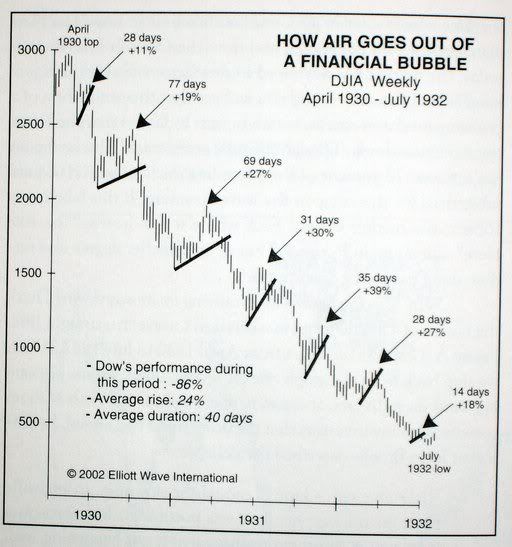

Wat voor gedachte hebben de medefokkers hierover?
[ Bericht 4% gewijzigd door digitaLL op 14-10-2008 18:47:32 ]
It is important to distinguish between a stupid person and a shit head. A stupid person simply can't process the information , a shit head is intelligent but his mind is full of garbage.

Dus wat gaan we doen mensen?
Kopen kopen kopen!
Kopen kopen kopen!
When I get sad, I stop being sad and just be awesome instead.


AEX op 259 is het begin van de neergang?quote:Op maandag 13 oktober 2008 22:42 schreef Tokamak het volgende:
http://www.usmarkets.nl/A(...)-van-1929.60563.html
Yup, we zijn net pas begonnen met de neergang
Never in the entire history of calming down did anyone ever calm down after being told to calm down.

we gaan eerst naar de 350 en als de dollar valt, wat echt zal gebeuren, anders komt de US niet van die schulden af.quote:Op maandag 13 oktober 2008 22:53 schreef Arcee het volgende:
[..]
AEX op 259 is het begin van de neergang?
Dan gaat de AEX ook naar de 120 met hopjes.
Bloombergquote:U.S. Stocks Rally Most Since 1930s on Bank Plan; Dow Gains 936
By Elizabeth Stanton
Oct. 13 (Bloomberg) -- U.S. stocks staged the biggest rally in seven decades on a government plan to buy stakes in banks and a Federal Reserve-led push to flood the global financial system with dollars.
The Standard & Poor's 500 Index rebounded from its worst week in 75 years with an 11.6 percent advance, its steepest since 1939, and the Dow Jones Industrial Average climbed more than 936 points. Morgan Stanley soared 87 percent after sealing a $9 billion investment from Japan's Mitsubishi UFJ Financial Group Inc. Alcoa Inc., Johnson & Johnson, Chevron Corp. and Prudential Financial Inc. posted their biggest gains since Bloomberg began tracking the data. Europe's benchmark index climbed 10 percent, its best jump ever, and Asia's added 3.1 percent.
``The worst of the immediate danger is past,'' said Bruce McCain, chief investment strategist at Key Private Bank in Cleveland, which manages $30 billion. ``It's always easier when you've got markets going up and you're not having to talk clients back in off the ledge.
......
''
Hoe zo'n positief bericht ook een negatieve connotatie kan hebben.
It is important to distinguish between a stupid person and a shit head. A stupid person simply can't process the information , a shit head is intelligent but his mind is full of garbage.


Ik denk dat beurskoersen enigzins vooruitlopen omdat de beurskoersen afhankelijk zijn van de winstgevendheid en de verwachte winstgevendheid van de onderliggende bedrijven. Er zit natuurlijk een selffullfilling prophecy in wat zich versterk zowel naar boven als beneden. Uit de Dow grafiek van de jaren 30 blijkt mi toch een sterke correlatie.quote:Op dinsdag 14 oktober 2008 20:58 schreef Wheelgunner het volgende:
Depressie gaat om een krimp van de economie, niet om een krimp van de beurskoersen.
It is important to distinguish between a stupid person and a shit head. A stupid person simply can't process the information , a shit head is intelligent but his mind is full of garbage.
Oh er is zeker een verband, dat probeerde ik ook niet te ontkennen. Maar het is nog te vroeg om te spreken van een depressie of zelfs recessie. Dan moet eerst minimaal 2 maanden achter elkaar het BNP duidelijk krimpen.quote:Op dinsdag 14 oktober 2008 22:32 schreef digitaLL het volgende:
[..]
Ik denk dat beurskoersen enigzins vooruitlopen omdat de beurskoersen afhankelijk zijn van de winstgevendheid en de verwachte winstgevendheid van de onderliggende bedrijven. Er zit natuurlijk een selffullfilling prophecy in wat zich versterk zowel naar boven als beneden. Uit de Dow grafiek van de jaren 30 blijkt mi toch een sterke correlatie.
Ik ben liever een beetje vroegquote:Op dinsdag 14 oktober 2008 22:35 schreef Wheelgunner het volgende:
[..]
Oh er is zeker een verband, dat probeerde ik ook niet te ontkennen. Maar het is nog te vroeg om te spreken van een depressie of zelfs recessie. Dan moet eerst minimaal 2 maanden achter elkaar het BNP duidelijk krimpen.

Vandaar ook dat het topic the next Great Depression heet.
Denk jij dat er een redelijke kans op is de komende jaren of dat het wel mee zal vallen allemaal?
It is important to distinguish between a stupid person and a shit head. A stupid person simply can't process the information , a shit head is intelligent but his mind is full of garbage.
Ik denk dat we een flinke recessie ingaan, maar ik denk dat er teveel lessen geleerd zijn om het echt te laten verzakken tot een depressie. Toch is ook dat risico aanwezig.
Zonder meer waar.... deze crisis is anders (economisch zitten we wel beter in het zadel). Maar toch zijn er ook duidelijke overeenkomsten. Een zeer belangrijk verschil is wel dat er veel meer pro-activer wordt opgetreden (toen de kentering zichtbaar was). Toch heb ik mijn vraagtekens... in 2007 / begin 2008 was het easy om het gevaar af te wenden....nu eind 2008 heb ik er een beetje een hard hoofd in.quote:Op dinsdag 14 oktober 2008 23:00 schreef Wheelgunner het volgende:
Ik denk dat we een flinke recessie ingaan, maar ik denk dat er teveel lessen geleerd zijn om het echt te laten verzakken tot een depressie. Toch is ook dat risico aanwezig.
Deze crisis is nieuw terrein.... nieuwe condities... andere setting.. maar ook een beetje besef dat banken wel eens aan de verkeerde kant van het touw zitten te trekken. Het sociale/stabiliserende element is weg.... winstbejag is all you need.


Bronquote:Not Your Grandfather’s Depression
October 17, 2008
Peter Schiff
The current stock market crash has spurred a vital national debate about the causes and catalysts of the Great Depression. The dominant school of thought believes that the stubborn refusal of then president Herbert Hoover to intervene after the stock market crash of 1929, and his preference for free market solutions, led directly to the ensuing decade-long catastrophe. Through this lens, our leaders assure us that the most recent raft of government measures will prevent another episode of bread lines, Hoovervilles and pencil salesmen. As usual they have it completely wrong. In my view, the Depression was created precisely because Hoover followed the path that our government is now taking.
When the stock market bubble of the Roaring Twenties (which was created as a result of the loose monetary policy of the newly created Federal Reserve) finally popped, Hoover would not allow market forces to correct the imbalances. His policies were aimed at propping up unsound businesses, artificially supporting prices, particularly wages, and providing Federal funds for public works projects. These moves went well beyond the progressive reforms of Teddy Roosevelt, and established Hoover as the most interventionist president ever up to that point. In fact, much of what eventually became the New Deal had its roots in Hoover’s policies.
However, at the time, there were those who recommended a different course. Andrew Mellon, the long-serving Secretary of the Treasury whom Hoover had inherited from the prior two Republican Administrations, was labeled by Hoover as a “leave it alone isolationist” who wanted to “liquidate labor, liquidate stocks, liquidate the farmers, and liquidate real estate.” Hoover would have none of it. In fact, during his nomination speech for a potential second term, Hoover bragged “We determined that we would not follow the advice of the bitter liquidationists and see the whole body of debtors of the United States brought to bankruptcy and the savings of our people brought to destruction.”
Hoover chose to ignore the sound advice of his Treasury Secretary (in contrast to today where the current Treasury Secretary Henry Paulson is actually leading the charge over the cliff) and instead used every tool at his disposal to “fix” the problem. As a result, rather than allowing a recession to run its course, with healthy and rapid liquidations of the mal-investments built up during the boom, Hoover inadvertently created what became the Great Depression.
When Roosevelt took office he continued the same failed policies only on a grander scale. The magnitude and the idiocy of many New Deal programs, such as the wage and price setting National Recovery Administration (NRA), compounded the problems. So while Mellon’s advice would have caused a sharp but relatively brief economic downturn (which occurred after the Panic of 1907, for example), the Depression plodded on for nearly a decade until the country began gearing up for the Second World War.
In an amazing feat of revisionist history, somehow Hoover’s interventionist policies have been completely forgotten. It is taken as fundamental that his inaction led to the Depression and Roosevelt’s “heroics” got us out. Unfortunately, since we have learned nothing from history, we are about to repeat the very mistakes that lead to the most dire economic circumstance of the last century.
A major difference however, is that the structure of the U.S economy today is far weaker than it was in the fall of 1929. Years of reckless consumer borrowing and spending, and enormous trade and budget deficits have resulted in a hollowed out industrial base and an unmanageable mountain of debt owed to foreign creditors. Instead of the support of a strong currency backed by gold, the public now must deal with a modern Fed free to print as much money as politicians want. So rather than getting the benefits of falling consumer prices (as happened during the Depression), consumers today will contend with much higher consumer prices, even as the economy contracts.
With Barack Obama now waiting in the wings to conjure a newer New Deal, far larger than even FDR could have imagined, and at a time when we cannot even afford the old one, this will not be your grandfather’s Depression. It may be much worse.
Ik ben het eens met het het feit dat de VS er slechter voorstaan als in de jaren 30.
1. Toen een spaaroverschot nu grote schulden zowel de US gov als de burgers.
2, Destijds was de VS de grootste exporteur van grondstoffen zoals olie nu juist importeur.
3. Gemeenschappen hielpen elkaar meer, er was meer sociale cohesie. Nu viert individualisme hoogtij.
It is important to distinguish between a stupid person and a shit head. A stupid person simply can't process the information , a shit head is intelligent but his mind is full of garbage.
Ja, de US doet mij wel eens denken aan een rijke man die maar blijft lenen en lenen en eenmaal aan lager wal geraakt alles moet terugbetalen
De enige vergelijking die er opgaat met de Great Depression is het feit dat de bordjes rood stonden voor een lange periode, voor de rest slaan de meeste vergelijkingen op niets uit. Zoiets als de 'Great Depression' krijgen we ook niet weer.
People once tried to make Chuck Norris toilet paper. He said no because Chuck Norris takes crap from NOBODY!!!!
Megan Fox makes my balls look like vannilla ice cream.
Megan Fox makes my balls look like vannilla ice cream.
maar, met Pauw en Wiitteman zag ik Vermeend en die had en heel dom plan over windmolens,waar ik wel veel in zie is het aanleggen van en super glasvezelnet in Nederland.quote:Op zaterdag 18 oktober 2008 00:04 schreef sitting_elfling het volgende:
De enige vergelijking die er opgaat met de Great Depression is het feit dat de bordjes rood stonden voor een lange periode, voor de rest slaan de meeste vergelijkingen op niets uit. Zoiets als de 'Great Depression' krijgen we ook niet weer.
Uhh? Waar heb je het over? Neem de grafieken van nu en de great depression eens naast elkaar zoals de mate van techonologie, de werkloosheid, het industriele index cijfer, het aantal banken dat 'om' vielen, De 'groei' van GDP, inflatie etc. Het enige verband is dat ze de zelfde kant opgaan, de groei en snelheid is totaal out of order.quote:Op zaterdag 18 oktober 2008 00:08 schreef henkway het volgende:
[..]
maar, met Pauw en Wiitteman zag ik Vermeend en die had en heel dom plan over windmolens,waar ik wel veel in zie is het aanleggen van en super glasvezelnet in Nederland.
People once tried to make Chuck Norris toilet paper. He said no because Chuck Norris takes crap from NOBODY!!!!
Megan Fox makes my balls look like vannilla ice cream.
Megan Fox makes my balls look like vannilla ice cream.
Wat wil hij met windmolens dan?quote:Op zaterdag 18 oktober 2008 00:08 schreef henkway het volgende:
maar, met Pauw en Wiitteman zag ik Vermeend en die had en heel dom plan over windmolens,waar ik wel veel in zie is het aanleggen van en super glasvezelnet in Nederland.
 Brengen die dingen nou al meer op dan ze kosten eigenlijk (en dan bedoel ik dus zonder prijstrucjes zoals met subsidies)?
Klopt, en op dit moment doet de federal reserve er alles aan om de wereld te overspoelen met relatief goedkope dollars, maar er komt een moment dat die weer duurder gaan worden en dan is het cashen voor ze.quote:Op vrijdag 17 oktober 2008 23:53 schreef henkway het volgende:
Ja, de US doet mij wel eens denken aan een rijke man die maar blijft lenen en lenen en eenmaal aan lager wal geraakt alles moet terugbetalen

Is dat ook de reden dat de FED eind septemer in de eerste paar dagen van de crash per dag honderden miljarden in de geldmarkt injecteerden? Dat ging zo rap toen...quote:Op zaterdag 18 oktober 2008 11:53 schreef -scorpione- het volgende:
[..]
Klopt, en op dit moment doet de federal reserve er alles aan om de wereld te overspoelen met relatief goedkope dollars, maar er komt een moment dat die weer duurder gaan worden en dan is het cashen voor ze.
(dat was nog voor Bush' reddingsplan met belastinggeld).
[ Bericht 0% gewijzigd door gebrokenglas op 18-10-2008 12:56:14 (typo) ]
Geduld
(zelfst. naamw.)
Iets dat op is tegen de middag.
(zelfst. naamw.)
Iets dat op is tegen de middag.
|
|
