WKN Weer, Klimaat en Natuurrampen
Lees alles over het onstuimige weer op onze planeet, volg orkanen en tornado's, zie hoe vulkanen uitbarsten en hoe Moeder Aarde beeft bij een aardbeving. Alles over de verwoestende kracht van onze planeet en tal van andere natuurverschijnselen.



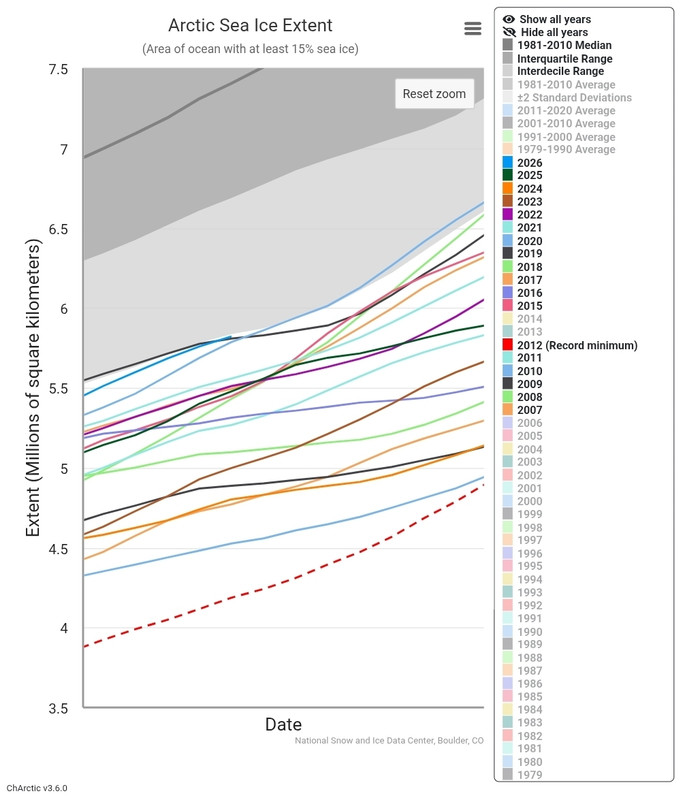
De westpassage is nog niet geopend dit jaar.
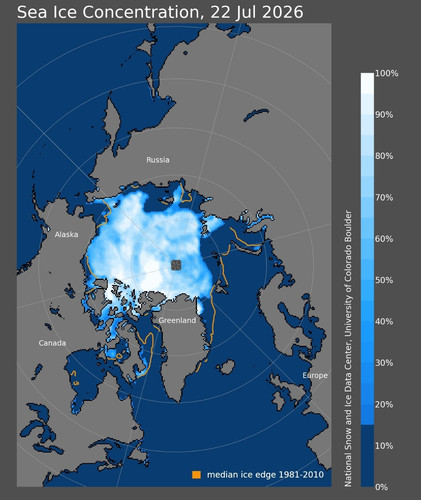
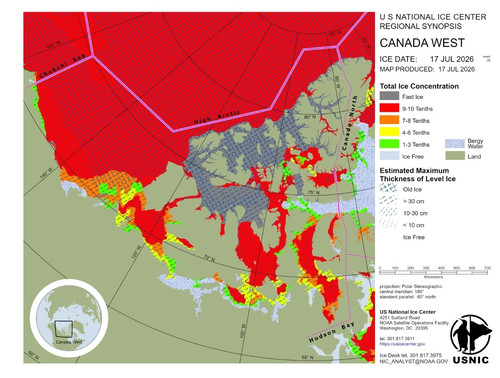
Vooral rond Groenland (Baffin bay en Groenland zee), de Barentszzee, Lara zee en het noorden van Rusland (Laptev zee en oost Siberische zee) ligt er minder ijs dan normaal. Bij het noorden van Alaska (Beaufortzee) en Canada (Nunavut) is de hoeveelheid ijs rond normaal te noemen. De komende weken zal er nog een grote hoeveelheid ijs wegsmelten en zal onderstaande kaartje er heel anders uitzien.
[ Bericht 0% gewijzigd door 12Beaufort op 23-07-2026 17:11:28 ]
Vooral rond Groenland (Baffin bay en Groenland zee), de Barentszzee, Lara zee en het noorden van Rusland (Laptev zee en oost Siberische zee) ligt er minder ijs dan normaal. Bij het noorden van Alaska (Beaufortzee) en Canada (Nunavut) is de hoeveelheid ijs rond normaal te noemen. De komende weken zal er nog een grote hoeveelheid ijs wegsmelten en zal onderstaande kaartje er heel anders uitzien.
[ Bericht 0% gewijzigd door 12Beaufort op 23-07-2026 17:11:28 ]
v
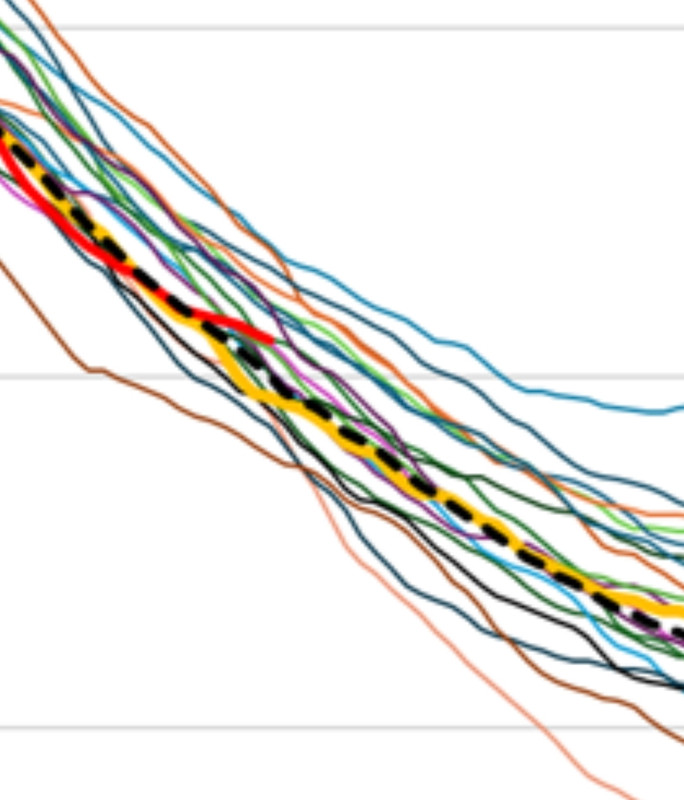
En zo staat het noordpoolijs ineens op plek 12 van de lijst met laagste hoeveelheid. Het zegt nog niks, want we hebben nog een dikke maand te gaan. Maar het valt nog niet te voorspellen in iedergeval. We gaan het volgen.
Een hardnekkig lagedrukgebied lijkt af te zwakken, waardoor warmere lucht het poolgebied in kan stromen, wat betekent dat er mogelijk nog een versnelling zal komen van het smeltseizoen. Er lig heel veel gebroken dunner ijs voor de kusten van Rusland en Noord Amerika. Voor nu staat 2026 op een 12e plek, maar of dat zo blijft weten we rond half september (iets eerder of later kan ook)
Een hardnekkig lagedrukgebied lijkt af te zwakken, waardoor warmere lucht het poolgebied in kan stromen, wat betekent dat er mogelijk nog een versnelling zal komen van het smeltseizoen. Er lig heel veel gebroken dunner ijs voor de kusten van Rusland en Noord Amerika. Voor nu staat 2026 op een 12e plek, maar of dat zo blijft weten we rond half september (iets eerder of later kan ook)
.png)
v
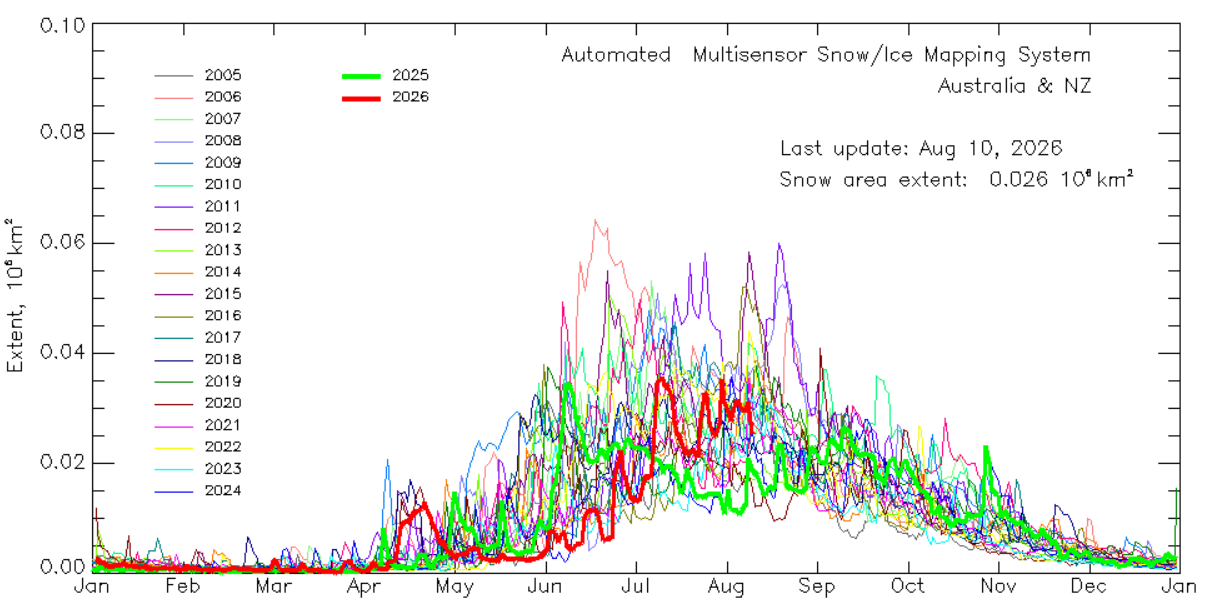
De hoeveelheid sneeuw in zuid Amerika was de hele winter beneden gemiddeld, maar is de laatste paar dagen enorm toegenomen en piekt nu bovenin de grafiek. In gedeeltes van het zuiden van Argentinie en Chili is de laatste tijd enorm veel sneeuw gevallen.
In Nieuw Zeeland en Australie lag de hoeveelheid sneeuw ook onder het gemiddelde. Hier is de lijn ook wat omhoog gegaan, maar niet indrukwekkend. Er ligt momenteel meer sneeuw dan vorig jaar.
In Nieuw Zeeland en Australie lag de hoeveelheid sneeuw ook onder het gemiddelde. Hier is de lijn ook wat omhoog gegaan, maar niet indrukwekkend. Er ligt momenteel meer sneeuw dan vorig jaar.

v
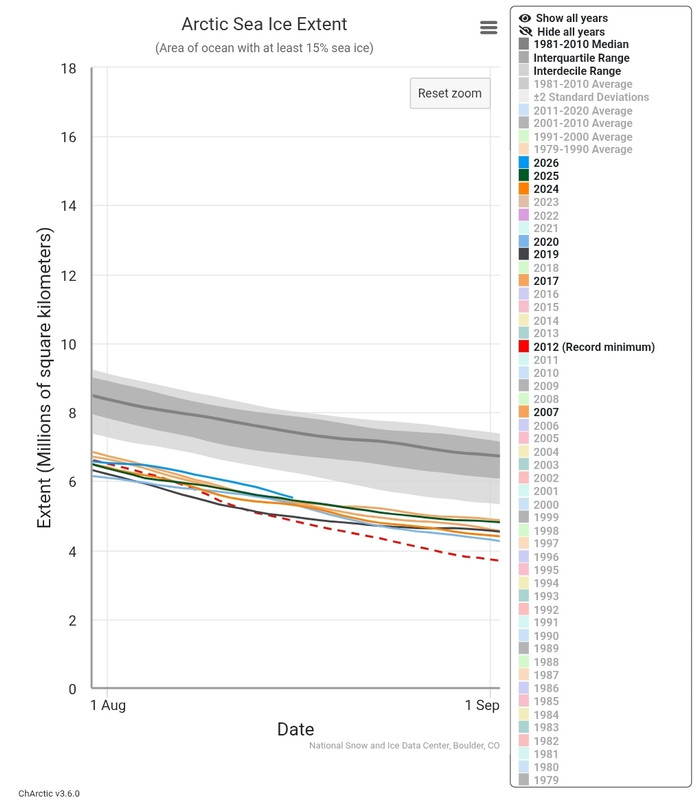
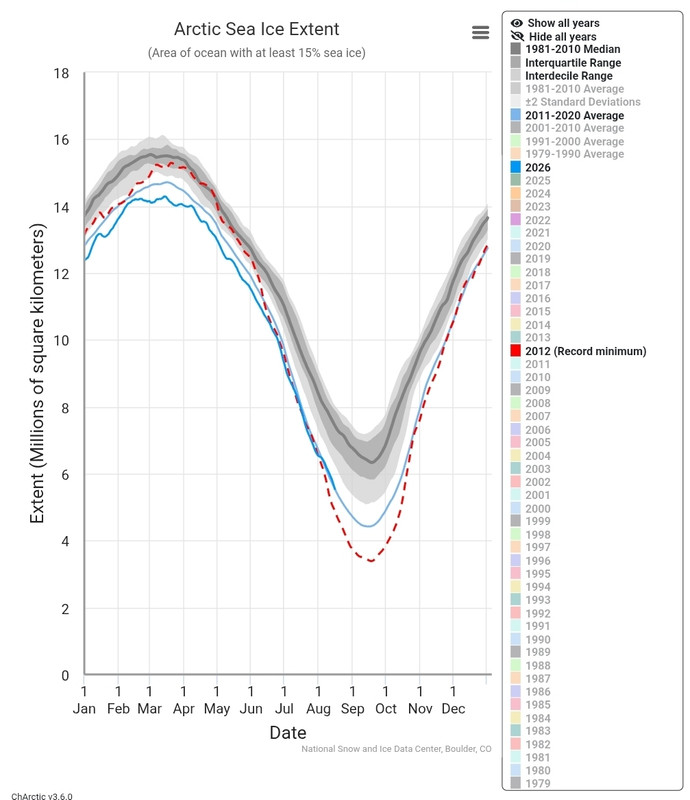
We zijn de laatste maand in gegaan van het smeltseizoen. Het valt nog niet precies te zeggen wanneer het minimum is bereikt, dit kan begin september zijn maar kan ook nog enkele weken later zijn. Het varieert van ongeveer 7 september tot rond 20 september.
Momenteel staat de hoeveelheid ijs in het noordpoolgebied op een 8e plek, als het gaat om laagste hoeveelheid. Dit jaar loopt gelijk met het gemiddelde van de jaren 2011 - 2020.
Ik hou hierbij het NSIDC model aan. Er zijn n.l. meer modellen en die komen ook met een andere berekening. Dit heeft te maken met het percentage ijs wat wordt meegenomen. Het JAXA model laat dit jaar nu bijvoorbeeld zien op een 11e plek.
[ Bericht 5% gewijzigd door 12Beaufort op 18-08-2026 14:50:00 ]
Momenteel staat de hoeveelheid ijs in het noordpoolgebied op een 8e plek, als het gaat om laagste hoeveelheid. Dit jaar loopt gelijk met het gemiddelde van de jaren 2011 - 2020.
Ik hou hierbij het NSIDC model aan. Er zijn n.l. meer modellen en die komen ook met een andere berekening. Dit heeft te maken met het percentage ijs wat wordt meegenomen. Het JAXA model laat dit jaar nu bijvoorbeeld zien op een 11e plek.
[ Bericht 5% gewijzigd door 12Beaufort op 18-08-2026 14:50:00 ]
v
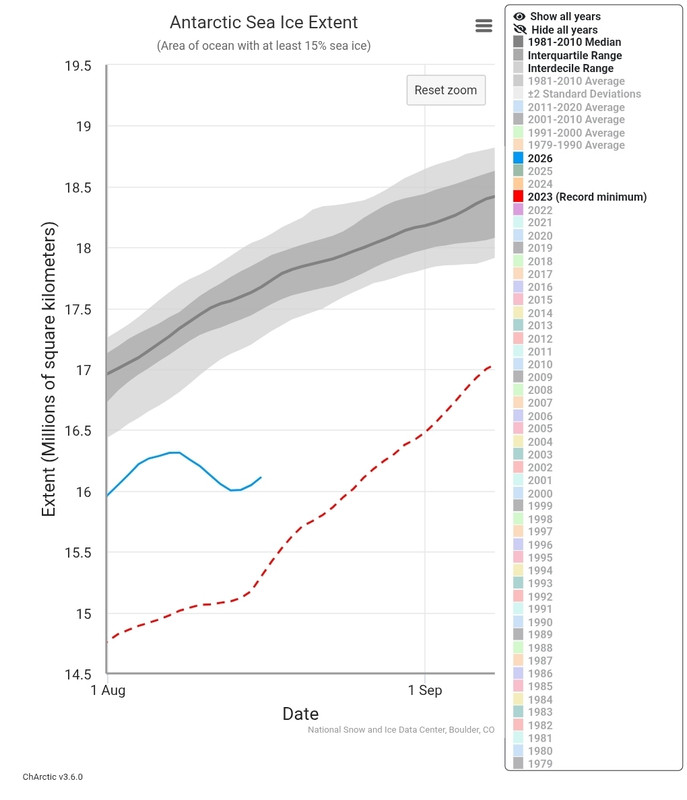
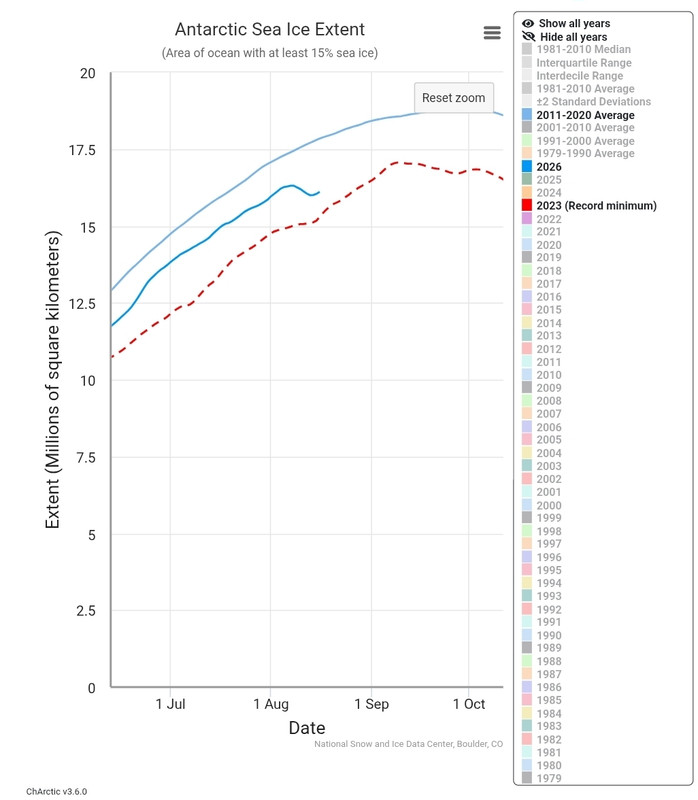
Het ijs van Antarctica heeft een flinke dip gehad en staat inmiddels op plek 2 van laagste hoeveelheid. Dit is ver onder het gemiddelde van 2011 - 2020.
v
Het smeltseizoen loopt ten einde
We zijn in de laatste twee weken beland van het smeltseizoen. Het valt nog niet precies te zeggen wanneer het smeltseizoen eindigt, maar als we naar de grafiek kijken dan lijkt dat ergens in deze twee weken te gaan gebeuren. We moeten wel een slag om de arm houden, want er kunnen nog onverwachte dalingen voorkomen, maar het lijkt erop dat we snel richting het einde gaan.
Aantal jaren met minder ijs dan dit jaar
Momenteel staat de hoeveelheid ijs op een 10e plek (gemeten door NDISC), als het gaat om laagste hoeveelheid. Bij het JAXA model staat het ijs op een 12 plek.
Zoals in de afbeeldingen te zien is, zijn de aantal jaren met meer ijs dan dit jaar veruit in de meerderheid. Wel ligt dit jaar net boven het gemiddelde van de jaren 2011 t/m 2020.
Aantal jaren met meer ijs dan dit jaar
Het is nu wachten tot het smeltseizoen overgaat in het vriesseizoen en dat gaat binnenkort van start. Wat we wel met zekerheid kunnen zeggen is dat dit jaar geen nieuw record zal gaan opleveren. Het jaar met de minste hoeveelheid ijs is het jaar 2012 en de laatste jaren lijken vrij stabiel en komen niet in de buurt van dit dieptepunt. Er moet wel bij gezegd worden dat de opwarming van de aarde gewoon doorgaat en het volgend jaar gewoon raak kan zijn met een El Nino die nog niet op zijn hoogtepunt is en voor veel warmte wereldwijd zorgt.

We zijn in de laatste twee weken beland van het smeltseizoen. Het valt nog niet precies te zeggen wanneer het smeltseizoen eindigt, maar als we naar de grafiek kijken dan lijkt dat ergens in deze twee weken te gaan gebeuren. We moeten wel een slag om de arm houden, want er kunnen nog onverwachte dalingen voorkomen, maar het lijkt erop dat we snel richting het einde gaan.
Aantal jaren met minder ijs dan dit jaar

Momenteel staat de hoeveelheid ijs op een 10e plek (gemeten door NDISC), als het gaat om laagste hoeveelheid. Bij het JAXA model staat het ijs op een 12 plek.
Zoals in de afbeeldingen te zien is, zijn de aantal jaren met meer ijs dan dit jaar veruit in de meerderheid. Wel ligt dit jaar net boven het gemiddelde van de jaren 2011 t/m 2020.
Aantal jaren met meer ijs dan dit jaar

Het is nu wachten tot het smeltseizoen overgaat in het vriesseizoen en dat gaat binnenkort van start. Wat we wel met zekerheid kunnen zeggen is dat dit jaar geen nieuw record zal gaan opleveren. Het jaar met de minste hoeveelheid ijs is het jaar 2012 en de laatste jaren lijken vrij stabiel en komen niet in de buurt van dit dieptepunt. Er moet wel bij gezegd worden dat de opwarming van de aarde gewoon doorgaat en het volgend jaar gewoon raak kan zijn met een El Nino die nog niet op zijn hoogtepunt is en voor veel warmte wereldwijd zorgt.
quote:* Extent loss on this day 105k, which is 39 k more than the average loss on this day (of the last 10 years) of 66k,
* Extent loss from maximum on this date is 9,625 k, which is 469 k, 4.6% less than the 10 year average of 10,094 k.
* Extent is 10th lowest in the 49 year satellite record. Extent has been lowest for 37 days so far this year.
* Extent is 13 k LESS than 2025,
* Extent is 408 k MORE than 2024,
* Extent is 206 k MORE than 2023,
* Extent is 628 k MORE than 2020,
* Extent is 403 k MORE than 2016,
* Extent is 1,160 k MORE than 2012,
* Extent is 2,420 k LESS than the 1980's Average
* Extent is 39 k MORE than the 2010's Average
* Extent is 91 k MORE than the 2020-2025 Average.
On average 93.0% of Extent losses from maximum to minimum done, and 12 days to the average date of the minimum.
Projections. (See Table 4)
Average remaining Extent loss (of the last 10 years) would produce a minimum in September 2026 of 4.48 million km2, 1.14 million km2 above the September 2012 record low minimum of 3.34 million km2, and 10th lowest in the 49 year satellite record.
bron
v
Het smeltseizoen lijkt ten einde. Het is nog niet officieel, maar het ijs lijkt vanaf nu weer aan te groeien. Het minimum ijs lijkt bereikt op 13 september, waarbij dit jaar op een 10e plek stond van laagste hoeveelheid.


v
12 september volgens het NSIDC
quote:On September 12, Arctic sea ice likely reached its annual minimum extent of 4.60 million square kilometers (1.78 million square miles). The 2026 minimum shares the tenth lowest spot in the nearly 48-year satellite record with 2008, 2010, and 2025. The last 20 years, from 2007 to 2026, are the lowest 20 sea ice extents in the satellite record.
v
Het ijs in het noordpoolgebied is flink aan het groeien en staat momenteel op een een 16e plek. Deze gegevens worden bijgehouden vanaf 1979, wat betekent dat er nog wel 31 jaren kouder waren op deze datum. Maar het is wel bijzonder om te zien dat dit jaar momenteel zo hoog staat. Hoe het gaat eindigen dit jaar valt nog niet te zeggen, We hebben een Super El Nino die misschien nog van invloed kan zijn. Maar voor hetzelfde heeft dit juist een positief effect op het ijs. We gaan het zien.
Kijken we naar de beelden, dan is duidelijk zichtbaar dat er minder ijs ligt dan het gemiddelde van de jaren 80 tot 2010. Dit jaar ligt wel boven het gemiddelde van 2011-2020.

Kijken we naar de beelden, dan is duidelijk zichtbaar dat er minder ijs ligt dan het gemiddelde van de jaren 80 tot 2010. Dit jaar ligt wel boven het gemiddelde van 2011-2020.

v
Globaal gezien staat dit jaar op een derde plek.
#1: 2023 - 20.96 M km²
#2: 2024 - 21.35 M km²
#3: 2026 - 22.06 M km²
#4: 2025 - 22.42 M km²
#5: 2017 - 22.47 M km²
#6: 2019 - 22.60 M km²
#7: 2008 - 22.67 M km²
#8: 2018 - 22.70 M km²
#9: 2016 - 22.84 M km²
#10: 2015 - 22.87 M km²
#1: 2023 - 20.96 M km²
#2: 2024 - 21.35 M km²
#3: 2026 - 22.06 M km²
#4: 2025 - 22.42 M km²
#5: 2017 - 22.47 M km²
#6: 2019 - 22.60 M km²
#7: 2008 - 22.67 M km²
#8: 2018 - 22.70 M km²
#9: 2016 - 22.84 M km²
#10: 2015 - 22.87 M km²
v
Het ijs op Antarctica ligt momenteel op een 2e plek van minste hoeveelheid. Alleen in het jaar 2023 lag er minder ijs dan dit jaar. De maximale hoeveelheid zee ijs werd dit jaar waarschijnlijk bereikt op 14 september 2026, maar dit moet nog officieel bevestigd worden.
#1: 2023 - 16.56 M km²
#2: 2026 - 16.97 M km²
#3: 2024 - 17.04 M km²
#4: 2017 - 17.63 M km²
#5: 2025 - 17.66 M km²
#6: 2002 - 17.68 M km²
#7: 1986 - 17.69 M km²
#8: 1992 - 17.88 M km²
#9: 2008 - 17.91 M km²
#10: 2016 - 17.92 M km²

#1: 2023 - 16.56 M km²
#2: 2026 - 16.97 M km²
#3: 2024 - 17.04 M km²
#4: 2017 - 17.63 M km²
#5: 2025 - 17.66 M km²
#6: 2002 - 17.68 M km²
#7: 1986 - 17.69 M km²
#8: 1992 - 17.88 M km²
#9: 2008 - 17.91 M km²
#10: 2016 - 17.92 M km²

v
https://nsidc.org/news-an(...)-likely-reached-wellquote:Arctic sea ice
Arctic sea ice likely reached its minimum extent for the year, at 4.60 million square kilometers (1.78 million square miles) on September 12, 2026, according to scientists at the National Snow and Ice Data Center (NSIDC) at the University of Colorado Boulder. The 2026 minimum is ranked tenth lowest in the nearly 48-year satellite record, tied with 2008, 2010, and 2025. The last 20 years are the lowest 20 Arctic sea ice extents in the satellite record.
“This year’s minimum is yet another low extent in a changed Arctic,” said senior scientist Walt Meier. “While this year’s minimum is in line with recent years, it is far lower than anything we saw in the 1980s, 1990s, and early 2000s.”
NSIDC director Mark Serreze said, “It’s been a strange year. It was only tenth lowest in extent, but despite the fairly cool Arctic Ocean summer, there was loose ice all the way to the pole.”
NSIDC scientists stress that the Arctic sea ice extent number is preliminary—compaction from winds could still push the ice extent lower.
Antarctic sea ice
NASA Blue Marble image shows Antarctic sea ice on September 14, 2026, when sea ice likely reached its maximum extent for the year
In the Antarctic, sea ice extent has been tracking near record low levels for most of the growth season, most likely reaching its maximum extent on September 14 at 17.59 million square kilometers (6.79 million square miles). If this maximum date holds, this will be the third lowest Antarctic sea ice maximum on record.
“Antarctica’s sea ice during this year's growth season has steadily lagged the long-term average,” said senior scientist Ted Scambos. “This is a continuation of below-average extent across all seasons for most of the past decade.”
It must be noted that large fluctuations in extent are typical of Antarctic sea ice near the seasonal maximum, often leading to some delay in confidently identifying the maximum, which typically occurs in late September or early October but has been reached as early as August 30.
NSIDC will issue a full analysis at the beginning of October addressing the possible causes behind this year’s ice conditions, interesting aspects of the Arctic melt season and Antarctic growth season, and graphics comparing this year to the long-term record.
v
Op 14 september lag er in de jaren 2023 en 2024 minder ijs dan in 2026. Op 14 september (maximum hoeveelheid ijs van dit jaar) lag 2026 dus op een derde plek.quote:Op zondag 27 september 2026 12:14 schreef 12Beaufort het volgende:
Het ijs op Antarctica ligt momenteel op een 2e plek van minste hoeveelheid. Alleen in het jaar 2023 lag er minder ijs dan dit jaar. De maximale hoeveelheid zee ijs werd dit jaar waarschijnlijk bereikt op 14 september 2026, maar dit moet nog officieel bevestigd worden.
[ afbeelding ]
#1: 2023 - 16.56 M km²
#2: 2026 - 16.97 M km²
#3: 2024 - 17.04 M km²
#4: 2017 - 17.63 M km²
#5: 2025 - 17.66 M km²
#6: 2002 - 17.68 M km²
#7: 1986 - 17.69 M km²
#8: 1992 - 17.88 M km²
#9: 2008 - 17.91 M km²
#10: 2016 - 17.92 M km²
[ afbeelding ]
#1: 2023 - 16.93 M km²
#2: 2024 - 16.98 M km²
#3: 2026 - 17.59 M km²
#4: 2018 - 17.62 M km²
#5: 2002 - 17.74 M km² *
#6: 2016 - 17.76 M km²
#7: 2025 - 17.78 M km²
#8: 2017 - 17.93 M km²
#8: 1986 - 18.00 M km² *
#10: 1990 - 18.06 M km²
v
Het is wel bijzonder dat dit jaar momenteel op een 17e plek ligt. Sinds 2015 heeft er niet zoveel ijs gelegen in het noordpoolgebied. Ik ben wel benieuwd hoe het ijs zich deze winter verder gaat uitbreiden.

v
In onderstaande link is te zien hoe het ijs in september (minimum) en in maart (maximum) was. Vanaf 1990.
https://science.nasa.gov/(...)to-its-2026-minimum/
https://science.nasa.gov/(...)to-its-2026-minimum/
v


Zulke cijfertjes reken ik altijd om naar een unit waar ik me iets kan bij voorstellen. Er lag dus een half miljoen vierkante km meer dan in het laagste jaar, en bijna een half miljoen vierkante km minder dan in nr 10 op de lijst. Dat is ruim 12 keer Nederland.quote:
[..]
Op 14 september lag er in de jaren 2023 en 2024 minder ijs dan in 2026. Op 14 september (maximum hoeveelheid ijs van dit jaar) lag 2026 dus op een derde plek.
#1: 2023 - 16.93 M km²
#2: 2024 - 16.98 M km²
#3: 2026 - 17.59 M km²
#4: 2018 - 17.62 M km²
#5: 2002 - 17.74 M km² *
#6: 2016 - 17.76 M km²
#7: 2025 - 17.78 M km²
#8: 2017 - 17.93 M km²
#8: 1986 - 18.00 M km² *
#10: 1990 - 18.06 M km²
Die cijfers zeggen idd niet zoveel. Maar als je het zo gaat omrekenen lijkt het weer heel anders. 12 keer Nederland is een aardige oppervlakte.quote:Op donderdag 8 oktober 2026 11:43 schreef George_of_the_Jungle het volgende:
[..]
Zulke cijfertjes reken ik altijd om naar een unit waar ik me iets kan bij voorstellen. Er lag dus een half miljoen vierkante km meer dan in het laagste jaar, en bijna een half miljoen vierkante km minder dan in nr 10 op de lijst. Dat is ruim 12 keer Nederland.
v
WEDNESDAY, OCTOBER 7, 2026
The continuation of cool and stormy conditions over the Arctic Ocean during September bookends the strange summer of 2026. While global air temperatures were at or near record highs for June, July, and August, the summer was cool and stormy over the Arctic Ocean. The Arctic sea ice minimum extent tied for tenth lowest on the satellite record with 2008, 2010, and 2025, with a loose ice pack on the Atlantic side extending to the pole. However, the post-minimum freeze up has been rapid. Antarctic sea ice extent, which reached its maximum on September 14, dropped sharply through September, hitting record low daily extents since October 2.
The continuation of cool and stormy conditions over the Arctic Ocean during September bookends the strange summer of 2026. While global air temperatures were at or near record highs for June, July, and August, the summer was cool and stormy over the Arctic Ocean. The Arctic sea ice minimum extent tied for tenth lowest on the satellite record with 2008, 2010, and 2025, with a loose ice pack on the Atlantic side extending to the pole. However, the post-minimum freeze up has been rapid. Antarctic sea ice extent, which reached its maximum on September 14, dropped sharply through September, hitting record low daily extents since October 2.
v
https://science.nasa.gov/(...)to-its-2026-maximum/quote:Unlike the Arctic—an ocean basin surrounded by land—the Antarctic is a large continent surrounded by an ocean. Because of this geography, sea ice has more room to expand during the winter. However, that ice also stretches into warmer latitudes, leading to more melting in the summer. Antarctic sea ice usually peaks in September, around the end of the Southern Hemisphere’s winter, and retreats to a minimum in February.
According to NASA and the National Snow and Ice Data Center (NSIDC), Antarctic sea ice in 2026 likely reached its annual maximum extent on September 14 (above). On that date, the ice covered an estimated 17.59 million square kilometers (6.79 million square miles), making it the third-lowest maximum on record.
The maps below show the average concentration of Antarctic sea ice for the month of September (left) and the following February (right) from 1990 to 2026. Opaque white areas indicate the highest concentrations, and dark blue areas are open water. The images include only areas where ice concentration was at least 15 percent, a threshold scientists commonly use to count an area as ice-covered in satellite data. Scientists refer to the total area of these regions as the “sea ice extent.”
v
|
|
