Anyway, een leuk berichtje van de FP

quote:Dat ziet er potdomme leuk uit, lijkt me wel gaaf om te doen'Waterauto' snel over Het Kanaal
Richard Branson heeft een nieuw record gevestigd. De Engelse zakenman en avonturier stak in één uur, veertig minuten en zes seconden met een amfibievoertuig Het Kanaal over. Het oude record stond op 4,5 uur en werd in de jaren zestig gevestigd. De oversteek van Dover naar Calais verliep zonder problemen.
Branson is onder meer de baas van het Engelse concern Virgin. Hij baarde eerder opzien door zijn pogingen met een luchtballon de aarde rond te vliegen. De 35 km lange tocht van Engeland naar Frankrijk legde de miljonair af in de Aquada, een sportauto die zich zowel over land als op het water razendsnel kan voortbewegen. Het voertuig doorstond de golven, de bestuurder moest een nat pak op de koop toenemen. "Dat was verfrissend", verklaarde Branson bij aankomst.
De Aquada maakte vorig jaar september een eerste geslaagde proefrit. Het voertuig werd ontwikkeld door de firma Gibbs Technologies. Op de weg kunnen snelheden van bijna 160 km per uur worden behaald, op het water bijna 50 km per uur. Door inklapbare voorwielen is de omschakeling van auto naar boot een secondenkwestie. Doordat het voertuig de voorkant boven de waterspiegel kan laten uitstijgen is het mogelijk hoge snelheden te halen.
De Aquada tijdens een proefvaart
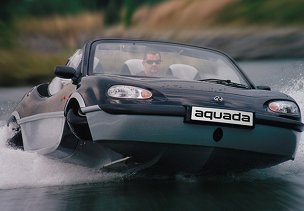


quote:Engine: 175 hp, 24 valve, V6 with EEC compliant immobiliser.
Gearbox: 5 Speed Automatic and Reverse.
Fuel: 95 ROZ Unleaded.
Fuel Tank Capacity: 15 Gallons / 67 Litres.
Wheels: Front/Rear 16 x 6.5 J Alloy 6 Spoke.
Tyres: Front 215/65R16; Rear 225/60R16.
Brakes: All Round Power Assisted Discs. Front Ventilated.
Suspension: Computer Controlled Air/Oil Hydraulic Self-Levelling with Variable Ride Height
Steering: Power Assisted on Road and Water.
Seating: 3 Across - Centre Steer. Seats can be Elevated for Improved Viewing on Water
Seat Belts: Three-Point Pre-Tension Seat Belts for Driver and 2 Passengers
Kerb Weight (kg): 1466
Permissible Gross Weight (kg): 1750
Jet: Proprietary Gibbs Unit
Trim Tabs: Dihedral Electric Trim Tabs
Bilge Pumps: 3 Independent Systems
Buoyancy: Non-Sinkable if Swamped
Lights: Marine Navigation Lights
Fire Protection: Automatic Engine Compartment Suppression System
Boot Capacity (kg): 35
Hood: Bimini Style
Heater: Included
Audio: Water-Resistant CD/Radio
Colours: Black, Yellow, Red or Blue with Silver Hull; Solid Colour Option
at Extra Cost
Warranty: Standard 2 years in the United Kingdom only.
quote:ik ookOp dinsdag 15 juni 2004 01:05 schreef Tommy_Kuklinski het volgende:
ik vind dat zeer gaaf

Was laatst op tv
Kunnen ze de kanaaltunnel gaan dichtgooien,


quote:How the Gibbs Aquada Works
Part of the car-buying process involves selecting the options you want to upgrade or customize your vehicle. In a few years, automotive retailers might offer us an option that will transform landlocked sports utility vehicles and sedans into amphibians that can traverse land and water with equal ease.
Gibbs Technologies has developed High Speed Amphibian (HSA) technology that could transform cars into amphibians. To showcase this new technology, Gibbs built the Aquada, an amphibian vehicle that debuted in late 2003. While the British company eventually hopes to license the HSA technology to large automotive manufacturers, they are currently focused on selling the Aquada at a cost of £150,000 ($271,318.90).
In this article, we will take a look at the Aquada and the technologies that could meld our waterways and roadways into a single, unified transportation channel.
Aquada Basics
Stepping over the side of the vehicle and into the cockpit, you realize that the Aquada is a vehicle that doesn't fit neatly into any existing category. You step directly into it like a boat, but the driver sits behind a car-like steering wheel. The three-seat Aquada was designed to allow for a driver, a water skier, and an observer.
"It is uncanny because all the cues inside the vehicle say you are driving a car, but outside it's a boat," said Dr. Keith Alexander, a senior lecturer in mechanical engineering at Canterbury University, who acted as a consultant on the Aquada. "You are sitting there at the steering wheel, with your foot on the pedal but instead of the roadside going past, it's water."
In developing the Aquada, Gibbs designers and engineers used the Seadoo watercraft as their comparator for water performance, according to Neil Jenkins, Managing Director of Gibbs Technologies. It is intended as a leisure vehicle with agility on the water. On the road, it is expected to handle and perform like an average sports car, but Jenkins doesn't identify a specific comparator.
"It corners and handles well, and it's predictable. It's a good average sports car," says Jenkins.
Jenkins says performance has not been compromised for either mode of travel, and that consumers will get equal performance on land and water. To understand just how well it compares with its road and water counterparts, we need to look at the components of the Aquada.
Aquada Components
Powering the vehicle is a 175-horsepower, V6, 2.5-liter, 24-valve engine. On land, this engine enables the Aquada to reach 100 miles per hour (161 kilometers per hour) and accelerate from 0 to 60 mph in less than 10 seconds.
This engine also provides power to the amphibian's jet, which propels the vehicle through water.
The jet is a proprietary unit created by Gibbs. As Gibbs developed the Aquada, it was necessary to design a jet that was lightweight and compact. The jet also needed to expel 1 ton of thrust, which is the force required for the vehicle to plane in the water. The jet is 35 inches (.89 meters) long and weighs 88 pounds (40 kilograms).
Jenkins says that most jets that produce the same amount of force are twice as long and would not fit the Aquada. The jet's thrust and the low power-to-weight ratio of the engine allow the amphibian to travel up to a maximum of 34.7 mph (55.8 kph) and accelerate to a plane in five seconds.
More Aquada Features
Here is a breakdown of some other features of the Aquada:
Transmission: Four-speed automatic
Brakes: All-round discs
Tires: F215x65, R225x60
Wheels: F-16 X 6.5J; Alloy 6-spoke
Fuel capacity: 15 gallons (67 liters)
Fuel type: 95 Ron Unleaded
Trim tabs: Dihedral trim (Trim tabs are plates attached to the rear of the vehicle that push down on the water to help the vehicle plane.)
Bilge pumps: Three independent systems (Bilge pumps remove water taken on due to normal operation.)
Weight without occupants: 2,976 pounds (1,350 kg)
The Aquada also uses patented technologies to allow it to transition from water to land and back. We'll take a look at this transformation process in the next section.
In the Water
About 75 percent of the Earth's surface is covered by water. A vehicle that could travel on land and water could potentially change current transportation models. For an amphibian to work, it must be able to float, prevent leakage and corrosion, and successfully transition from land to sea and back.
The Aquada has no doors, which helps prevent leaks. The basic structure is an aluminum-bonded space frame. To address the issue of corrosion, Gibbs has tested its materials under extreme conditions. Every component has undergone a 2,000-hour salt-spray test, which is about four times longer than a standard automobile is tested. Jenkins said that the company has gone to extra lengths to ensure safety.
"There's residual buoyancy, so you can't sink the vehicle," says Jenkins. "If you chain it to the bottom of the English Channel for a week and then let it go, it would pop to the surface."
Conversion
Other attempts at amphibian vehicles have been less successful because of drag, which is mainly due to an inability to retract the wheels. Gibbs has patented several technologies that allow it to retract its wheels like an airplane retracting its landing gear.
As the vehicle enters the water, the driver simply presses a button to trigger the vehicle's four-second transformation. Here are the actions involved in the conversion:The vehicle recognizes it's in the water. The vehicle recognizes it's in appropriate depth. The engine drive to the road wheels is cut. The wheels are retracted. Trim tabs are deployed to an optimized position. Road lights change to marine lights.
During the transformation, the driver should rev the engine to about 2,000 revolutions per minute (rpm) to provide sufficient thrust to the jet. At this point, the jet is already submerged and begins expelling water to push the Aquada.
The Aquada is an engineering achievement that was made possible by the work of several dozen engineers and designers over the course of seven years. In the next section, we'll discuss the future of the Aquada.
Bringing the Aquada to Market
The Aquada is an expensive leisure vehicle at £150,000 ($271,318.90). Its current price makes it more expensive then all but a few cars in the world. Jenkins concedes that the Aquada is an exclusive vehicle that will appeal to a niche market for the next year or two.
For approximately the price of an Aquada, you could also buy one of the following luxury sports cars:Lamborghini Murciélago ($273,000/£149,613) Aston Martin Vanquish ($228,000/£124,951) Ferrari 575 M Maranello ($215,000/£117,822) Porsche GT2 ($180,665/£99,006)
"We're not out to compete with Porsche or Ferrari, because you can have more fun with the Aquada on a bit of water than you can in a 40-acre car park with a Ferrari," says Jenkins.
Gibbs' long-term plan is focused on licensing the patented HSA technology to automotive manufacturers, who would integrate it into their vehicle designs.
"Our aim is in five, six, 10 years time, you'll be able to go out and purchase your normal vehicle from a normal showroom, and one of the options that you might have on the options list is High-Speed Amphibian technology," says Jenkins.
In the meantime, Gibbs is selling the Aquada; 200 are to be built by the end of 2004. Gibbs is now in the process of getting the amphibian on the road. It is already legal for road and water use in Europe, where the European Recreational Craft Directive classifies it as a passenger-car vehicle and a Category D watercraft.
Drivers need a road license and a water license, and England requires a Ministry of Transport (MOT) certificate every year from the vehicle's third birthday. The Aquada is not yet legal in the United States, where it still faces Environmental Protection Agency (EPA) concerns.
History of Amphibians
The history of the amphibian parallels that of the automobile. Even as the automobile was in its infancy in the early twentieth century, people were already working on creating an amphibian. This a list of some of the more notable efforts to build one.*
Magrelen Amphibium (1899) - Possibly the first motorized attempt at an amphibian, the Amphibium was built in Denmark.
Trippel SG6 (1937) - Designed by Hannes Trippel, who designed several amphibious cars for Germany, the SG6 was produced for the German army. Trippel was also involved in the Amphicar, described below.
Hydromobile (1942) - Built in 1942 by a Hungarian engineer in the United States, it had a wooden hull and three retractable wheels.
Amphicar (1961-68) - Perhaps the most successful commercial amphibian, it is the only mass-produced amphibious automobile ever, with 3,878 built. The Amphicar sold for between $2,800 and $3,300. It could reach 70 mph (113 kph) on the road and 7 mph (11 kph) on water.
Renault Racoon (1993) - Developed by the French auto manufacturer, the Racoon was a concept car designed to go anywhere, including in the water. It was a four-wheel-drive vehicle with a V6 twin-turbo engine. Its top water speed was 5 knots (8 mph/13 kph).
The 7th International Amphicar Owners Club Swim-In, Celina, OH


quote:Wat is dat nou toch voor een eng snorretjeOp zondag 11 juli 2004 16:26 schreef joohgf het volgende:
de Amphicar!
[afbeelding]
[afbeelding]
[afbeelding]
[afbeelding]


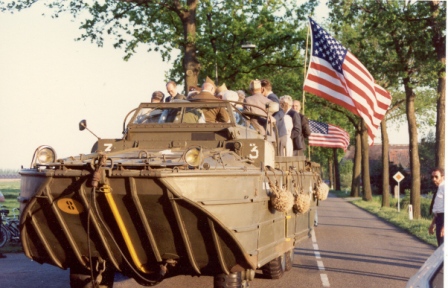
(1990 - Vervoer van de veteranen van de 101e Airbornedivisie in een amfibievoertuig naar de herdenking)


(BIRMINGHAM - De toenemende populariteit van SUV’s, gekscherend PC Hooftstraattractor genoemd, heeft het Engelse Gibbs Technologies op het idee gebracht om ook van een 4x4-model een amfibievoertuig te maken.
MEER: http://autotelegraaf.nl/vanonzeredactie/?id=24536
.En als er iemand nog aanvullingen heeft: graag!
GamaGoat


GMC DUKW


DAF

Orukter Amphibolos uit 1805

Trippel SG 6
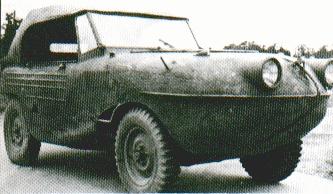
Volkswagen typ 128 en typ 166
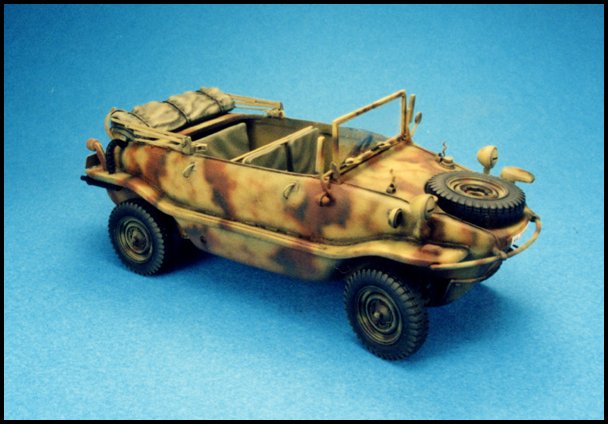


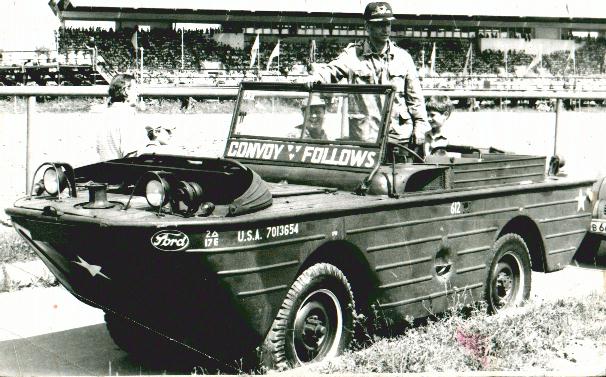
Ford GPA

Amphicar 770


Amphi Ranger


Schäfer Orion

Trippel Aqua-terra

Hobbycar


Dobbertin Surface Orbiter


Dutton Mariner


Renault Racoon


Aquastrada Delta

Tatra 801

Skoda 972

GAZ-46

Europa-Jeep

Ryan FIAT Panda 4X4

En dan nog wat waarvan ik geen zin had de naam op te zoeken


 Zijn er eik al Amfibie-topics hier in PTA?
 Gecopy/paste van howstuffworks.com (wat een teringwerk was dat met al die plaatjes!
 )
)Landshark lijkt me ook een potentieel


Rinspeed Splash, was afgelopen vrijdag bij Top Gear
amfibies zijn leuk!
Gaat dit ooit drijven????? Containerschepen van XXXXX maal dat gewicht drijven toch ook?!

quote:Wet van Archimedes ooit geprobeert? Een baksteen weegt toch ook minder dan zo'n container schip, maar zinkt toch...Op dinsdag 9 november 2004 20:59 schreef Tique het volgende:
waarom zou dat niet drijven?
Containerschepen van XXXXX maal dat gewicht drijven toch ook?!
quote:Hoovercraft?Op dinsdag 9 november 2004 21:39 schreef Alexxxxx het volgende:
inderdaad, ik heb nog wel grotere amfibievoertuigen gezien ook.. bedoeld voor het vervoer van bijvoorbeeld die oranje dingen zoals op dit plaatje.. passen er vier van in de bak of zo.. maar ja, ik ben vergeten hoe ze heten, en dan gaatplaatjes vinden zo moeilijk he

http://www.watercar.com/photo.html
quote:nee, wielvoertuig.. te vergelijken met zo'n dumper voor open mijnbouw, maar dan als amfibie... als ik m tegenkom post ik m meteenOp dinsdag 9 november 2004 21:54 schreef Skull-splitter het volgende:
[..]
Hoovercraft?
quote:en dan slaat je neus tegen een golfjeOp dinsdag 9 november 2004 21:58 schreef Foo_niks het volgende:
[afbeelding]
http://www.watercar.com/photo.html


Merk en type: GMC DUKW
Eigenaar:
Land van herkomst: Nederland
Locatie: Leeuwarden: Hemrik
Datum: 15-8-2005
Fotograaf/Bron: Alex Miedema
quote:Dat is gewoon de Aquada uit de Startpost hoorOp dinsdag 9 november 2004 20:13 schreef Alexxxxx het volgende:
Voor dat er mensen gaan vragen 'waar slaat dit topic op': 'Ter Leeringh ende Vermaeck'
En als er iemand nog aanvullingen heeft: graag!
GamaGoat
[afbeelding]
[afbeelding]
GMC DUKW
[afbeelding]
[afbeelding]
[afbeelding]
DAF
[afbeelding]
Orukter Amphibolos uit 1805
[afbeelding]
Trippel SG 6
[afbeelding]
Volkswagen typ 128 en typ 166
[afbeelding]
[afbeelding]
[afbeelding]
[afbeelding]
Ford GPA
[afbeelding]
[afbeelding]
Amphicar 770
[afbeelding]
[afbeelding]
Amphi Ranger
[afbeelding]
[afbeelding]
[afbeelding]
Schäfer Orion
[afbeelding]
Trippel Aqua-terra
[afbeelding]
Hobbycar
[afbeelding]
[afbeelding]
Dobbertin Surface Orbiter
[afbeelding]
[afbeelding]
Dutton Mariner
[afbeelding]
[afbeelding]
Renault Racoon
[afbeelding]
[afbeelding]
[afbeelding]
Aquastrada Delta
[afbeelding]
Tatra 801
[afbeelding]
Skoda 972
[afbeelding]
GAZ-46
[afbeelding]
Europa-Jeep
[afbeelding]
Ryan FIAT Panda 4X4
[afbeelding]
En dan nog wat waarvan ik geen zin had de naam op te zoeken
[afbeelding]
[afbeelding]
[afbeelding]
[afbeelding]
[afbeelding]
[afbeelding]
[afbeelding]
[afbeelding]
quote:Dit topic is ontstaan uit drie andere topics die zijn gemerged. Daarom lijken sommige dingen wat vreemd.Op woensdag 17 augustus 2005 19:29 schreef Uddel het volgende:
[..]
Dat is gewoon de Aquada uit de Startpost hoor
quote:Ah okOp donderdag 18 augustus 2005 00:47 schreef Alexxxxx het volgende:
[..]
Dit topic is ontstaan uit drie andere topics die zijn gemerged. Daarom lijken sommige dingen wat vreemd.

Rotary turbo.